1. Monday, July25 , 2016: 2-3:30 PM PDT (5-6:30 PM EDT, 4-5:30 PM CDT): We welcome DR. RISHABH MAHARAJA to the program to discuss the Hermes Project.
2. Tuesday, July 26, 2016: 7-8:30 PM PDT (10-11:30 PM EDT, 9-10:30 PM CDT) We welcome back DR. PAT PATTERSON to discuss the SmallSat Conference for this year. Visit www.smallsat.org.
3. Friday, July 29, 2016: 2016; 9:30-11AM PDT; (12:30-2 PM EDT; 11:30 AM – 1 PM CDT) We welcome back DR. ERIK SEEDHOUSE with some of his students for a special Space Show program.
4. Sunday, July 31, 2016: 12-1:30 PM PDT (3-4:30 PM EDT, 2-3:30 PM CDT): OPEN LINES. First time callers are welcome. All topics regarding space and STEM issues are welcome.
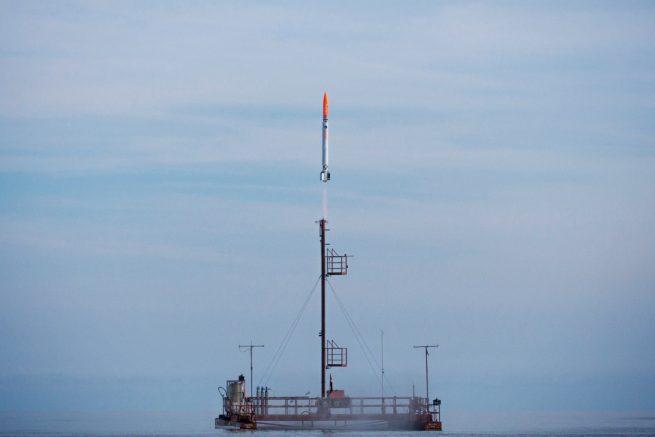
Yesterday Copenhagen Suborbitals launched their rocket Nexø I, their most advanced vehicle yet, from a floating platform in the Baltic Sea. (See earlier posting). The good news is that the rocket lifted off successfully with its liquid-fueled engine (Ethanol and Liquid Oxygen) and active guidance system and was successfully recovered. The bad news is that it failed to reach its planned altitude and the parachute system failed to open: The Nexø I rocket launched – Copenhagen Suborbitals –
It was a beautiful launch with a not so great landing. The rocket flew to about 1514 meters before a catastrophic failure occurred.
Even though it didn’t go completely as planed we still see it as a partially success. A lot of sub systems actually work as they should.
We managed to recover the rocket. We will therefore have a good chance of finding the root cause of the failure.
We will post more about the launch and crash after we have had a closer look at the rocket and telemetry data.
Here is a video of the webcast. The countdown to liftoff starts at the 3 hr 20 min 8 sec mark:
We have not yet had opportunity to examine data, parts or footage.
A tentative speculation on root cause would be simple LOX [Liquid Oxygen] overload. In other words a problem with measuring the correct amount of LOX in the tank, which we have encountered previously, and worked on solving via several methods. We will look into this.
Too much LOX will result in a too small gas pocket in the tank – which equals too little gas propellant energy and a premature loss of tank pressure in the LOX tank, again resulting in an increasing O/F-ratio mismatch. The engine subsequently extinguished.
The GNC didn’t detect acceleration below minimum, as this detection was removed from the algorithm prior to the mission, based on the fact that the acceleration, through the use of pressure blow-down at relatively low altitude, would be very low before the occurrence of MECO.
The GNC instead used the chamber pressure. This was low at an unusually early time. The GNC treated this as a sensor failure, and instead an estimated pressure, based on a table generated from earlier tests, was used.
Thus the GNC didn’t signal the deployment of the parachute, as it was under the (false) impression that the engine was still operating as expected.
Here is a video for the Science Fiction/Future Now panel at Comic-Con:
Science fiction has ever been the muse of real-world advances, but now ideas can be achieved almost as soon as they are thought up. So how do writers, out-dream the dream makers? How do writers handle the truth of real science and the fiction that is needed for writing their stories? Is it a crisis for the writer’s imagination? Or does it serve to inspire?
More than 280 items were for sale at Bonhams; all told, they racked up a combined total of $1,315,063. Among the most expensive items was a set of 15 gold-colored plaster casts of the right hand of 15 NASA astronauts, including those of Neil Armstrong and the ubiquitous Buzz Aldrin. The casts, which sold for $155,000, were used to make perfectly fitting space suit gloves in 1967. A flown space suit worn in 2003 by Don Pettit aboard the Soyuz TMA-1, following the Space Shuttle Columbia disaster, sold for $62,500.
A full scale vintage test model of the Sputnik-1 satellite, serial number “OKб-1/003/1957”, with live transmitter (still operational, with a new 12v battery). Polished metal sphere with 4 external antennae, approx 23 inches in diameter on manganese brass stand with anti-static o-ring, stand approx 4 feet 9 inches tall, stand and model together approx 6 feet 6 inches tall, and approx 100 lbs. Produced at the OKб-1[OKB-1], the Experimental Design Bureau-1 factory, also known as the S. P. Korolev Rocket and Space Corporation Energia, in 1957 sometime prior to the launch of the Sputnik-1… Continue—
Still, [Robert Pearlman of collectSpace.com] says, it doesn’t have to be an expensive hobby. “You don’t need to be able to afford anything more than a stamp,” he says, to send NASA a request for an astronaut autograph. “Bonhams represents a very specific audience. Their bid amounts and their valuations are high—not unheard of and not unwarranted for what they’re auctioning. But for under $100, you could build a very respectable collection.”

 )
 )
 )
 )
