ESO: Ancient stars discovered at center of the Milky Way

The latest report from the European Southern Observatory (ESO):

The Milky Way’s Ancient Heart
VISTA finds remains of archaic globular star cluster
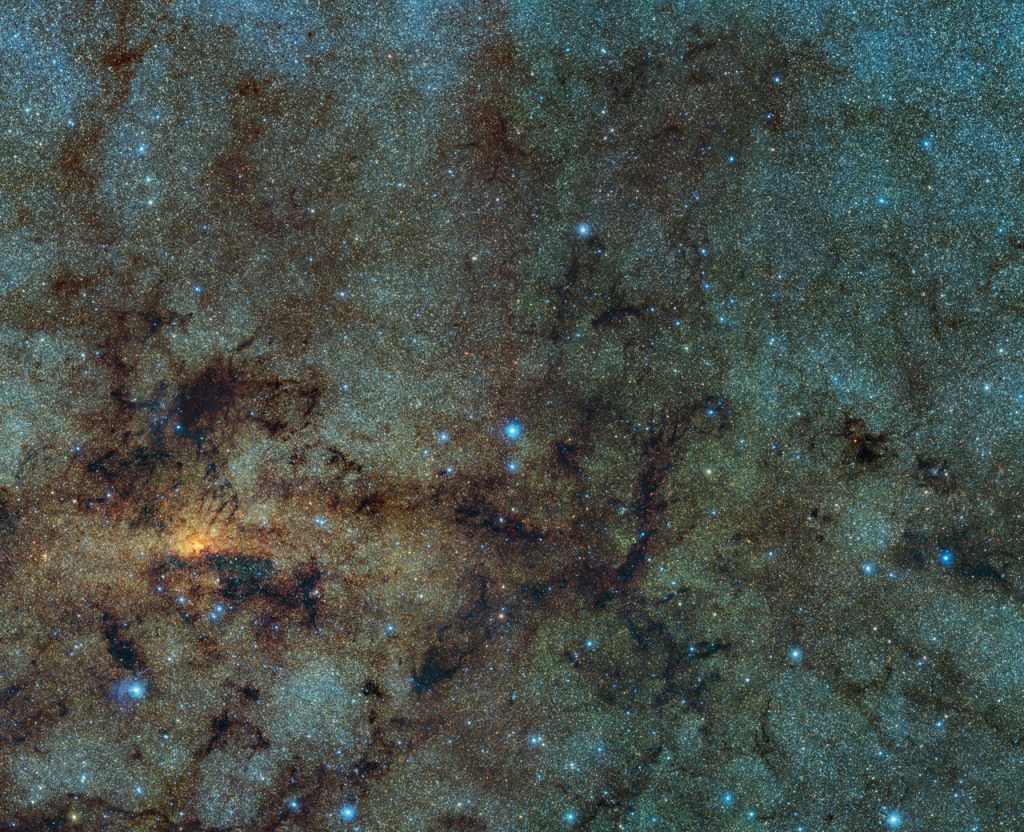
This image, captured with the VISTA infrared survey telescope, as part of the Variables in the Via Lactea (VVV) ESO public survey, shows the central part of the Milky Way. While normally hidden behind obscuring dust, the infrared capabilities of VISTA allow to study the stars close to the galactic centre. Within this field of view astronomers detected several ancient stars, of a type known as RR Lyrae. As RR Lyrae stars typically reside in ancient stellar populations over 10 billion years old, this discovery suggests that the bulging centre of the Milky Way likely grew through the merging of primordial star clusters.
This image, captured with the VISTA infrared survey telescope, as part of the Variables in the Via Lactea (VVV) ESO public survey, shows the central part of the Milky Way. While normally hidden behind obscuring dust, the infrared capabilities of VISTA allow to study the stars close to the galactic centre. Within this field of view astronomers detected several ancient stars, of a type known as RR Lyrae. As RR Lyrae stars typically reside in ancient stellar populations over 10 billion years old, this discovery suggests that the bulging centre of the Milky Way likely grew through the merging of primordial star clusters. (Larger images)

Ancient stars, of a type known as RR Lyrae, have been discovered in the centre of the Milky Way for the first time, using ESO’s infrared VISTA telescope. RR Lyrae stars typically reside in ancient stellar populations over 10 billion years old. Their discovery suggests that the bulging centre of the Milky Way likely grew through the merging of primordial star clusters. These stars may even be the remains of the most massive and oldest surviving star cluster of the entire Milky Way.

The video, based on observations made in the infrared with the VISTA infrared survey telescope shows the central region of the Milky Way galaxy. Several variable stars within the field of views are marked with circles. They can also be identified as they brighten and fade in regular intervals. At the end the video zooms on one of the newly discovered RR Lyrae stars (marked with a red circle), which are too faint to be seen clearly in the large field of view. Credit: ESO/VVV Survey/D. Minniti

A team led by Dante Minniti (Universidad Andrés Bello, Santiago, Chile) and Rodrigo Contreras Ramos (Instituto Milenio de Astrofísica, Santiago, Chile) used observations from the VISTA infrared survey telescope, as part of the Variables in the Via Lactea (VVV) ESO public survey, to carefully search the central part of the Milky Way. By observing infrared light, which is less affected by cosmic dust than visible light, and exploiting the excellent conditions at ESO’s Paranal Observatory, the team was able to get a clearer view of this region than ever before. They found a dozen ancient RR Lyrae stars at the heart of the Milky Way that were previously unknown.
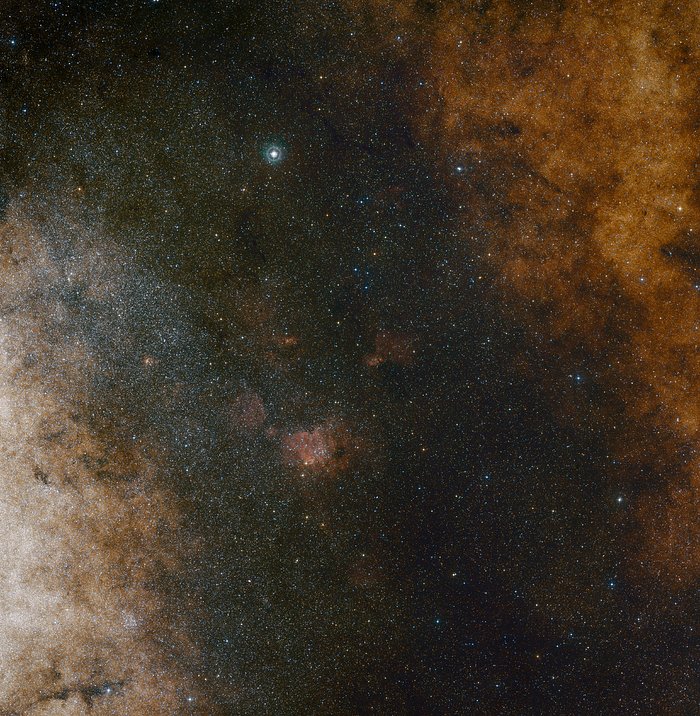
This visible light wide-field view shows the rich star clouds in the constellation of Sagittarius (the Archer) in the direction of the centre of our Milky Way galaxy. The entire image is filled with vast numbers of stars — but far more remain hidden behind clouds of dust and are only revealed in infrared images. This view was created from photographs in red and blue light and forming part of the Digitized Sky Survey 2. The field of view is approximately 3.5 degrees x 3.6 degrees.
This visible light wide-field view shows the rich star clouds in the constellation of Sagittarius (the Archer) in the direction of the centre of our Milky Way galaxy. The entire image is filled with vast numbers of stars — but far more remain hidden behind clouds of dust and are only revealed in infrared images. This view was created from photographs in red and blue light and forming part of the Digitized Sky Survey 2. The field of view is approximately 3.5 degrees x 3.6 degrees. (Larger images)

Our Milky Way has a densely populated centre — a feature common to many galaxies, but unique in that it is close enough to study in depth. This discovery of RR Lyrae stars provides compelling evidence that helps astronomers decide between two main competing theories for how nuclear bulges form [1].

This video sequence starts from a wide field view of the Milky Way and closes near the galactic centre. Here astronomers using the VISTA infrared survey telescope discovered several ancient stars, of a type known as RR Lyrae. RR Lyrae stars typically reside in ancient stellar populations over 10 billion years old. Their discovery suggests that the bulging centre of the Milky Way likely grew through the merging of primordial star clusters. Credit: ESO, Digitized Sky Survey 2, N. Risinger (skysurvey.org. Acknowledgment: Davide De Martin and S. Guisard (www.eso.org/~sguisard), Music: Johan B. Monell (www.johanmonell.com)

RR Lyrae stars are typically found in dense globular clusters. They are variable stars, and the brightness of each RR Lyrae star fluctuates regularly. By observing the length of each cycle of brightening and dimming in an RR Lyrae, and also measuring the star’s brightness, astronomers can calculate its distance [2].

Unfortunately, these excellent distance-indicator stars are frequently outshone by younger, brighter stars and in some regions they are hidden by dust. Therefore, locating RR Lyrae stars right in the extremely crowded heart of the Milky Way was not possible until the public VVV survey was carried out using infrared light. Even so, the team described the task of locating the RR Lyrae stars in amongst the crowded throng of brighter stars as “daunting”.

This video zooms across a part of the sky close to the centre of our Milky Way, which was observed with the VISTA infrared survey telescope. Within this part of the sky astronomers discovered a dozen new variable stars. Their discovery suggests that the bulging centre of the Milky Way likely grew through the merging of primordial star clusters. Credit: ESO/VVV Survey/D. Minniti. Music: 5th Dimension

Their hard work was rewarded, however, with the identification of a dozen RR Lyrae stars. Their discovery indicate that remnants of ancient globular clusters are scattered within the centre of the Milky Way’s bulge.

Rodrigo Contreras Ramos elaborates:

“This discovery of RR Lyrae Stars in the centre of the Milky Way has important implications for the formation of galactic nuclei. The evidence supports the scenario in which the nuclear bulge was originally made out of a few globular clusters that merged.”

The theory that galactic nuclear bulges form through the merging of globular clusters is contested by the competing hypothesis that these bulges are actually due to the rapid accretion of gas. The unearthing of these RR Lyrae stars — almost always found in globular clusters — is very strong evidence that part of the Milky Way’s nuclear bulge did in fact form through merging. By extension, all other similar galactic bulges may have formed the same way.

Not only are these stars powerful evidence for an important theory of galactic evolution, they are also likely to be over 10 billion years old — the dim, but dogged survivors of perhaps the oldest and most massive star cluster within the Milky Way.
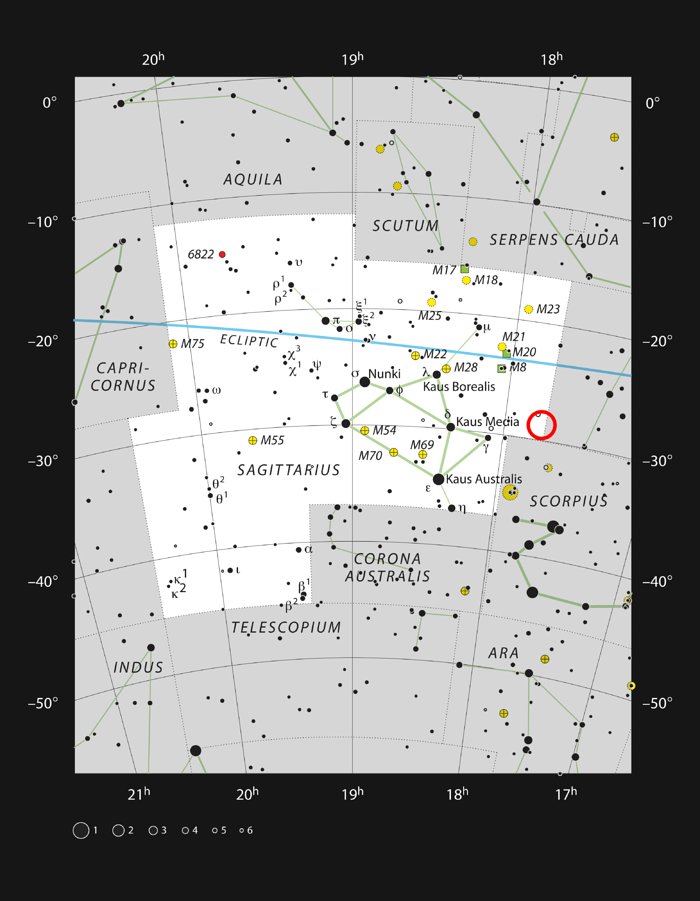
This chart shows the location of the field of view within which the RR Lyrae stars close to the galactic centre were discovered — marked with a red circle. The variable stars and the centre of the Milky Way are within the constellation of Sagittarius (The Archer). This map shows most of the stars visible to the unaided eye under good conditions.

Notes

[1] The nuclear stellar bulge is the compact component in the innermost regions of the Milky Way (and other galaxies) extending to a size of about 400 light-years.

[2] RR Lyrae stars, like some other regular variables such as Cepheids, show a simple relationship between how quickly they change in brightness and how luminous they are. Longer periods mean brighter stars. This period-luminosity relationship can be used to deduce the distance of a star from its period of variation and its apparent brightness.

Videos: Moon gems from Japan’s Kaguya spacecraft

Check  out these nice views of the Moon and Earth from the Japanese Kaguya (Selene)  mission: New Gems from the Moon | The Planetary Society –

20161008_half_earth_f8401

Although the mission took place in 2007-2009, only now has

 the Japanese space agency, JAXA, […] publicly released the entire data set from Kaguya’s HDTV cameras. The iconic views are all there…plus some gems that haven’t been widely seen before. One reason they weren’t previously released may be that some of them are “marred” by lens flare and other imperfections, but I think such things lend interesting visual texture and context to the images and videos.

Enjoy a few examples below, then visit the Kaguya HDTV Data Publication System website if you want to explore further.

More than seven years after Kaguya’s planned impact on the lunar surface, it’s good to have these fresh visions, courtesy of the moon’s brave princess.

Video: TMRO 9.32 – The Everyday Astronaut

The latest TMRO.tv program is now available on line: The Everyday Astronaut – TMRO

We have an in-studio interview with Tim Dodd talking about his character the Everyday Astronaut. Tim puts the Art in STEM (science, technology, engineering and math) and has an inspiring series with Everyday Astronaut. You can follow Tim on twitter @Erdayastronaut, Instagram @everydayastronaut or via his website at timdoddphotography.com.

News topics discussed:

* Blue Origin abort test was eppppiiiiccccc
* Hurricane Matthew grazes the Space Coast
* Ariane 5 launches Sky Muster 2 and GSAT 18
* Protoplanetary Disk’s Spiral Arms Embrace Young Star
* Antares about to launch again
* Possible Water Plumes Spotted Erupting From Europa Again

TMRO.tv is viewer supported:

TMRO:Space is a crowd funded show. If you like this episode consider contributing to help us to continue to improve. Head over to http://www.patreon.com/tmro for information, goals and reward levels. Don’t forget to check out our SpacePod campaign as well over at http://www.patreon.com/spacepod

Project Blue: Crowd-funded space telescope aims to image exoplanet

Project Blue at the BoldlyGo Institute 

is a new science initiative to capture the first photograph of a potential Earth-like planet orbiting another Sun-like star. The mission aims to launch a lightweight space telescope to directly image exoplanets around Earth’s nearest star system, Alpha Centauri A and B.

With a budget the fraction of the cost of a mid-size astrophysics mission, and a planned launch by the end of the decade, this venture represents an ambitious leap forward in low-cost, high-impact space exploration.

Through active collaboration between research institutions, universities, private industry and citizens, Project Blue seeks to make space exploration a participatory, collective endeavor and inspire millions worldwide to engage in scientific inquiry.

The key technology will be a coronagraph that blocks the otherwise blinding light of the star and allows the planet’s far weaker reflected light to be observed:

Project Blue will place a state-of-the-art exoplanet imaging telescope into orbit. The instrument will be equipped with advanced high contrast imaging technologies embedded in a coronagraph with a deformable mirror, multi-star wavefront control, and specialized post-processing techniques.

Together they can efficiently suppress the light from both stars (Alpha Centauri A and B) separately, thus allowing any planets to be seen. Our team has extensive experience developing and testing these technologies — now it’s time to get them into space!

More details of the space telescope are described here.

Alpha Centauri A and B were chosen because:

  • Unusual proximity: At only 4.37 light years distance, Alpha Centauri is the closest star system to us, and contains not just one, but two stars similar to our Sun. The next Sun-like star is located 2.5x further away and would require a telescope 2.5 times larger in size.
  • Accessible Habitable Zone: Its proximity allows us to observe the habitable zone of each star for Earth-like planets with a modest space telescope with a powerful coronagraph, while any other star requires telescopes of at least 1 meter in size.
  • Fertile ground: Proxima Centauri, which is thought to be part of the same system, is now known to have a potentially habitable planet. We are acting on a new scientific urgency to investigate our nearest Sun-like stars!

The goal is to launch the privately funded observatory in 2019.

To sign up for email updates and/or to donate to the project, see Get Involved.

Follow developments at

Some articles about the project:

Update: Here is the official press release about the project:

The Push to Photograph Earth-Like Planet Begins With Launch of Project Blue
BoldlyGo Institute and Mission Centaur to Lead Consortium of Prominent Organizations Including the SETI Institute and University of Massachusetts Lowell to Reach the Next Great Milestone of Space Exploration

SAN FRANCISCO, CA–(Marketwired – Oct 11, 2016) – A consortium of prominent science and research institutions led by BoldlyGo Institute and Mission Centaur today announced Project Blue, an endeavor for a new era of discovery and space exploration. Employing recent technological advances, Project Blue is designed to be the first mission capable of obtaining an image of another planet like Earth — a powerful next step to understanding and exploring worlds outside our solar system. This new kind of privately-led, non-profit space initiative unites an extraordinary range of experts, including teams from the SETI Institute and the University of Massachusetts Lowell, on a daunting scientific and technical challenge.

Project Blue will work to fund, build and launch a compact exoplanet imaging telescope aimed at Alpha Centauri — the closest star system to Earth — to determine whether Earth-like planets exist around it and if so, to capture a direct “pale blue dot” image. While NASA’s Kepler mission has shown that terrestrial-sized planets are common in our galaxy, no one has yet been able to take a picture of one as small as Earth, in an orbit that could potentially sustain life. Project Blue would be the first. The mission will take about three years to construct and will conduct an intensive two-year study once in orbit.

“Now is the time to embark on this mission. Scientific imperative and technological advancements have converged to a point where we can finally take a serious look at our closest neighbor, Alpha Centauri,” said Jon Morse, CEO of BoldlyGo Institute. “Does it contain rocky planets? Do they have oceans and atmospheres? Could they conceivably support life? We launched Project Blue because we believe such a discovery would profoundly impact humankind’s understanding of the universe and spur a new wave of excitement in science and astronomy.”

Seeing Blue

Recent developments, including the extraordinary success of the Kepler mission and advances in optics and imaging technologies, have laid the groundwork for Project Blue. Kepler has discovered over 2300 confirmed exoplanets through indirect observation techniques, many of which scientists believe could have Earth-like characteristics. Imaging one directly is an achievement that would open a new path to detecting and characterizing possible life-sustaining worlds around nearby stars.

An Earth-like planet is characterized as 0.5 to 1.5 times the size of Earth and orbiting within the host star’s “habitable zone,” where the temperature could allow liquid water to exist on the planet’s surface. Such a planet with oceans and an atmosphere similar to Earth, unless obscured by clouds, could appear blue to the human eye.

Project Blue’s customized telescope will be mounted on an optimized commercial spacecraft and specifically focus on Alpha Centauri, allowing it to maintain modest size and cost compared to larger astrophysics missions. The spacecraft will conduct its study of the Alpha Centauri system from a special north-south, low-Earth orbit that provides the stable conditions necessary for such precise measurements.

Despite Alpha Centauri’s proximity, there is currently no telescope with high enough contrast capability to observe orbiting planets directly; detecting an Earth-sized planet next to its host star has been compared to detecting a firefly next to a lighthouse from ten miles away. Additionally, Alpha Centauri’s binary structure makes it a particularly challenging target. Since the system’s two stars, Alpha Centauri A and B, appear so close together in the night sky, observation requires a special approach to suppress both light sources to see any orbiting planets.

“What makes the Alpha Centauri system so attractive is that each of the two stars is a lot like our own sun, which gives us two chances to find planets in either of their habitable zones,” said Supriya Chakrabarti, professor in the Department of Physics and Applied Physics at the University of Massachusetts Lowell and director of its Lowell Center for Space Science and Technology. “This also gives us an opportunity to design a mission that leverages technology we’ve been developing and space qualifying in our NASA-supported programs.”

The Blue Moment

Beyond pioneering a range of cutting-edge technologies, Project Blue represents a new kind of endeavor: a privately-funded partnership of research organizations, universities and industry aiming to play a leadership role in space science. With BoldlyGo Institute and Mission Centaur at the helm, a number of leading institutions will partner on the project, with the list expected to grow.

“We’re excited to be an original member of this distinguished consortium working on this seminal project,” said Bill Diamond, President and CEO of the SETI Institute. “The SETI Institute has accumulated world-class scientific and technical expertise from previous space missions that we can contribute to make Project Blue a success.”

The partnership will combine its expertise to design, construct and operate the mission. Launch services will be provided by one of several commercial vendors expected to be proven by the time of launch.

About BoldlyGo Institute: The BoldlyGo Institute is based in New York and was founded to address highly compelling scientific questions through new approaches to developing space science missions while engaging the global community in the quest. The organization is led by a highly qualified and reputable Board of Directors, comprised of space scientists, engineers and explorers. Board members have decades of combined space involvement, including more than a decade of recent, senior leadership experience across NASA, specializing in spaceflight and the development of space hardware.

About Mission Centaur: Mission Centaur is a nonprofit organization that fosters public and private collaboration through Project Blue, an initiative seeking to find and capture the first image of an Earth-like planet in our neighboring star system Alpha Centauri. Mission Centaur was founded by a group of philanthropists, scientists and engineers to pursue one of humanity’s most ambitious and transformational space exploration missions.

Space podcasts – Oct.11.2016

A sampling of recent space related podcasts:

** WeMartians | Follow humanity’s journey to Mars

  • WeMartians Podcast Episode 12: Mission to sMarts (feat. the crew of HI-SEAS IV) – “This special episode features interviews with all six members of the HI-SEAS IV crew, who recently completed a 1 year simulated Mars mission on the slopes of Mauna Loa. Crew members include Sheyna Gifford, Carmel Johnston, Cyprien Verseux, Christiane Heinicke, Andrzej Stewart and Tristan Bassingthwaighte.”

** This Orbital Life

  • Voices From L5 – Practical Problems with the Outer Space Treaty  – “We are joined this week by Martin Elvis, a senior astrophysicist at the Harvard Smithsonian centre for astrophysics. Martin joins us to discuss a paper regarding a potential loophole in the Outer Space Treaty and how it handles property. In this episode we highlight the need for practical considerations and questions being asked regarding space and space law and policy.”
  • Voices From L5 – To The Stars – “Phillip Lubin joins us to discuss that next step in the farthest reaches of space exploration – Interstellar travel. How can we go beyond our solar system and what might we find there? Why would we do such things? Phillip tells us about his project and the projects he’s involved with that hope to one day send out fleets of tiny ships to other stars.”

** Planetary Radio

  • Farewell Rosetta! – “The European Space Agency’s magnificent Rosetta mission ended last week as the spacecraft gently touched down on the comet it has revealed.”

** The Space Show

** John Batchelor Show


====

Everyone can participate in space