ExoMars: New images of the ExoMars Schiaparelli crash site

The European Space Agency‘s Trace Gas Orbiter (TGO) spacecraft went into orbit around Mars successfully last week. However, TGO’s companion on the ExoMars mission, the Schiaparelli lander demonstrator, went permanently silent when it neared the surface of the Red Planet. NASA’s Mars Reconnaissance Orbiter has taken pictures of the landing site and the mission team will use the images to try to understand what happened in the final seconds of Schiaparelli’s fatal fall:

Here is NASA’s statement on the MRO images:

Further Clues to Fate of Mars Lander, Seen From Orbit

pia21131-hirise_of_edm1
This Oct. 25, 2016, image from the HiRISE camera on NASA’s Mars Reconnaissance Orbiter shows the area where the Europe’s Schiaparelli test lander struck Mars, with magnified insets of three sites where spacecraft components hit the ground. It adds detail not seen in earlier imaging of the site. Credits: NASA/JPL-Caltech/Univ. of Arizona

The most powerful telescope orbiting Mars is providing new details of the scene near the Martian equator where Europe’s Schiaparelli test lander hit the surface last week.

An Oct. 25 observation using the High Resolution Imaging Science Experiment (HiRISE) camera on NASA’s Mars Reconnaissance Orbiter shows three impact locations within about 0.9 mile (1.5 kilometers) of each other.

The scene shown by HiRISE includes three locations where hardware reached the ground. A dark, roughly circular feature is interpreted as where the lander itself struck. A pattern of rays extending from the circle suggests that a shallow crater was excavated by the impact, as expected given the premature engine shutdown. About 0.8 mile (1.4 kilometers) eastward, an object with several bright spots surrounded by darkened ground is likely the heat shield. About 0.8 mile (1.4 kilometers) south of the lander impact site, two features side-by-side are interpreted as the spacecraft’s parachute and the back shell to which the parachute was attached. Additional images to be taken from different angles are planned and will aid interpretation of these early results.

The test lander is part of the European Space Agency’s ExoMars 2016 mission, which placed the Trace Gas Orbiter into orbit around Mars on Oct. 19. The orbiter will investigate the atmosphere and surface of Mars and provide relay communications capability for landers and rovers on Mars.

Data transmitted by Schiaparelli during its descent through Mars’ atmosphere is enabling analysis of why the lander’s thrusters switched off prematurely. The new HiRISE imaging provides additional information, with more detail than visible in an earlier view with the Context Camera (CTX) on the Mars Reconnaissance Orbiter.

With HiRISE, CTX and four other instruments, the Mars Reconnaissance Orbiter has been investigating Mars since 2006.

The University of Arizona, Tucson, operates HiRISE, which was built by Ball Aerospace & Technologies Corp. of Boulder, Colorado. NASA’s Jet Propulsion Laboratory, a division of Caltech in Pasadena, California, manages the Mars Reconnaissance Orbiter Project for NASA’s Science Mission Directorate, Washington. Lockheed Martin Space Systems, Denver, built the orbiter and collaborates with JPL to operate it. For additional information about the project, visit: mars.nasa.gov/mro
Video: Int. Space Station fisheye fly-through at 4K (Ultra HD)

In this video, fly through the International Space Station at the 4k resolution setting for a super high definition tour of the orbital facility:

ESO: Giant glowing halos observed around distant quasars

A new report from ESO (European Southern Observatory):

ESO’s VLT Detects Unexpected Giant Glowing Halos around Distant Quasars

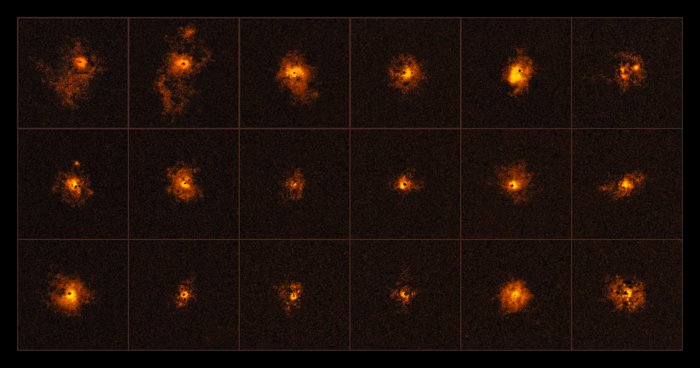
This mosaic shows 18 of the 19 quasars observed by an international team of astronomers, led by the ETH Zurich, Switzerland. Each observed quasar is surrounded by a bright gaseous halo. It is the first time that a survey of quasars shows such bright halos around all of the observed quasars. The discovery was made using the MUSE instrument at ESO’s Very Large Telescope.
This mosaic shows 18 of the 19 quasars observed by an international team of astronomers, led by the ETH Zurich, Switzerland. Each observed quasar is surrounded by a bright gaseous halo. It is the first time that a survey of quasars shows such bright halos around all of the observed quasars. The discovery was made using the MUSE instrument at ESO’s Very Large Telescope. [Larger images]

An international team of astronomers has discovered glowing gas clouds surrounding distant quasars. This new survey by the MUSE instrument on ESO’s Very Large Telescope indicates that halos around quasars are far more common than expected. The properties of the halos in this surprising find are also in striking disagreement with currently accepted theories of galaxy formation in the early Universe.

The MUSE instrument on ESO’s Very Large Telescope is able to collect three-dimensional data. Using this data cube, astronomers were able to create a 3D representation of the gas halos surrounding the distant quasars. Credit: ESO/S. Cantalupo

An international collaboration of astronomers, led by a group at the Swiss Federal Institute of Technology (ETH) in Zurich, Switzerland, has used the unrivalled observing power of MUSE on the Very Large Telescope (VLT) at ESO’s Paranal Observatory to study gas around distant active galaxies, less than two billion years after the Big Bang. These active galaxies, called quasars, contain supermassive black holes in their centres, which consume stars, gas, and other material at an extremely high rate. This, in turn, causes the galaxy centre to emit huge amounts of radiation, making quasars the most luminous and active objects in the Universe.

The study involved 19 quasars, selected from among the brightest that are observable with MUSE. Previous studies have shown that around 10% of all quasars examined were surrounded by halos, made from gas known as the intergalactic medium. These halos extend up to 300 000 light-years away from the centres of the quasars. This new study, however, has thrown up a surprise, with the detection of large halos around all 19 quasars observed  — far more than the two halos that were expected statistically. The team suspects this is due to the vast increase in the observing power of MUSE over previous similar instruments, but further observations are needed to determine whether this is the case.

“It is still too early to say if this is due to our new observational technique or if there is something peculiar about the quasars in our sample. So there is still a lot to learn; we are just at the beginning of a new era of discoveries”, says lead author Elena Borisova, from the ETH Zurich.

The original goal of the study was to analyse the gaseous components of the Universe on the largest scales; a structure sometimes referred to as the cosmic web, in which quasars form bright nodes [1]. The gaseous components of this web are normally extremely difficult to detect, so the illuminated halos of gas surrounding the quasars deliver an almost unique opportunity to study the gas within this large-scale cosmic structure.

This mosaic shows 18 of the 19 quasars observed by an international team of astronomers, led by the ETH Zurich, Switzerland. Each observed quasar is surrounded by a bright gaseous halo. It is the first time that a survey of quasars shows such bright halos around all of the observed quasars. The discovery was made using the MUSE instrument at ESO’s Very Large Telescope. Credit: ESO/Borisova et al.

The 19 newly-detected halos also revealed another surprise: they consist of relatively cold intergalactic gas — approximately 10 000 degrees Celsius. This revelation is in strong disagreement with currently accepted models of the structure and formation of galaxies, which suggest that gas in such close proximity to galaxies should have temperatures upwards of a million degrees.

It is the first time that MUSE and its unique observing capabilities have been used for a survey of this kind. The discovery shows the potential of the instrument for observing this type of object [2]. Co-author Sebastiano Cantalupo is very excited about the new instrument and the opportunities it provides:

“We have exploited the unique capabilities of MUSE in this study, which will pave the way for future surveys. Combined with a new generation of theoretical and numerical models, this approach will continue to provide a new window on cosmic structure formation and galaxy evolution.”

Notes

[1] The cosmic web is the structure of the Universe at the largest scale. It is comprised of spindly filaments of primordial material (mostly hydrogen and helium gas) and dark matter which connect galaxies and span the chasms between them. The material in this web can feed along the filaments into galaxies and drive their growth and evolution.

[2] MUSE is an integral field spectrograph and combines spectrographic and imaging capabilities. It can observe large astronomical objects in their entirety in one go, and for each pixel measure the intensity of the light as a function of its colour, or wavelength.


Videos: Jeff Bezos talks about Blue Origin, a 10000 year clock, & Saturn engine recovery

Jeff Bezos, founder and CEO of Amazon.com, recently  received an award at the Museum of Flight near Seattle and he was interviewed on stage. He talked about plans for Amazon and about his various outside projects including the Blue Origin space development company: Jeff Bezos explains Blue Origin’s space symbology – Alan Boyle/Geekwire  –

In this segment of the interview, he talked about the 10,000 year clock project: Jeff Bezos shares big ideas, from drones to 10,000-year clock – Alan Boyle/Geekwire –

In this video, he talks

about the mission to recover the F-1 rocket engines from the Apollo 11 moon landing flight. His team was able to retrieve the engines from 14,000 ft under the sea.

Find more about Bezos’s many projects at www.bezosexpeditions.com.

====

Everyone can participate in space