ESO: The Very Large Telescope sees exo-planetary systems forming

This week’s ESO (European Southern Observatory) report:

Sculpting Solar Systems
ESO’s SPHERE instrument reveals protoplanetary discs
being shaped by newborn planets 

Sharp new observations have revealed striking features in planet-forming discs around young stars. The SPHERE instrument, mounted on ESO’s Very Large Telescope, has made it possible to observe the complex dynamics of young solar systems — including one seen developing in real-time. The recently published results from three teams of astronomers showcase SPHERE’s impressive capability to capture the way planets sculpt the discs that form them — exposing the complexities of the environment in which new worlds are formed.

These three planetary discs have been observed with the SPHERE instrument, mounted on ESO’s Very Large Telescope. The observations were made in order to shed light on the enigmatic evolution of fledgling planetary systems.
These three planetary discs have been observed with the SPHERE instrument, mounted on ESO’s Very Large Telescope. The observations were made in order to shed light on the enigmatic evolution of fledgling planetary systems. [Larger images]
Three teams of astronomers have made use of SPHERE, an advanced exoplanet-hunting instrument on the Very Large Telescope (VLT) at ESO’s Paranal Observatory, in order to shed light on the enigmatic evolution of fledgling planetary systems. The explosion in the number of known exoplanets in recent years has made the study of them one of the most dynamic fields in modern astronomy.

Today it is known that planets form from vast discs of gas and dust encircling newborn stars, known as protoplanetary discs. These can extend for thousands of millions of kilometres. Over time, the particles in these protoplanetary discs collide, combine and eventually build up into planet-sized bodies. However, the finer details of the evolution of these planet-forming discs remain mysterious.
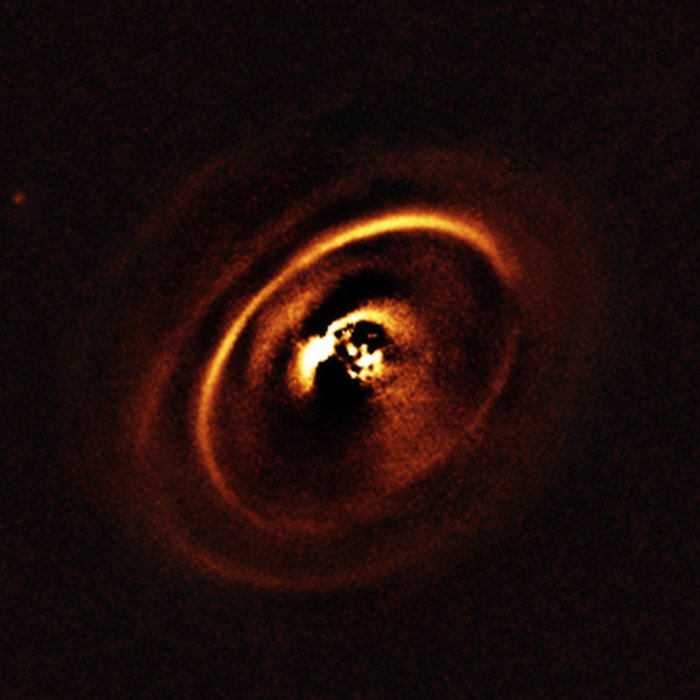
Using the ESO’s SPHERE instrument at the Very Large Telescope, a team of astronomer observed the planetary disc surrounding the star RXJ1615 which lies in the constellation of Scorpius, 600 light-years from Earth. The observations show a complex system of concentric rings surrounding the young star, forming a shape resembling a titanic version of the rings that encircle Saturn. Such an intricate sculpting of rings in a protoplanetary disc has only been imaged a handful of times before. The central parts of the image appears dark because SPHERE blocks out the light from the brilliant central star to reveal the much fainter structures surrounding it.
Using the ESO’s SPHERE instrument at the Very Large Telescope, a team of astronomer observed the planetary disc surrounding the star RXJ1615 which lies in the constellation of Scorpius, 600 light-years from Earth. The observations show a complex system of concentric rings surrounding the young star, forming a shape resembling a titanic version of the rings that encircle Saturn. Such an intricate sculpting of rings in a protoplanetary disc has only been imaged a handful of times before. The central parts of the image appears dark because SPHERE blocks out the light from the brilliant central star to reveal the much fainter structures surrounding it. [Larger images]
SPHERE is a recent addition to the VLT’s array of instruments and with its combination of novel technologies, it provides a powerful method to directly image the fine details of protoplanetary discs [1]. The interaction between protoplanetary discs and growing planets can shape the discs into various forms: vast rings, spiral arms or shadowed voids. These are of special interest as an unambiguous link between these structures and the sculpting planets is yet to be found; a mystery astronomers are keen to solve. Fortunately, SPHERE’s specialised capabilities make it possible for research teams to observe these striking features of protoplanetary discs directly.

For example, RX J1615 is a young star, which lies in the constellation of Scorpius, 600 light-years from Earth. A team led by the Jos de Boer, of Leiden Observatory in the Netherlands, found a complex system of concentric rings surrounding the young star, forming a shape resembling a titanic version of the rings that encircle Saturn. Such an intricate sculpting of rings in a protoplanetary disc has only been imaged a handful of times before, and even more excitingly, the entire system seems to be only 1.8 million years old. The disc shows hints of being shaped by planets still in the process of formation.

The age of the newly detected protoplanetary disc makes RX J1615 an outstanding system, as most other examples of protoplanetary discs detected so far are relatively old or evolved. De Boer’s unexpected result was quickly echoed by the findings of a team led by Christian Ginski, also of Leiden Observatory. They observed the young star HD 97048, located in the constellation of Chamaeleon, about 500 light-years from Earth. Through painstaking analysis, they found that the juvenile disc around this star has also formed into concentric rings. The symmetry of these two systems is a surprising result, as most protoplanetary systems contain a multitude of asymmetrical spiral arms, voids and vortexes. These discoveries significantly raise the number of known systems with multiple highly symmetrical rings.

A particularly spectacular example of the more common asymmetric disc was captured by a group of astronomers led by Tomas Stolker of the Anton Pannekoek Institute for Astronomy, the Netherlands. This disc surrounds the star HD 135344B, about 450 light-years away. Although this star has been well-studied in the past, SPHERE allowed the team to see the star’s protoplanetary disc in more detail than ever before. The large central cavity and two prominent spiral arm-like structures are thought to have been created by one or multiple massive protoplanets, destined to become Jupiter-like worlds.
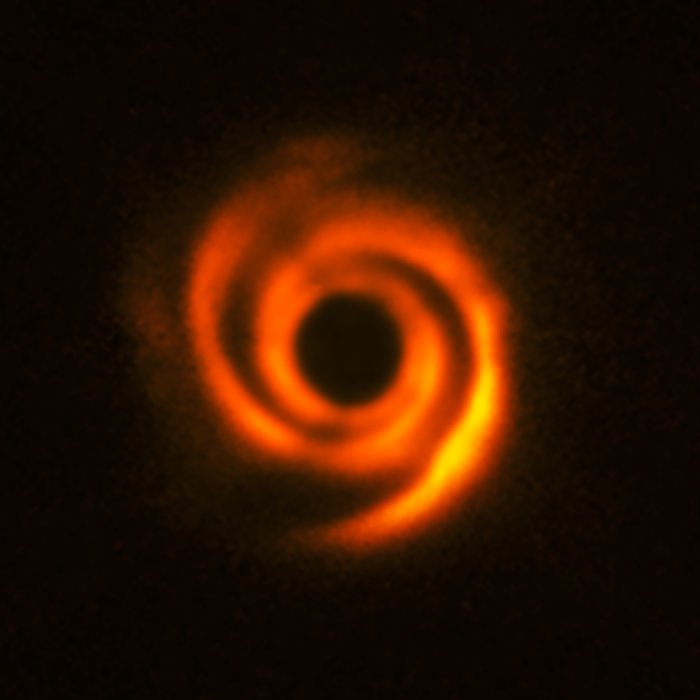
Using the ESO’s SPHERE instrument at the Very Large Telescope, a team of astronomer observed the planetary disc surrounding the star HD135344B, about 450 light-years away. The disc shows prominent spiral arm-like structures. These are thought to have been created by one or multiple massive protoplanets, destined to become Jupiter-like worlds.
Using the ESO’s SPHERE instrument at the Very Large Telescope, a team of astronomer observed the planetary disc surrounding the star HD135344B, about 450 light-years away. The disc shows prominent spiral arm-like structures. These are thought to have been created by one or multiple massive protoplanets, destined to become Jupiter-like worlds. [Larger images]
In addition, four dark streaks, apparently shadows thrown by the movement of material within HD 135344B’s disc, were observed. Remarkably, one of the streaks noticeably changed in the months between observing periods: a rare example of observing planetary evolution occur in real time, hinting at changes occurring in the inner disc regions that can not be directly detected by SPHERE. As well as producing beautiful images, these flickering shadows provide a unique way of probing the  dynamics of innermost disc regions.

As with the concentric rings found by de Boer and Ginski, these observations by Stolker’s team prove that the complex and changing environment of the discs surrounding young stars are still capable of producing surprising new discoveries. By building an impressive body of knowledge about these protoplanetary discs, these teams are stepping closer to understanding how planets shape the discs that form them — and therefore understanding planet formation itself.

Notes

[1] SPHERE had first light in June 2014. The instrument uses advanced adaptive optics to remove atmospheric distortion, a coronagraph to block most of the light from the central star and a combination of differential imaging and polarimetry to isolate the light from features in the disc.

Sally Ride EarthKAM lets middle-school kids take photos of the world from the ISS

The Sally Ride EarthKAM program

is a NASA educational outreach program that enables students, teachers, and the public to learn about Earth from the unique perspective of space.

[It allows] middle school students around the world request images of specific locations on Earth.

Check out the gallery of EarthKAM images taken from the International Space Station.

The 55th round of EarthKAM imaging starts today:

earthcam_mission 54

Yesterday the crew on the ISS set up the EarthKAM for taking images: ISS Daily Summary Report – 11/07/2016 | ISS On-Orbit Status Report:

Sally Ride Earth Knowledge Acquired by Middle Schools (EarthKAM):
The crew configured the camera, laptop and associated Sally Ride EarthKAM software at the Node 2 Nadir hatch window. Once configured, the EarthKAM team, in association with middle school students around the world, selected image targets which will be downlinked and used in the study of physics, computers, geography, math, earth science, biology, art, history, and cultural studies.

The objective of Sally Ride EarthKAM is to integrate Earth images with inquiry-based learning to enhance curricula in support of national and state education standards; to provide students and educators the opportunity to participate in a space mission and to develop teamwork, communication, and problem solving skills; to engage teams of students, educators, and researchers in collaborative investigations using remotely-sensed data; and to incorporate the active use of Web-based tools and resources in support of the learning process.

In this video, Tom Marshburn shows how the EarthKAM is set up on the ISS:

Leesa Hubbard is a school teacher in Tennesseee and here she talks about using the EarthKAM and other space resources in her science lessons:

Carnival of Space #482 – Astronomy For You

Astronomy For You hosts the latest Carnival of Space.

One of the items in the Carnival is about China’s first launch of the Long March 5 heavy lift expendable rocket. Here is a video:

====

Mars weather seen in animations of orbiter images

Check out the cool animated clips of Mars weather in action created by Justin Cowart of The Planetary Society from still images taken by the HRSC (High/Super Resolution Stereo Colour Imager) on the Mars Express spacecraft orbiting the Red Planet:

Here are a couple of examples:


20161104_dust-lifting-tempe-terra_f8401
Dust storm over Tempe Terra, seen by Mars Express’ HRSC during a pass on June 17, 2011. This image was taken during the spacecraft’s 9520th orbit of Mars. Credits: ESA / DLR / FU Berlin (G. Neukum) / Justin Cowart


20161104_hrsc-orbit-9563-dust-lifting-1_f8401
Wake clouds and dust lifting in Arcadia Planitia, seen by Mars Express’ HRSC during a pass on June 30, 2011. This image was taken during the spacecraft’s 9563rd orbit of Mars. Credits: ESA / DLR / FU Berlin (G. Neukum) / Justin Cowart


====

The Space Show this week – Nov.7.2016

The guests and topics of discussion on The Space Show this week:

1. Monday, Nov. 7, 2016: 2-3:30 PM PST (5-6:30 PM EST, 4-5:30 PM CST): We welcome back STEVE WOLFE AND JAMES CAUSEY to discuss the SpaceCom event this year in Houston. Visit http://spacecomexpo.com/ for details.

2. Tuesday, Nov. 8, 2016: 2016: 7-8:30 PM PST, 10-11:30 PM EST, 9-10:30 PM CST: No show due to election day and returns.

3. Friday, Nov. 11, 2016: 9:30-11AM PST; (12:30-2 PM EST; 11:30 AM – 1 PM CST) We welcome author BOB KING regarding his new book, Night Sky with the Naked Eye.

4. Sunday, 13, 2016: 12-1:30 PM PST (3-4:30 PM EST, 2-3:30 5PM CST): We welcome back RAND SIMBERG for what is sure to be an interesting and thought provoking discussion

See also:
* The Space Show on Vimeo – webinar videos
* The Space Show’s Blog – summaries of interviews.
* The Space Show Classroom Blog – tutorial programs

The Space Show is a project of the One Giant Leap Foundation.

The Space Show - David Livingston
David Livingston

Everyone can participate in space