Sci-Tech: Boom Technology to roll out XB-1 supersonic demonstrator aircraft

The company Boom Technology plans to develop a commercial supersonic airliner. To prove out various aspects of the design, including suppression of the sonic boom, the company has developed the XB-1, a two seat supersonic demonstrator unveiled today that will start flying in 2017: A supersonic jet faster than the Concorde will get public design debut in Centennial – The Denver Post

Here is the company press release:

 Affordable Supersonic Flight on the Horizon:
Boom Unveils XB-1 Supersonic Demonstrator

Boom Unveils Aircraft, Support from Virgin Galactic’s
The SpaceShip Company, Honeywell, Tencate, and Blue Force 
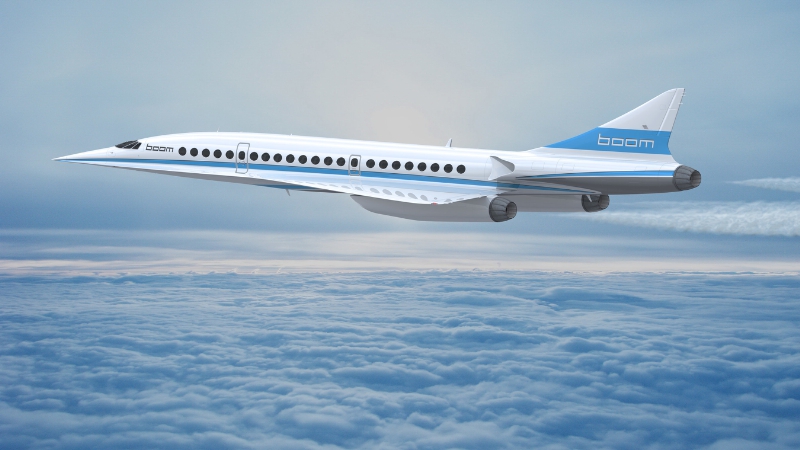
Boom supersonic plane in flight. (PRNewsFoto/Boom Technology, Inc.)

DENVER, Nov. 15, 2016 /PRNewswire/ — Boom Technology today unveiled the XB-1 Supersonic Demonstrator, a subscale prototype of the Boom supersonic passenger airliner. On display for the first time ever at Boom’s Hangar 14 at Centennial Airport, the XB-1, nicknamed “Baby Boom,” will be unveiled this evening at an exclusive VIP event for airline and aerospace executives and media. The XB-1 is the world’s fastest civil aircraft ever made, and it will demonstrate in flight the key technologies for affordable supersonic travel.
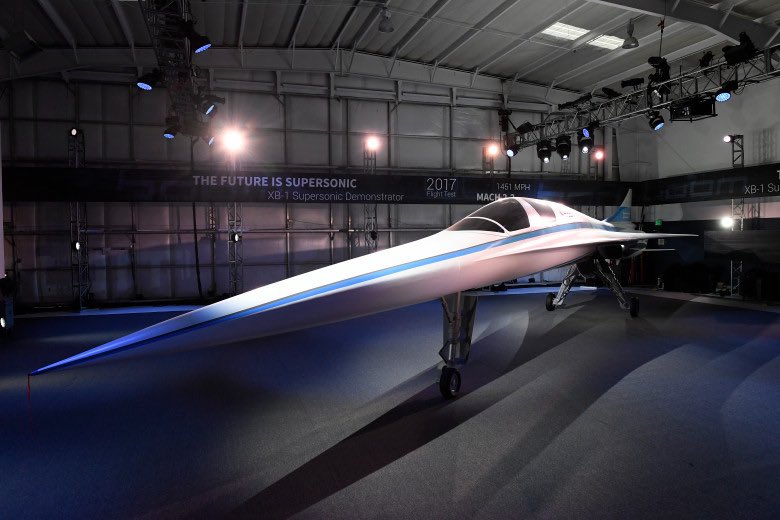
XB-1 Boom Technology

“60 years after the dawn of the jet age, we’re still flying at 1960s speeds,” said Blake Scholl, chief executive officer and founder of Boom. “Concorde’s designers didn’t have the technology for affordable supersonic travel, but now we do. Today, we’re proud to unveil our first aircraft as we look forward to first flight late next year.”

First flight of the XB-1 is planned for late 2017. Subsonic flight test will be conducted east of Denver; supersonic test flights will be conducted near Edwards Air Force Base in Southern California, in partnership with Virgin Galactic’s The Spaceship Company. The XB-1 is a technically representative ⅓-scale version of the production Boom airliner.

“I have long been passionate about aerospace innovation and the development of high-speed commercial flights,” said Richard Branson, founder of Virgin Group. “As an innovator in the space, Virgin Galactic’s decision to work with Boom was an easy one. We’re excited to have an option on Boom’s first 10 airframes. Through Virgin Galactic’s manufacturing arm, The Spaceship Company, we will provide engineering and manufacturing services, along with flight test support and operations as part of our shared ambitions.”

[Mike Boyd, Boyd Group International said,]

“The Boom airliner will be a core part of the intercontinental airline fleet,” … “Travelers are hungry for faster flights and airlines will be excited for a differentiated and profitable option for their premium travelers.”

The XB-1 Supersonic Demonstrator will fly with hardware from General Electric (engines), Honeywell (avionics), Tencate (carbon fiber), with composite structures fabricated by Blue Force. Final assembly and vehicle integration are taking place in Boom’s facility at Centennial Airport.

“At Honeywell, we are inspired by Boom’s vision of affordable supersonic travel. Honeywell is working closely with Boom on products ranging from avionics to air data in support of Boom’s supersonic airliner and to fly on the the XB-1 demonstrator,” said Carl Esposito, Vice President of Marketing and Product Management at Honeywell Aerospace.

Boom’s Leading Design Team Making Supersonic Possible

Formerly of NASA, SpaceX and Boeing, Boom brought together the top minds in aviation to build its modern supersonic passenger airliner. Learning from the Concorde, they combined advanced aerodynamics, efficient engine technology and new composite materials to power a safe and affordable supersonic aircraft 2.6x faster than current jetliners.

The product of over 1,000 simulated wind tunnel tests, Boom’s tri-jet design features a refined delta wing, a gracefully tapered carbon fiber fuselage, and efficient turbofan jet engines. Unlike Concorde, the Boom design requires no afterburner, significantly improving fuel economy.

Notable Features

  1. First independently developed supersonic jet: Previously, supersonic flight has been the province of governments and militaries. The XB-1 is the first independently developed and privately-funded supersonic jet.
  2. Fastest Civil Aircraft Ever: Cruising at Mach 2.2 (1,451mph), Boom jets are 10% faster than Concorde and 2.6X faster than other airliners.
  3. State of the Art, Proven Technology: Leveraging 50 years’ progress in fundamental aerospace technologies, Boom uses proven tech (aerodynamics, materials, propulsion) to create a revolutionary new design. While the design is new, every key technology has already been proven safe and reliable on other commercial aircraft.
  4. Premium Passenger Experience: With one spacious seat on each side of the aisle, each passenger has a large window, a personal overhead bin, and direct aisle access. Cruising up to 60,000′, passengers experience a smoother ride with less turbulence.
  5. Safety First: The Boom design meets or exceeds industry and regulatory safety guidelines. Our aim is to create an aircraft that is safe, fast, and a pleasant to fly.

Design Specifications: XB-1 Supersonic Demonstrator

  • Crew: Two (pilot + optional flight test engineer or passenger)
  • Length: 68′, Wingspan: 17′
  • Maximum Takeoff Weight: 13,500 lb
  • Powerplant: 3X General Electric J85-21, non-afterburning; proprietary variable-geometry intake and exhaust
  • Aerodynamics: Chine, refined delta wing with swept trailing edge
  • Cruise: Mach 2.2 (1,451mph, 2,335 km/h)
  • Nose Temperature: 307°F (345°F on ISA+20 day)
  • Range: > 1,000nmi

Design Specifications: Boom Passenger Airliner

  • Crew: Two
  • Length: 170′, Wingspan: 60′
  • Passengers: 45 standard (up to 55 in high density)
  • Flight attendants: Up to 4
  • Lavatories: 2
  • Powerplane: 3X non-afterburning medium bypass turbofan; proprietary variable geometry intake and exhaust
  • Aerodynamics: Chine, refined delta wing with swept trailing edge
  • Long Range Cruise: Mach 2.2 (1,451mph, 2,335 km/h)
  • Nose Temperature: 307°F (345°F on ISA+20 day)
  • Maximum Design Route: 9,000nm (4,500nm unrefueled)

About Boom Technology, Inc: Boom Technology is creating supersonic passenger aircraft affordable for routine travel. Boom is backed by 8VC, RRE, Lightbank, and Y Combinator, as well as angels including Sam Altman, Paul Graham, and Kyle Vogt. For more information, please visit boomsupersonic.com

===

See also:

=====

New Astronomy textbook available for free download from OpenStax

Checkout the free new Astronomy textbook at OpenStax:

A Free, Professionally-edited, Non-profit Introductory Astronomy Textbook

A new introductory textbook called Astronomy has just been published by OpenStax, a national, non-profit project to develop high-quality, introductory textbooks that are free to students.  The publisher is located at Rice University and supported by several major foundations (including the Gates and Hewlett Foundations.)  They have already done over 20 free textbooks in other fields, used by hundreds of thousands of students around the country.

astronomy_ch1page1
Figure 1.1. Distant Galaxies. These two interacting islands of stars (galaxies) are so far away that their light takes hundreds of millions of years to reach us on Earth (photographed with the Hubble Space Telescope). (credit: modification of work by NASA, ESA, the Hubble Heritage (STScl/ AURA)-ESA/Hubble Collaboration, and K. Noll (STScl))

Senior authors for the new non-technical astronomy text are Andrew Fraknoi (Foothill College), David Morrison (NASA Ames Research Ctr.), and Sidney Wolff (National Optical Astronomy Observatory), who have had many years of experience writing texts and educational materials.  The project had the help of over 75 astronomers and astronomy educators, to make sure that the text is up-to-date, authoritative, and educationally sound.  None of the authors receive one penny of royalties.

The book is free to students in the electronic version, and can be custom printed on demand – at cost. Even more interesting, the book is open source, which means professors can use it as is, or develop their own electronic version of it, selecting only the sections they teach and adding course-specific curriculum materials.

The textbook is now available for review and adoption at: https://openstax.org/details/astronomy

Featuring such current topics as the results from the New Horizons exploration of Pluto, the classification of exoplanets from Kepler and other projects, and the discovery of gravitational waves, the book is current and easily updated electronically.  At the same time, it is written in everyday language specifically for non-science majors, with many analogies drawn from students’ lives, clear diagrams, the latest color images, and occasional touches of humor.

Math boxes throughout the chapters put topics on a quantitative footing for those who want to use math in their courses.  Each chapter has math problems at the end.  However, if a course doesn’t use math, these boxes and problems can easily be skipped.  Chapters also include suggested collaborative group activities (especially useful for discussion sections), links to web resources, biographies of astronomers, interdisciplinary connections, and much more.

Ancillary materials are also being developed and the book will be compatible with several class management software systems.

At a time when both students and professors have so often thrown up their hands in despair over the growing cost of astronomy textbooks, OpenStax Astronomy makes a professionally-edited, high-quality text available world-wide without charge.

_____________________________________________

Andrew Fraknoi
Chair, Astronomy Department
Web site: www.foothill.edu/ast
AstroProf Facebook Pages: www.facebook.com/Fraknoi

Cassini: The watercolor swirls of Saturn’s north pole & the flow of methane clouds on Titan

New views from Cassini of the bands and swirls of Saturn‘s north pole and of the clouds of Saturn’s moon Titan:

Saturn’s ‘Watercolor’ Swirls

pia20507_10411

Saturn’s north polar region displays its beautiful bands and swirls, which somewhat resemble the brushwork in a watercolor painting.

Each latitudinal band represents air flowing at different speeds, and clouds at different heights, compared to neighboring bands. Where they meet and flow past each other, the bands’ interactions produce many eddies and swirls.

The northern polar region of Saturn is dominated by the famous hexagon shape (see PIA11682) which itself circumscribes the northern polar vortex – seen as a dark spot at the planet’s pole in the above image – which is understood to the be eye of a hurricane-like storm (PIA14946).

This view looks toward the sunlit side of the rings from about 20 degrees above the ring plane. The image was taken with the Cassini spacecraft wide-angle camera on Sept. 5, 2016 using a spectral filter which preferentially admits wavelengths of near-infrared light centered at 728 nanometers.

The view was obtained at a distance of approximately 890,000 miles (1.4 million kilometers) from Saturn. Image scale is 53 miles (86 kilometers) per pixel.

The Cassini mission is a cooperative project of NASA, ESA (the European Space Agency) and the Italian Space Agency. The Jet Propulsion Laboratory, a division of the California Institute of Technology in Pasadena, manages the mission for NASA’s Science Mission Directorate, Washington. The Cassini orbiter and its two onboard cameras were designed, developed and assembled at JPL. The imaging operations center is based at the Space Science Institute in Boulder, Colorado.

For more information about the Cassini-Huygens mission visit saturn.jpl.nasa.gov and www.nasa.gov/cassini. The Cassini imaging team homepage is at ciclops.org.

====

Watching Summer Clouds on Titan

NASA’s Cassini spacecraft watched clouds of methane moving across the far northern regions of Saturn’s largest moon, Titan, on Oct. 29­­­­ and 30, 2016.

Several sets of clouds develop, move over the surface and fade during the course of this movie sequence, which spans 11 hours, with one frame taken every 20 minutes. Most prominent are long cloud streaks that lie between 49 and 55 degrees north latitude. While the general region of cloud activity is persistent over the course of the observation, individual streaks appear to develop then fade. These clouds are measured to move at a speed of about 14 to 22 miles per hour (7 to 10 meters per second).

There are also some small clouds over the region of small lakes farther north, including a bright cloud between Neagh Lacus and Punga Mare, which fade over the course of the movie. This small grouping of clouds is moving at a speed of about 0.7 to 1.4 miles per hour (1 to 2 meters per second).

Time-lapse movies like this allow scientists to observe the dynamics of clouds as they develop, move over the surface and fade. A time-lapse movie can also help to distinguish between noise in images (for example from cosmic rays hitting the detector) and faint clouds or fog.

In 2016, Cassini has intermittently observed clouds across the northern mid-latitudes of Titan, as well as within the north polar region — an area known to contain numerous methane/ethane lakes and seas see PIA19657 and PIA17655. However, most of this year’s observations designed for cloud monitoring have been short snapshots taken days, or weeks, apart. This observation provides Cassini’s best opportunity in 2016 to study short-term cloud dynamics.

Models of Titan’s climate have predicted more cloud activity during early northern summer than what Cassini has observed so far, suggesting that the current understanding of the giant moon’s changing seasons is incomplete.

The mission will continue monitoring Titan’s weather around the 2017 summer solstice in Titan’s northern hemisphere.

The movie was acquired using the Cassini narrow-angle camera using infrared filters to make the surface and tropospheric methane clouds visible.

The Cassini mission is a cooperative project of NASA, ESA (the European Space Agency) and the Italian Space Agency. The Jet Propulsion Laboratory, a division of the California Institute of Technology in Pasadena, manages the mission for NASA’s Science Mission Directorate, Washington. The Cassini orbiter and its two onboard cameras were designed, developed and assembled at JPL. The imaging operations center is based at the Space Science Institute in Boulder, Colorado.

====

The Space Show this week – Nov.14.2016

The guests and topics of discussion on The Space Show this week:

1. Monday, Nov. 14, 2016: 2-3:30 PM PST (5-6:30 PM EST, 4-5:30 PM CST): We welcome back Marianne Dyson to discuss her new book, A Passion for Space: Adventures of a Pioneering Female NASA Flight Controller.

2. Tuesday, Nov. 15, 2016: 2016: 7-8:30 PM PST, 10-11:30 PM EST, 9-10:30 PM CST: Bob Zimmerman returns.

3. Friday, Nov. 18, 2016: 9:30-11AM PST; (12:30-2 PM EST; 11:30 AM – 1 PM CST) We welcomed. back Dr. Bruce Cordell [21stCenturyWaves.com] to the show.

5. Sunday, Nov. 20, 2016: 12-1:30 PM PST (3-4:30 PM EST, 2-3:30 5PM CST): We welcome back Jay Witner [Integrated Space Analytics | An affiliate of Space Finance Group] with first time guest Steve Jorgenson [Space Finance Group].

See also:
* The Space Show on Vimeo – webinar videos
* The Space Show’s Blog – summaries of interviews.
* The Space Show Classroom Blog – tutorial programs

The Space Show is a project of the One Giant Leap Foundation.

The Space Show - David Livingston
David Livingston

Film trailers: Valerian, Life, Arrival, Rogue One

Writer/Director Luc Besson made the 1997 sci-fi movie The Fifth Element and his new movie, Valerian and the City of a Thousand Planets, appears to have a similar extravagantly stylized look to it.  The movie is inspired by the French comic book series Valérian and Laureline. The movie won’t hit theaters until 21 July 2017 but there is now this official “Teaser Trailer”:

===

The movie Life, about an international space crew discovering life on Mars, will be released on May 26, 2017. Here is the first trailer:

===


The movie Arrival arrived in US theaters this weekend. Here is the final trailer:

===

No new trailer for Passengers since I posted one here last month. The movie will open in theaters December 21st.

===

Here is the latest trailer for Rogue One: A Star Wars Story, which is to open on Dec.16th (find lots more short Star Wars official videos here):

===

Here is an infographic about technology predictions in science fiction movies and books: How Technology Will Change According to Science Fiction – The Solar Centre Blog.

Everyone can participate in space