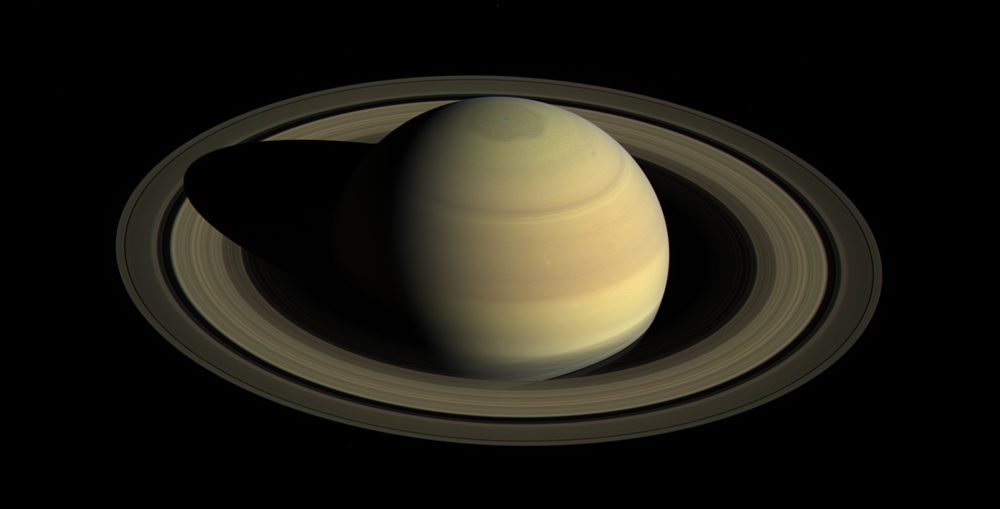
At the time of closest approach (called perijove), Juno will be about 2,700 miles (4,400 kilometers) above the planet’s cloud tops, traveling at a speed of about 129,000 miles per hour (57.8 kilometers per second) relative to the gas-giant planet. All of Juno’s eight science instruments will be on and collecting data during the flyby.
Some of the most dramatic Juno images of the solar system’s largest planet have come from private individuals who have downloaded raw images from the JunoCam and applied their own image processing recipies. The Juno mission in fact invites public to participate in such activities: JunoCam : Processing | Mission Juno
… do your own image processing, and we encourage you to upload your creations for us to enjoy and share. The types of image processing we’d love to see range from simply cropping an image to highlighting a particular atmospheric feature, as well as adding your own color enhancements, creating collages and adding advanced color reconstruction.
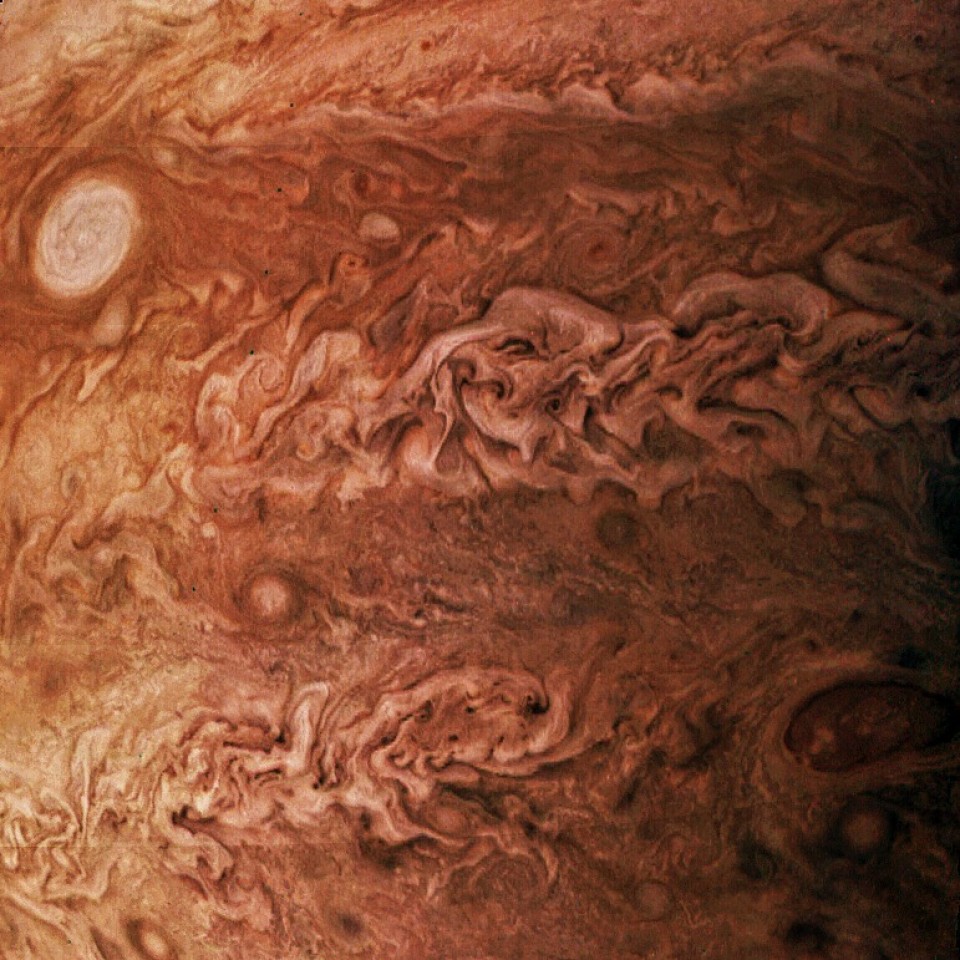
This enhanced-color image of a mysterious dark spot on Jupiter seems to reveal a Jovian “galaxy” of swirling storms.
Juno acquired this JunoCam image on Feb. 2, 2017, at 5:13 a.m. PDT (8:13 a.m. EDT), at an altitude of 9,000 miles (14,500 kilometers) above the giant planet’s cloud tops. This publicly selected target was simply titled “Dark Spot.” In ground-based images it was difficult to tell that it is a dark storm.
Citizen scientist Roman Tkachenko enhanced the color to bring out the rich detail in the storm and surrounding clouds. Just south of the dark storm is a bright, oval-shaped storm with high, bright, white clouds, reminiscent of a swirling galaxy. As a final touch, he rotated the image 90 degrees, turning the picture into a work of art.
JunoCam’s raw images are available at www.missionjuno.swri.edu/junocam for the public to peruse and process into image products.
The mound in the center of this image appears to have blocked the path of the dunes as they marched south (north is to the left in this image) across the scene. Many of these transverse dunes have slipfaces that face south, although in some cases, it’s hard to tell for certain. Smaller dunes run perpendicular to some of the larger-scale dunes, probably indicating a shift in wind directions in this area.
Although it might be hard to tell, this group of dunes is very near the central pit of a 35-kilometer-wide impact crater. Data from other instruments indicate the presence of clay-like materials in the rock exposed in the central pit.
Sand dunes are scattered across Mars and one of the larger populations exists in the Southern hemisphere, just west of the Hellas impact basin. The Hellespontus region features numerous collections of dark, dune formations that collect both within depressions such as craters, and among “extra-crater” plains areas.
This image displays the middle portion of a large dune field composed primarily of crescent-shaped “barchan” dunes. Here, the steep, sunlit side of the dune, called a slip face, indicates the down-wind side of the dune and direction of its migration. Other long, narrow linear dunes known as “seif” dunes are also here and in other locales to the east.
NB: “Seif” comes from the Arabic word meaning “sword.”
Much of Mars’ surface is covered by fine-grained materials that hide the bedrock, but elsewhere, such as in this scene, the bedrock is well exposed (except where covered by sand dunes).
Artist’s impression of a galaxy forming stars within powerful outflows of material blasted out from supermassive black holes at its core. Results from ESO’s Very Large Telescope are the first confirmed observations of stars forming in this kind of extreme environment. The discovery has many consequences for understanding galaxy properties and evolution. [Larger images]Observations using ESO’s Very Large Telescope have revealed stars forming within powerful outflows of material blasted out from supermassive black holes at the cores of galaxies. These are the first confirmed observations of stars forming in this kind of extreme environment. The discovery has many consequences for understanding galaxy properties and evolution. The results are published in the journal Nature.
New observations from ESO’s Very Large Telescope have revealed stars forming in the huge outflows in galaxies, which are driven by central supermassive black holes. This ESOcast Light takes a quick look at the important facts. Credit: ESO
A UK-led group of European astronomers used the MUSE and X-shooter instruments on the Very Large Telescope (VLT) at ESO’s Paranal Observatory in Chile to study an ongoing collision between two galaxies, known collectively as IRAS F23128-5919, that lie around 600 million light-years from Earth. The group observed the colossal winds of material — or outflows — that originate near the supermassive black hole at the heart of the pair’s southern galaxy, and have found the first clear evidence that stars are being born within them [1].
Such galactic outflows are driven by the huge energy output from the active and turbulent centres of galaxies. Supermassive black holes lurk in the cores of most galaxies, and when they gobble up matter they also heat the surrounding gas and expel it from the host galaxy in powerful, dense winds [2].
“Astronomers have thought for a while that conditions within these outflows could be right for star formation, but no one has seen it actually happening as it’s a very difficult observation,”
comments team leader Roberto Maiolino from the University of Cambridge.
“Our results are exciting because they show unambiguously that stars are being created inside these outflows.”
The group set out to study stars in the outflow directly, as well as the gas that surrounds them. By using two of the world-leading VLT spectroscopic instruments, MUSE and X-shooter, they could carry out a very detailed study of the properties of the emitted light to determine its source.
Artist’s impression of a galaxy forming stars within powerful outflows of material blasted out from supermassive black holes at its core. Results from ESO’s Very Large Telescope are the first confirmed observations of stars forming in this kind of extreme environment. The discovery has many consequences for understanding galaxy properties and evolution. Credit: ESO/M. Kornmesser
Radiation from young stars is known to cause nearby gas clouds to glow in a particular way. The extreme sensitivity of X-shooter allowed the team to rule out other possible causes of this illumination, including gas shocks or the active nucleus of the galaxy.
The group then made an unmistakable direct detection of an infant stellar population in the outflow [3]. These stars are thought to be less than a few tens of millions of years old, and preliminary analysis suggests that they are hotter and brighter than stars formed in less extreme environments such as the galactic disc.
As further evidence, the astronomers also determined the motion and velocity of these stars. The light from most of the region’s stars indicates that they are travelling at very large velocities away from the galaxy centre — as would make sense for objects caught in a stream of fast-moving material.
Co-author Helen Russell (Institute of Astronomy, Cambridge, UK) expands:
“The stars that form in the wind close to the galaxy centre might slow down and even start heading back inwards, but the stars that form further out in the flow experience less deceleration and can even fly off out of the galaxy altogether.”
The discovery provides new and exciting information that could better our understanding of some astrophysics, including how certain galaxies obtain their shapes [4]; how intergalactic space becomes enriched with heavy elements[5]; and even from where unexplained cosmic infrared background radiation may arise [6].
Maiolino is excited for the future:
“If star formation is really occurring in most galactic outflows, as some theories predict, then this would provide a completely new scenario for our understanding of galaxy evolution.”
Notes
[1] Stars are forming in the outflows at a very rapid rate; the astronomers say that stars totalling around 30 times the mass of the Sun are being created every year. This accounts for over a quarter of the total star formation in the entire merging galaxy system.
[2] The expulsion of gas through galactic outflows leads to a gas-poor environment within the galaxy, which could be why some galaxies cease forming new stars as they age. Although these outflows are most likely to be driven by massive central black holes, it is also possible that the winds are powered by supernovae in a starburst nucleus undergoing vigorous star formation.
[3] This was achieved through the detection of signatures characteristic of young stellar populations and with a velocity pattern consistent with that expected from stars formed at high velocity in the outflow.
[4] Spiral galaxies have an obvious disc structure, with a distended bulge of stars in the centre and surrounded by a diffuse cloud of stars called a halo. Elliptical galaxies are composed mostly of these spheroidal components. Outflow stars that are ejected from the main disc could give rise to these galactic features.
[5] How the space between galaxies — the intergalactic medium — becomes enriched with heavy elements is still an open issue, but outflow stars could provide an answer. If they are jettisoned out of the galaxy and then explode as supernovae, the heavy elements they contain could be released into this medium.
[6] Cosmic-infrared background radiation, similar to the more famous cosmic microwave background, is a faint glow in the infrared part of the spectrum that appears to come from all directions in space. Its origin in the near-infrared bands, however, has never been satisfactorily ascertained. A population of outflow stars shot out into intergalactic space may contribute to this light.
SPECIAL TIME: 1. Monday, March 27, 2017: 9:30-11 am PDT (12:30-2:00 pm EDT, 11:30 am -1 pm CDT): We welcome back Dr. M.V. “Coyote” Smith, COL, USAF (Ret)to discuss his proposal for a US Space Corps.
2. Tuesday, March 28, 2017: 7-8:30 pm PDT, 10-11:30 pm EDT, 9-10:30 pm CDT: We welcome back Jay Wittner with Kirby Ikin and Dale Skran in honor of the NSS [National Space Society] anniversary.
3. Friday, March 31, 2016: 9:30-11 am PDT; (12:30-2 pm EDT; 11:30 am – 1 pm CDT): We welcome back Dr. Anita Sengupta of JPL for updates with the Cold Atom Lab.
4. Sunday, April 2, 2017: 12-1:30 pm DST (3-4:30 pm EDT, 2-3:30 pm CDT): I am at the Space Foundation Symposium. Please see the website newsletter for suggested Golden Oldie programs you can play.