Dr. Madhulika (Lika) Guhathakurta, NASA’s Lead Scientist for the 2017 Solar Eclipse joins us to talk about the upcoming eclipse, the Sun and solar weather. For more information on the eclipse and information on how you can do citizen science head over to NASA’s eclipse website at eclipse2017.nasa.gov
Space news reviewed:
New Horizons Next Target, 2014 MU69, Surprises In Study
Commercial Crew Updates: One Year Away Edition
Most Accurate Measurement Of Dark Matter Distribution Yet
Two new Companies to launch rockets from balloons
TMRO is viewer supported:
TMRO:Space is a crowd funded show. If you like this episode consider contributing to help us to continue to improve. Head over to http://www.patreon.com/tmro for information plus our all new goals and reward levels
A SpaceX Falcon 9 rocket launched today and put a Dragon cargo spacecraft on track to berth with the International Space Station on Wednesday morning. The first stage booster of the Falcon 9 came down for a successful landing back at Cape Canaveral. Here are a couple of videos showing the launch and the booster return (note the sonic booms just after landing):
SpaceX is reaching a launch rate of about two per month. Plus, United Launch Alliance launches an Atlas V or Delta IV rocket once a month or so as well. So when you scheduled your next Florida vacation trip, you might check a launch schedule to see if you can overlap with an upcoming liftoff.
2. Tuesday, August 15, 2017: 7-8:30 pm PDT, 10-11:30 pm EDT, 9-10:30 pm CDT: We welcome back Gary Hudson of the Space Studies Institute.
3. Wednesday, August 16, 2016:: Hotel Mars. See Upcoming Show Menu and the website newsletter for details.
4. SPECIAL TIME: Friday, August 18, 2017; 7 pm PDT, (10 pm EDT; 9 pm CDT): OPEN LINES. All space and STEAM calls welcome. First time callers welcome. Let’s see how a Friday evening Open Lines show works on TSS!
Saturn’s giant, hazy moon Titan has been essential to NASA’s Cassini mission during its 13 thrilling years of exploration there. Cassini and the European Huygens probe have revealed a fascinating world of lakes and seas, great swaths of dunes, and a complex atmosphere with weather – with intriguing similarities to Earth. Titan has also been an engine for the mission, providing gravity assists that propelled the spacecraft on its adventures around the ringed planet. For more about the Cassini-Huygens mission, visit https://saturn.jpl.nasa.gov
Over the course of its 13-year mission at Saturn, Cassini has made 127 close flybys of Titan, with many more-distant observations. Cassini also dropped off the European Space Agency’s Huygens probe, which descended through Titan’s atmosphere to land on the surface in January 2005.
Successes for Cassini during its mission include the revelation that, as researchers had theorized, there were indeed bodies of open liquid hydrocarbons on Titan’s surface. Surprisingly, it turned out Titan’s lakes and seas are confined to the poles, with almost all of the liquid being at northern latitudes in the present epoch. Cassini found that most of Titan has no lakes, with vast stretches of linear dunes closer to the equator similar to those in places like Namibia on Earth. The spacecraft observed giant hydrocarbon clouds hovering over Titan’s poles and bright, feathery ones that drifted across the landscape, dropping methane rain that darkened the surface. There were also indications of an ocean of water beneath the moon’s icy surface.
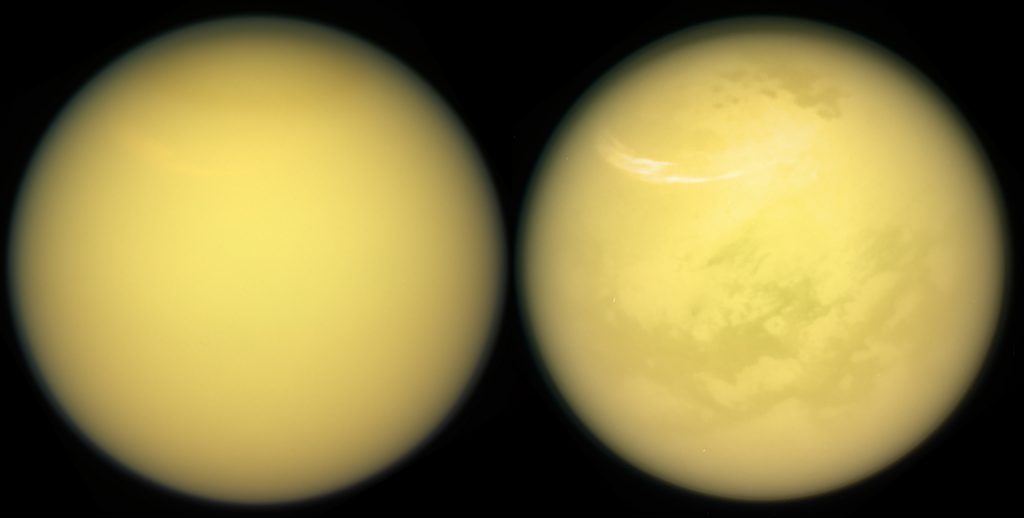
These views were obtained with the Cassini spacecraft narrow-angle camera on March 21, 2017. Images taken using red, green and blue spectral filters were combined to create the natural-color view at left. The false-color view at right was made by substituting an infrared image (centered at 938 nanometers) for the red color channel.
These two views of Saturn’s moon Titan exemplify how NASA’s Cassini spacecraft has revealed the surface of this fascinating world. > Full image and caption
 .
. .
.