New telescope with light amplification brings galaxies, nebulae, asteroids, etc into bright sharp images

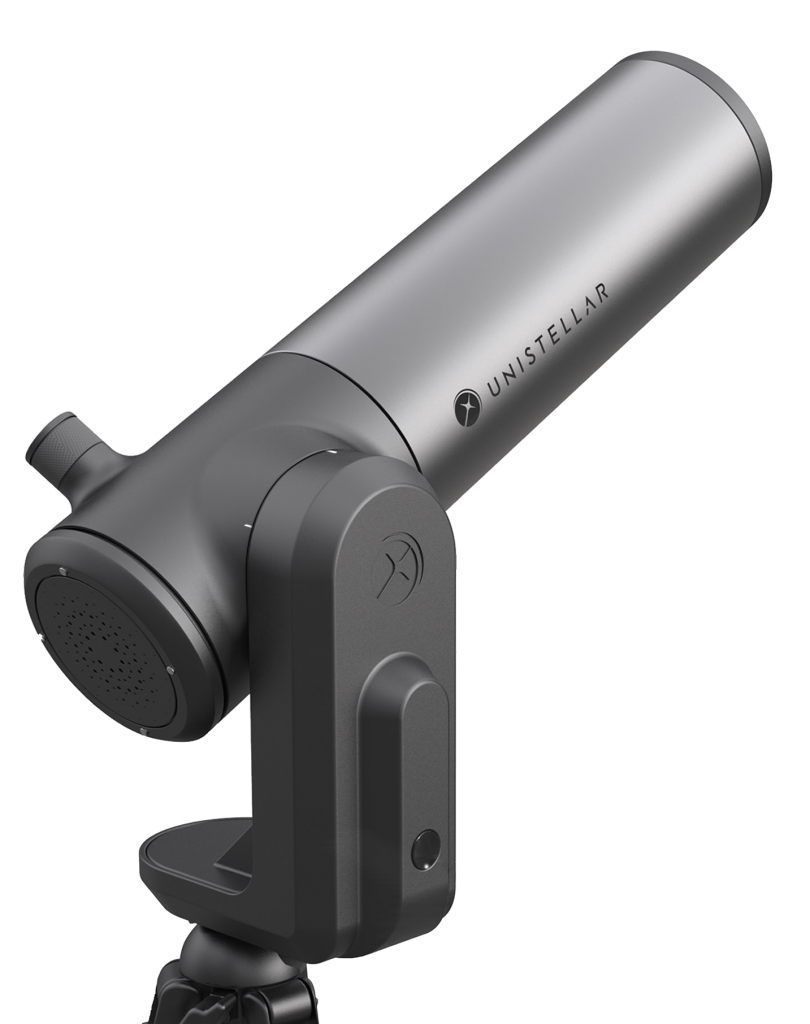
The company Unistellar is developing a small telescope called the evScope that includes an active light amplification system that greatly brightens and sharpens images:

Turn the Amplified Vision ON and the system will start to accumulate light from the objects you are viewing all the while projecting it directly into the eyepiece of the telescope: the image is progressively intensified and in a matter of seconds colors and shapes of galaxies and nebulae, invisible in normal telescopes, will appear. Turn Field Recognition ON and the system will recognize and name the objects in the field !

More about the evScope in New Telescope “Gives Back the Sky” to City-Dwellers – Scientific American Blog Network

Called the “eVscope” (pronounced Ee-Vee Scope) for short, Unistellar’s product outwardly appears to be just a typical 4.5-inch Newtonian reflector—a simple small telescope that, along with its tripod, easily fits inside a backpack. But a peek through its eyepiece reveals the eVscope’s power: Using a proprietary system of sensors, optics and specialized software, the telescope can amplify and display the accumulated light from a faint target over time, stacking up and processing hundreds of images to correct for instrumental jitter and smeared exposures to build up vivid, sharp views that rival those from far larger and more expensive equipment. And, as Marchis intends to show with his demonstration from a Brooklyn graveyard, the technology even works under poor viewing conditions—such as in and around New York City, where the glare of city lights is so oppressive that even on clear nights one can practically count on fingers and toes all the stars visible to the naked eye. (The technology works so well, in fact, that Unistellar’s eVscope has managed to capture and display images of faraway Pluto in its eyepiece as a dim and distant dot hanging in the light-polluted skies over Marseilles, France, and San Francisco.) 

The evScope is sensitive enough for amateurs to do real science with it. The company plans to encourage citizen science projects with the device:

Through a partnership with the SETI Institute, eVscope users will have the option of automatically uploading their observations to an online database for use by amateur and professional astronomers alike. “We’ll build it up slowly, with a thousand eVscopes providing millions of frames for any given region of sky that can be combined to get good signal to noise,” Marchis says. “We could use it to search for Earth-threatening asteroids and comets, stellar occultations, supernovae, variable stars; maybe even things we can scarcely imagine—a flash of light, a laser pulse from another cosmic civilization? Who knows what we might find—it’s not like we have been observing the sky continuously at these magnitudes.”

T
Unistellar plans to begin selling the evScope in 2018.

====
Videos: SpaceX Falcon 9 launches 10 satellites & booster lands on droneship

A SpaceX Falcon 9 rocket launched ten Iridium NEXT satellites on Monday from Vandenberg AFB on the California coast. The first stage booster landed on a floating platform at sea, becoming the 17th successful landing either at sea or on land.

A video of the liftoff and first few minutes of the launch:

This shows scenes of the booster landing at about 1:30:

Here is a video showing some of the satellites being deployed from the upper stage of the rocket:

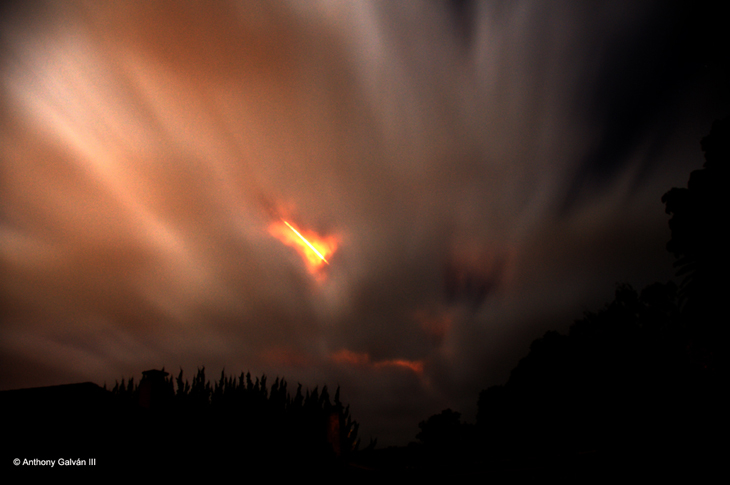
Here is a photo of the launch taken by Anthony Galván III :

The view through heavy cloud cover 50 miles for the launch site provided a dramatic effect of the booster engine’s flames illuminating the clouds from the launch site and a small opening to see the rocket for a few seconds.


This video was taken from about 100 miles from Vandenberg but is still quite impressive, especially when the booster separates from the upper stage and fires its booster to return to earth at around 2:40 :

Here is the full SpaceX webcast:


====

Video: TMRO Orbit 10.37 – National Space Council Round Table

The latest TMRO.tv live program is now available in the archive: National Space Council Round Table – Orbit 10.37 – TMRO

The National Space Council had its first meeting this last week. Benjamin, Cariann, Mike and Jared discuss what happened in the first meeting and what power this group may have.

Space news covered:

  • Thirty-Meter Telescope Is Cleared To Begin Construction…Again
  • Bigelow’s Expandable Space Module May Get More Time at ISS
  • JWST launch delayed to 2019

TMRO is viewer supported:

TMRO:Space is a crowd funded show. If you like this episode consider contributing to help us to continue to improve. Head over to http://www.patreon.com/tmro for information plus our all new goals and reward levels

A couple of TMRO short reports:

====

The Space Show this week – Oct.9.2017

The guests and topics of discussion on The Space Show this week:

  1. Special Time: Monday, Oct. 9, 2017; 7-8:30 pm PDT (9-10:30 pm CDT, 10-11:30 pm EDT); We welcome Michelle Hanlon to discuss preserving the Apollo lunar landing sites. ​
  2. Wednesday, Oct. 10, 2017; 7-8:30 pm PDT (9-10:30 pm CDT, 10-11:30 pm EDT) : We welcome John Bucknell on advanced propulsion ideas.
  3. Wednesday, Oct. 11, 2017: : Hotel Mars with John Batchelor, Dr. David Livingston. See upcoming show menu on the website for details. Note that this is a pre-recorded session.
  4. Friday, Oct. 13, 2017: 9:30-11 am PDT, (12:30-2 pm EDT; 11:30 am – 1 pm CDT): We welcome back Chris Newman on the UK space law and policy.
  5. Sunday, Oct. 15 2017: 12-1:30 pm PDT (3-4:30 pm EDT, 2-3:30 5 pm CDT): We welcome back Esther Dyson to discuss commercial space investing.

See also:
* The Space Show on Vimeo – webinar videos
* The Space Show’s Blog – summaries of interviews.
* The Space Show Classroom Blog – tutorial programs

The Space Show is a project of the One Giant Leap Foundation.

The Space Show - David Livingston
David Livingston

Everyone can participate in space