BrownSpaceman blog hosts the latest Carnival of Space.
BrownSpaceman blog hosts the latest Carnival of Space.
Anna Fox, a seventh grader in Virginia Beach, wins the NASA Langley Student Art Contest for 2018:
Virginia Middle-Schooler Wins Grand Prize at NASA Langley Art Contest
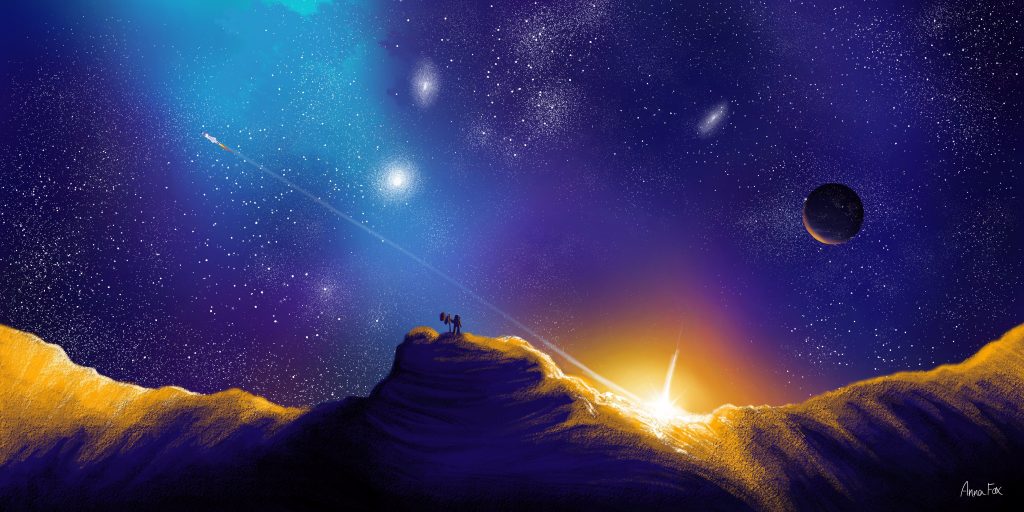
Anna Fox, a seventh-grader from Virginia Beach Middle School in Virginia Beach, Virginia, was named as the grand prize winner of Langley Research Center’s Student Art Contest.
“I was very excited when I heard that I won first place for my grade,” Anna said. “But when I heard that I won grand prize, I was speechless.”
A record 831 entries were submitted from hundreds of children in 39 states, the District of Columbia and Puerto Rico, with 13 students earning first-place honors in grade levels K-12 and the opportunity to be considered for the grand prize, said Kristina Cors, Langley Student Art Contest coordinator.
“We hope this contest continues to grow and provide a place for students to explore science and technology through creativity,” she said.
The art contest theme, “The Next 100 Years,” was intended to illustrate how NASA research and innovation propels science to new discoveries.
“This year’s artwork was particularly remarkable, and represented the theme ‘The Next 100 Years’ with imagination and immense talent,” Cors said.
Anna’s winning piece shows a deep-space scene with an astronaut planting a flag on a planet’s mountain while watching a rocket fly off in the distance in a sky populated by stars, galaxies and a moon.
“When I started drawing, I had no idea what to do, so I had looked at a bunch of videos on how to do galaxies for inspiration,” Anna said. “After that I randomly placed colors together until I found something I liked. It all started coming together from there.”
Once she got an idea in motion, Anna did her work using old and new techniques.
“I created my artwork digitally on Photoshop,” Anna said. “I had started with basic colors for the background, including the explosion behind the rocks. Then, on another layer I created the rocks, planet, astronaut and rocket ship taking off. Later I added detail on all the layers to look more realistic. The last step was to add all of the stars and galaxies, which I did with a special brush.”
Anna, who has been an artist for as long as she could pick up a pencil, said she started drawing digitally when she was 11, inspired by her father’s work on a computer.
“I think the best part of creating art is having fun with it and inspiring others to do art as well,” she said.
Anna said she always had an interest in space and the art contest was a perfect vehicle to express that.
“I think that the coolest thing about NASA is that they help so many people achieve their dreams, and send people to do what not a lot of people get to do,” Anna said.
For her grand-prize victory, Anna received a certificate, and a NASA Exploration Package of posters, pens, stickers, patches and lapel pins. Her artwork will be displayed at the Virginia Air & Space Center in Hampton, Virginia.
The 13 grade-level winners were selected by a panel of five judges from the Hampton Roads art community, and the grand champion was picked by Langley employees. Each piece was evaluated on originality, interpretation of subject matter/theme, creative techniques, composition and overall art appearance.
====
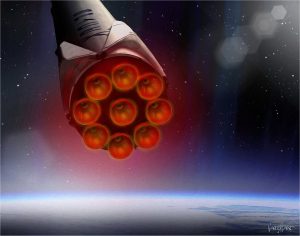
Here is a story about James Vaughan and his renderings of NewSpace rockets and spacecraft: Pixels and privatization: An artist’s view of NewSpace – SpaceFlight Insider
While working in an exciting field that has seen a swell of innovation might seem hectic and stressful, for Vaughan, being able to participate in the NewSpace age has enabled him, in some ways, to live out his dreams.
“I get to make important and far-reaching dreams take on believable and inspiring sense of reality,” Vaughan said, noting that one’s imagination is almost as important as a degree in aeronautics. “In order to build and advance, we have to be able to imagine. What I do helps to make these possibilities seem attainable.”
====
The guests and topics of discussion on The Space Show this week:
1. Monday, March 12, 218: 2-3:30 pm PDT; 4-5:30 pm CDT; 6-6:30 pm EDT We welcome back Dr. Jeff Bell to the program for a multi-topic discussion.
2. Tuesday, March 13, 2018: 7-8:30 pm PDT; 9-10:30 pm CDT; 10-11:30 pm EDT: We welcome back Dr. Robert Zubrin to the program.
3. Wednesday, March 14, 2018: Hotel Mars. See Upcoming Show Menu and the website newsletter for details. Hotel Mars is pre-recorded by John Batchelor. It is archived on The Space Show site after John posts it on his website.
4. Friday, March 16, 2018; 9:30 am -11 am PDT, (12:30 -2 pm EDT; 11:30 am -1 pm CDT): We welcome back Dr. Erik Seedhouse to discuss his new book regarding British astronaut Tim Peake.
5. Sunday, March 18, 2018: 12-1:30 pm PDT; 2-3:30 pm CDT; 3-4:30 pm EDT. OPEN LINES. All space, STEM, STEAM, & science topics welcome. First time callers are welcome.
See also:
* The Space Show on Vimeo – webinar videos
* The Space Show’s Blog – summaries of interviews.
* The Space Show Classroom Blog – tutorial programs
The Space Show is a project of the One Giant Leap Foundation.

Elon Musk on Saturday released a short video of the Falcon Heavy launch made by Jonathan Nolan, the co-creator of HBO series Westworld. It includes brief footage of the central core nearly crashing into the droneship landing pad at high speed. Elon Musk on Twitter:
“Why Falcon Heavy & Starman? Life cannot just be about solving one sad problem after another. There need to be things that inspire you, that make you glad to wake up in the morning and be part of humanity. That is why we did it. We did for you.”
More about the
A photo that provides some scale for those side boosters, which were on their second flights to suborbital space and back – AlanStern on Twitter: “Rockets are big!… “

====
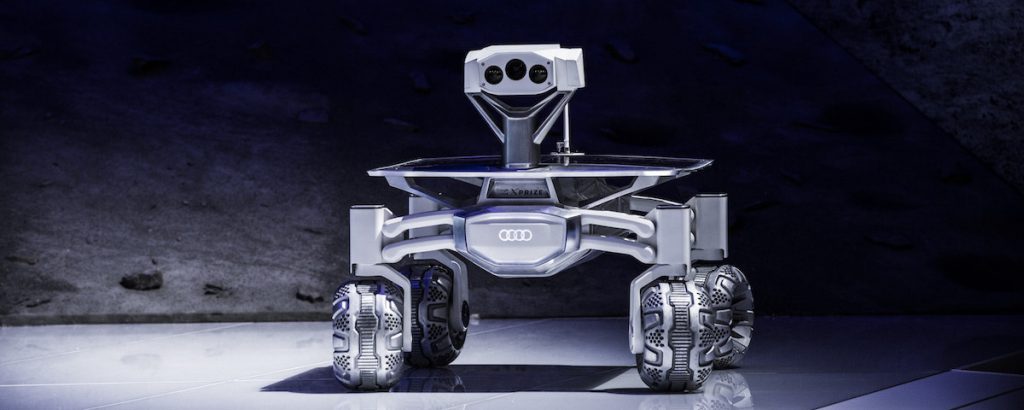
Jonny Smith of the Fully Charged Show on line program visited the Part Time Scientists group in Berlin, which is partnering with Audi and Vodafone on a private mission to the Moon. In this video, Smith gets to drive the Audi Lunar Quattro, “a remote controlled solar powered electric moon buggy”.
PT Scientists began as a team competing for the Google Lunar XPRIZE, which ended without any winners, However, like several other GLXP teams, a commercial company emerged from the effort and will continue to pursue lunar ventures.
====