Juno: A new image of Jupiter from the 12th close flyby

Juno sends a grand image of Jupiter:

Jupiter: A New Perspective

This extraordinary view of Jupiter was captured by NASA’s Juno spacecraft on the outbound leg of its 12th close flyby of the gas giant planet.

This extraordinary view of Jupiter was captured by NASA’s Juno spacecraft on the outbound leg of its 12th close flyby of the gas giant planet.

This new perspective of Jupiter from the south makes the Great Red Spot appear as though it is in northern territory. This view is unique to Juno and demonstrates how different our view is when we step off the Earth and experience the true nature of our three-dimensional universe.

Juno took the images used to produce this color-enhanced image on April 1 between 3:04 a.m. PDT (6:04 a.m. EDT) and 3:36 a.m. PDT (6:36 a.m. EDT). At the time the images were taken, the spacecraft was between 10,768 miles (17,329 kilometers) to 42,849 miles (68,959 kilometers) from the tops of the clouds of the planet at a southern latitude spanning 34.01 to 71.43 degrees.

Citizen scientists Gerald Eichstädt and Seán Doran created this image using data from the spacecraft’s JunoCam imager. The view is a composite of several separate JunoCam images that were re-projected, blended, and healed.

JunoCam’s raw images are available for the public to peruse and process into image products at:  www.missionjuno.swri.edu/junocam

More information about Juno is at: https://www.nasa.gov/juno and http://missionjuno.swri.edu

Image Credits: NASA/JPL-Caltech/SwRI/MSSS/Gerald Eichstäd/Seán Doran

===

Find more great Juno Jupiter imagery in the Juno Image Gallery | NASA
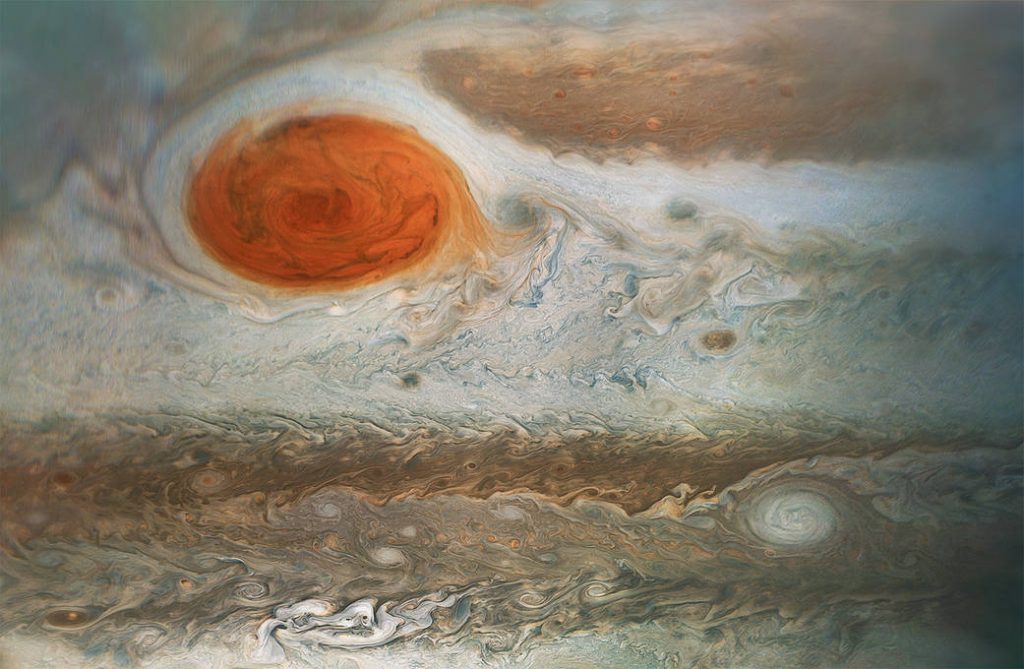
This image of Jupiter’s iconic Great Red Spot and surrounding turbulent zones was captured by NASA’s Juno spacecraft.

====

x

Video: Alan Stern and David Grinspoon talk about the “Epic First Mission to Pluto”

Dr. Alan Stern (Southwest Research Inst) and Dr. David Grinspoon (Planetary Science Inst) recently gave a public lecture on the New Horizon  mission to Pluto and beyond:  

In July 2015, the New Horizons spacecraft flew by Pluto, revealing its surface to our view for the first time. In this program, Drs. Stern and Grinspoon give us an insider’s view of how this complex mission came to be and what it discovered at the edge of our solar system. Their new book (like the talk and with the same title) tells the full story of the mission, its ground-breaking discoveries at Pluto, and where it’s going next. Here is new science, straight from the source, with great insight into what it’s like to be part of a pioneering planetary mission.

Grinspoon and Stern have written a well-reviewed new book about the New Horizon project: Chasing New Horizons: Inside the Epic First Mission to Pluto.

And the two have refuted the silly assertion that Pluto is not a planet: Why Pluto is a planet and many moons are, too – The Washington Post

… the process for redefining planet was deeply flawed and widely criticized even by those who accepted the outcome. At the 2006 IAU conference, which was held in Prague, the few scientists remaining at the very end of the week-long meeting (less than 4 percent of the world’s astronomers and even a smaller percentage of the world’s planetary scientists) ratified a hastily drawn definition that contains obvious flaws. For one thing, it defines a planet as an object orbiting around our sun — thereby disqualifying the planets around other stars, ignoring the exoplanet revolution, and decreeing that essentially all the planets in the universe are not, in fact, planets.

Even within our solar system, the IAU scientists defined “planet” in a strange way, declaring that if an orbiting world has “cleared its zone,” or thrown its weight around enough to eject all other nearby objects, it is a planet. Otherwise it is not. This criterion is imprecise and leaves many borderline cases, but what’s worse is that they chose a definition that discounts the actual physical properties of a potential planet, electing instead to define “planet” in terms of the other objects that are — or are not — orbiting nearby. This leads to many bizarre and absurd conclusions. For example, it would mean that Earth was not a planet for its first 500 million years of history, because it orbited among a swarm of debris until that time, and also that if you took Earth today and moved it somewhere else, say out to the asteroid belt, it would cease being a planet.

See also Pluto’s demotion ignores astronomical history | Science News

====

Videos: TMRO Orbit 11.21 – Riverside Telescope Makers Conference

The latest episode of TMRO.tv Space is now available on line at: Riverside Telescope Makers Conference – Orbit 11.21 – TMRO

We have Space Mike at the @ISDC 2018 Expo and Jared at the @RTMCAstroExpo 2018 Astronomy Expo! Jared sits down with Martin Carey and Travis Holmes to talk about citizen astronomy.

Launches and news topics covered:

Launches:
Long March 4C Launches Queqiao Lunar Relay
Antares launches Cygnus OA-9 mission to ISS
Falcon 9 Launches Iridium-6 and GRACE-FO

Space News:
Grande-sized black holes
More former GXLP teams have announced future landing plans
RocketLab “It’s Business Time” update

TMRO is supported by viewers:

TMRO shows are crowd funded. If you like this episode consider contributing to help us to continue to improve. Head over to http://www.patreon.com/tmro for funding levels, goals and all of our different rewards!

===

Other recent TMRO videos

====

Apollo 12 astronaut Alan Bean dies at 86

Astronaut, Moon walker and artist, Alan Bean has passed away at the age of 86 following an illness that came on two weeks ago while traveling : Alan Bean Family Obituary Statement | NASA

Bean was the lunar pilot on the Apollo 12 mission and he and mission commander Pete Conrad explored the Moon’s Ocean of Storms in November 1969.

Bean became an accomplish artist after retiring from the astronaut corps. See galleries of his works at Alan Bean Art. He had been allowed to keep the name patch from his Apollo EVA suit and it turned out to be saturated with space dust. He would crush a tiny bit of the patch into the paints used for his lunar renderings.

[]

[]

[]

Another NASA video about Bean:

Video: Mars reports

Here’s a report from NASA JPL on what’s been happening on Mars:

Bob Zimmerman is keeping track of where the Mars rovers are roving:

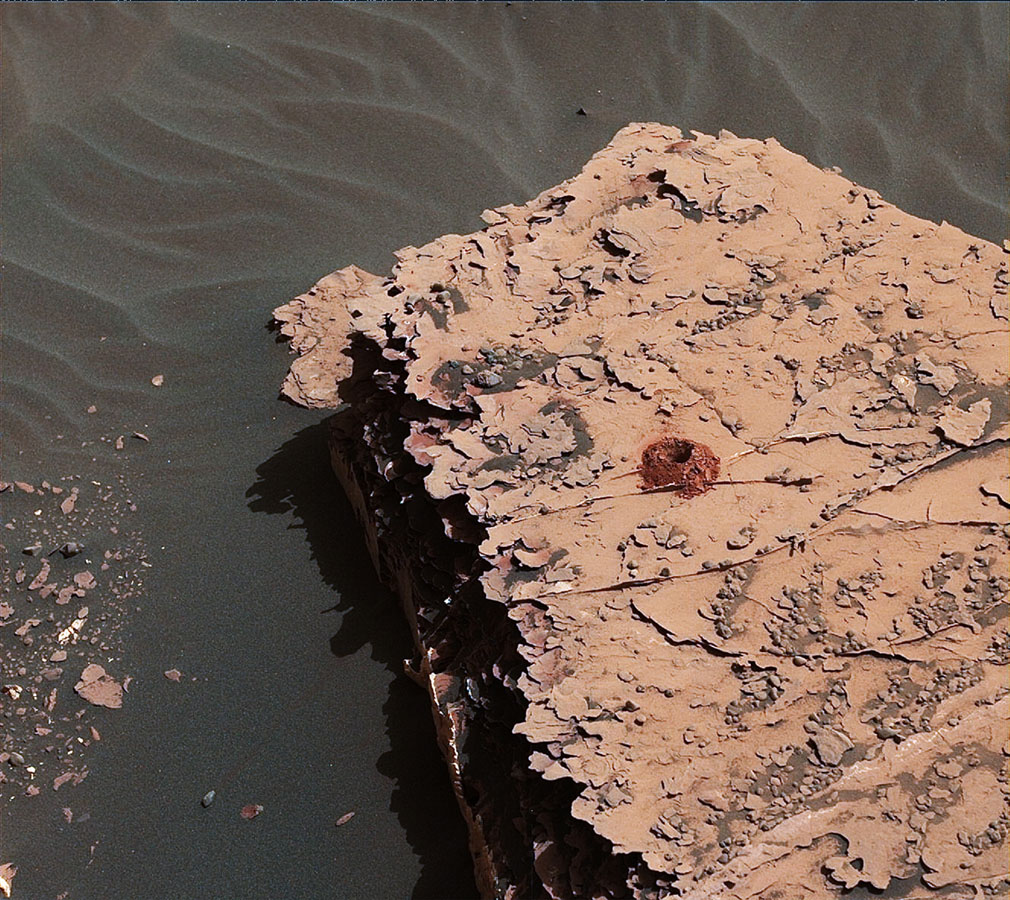
As noted in these reports, Curiosity is drilling in rock again:

===

Meanwhile, the Onion reports on a new discovery on the Red Planet: NASA Says Presence Of Diving Board On Mars Confirms Planet May Have Once Contained Water

====

Everyone can participate in space