Everyday Spacer Blog hosts the latest Carnival of Space.
Everyday Spacer Blog hosts the latest Carnival of Space.
The latest report from ESO (European Southern Observatory):
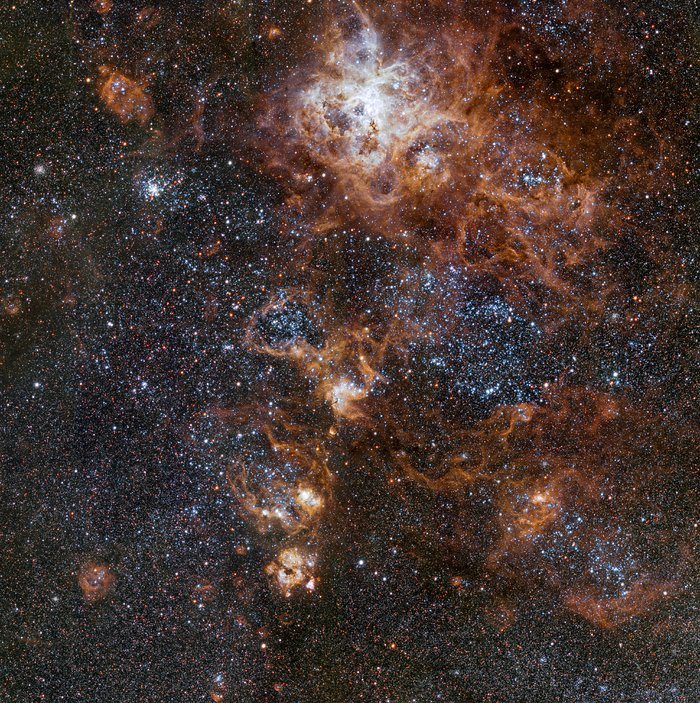
Taking advantage of the capacities of the VLT Survey Telescope (VST) at ESO’s Paranal Observatory in Chile, astronomers captured this very detailed new image of the Tarantula Nebula and its numerous neighbouring nebulae and star clusters. The Tarantula, which is also known as 30 Doradus, is the brightest and most energetic star-forming region in the Local Group of galaxies.
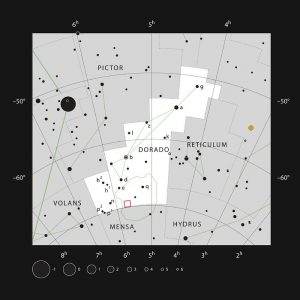
The Tarantula Nebula, at the top of this image, spans more than 1000 light-years and is located in the constellation of Dorado (The Dolphinfish) in the far southern sky. This stunning nebula is part of the Large Magellanic Cloud, a dwarf galaxy that measures about 14 000 light-years across. The Large Magellanic Cloud is one of the closest galaxies to the Milky Way.
At the core of the Tarantula Nebula lies a young, giant star cluster called NGC 2070, a starburst region whose dense core, R136, contains some of the most massive and luminous stars known. The bright glow of the Tarantula Nebula itself was first recorded by French astronomer Nicolas-Louis de Lacaille in 1751.
Another star cluster in the Tarantula Nebula is the much older Hodge 301, in which at least 40 stars are estimated to have exploded as supernovae, spreading gas throughout the region. One example of a supernova remnant is the superbubble SNR N157B, which encloses the open star cluster NGC 2060. This cluster was first observed by British astronomer John Herschel in 1836, using an 18.6-inch reflector telescope at the Cape of Good Hope in South Africa. On the outskirts of the Tarantula Nebula, on the lower right-hand side, it is possible to identify the location of the famous supernova SN 1987A [1].
Moving to the left-hand side of the Tarantula Nebula, one can see a bright open star cluster called NGC 2100, which displays a brilliant concentration of blue stars surrounded by red stars. This cluster was discovered by Scottish astronomer James Dunlop in 1826 while working in Australia, using his self-built 9-inch (23-cm) reflecting telescope.
At the centre of the image is the star cluster and emission nebula NGC 2074, another massive star-forming region discovered by John Herschel. Taking a closer look one can spot a dark seahorse-shaped dust structure — the “Seahorse of the Large Magellanic Cloud”. This is a gigantic pillar structure roughly 20 light-years long — almost five times the distance between the Sun and the nearest star, Alpha Centauri. The structure is condemned to disappear over the next million years; as more stars in the cluster form, their light and winds will slowly blow away the dust pillars.
Obtaining this image was only possible thanks to the VST’s specially designed 256-megapixel camera called OmegaCAM. The image was created from OmegaCAM images through four different coloured filters, including one designed to isolate the red glow of ionised hydrogen [2].
Notes
[1] SN 1987A was the first supernova to be observed with modern telescopes and the brightest since Kepler’s Star in 1604. SN 1987A was so intense that it blazed with the power of 100 million suns for several months following its discovery on 23 February 1987.
[2] The H-alpha emission line is a red spectral line created when the electron inside a hydrogen atom loses energy. This happens in hydrogen around hot young stars when the gas becomes ionised by the intense ultraviolet radiation and electrons subsequently recombine with protons to form atoms again. The ability of OmegaCAM to detect this line allows astronomers to characterise the physics of giant molecular clouds where new stars and planets form.
New transport for air and water:
** Martin Jetpack – Been awhile since I posted videos of the New Zealand company’s one person Vertical Takeoff and Landing with a ducted fan design
According to the 2017 annual report (pdf), the current engine requires more maintenance and has a shorter working life than needed for commercial operations in most markets. However, the company’s majority shareholder, KuangChi Science (KCS), has determined that the vehicle is “sufficiently advanced to generate revenue via repeatable show concept demonstrations and sales into the first responder market in China”
** Cormorant – Urban Aero/Tactical Robotics – I’ve also posted here several times over the years about this large vertical takeoff and landing UAV with a unique approach to a ducted fan vehicle. The Israeli based company remains focused on emergency services and military applications rather than civilian transport –
** SeaBubbles is developing a water taxi with hydrofoils intended to provide Uber style personal transport services on waterways with a fast and stable ride – SeaBubbles reveals its latest ‘flying water car’ as it brings in a new wave of cash – The Verge
====
The 21st Annual International Mars Society Convention will be held this year in Pasadena, California, August 23-26, 2018.
The four-day International Mars Society Convention brings together leading scientists, engineers, aerospace industry representatives, government policymakers and journalists to talk about the latest scientific discoveries, technological advances and political-economic developments that could help pave the way for a human mission to the planet Mars.
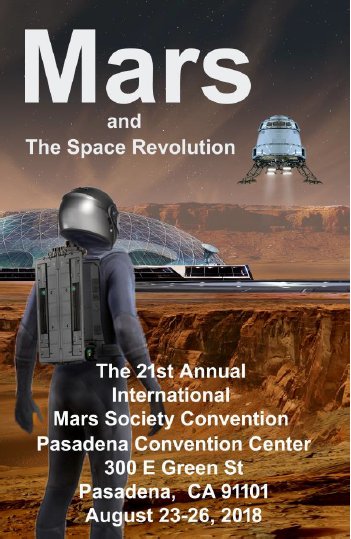
The Conference Flyer lists the wide variety of sessions with something for anyone with an interest in Mars, regardless of technical or non-technical background:
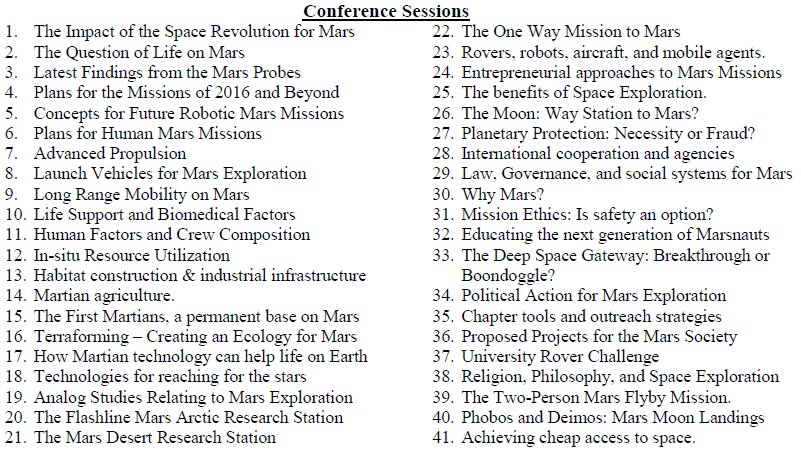
Mars Society founder and President Robert Zubrin recently said,
From a technical point of view, we are much closer today to sending humans to Mars than we were to sending men to the Moon in 1961, and we were there eight years later.
Go to the conference to understand the justification for that statement.
====
The guests and topics of discussion on The Space Show this week:
1. Monday, May 28, 2018; 2-3:30 pm PDT (4-5:30 pm CDT, 5-6:30 pm EDT): No show today due to Memorial Day Holiday.
2. Tuesday, May 29, 2018: 7-8:30 pm PDT; 9-10:30 pm CDT; 10-11:30 pm EDT: We welcome back journalist Alan Boyle of Geekwire to talk space news and development, ISDC 2018 and the Jeff Bezos ISDC keynote talk.
3. Wednesday, May 30, 2018: Hotel Mars. See Upcoming Show Menu and the website newsletter for details. Hotel Mars is pre-recorded by John Batchelor. It is archived on The Space Show site after John posts it on his website.
4. Friday, June 1, , 2018; 9:30 am -11 am PDT, (12:30 -2 pm EDT; 11:30 am -1 pm CDT): We welcome author and Washington Post journalist Christian Davenport, author of The Space Barons: Elon Musk, Jeff Bezos, and the Quest to Colonize the Cosmos
5. Sunday, June 3, 2018: 12-1:30 pm PDT; 2-3:30 pm CDT; 3-4:30 pm EDT. We welcome Dr. Brendan Cunningham about warehousing communication satellites to hold onto frequency allocations.
See also:
* The Space Show on Vimeo – webinar videos
* The Space Show’s Blog – summaries of interviews.
* The Space Show Classroom Blog – tutorial programs
The Space Show is a project of the One Giant Leap Foundation.
