In June, the constellations Boӧtes, Corona Borealis and Draco, and the planets Venus, Jupiter, Mars and Saturn are all visible from the Northern Hemisphere.
Behold, the Earth! These are live Earth views from the International Space Station from the High Definition Earth Viewing (HDEV) experiment. While the experiment is operational, views will typically sequence through the different cameras. If you are seeing a black image, the Space Station is on the night side of the Earth. If you are seeing an image with text displayed, the communications are switching between satellites and camera feeds are temporarily unavailable. Between camera switches, a black & gray slate will also briefly appear.
More from the caption:
The experiment was activated on April 30, 2014 and is mounted on the External Payload Facility of the European Space Agency’s Columbus module. This experiment includes several commercial HD video cameras aimed at the Earth which are enclosed in a pressurized and temperature controlled housing. To learn more about the HDEV experiment, visit: https://eol.jsc.nasa.gov/ESRS/HDEV/
Please note: The HDEV cycling of the cameras will sometimes be halted, causing the video to only show select camera feeds. This is handled by the HDEV team, and is only scheduled on a temporary basis. Nominal video will resume once the team has finished their scheduled event.
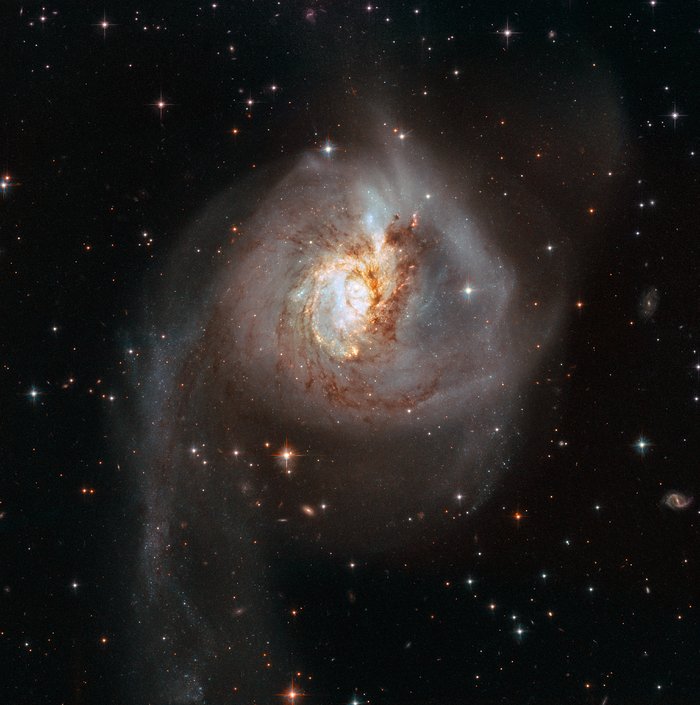
Though it resembles a peaceful rose swirling in the darkness of the cosmos, NGC 3256 is actually the site of a violent clash. This distorted galaxy is the relic of a collision between two spiral galaxies, estimated to have occurred 500 million years ago. Today it is still reeling in the aftermath of this event.
This image, taken with the Wide Field Camera 3 (WFC3) and the Advanced Camera for Surveys (ACS), both installed on the NASA/ESA Hubble Space Telescope, shows the peculiar galaxy NGC 3256. The galaxy is about 100 million light-years from Earth and is the result of a past galactic merger, which created its distorted appearance. As such, NGC 3256 provides an ideal target to investigate starbursts that have been triggered by galaxy mergers. Another image of NGC 3256 was already released in 2008, as part of a collection of interacting galaxies, created for Hubble’s 18th birthday. [Larger images]Located about 100 million light-years away in the constellation of Vela (The Sails), NGC 3256 is approximately the same size as our Milky Way and belongs to the Hydra-Centaurus Supercluster. It still bears the marks of its tumultuous past in the extended luminous tails that sprawl out around the galaxy, thought to have formed 500 million years ago during the initial encounter between the two galaxies, which today form NGC 3256. These tails are studded with young blue stars, which were born in the frantic but fertile collision of gas and dust.
When two galaxies merge, individual stars rarely collide because they are separated by such enormous distances, but the gas and dust of the galaxies do interact — with spectacular results. The brightness blooming in the centre of NGC 3256 gives away its status as a powerful starburst galaxy, host to vast amounts of infant stars born into groups and clusters. These stars shine most brightly in the far infrared, making NGC 3256 exceedingly luminous in this wavelength domain. Because of this radiation, it is classified as a Luminous Infrared Galaxy.
NGC 3256 has been the subject of much study due to its luminosity, its proximity, and its orientation: astronomers observe its face-on orientation, that shows the disc in all its splendour. NGC 3256 provides an ideal target to investigate starbursts that have been triggered by galaxy mergers. It holds particular promise to further our understanding of the properties of young star clusters in tidal tails.
As well as being lit up by over 1000 bright star clusters, the central region of NGC 3256 is also home to crisscrossing threads of dark dust and a large disc of molecular gas spinning around two distinct nuclei — the relics of the two original galaxies. One nucleus is largely obscured, only unveiled in infrared, radio and X-ray wavelengths.
These two initial galaxies were gas-rich and had similar masses, as they seem to be exerting roughly equal influence on each other. Their spiral disks are no longer distinct, and in a few hundred million years time, their nuclei will also merge and the two galaxies will likely become united as a large elliptical galaxy.
NGC 3256 was previously imaged through fewer filters by the NASA/ESA Hubble Space Telescope as part of a large collection of 59 images of merging galaxies, released for Hubble’s 18th anniversary on 24th April 2008.
Here is the latest episode of The Planetary Post with Robert Picardo courtesy of the Planetary Society:
Our PlantVac performed well in its test flight on the Xodiac rocket in the Mojave desert, but first Robert takes us to D.C. for the first Planetary Science Caucus event.
The focus of today’s flight was to expand our understanding of the spaceship’s supersonic handling characteristics and control system’s performance with vehicle parameters that were closer to the ultimate commercial configuration. This involved shifting the vehicle’s center of gravity rearward via the addition of passenger seats and related equipment. The rocket motor burned for the planned 31 seconds and propelled Unity to a speed of Mach 1.9 and an altitude of 114,500 ft.[34.9 km]. As will be the case for future commercial flights, Unity’s unique re-entry feathering system was deployed for the initial descent before the final glide home to a smooth runway landing.
If all goes well, commercial flights would begin next year with flights from Spaceport America in New Mexico taking 6 passengers at a time on the trip of a lifetime. Over 700 customers have paid up to $250,000 to ride a rocket to space and back.