A sampling of recent articles, videos, and images dealing with space transport (find previous roundups here):
** Blue Origin still planning for crewed New Shepard flights this year.
@blueorigin‘s Wagner says 1st crewed flight of New Shepard on track to fly by end of this year.
— Tariq J. Malik 🚀 (@tariqjmalik) September 16, 2019
The last flight of the New Shepard took place on May 2nd. Jeff Bezos and other Blue management have been indicating that the first flights with people on board would take place this year after a few more uncrewed test flights. So it would seem that they must soon begin flying again and at a much higher rate.
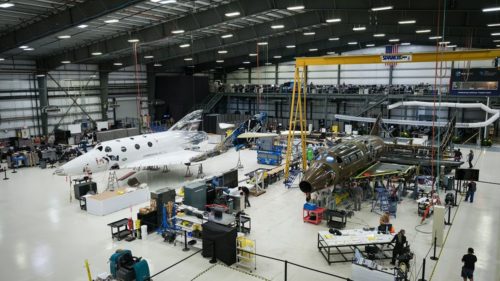
** Virgin Galactic marks a milestone in the assembly of a new SpaceShipTwo: Virgin Galactic Announces Major Milestone in Manufacture of Next Spaceship – Virgin Galactic
Virgin Galactic announced today that it has mated the fuselage and cabin of its next spaceship to the completed wing assembly. In addition, the two tail booms have been mated to the spaceship’s rear feather flap assembly. The completion of these two milestones brings assembly of the next SpaceShipTwo, planned to enter service after VSS Unity, a major step forward.
Meanwhile, Virgin Orbit plans to air launch the first LauncherOne rocket this year as well (a military payload, however, won’t be flown till next year): Branson: Virgin Launch Of USAF Sat By End Of Year – Breaking Defense
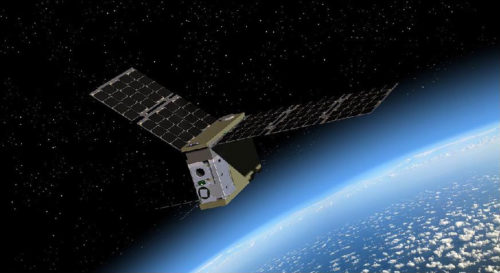
** A Chinese Long March 4B rocket launched last week with two remote sensing satellites and a CubeSat that will test a drag-sail for accelerated de-orbiting:
- China returns Long March 4 to service with Ziyuan-2D launch – NASASpaceFlight.com
- China launches Earth-observing satellites, solar sail experiment – Spaceflight Now
** Lunar space elevator possible with current technology according to a recent study:
- A space elevator to the moon could be doable — and surprisingly cheap – NBCNews.com
- The Spaceline: a practical space elevator alternative achievable with current technology, Zephyr Penoyre, Emily Sandford – arxiv.org
Perhaps the biggest hurdle to mankind’s expansion throughout the Solar System is the prohibitive cost of escaping Earth’s gravitational pull. In its many forms, the space-elevator provides a way to circumvent this cost, allowing payloads to traverse along a cable extending from Earth to orbit. However, modern materials are not strong enough to build a cable capable of supporting its own weight. In this work we present an alternative to the classic space elevator, within reach of modern technology: The Spaceline. By extending a line, anchored on the moon, to deep within Earth’s gravity well, we can construct a stable, traversable cable allowing free movement from the vicinity of Earth to the Moon’s surface. With current materials, it is feasible to build a cable extending to close to the height of geostationary orbit, allowing easy traversal and construction between the Earth and the Moon.
** Firefly begins firing tests of dual Reaver engines. The Alpha rocket will use 4 Reavers on the first stage.
You have to beware when walking around Texas at night – you might run into fire breathing Reavers! Big milestone for the whole Firefly team yesterday with the first Dual Reaver engine test. This slow motion video shows the two engine startup sequence. Getting the engines to start simultaneously is critical. Quad Reaver coming soon!
Images of the engines on the test stand:
The calm before the storm. We are stepping into the first multi-engine Reaver tests this week. Each Reaver engine generates over 41,000 lbf of thrust. We’re starting with two engines and the integration team already has the next two ready to fill out the Reaver Quad! pic.twitter.com/g2saL27mjc
— Firefly Aerospace (@Firefly_Space) September 16, 2019
** The Space Show – Fri, 09/13/2019 – Lars Osborne and Daudi Barnes discussed their company, Agile Space Propulsion, and “explained their propulsion systems, hypergolic fuel uses and why they stand out from other companies”.
** SpaceX:
*** Brief update on tests of the Crew Dragon abort system: SpaceX highlights Crew Dragon SuperDraco thrusters as explosion investigation nears end – Teslarati
Ahead of our in-flight abort test for @Commercial_Crew—which will demonstrate Crew Dragon’s ability to safely carry astronauts away from the rocket in the unlikely event of an emergency—our team has completed over 700 tests of the spacecraft’s SuperDraco engines pic.twitter.com/nswMPCK3F9
— SpaceX (@SpaceX) September 12, 2019
*** Next Falcon 9 launch from Vandenberg no earlier than Feb. 2020: SpaceX’s first West Coast Falcon 9 launch in eight months now set for early 2020 – Teslarati
Speaking at 2019’s World Satellite Business Week, Raúl Kulichevsky – a director at the Comisión Nacional de Actividades Espaciales (CONAE), Argentina’s national space agency – confirmed that the country’s SAOCOM-1B Earth observation satellite making great progress towards that launch target.
*** Progress on the Starship orbital demonstrators appears to be accelerating at the Boca Chica Beach, Texas and Cocoa Beach, Florida facilities. Elon Musk is expected to give a presentation on the Starship program on Sept. 28th at Boca Chica. He has said in tweets that the first suborbital test flight could happen as early as October for the Texas vehicle. Here are some items highlighting activities at the two sites.
Texas – Starship Mk.1:
— Views of the Starship construction and launch site activities:
StarShip Mk1 pic.twitter.com/7l6LNFCmfD
— Austin Barnard🚀 (@austinbarnard45) September 17, 2019
Droid Junkyard, Tatooine pic.twitter.com/yACFR9y04P
— Elon Musk (@elonmusk) September 17, 2019
— SPadre (@SpacePadreIsle) September 16, 2019
— What the final stack could look like:
What could the #bocachica Starship look like in ~12 days with all pieces stacked + wings & fins?
Couldnt resist editing these pictures by @SpacePadreIsle for a potential future glance.
Wonder how close to this it will turn out?!#SpaceX #Starship #Spaceflight #ElonMusk #Mars pic.twitter.com/iXf43gUEt7
— Alex Delderfield (@Alex_ADEdge) September 18, 2019
— SpaceX is attempting to buy the homes of the small village near the launch site: SpaceX wants to buy a Texas hamlet to make way for its Mars rockets – Business Insider
It takes a small village to raise a Mars rocket — or at least it does in South Texas, where SpaceX has built an experimental spaceport around a community of residents.
Now, according to interviews with residents and a proprietary offer letter obtained by Business Insider, SpaceX is trying to buy as much of Boca Chica Village as it can and move people out. But many of those who live in the hamlet, also known as Kopernik Shores, say they may not accept the company’s offer.
Florida – Starship Mk.2:
— Preparations are underway for moving the Mk.2 vehicle from the assembly site to Pad 39A. Presumably, the three main structures (the tanks/propulsion section, the nosecone, and the tip of the nosecone) visible in the photos and videos below will be moved separately. SpaceX wants to move Starship Mk2 to one of its Florida launch pads later this month – Teslarati
According to documents filed with local city and transportation authorities in recent months and cataloged by a few local news outlets and spaceflight fans, SpaceX is preparing to transport its East Coast Starship prototype – known as “Mk2” – as early as later this month.
Throughout August 2019, local resident, spaceflight fan, photographer, and cookie-baker Julia Bergeron did a significant amount of groundwork to flesh out an estimated route for Starship Mk2. Delivering the massive rocket prototype from Cocoa, Florida to SpaceX’s Kennedy Space Center Launch Complex 39A facilities would involve a 30+ mile trip by road, cost-prohibitive due to the amount of work required. Confirmed by documents unearthed by local ClickOrlando journalists, SpaceX will instead transport the rocket a few miles by road before loading it onto a barge and shipping the vehicle the rest of the way to KSC.
— Construction is underway on a section of Pad 39A that will support launches of the Starship : SpaceX breaks ground on Starship, Super Heavy launch facilities at Pad 39A
As of September 14th, SpaceX has officially broken ground on what will likely be the first orbital-class Starship and Super Heavy launch facilities, coming in the form of an addition to the company’s NASA-leased LC-39A pad at Kennedy Space Center.
Based on environmental assessment documents published in August 2019, the modifications SpaceX plans to make to Pad 39A are surprisingly minor and could arguably take just a handful of months from start to finish. Once complete, SpaceX will possess dedicated Starship launch facilities in both Florida and Texas, although there is a strong chance that Pad 39A will be ready to support orbital launch attempts well before SpaceX’s Boca Chica launch site is certified.
— A look at recent work on the propulsion section via www.USLaunchReport.com. Also includes views of the path along which the Starship will be moved.
— Aerial view below. Note the rings on the ground that will be used to build either another Starship or a Super Heavy Booster:
====


 , plus much more.