Taken with the HAWK-I instrument on ESO’s Very Large Telescope in the Chilean Atacama Desert, this stunning image shows the Milky Way’s central region with an angular resolution of 0.2 arcseconds. This means the level of detail picked up by HAWK-I is roughly equivalent to seeing a football (soccer ball) in Zurich from Munich, where ESO’s headquarters are located. The image combines observations in three different wavelength bands. The team used the broadband filters J (centred at 1250 nanometres, in blue), H (centred at 1635 nanometres, in green), and Ks (centred at 2150 nanometres, in red), to cover the near infrared region of the electromagnetic spectrum. By observing in this range of wavelengths, HAWK-I can peer through the dust, allowing it to see certain stars in the central region of our galaxy that would otherwise be hidden.
ESO’s Very Large Telescope (VLT) has observed the central part of the Milky Way with spectacular resolution and uncovered new details about the history of star birth in our galaxy. Thanks to the new observations, astronomers have found evidence for a dramatic event in the life of the Milky Way: a burst of star formation so intense that it resulted in over a hundred thousand supernova explosions.
“Our unprecedented survey of a large part of the Galactic centre has given us detailed insights into the formation process of stars in this region of the Milky Way,”
says Rainer Schödel from the Institute of Astrophysics of Andalusia in Granada, Spain, who led the observations.
“Contrary to what had been accepted up to now, we found that the formation of stars has not been continuous,”
adds Francisco Nogueras-Lara, who led two new studies of the Milky Way central region while at the same institute in Granada.
Caption: ESO’s Very Large Telescope (VLT) has observed the central part of the Milky Way with spectacular resolution and uncovered new details about the history of star birth in our galaxy. Watch this video summary to find out more about the stunning image captured with the HAWK-I instrument on the VLT and the discoveries made about star formation in the central region of our galaxy.
In the study, published today in Nature Astronomy, the team found that about 80% of the stars in the Milky Way central region formed in the earliest years of our galaxy, between eight and 13.5 billion years ago. This initial period of star formation was followed by about six billion years during which very few stars were born. This was brought to an end by an intense burst of star formation around one billion years ago when, over a period of less than 100 million years, stars with a combined mass possibly as high as a few tens of million Suns formed in this central region.
“The conditions in the studied region during this burst of activity must have resembled those in ‘starburst’ galaxies, which form stars at rates of more than 100 solar masses per year,”
says Nogueras-Lara, who is now based at the Max Planck Institute for Astronomy in Heidelberg, Germany. At present, the whole Milky Way is forming stars at a rate of about one or two solar masses per year.
“This burst of activity, which must have resulted in the explosion of more than a hundred thousand supernovae, was probably one of the most energetic events in the whole history of the Milky Way,”
he adds. During a starburst, many massive stars are created; since they have shorter lifespans than lower-mass stars, they reach the end of their lives much faster, dying in violent supernova explosions.
Caption: This video compares a visible light wide-field view (part of the Digitized Sky Survey 2) of the Milky Way’s central regions with a new near-infrared image taken with the HAWK-I instrument on ESO’s Very Large Telescope. The video starts by showing a visible light image of the Milky Way central regions, filled with vast numbers of stars. A moving slider then reveals that far more stars, hidden behind clouds of dust, are revealed when this region is observed in the near-infrared.
This research was possible thanks to observations of the Galactic central region done with ESO’s HAWK-I instrument on the VLT in the Chilean Atacama Desert. This infrared-sensitive camera peered through the dust to give us a remarkably detailed image of the Milky Way’s central region, published in October in Astronomy & Astrophysics by Nogueras-Lara and a team of astronomers from Spain, the US, Japan and Germany. The stunning image shows the galaxy’s densest region of stars, gas and dust, which also hosts a supermassive black hole, with an angular resolution of 0.2 arcseconds. This means the level of detail picked up by HAWK-I is roughly equivalent to seeing a football (soccer ball) in Zurich from Munich, where ESO’s headquarters are located.
Caption: This video compares a view of the Galactic centre captured with the VISTA infrared survey telescope, as part of the Variables in the Via Lactea (VVV) ESO public survey, and a new, sharper view of the same region obtained with the HAWK-I instrument on ESO’s Very Large Telescope.
This image is the first release of the GALACTICNUCLEUS survey. This programme relied on the large field of view and high angular resolution of HAWK-I on ESO’s VLT to produce a beautifully sharp image of the central region of our galaxy. The survey studied over three million stars, covering an area corresponding to more than 60 000 square light-years at the distance of the Galactic centre (one light-year is about 9.5 trillion kilometres).
Caption: This video pans across the central regions of the Milky Way, newly observed with the HAWK-I instrument on ESO’s Very Large Telescope in the Chilean Atacama Desert. This stunning view shows the Milky Way’s central region with an angular resolution of 0.2 arcseconds.
This beautiful image of the Milky Way’s central region, taken with the HAWK-I instrument on ESO’s Very Large Telescope, shows interesting features of this part of our galaxy. This image highlights the Nuclear Star Cluster (NSC) right in the centre and the Arches Cluster, the densest cluster of stars in the Milky Way. Other features include the Quintuplet cluster, which contains five prominent stars, and a region of ionised hydrogen gas (HII).
1. Monday, Dec. 16, 2019; 2 pm PST (4 pm CST; 5 pm EST): No special show today.
2. Tuesday, Dec. 17, 2019; 7-8:30 pm PST (9-10:30 pm CST, 10-11:30 pm EST): We welcome back Dr. Jim Logan on human spaceflight medical information updates and more.
3. Wednesday, Dec. 18, 2019: Pre-recorded Hotel Mars Program with John Batchelor. See Upcoming Show on The Space Show website for details.
4. Thursday, Dec. 19, 2019; 7-8:30 pm PST (9-10:30 pm CST, 10-11:30 pm EST): No special program today.
5. Friday, Dec. 20, 2019; 9:30-11 am PST (11:30 am-1 pm CST, 12:30-2 pm EST): We welcome Dylan Taylor back to the show for commercial space investing, progress, fundamentals, news and more.
6. Sunday, Dec. 22, 2019; 12-1:30 pm PST (3-4:30 pm EST, 2-3:30 pm CST): We welcome back Michael Listner, Atty, to discuss policy and legal news for space in 2019 and going forward for space for 2020.
Here is the latest episode in NASA’s Space to Ground weekly report on activities related to the International Space Station:
** Expedition 61 Inflight University of New Mexico – December 10, 2019
Aboard the International Space Station, Expedition 61 Flight Engineer Christina Koch of NASA discussed life and research on board the orbital outpost during an in-flight educational event Dec. 10 with students at the University of New Mexico in Albuquerque. Koch is nearing the home stretch of a long-duration mission on the station which is expected to span 328 days by the time she returns to Earth in early February – more days in space than any other woman in history
** Expedition 61 Inflight event with Second Baptist School – December 13, 2019
Aboard the International Space Station, Expedition 61 Flight Engineer Christina Koch of NASA discussed life and research aboard the outpost during an in-flight educational event Dec. 13 with the Second Baptist School in Houston, Texas. The event featured Senator Ted Cruz of Texas who attended the private school and graduated as valedictorian in 1988. Koch is nearing the home stretch of a long-duration mission on the station which is expected to span 328 days by the time she returns to Earth in early February – more days in space than any other woman in history.
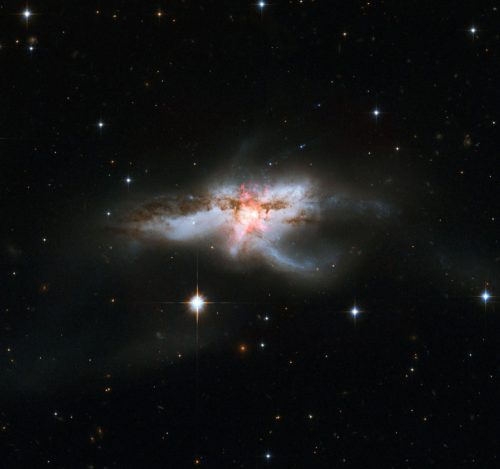
New observations find that NGC 6240 contains three supermassive black holes following the collision of three galaxies. W. Kollatschny et al. Via Carnival of Space.
New Shepard had a wholly successful mission on December 11, 2019.
This mission was another step towards verifying New Shepard for human spaceflight as we continue to mature the safety and reliability of the vehicle.
This was the 6th flight for this particular New Shepard vehicle. Blue Origin has so far reused two boosters five times each consecutively, so today marks a record with this booster completing its 6th flight to space and back.
This particular rocket has been an operational payload vehicle for several flights, meaning there are no more updates to the system.
Here are some videos Blue posted this afternoon:
]
** Blue Origin flew a New Shepard rocket vehicle today on its 6th mission to over 100 kilometers. The launch was postponed from Tuesday due to bad weather. Here is the webcast video (the liftoff is around the 40:15 point):
An earlier statement from Blue announcing the mission:
Blue Origin’s next New Shepard mission (NS-12) is currently targeting liftoff tomorrow, December 10th at 8:30 am CST / 14:30 UCT. Current weather conditions aren’t as favorable as we’d like, but we’re continuing to keep an eye on the forecast.
As we move towards verifying New Shepard for human spaceflight we are continuing to mature the safety and reliability of the vehicle.
It’s the 6th flight for this particular New Shepard vehicle, marking the first time a Blue Origin booster has made this many consecutive flights (the previous booster flew five times consecutively) – all with minimal refurbishment between flights. This particular rocket has been an operational payload vehicle for several flights, meaning there are no more updates to the system.
This will also be the 9th commercial payload mission for New Shepard, and we are proud to be flying our 100th customer on board.
Also on the vehicle are thousands of postcards from students around the world for our nonprofit Club for the Future. The Club’s mission is to inspire future generations to pursue careers in STEM and help visualize the future of life in space.
You can watch the launch live at BlueOrigin.com – the pre-show begins T-30 where Blue will provide more mission details and updates.
To follow the action, we’ll be posting live updates on Instagram and Twitter.
New Shepard Mission NS-12 Notable Payloads Manifested:
OK Go
Earlier this year we partnered with rock band OK Go on a contest called Art in Space, giving high school and middle school students a chance to send art experiments into space on our New Shepard vehicle. We are sending the two winning art projects on NS-12.
Columbia University
One of our educational payloads from Columbia University, designed and built by undergraduate students and advised by Dr. Michael Massimino (an astronaut), will study the acute impacts of microgravity environments on cell biology. This is crucial for humans living and working in space.
OSCAR
OSCAR, which was led by principal investigator Dr. Annie Meier, is a recycling technology payload from NASA’s Kennedy Space Center. It is designed to create a mixture of gasses that could be used for propulsion or life support from common waste on a deep space human exploration mission. This is Blue’s first full-stack payload, meaning there will be more room to do complex studies in flight.
** Several orbital launches took place in the past week.
*** Dec.11: India launched a PSLV (Polar Satellite Launch Vehicle) today with a radar imaging spy satellite on board. Liftoff happens at about 23:55 into this ISRO webcast video:
*** Dec. 7: China launched two Kuaizhou-1A rockets within a few hours, putting a total of seven satellites into orbit. This included the Jilin-1 Gaofen-2B remote sensing satellite for the Jilin constellation on the first launch and six smallsats on the second rocket:
*** Dec. 6: Rocket Lab launched an Electron rocket for the 10th time. Seven satellites were placed into orbit. In addition, the first stage booster remained intact after plummeting back through the atmosphere in a guided flight all the way to splashdown. This is a positive indication for plans to recover the boosters and reuse them. This Electron was also the first to fly with a fully Autonomous Flight Termination System (AFTS).
The USLaunchReport.com team posted this montage of scenes from before and during the Falcon 9 launch, plus they show the booster at Cape Canaveral and the retracting of the legs.
Road to the Space Elevator Era: This International Academy of Astronautics study report (4 years by 30 global space experts) was “released” during the IAC [2019] at the Robert Heinlein Prize Trust Booth (publisher). The report has significant inputs from ISEC and our members. Several of the ISEC concepts from our Chief Architect were accepted into the book and stood tall. These would include several of Fitzer’s Architectural Notes and his concept of a Galactic Harbour being a combination of a transportation infrastructure and an enterprise zone. This internationally endorsed study report again portrays an aggressive approach towards implementation of SEs. ISEC was instrumental in the content of the book and the editing of the content – as such, this year’s distribution of the document at the IAC was a “win-win.”
**** As usual, lots of activities underway across the wide range of SpaceX projects. Here are four upcoming Falcon 9 launches:
Dec. 16: Launch from Cape Canaveral of the Boeing built JCSAT 18/Kacific 1 comm-sat for SKY Perfect JSAT Corp. of Japan and Kacific Broadband Satellites of Singapore.
Late Dec: Starlink-2 launch of a batch of 60 operational Starlink satellites.
Jan.4: A “no-earlier-than’ (NET) date for the in-flight abort test in which a Crew Dragon spacecraft will separate from the Falcon 9 about a minute after to liftoff. This will simulate the
Early Jan: Starlink-3 launch of the third batch of 60 Starlink satellites
**** The Falcon upper stage successfully fired after coasting for a several hours following the release of the Cargo Dragon in last week’s mission discussed above. Such a capability is required for some types of satellite missions, especially for the military.
**** SpaceX plans to provide low cost launch services for smallsats on a fixed schedule. This will mean tough competition for small rocket launch providers. The use of Momentus space tugs will also allow smallsats released from the Falcon to reach a wide array of orbits. SpaceX’s First Rideshare Customer Means Competition for Northrop – Motley Fool
The article exaggerates the threat, though, to Northrop’s Mission Extension Vehicles (MEVs). These are intended to keep large comm-sats in geostationary orbit in operation after they have run out of station-keeping fuel. The SpaceX and Momentus services are focused on low earth orbit missions for smallsats.
12.08.2019 Go Discovery entered the Brazos Santiago at 7:18 AM local time. Spectacular view of SpaceX bulk head and stands being delivered to Boca Chica complex. Dolphins at the bow at 2:00 min mark. All images are explicitly owned by LabPadre Media
Disassembly of Starship Mk1 is in the final stages ahead of the stacking of Mk3. Sunrise. Normal speed disasembly, then additional clips in timelapse. Footage and photos from Mary (@bocachicagal) for NSF.
**** New SpaceX Launch Control Center at Boca Chica, Texas – LabPadre – Dec.3.2019
It appears that SpaceX is breaking ground for their new launch control center here at Boca Chica, Texas. Fast paced progress ahead for the push of MK-3. Video Credit: Maria Pointer
** Florida Starship facility – Aerial view via John Winkopp – Dec.6.2019:
Aerial view, still not much changed, more equipment on the way out. One large piece of wing root has been placed in the blue container for shipping. All of the sheets of steel that was in the On Deck Area has been shipped out.


 .