Student and amateur CubeSat news roundup – Mar.18.2020

A sampling of recent articles, press releases, etc. related to student and amateur CubeSat / SmallSat projects and programs (find previous smallsat roundups here):

** The student-led GU Orbit program at the University of Glasgow aims to

bring students into the world of space systems. It will primarily focus on developing micro-satellites with a specific mission in mind and getting them launched into orbit. Students from various disciplines are welcome to become members as we hope to create an interdisciplinary environment and ultimately provide members with an industrial-like setting so that they can get a feel of what it is like to work in the space technology sector.

The program recently arranged for getting their first satellite, Astraeus-01, to orbit via the Responsive Access launch broker: University of Glasgow GU Orbit Team Signs Smallsat Mission Agreement with Responsive Access – Satnews

Responsive Access Ltd. aims to simplify access to space through the use of innovative software and key partner relationships that provide a one-stop-shop for the launch of CubeSats and other small payloads into orbit.

While the search for a suitable rocket gets underway, GU Orbit are focusing on the technical development of their satellite, which is set to become the first ever to be fully built by a Scottish university. The University of Glasgow’s satellite could be set for launch by as early as next year, creating the possibility for it to be one of the first payloads to reach space from a developing UK spaceport.

GU Orbit’s President, Philip Voudouris, explained that thanks to the tremendous effort from the team members, significant progress on the cubesat, Astraeus-01, has been made, finally bringing ideas and ambitions to life as prototypes are manufactured and tested. The University of Glasgow has a strong reputation regarding its involvement in space technology and having opened its first space lab just last year, it has shown that it is prepared to push the boundaries of human presence in space. With Responsive Access helping to plan the mission ahead and selecting a suitable launch vehicle for Astraeus-01, the company is now one large step closer to seeing this satellite reach orbit and subsequently opening an exciting new frontier for students and researchers with a passion in space.

Astraeus-01 is intended “to demonstrate two innovative technologies: a deployable drag sail and a graphics processing unit (GPU)” (ref).  More at GU Orbit on Facebook.

** Environmental monitoring MeznSat cubesat, built by UAE based university teams, will launch on a Soyuz rocket this summer:

MeznSat is a nanosatellite for climate observation, manufactured by Khalifa University of Science and Technology (KUST) in partnership with the American University of Ras Al-Khaimah (AURAK) and funded by the UAE Space Agency. The satellite’s primary payload will be a shortwave infrared (SWIR) spectrometer that makes observations in the 1000-1650 nm wavelength range to derive atmospheric greenhouse gas concentrations.

The secondary payload on MeznSat will consist of a VGA camera for post-processing that brings increased precision and accuracy to the SWIR spectrometer data. The combination of visible and SWIR bands will make MeznSat a unique CubeSat mission, specifically designed to generate a rich dataset for exploring atmospheric correction algorithms.

** Univ. of Iowa Halosat is demonstrating effective astrophysics observations on a cubesat platform: HaloSat Offers Galactic X-Ray Measurements on Shoestring Budget – SPIE

The entire scientific instrument weighs in at less than 3 kg and consumes about 4 W. The control system brings the package up to 12 kg, while the entire satellite is about the size of a thick book.

HaloSat was launched in 2018, and its mission has been extended until mid-2020. So far, it has mapped x-ray emissions from the Milky Way and the Crab Nebula. The simple mapping spectrometer has delivered remarkably clean data, which will enable a few years of analysis and insights.

Live fast, die young

HaloSat will deorbit before the end of 2020 due to drag, so the mission cannot be extended much longer. Such temporal limitation is part of the life of a CubeSat-they are the mayfly of spacecraft. The question is not if the satellite will live longer, but if useful scientific results can be gained from such a short mission. The researchers have proven the affirmative: low-cost, short-lived satellite missions can deliver useful results.
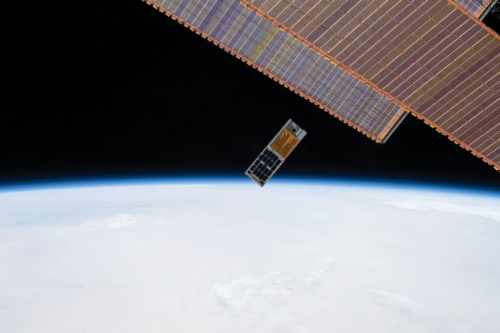
Deployment of HaloSat and RainCube cubesats from the ISS on July 13, 2018. Credits: NASA & Nature Magazine

Here is a technical paper published about the project: Design and construction of the x-ray instrumentation onboard the HaloSat CubeSat, D.M. LaRocca et al, J. or Astronoical Telescopes, Instruments, and Systems – SPIE

HaloSat is the first mission funded by NASA’s Astrophysics Division to use the CubeSat platform. Using three co-aligned silicon drift detectors, the HaloSat observatory measures soft (0.4 to 7 keV) x-ray emission from sources of diffuse emission such as the hot, gaseous halo of the Milky Way. We describe the design and construction of the science payload on HaloSat and the reasoning behind many of the choices. As a direct result of the design choices and adherence to best practices during construction, the HaloSat science payload continues to perform well after more than one year on-orbit.

This NASA video mentions HaloSat:

** AMSAT news on student and amateur CubeSat/smallsat projects: ANS-075 AMSAT News Service Special Bulletin

  • 38th Annual AMSAT Space Symposium and Annual General Meeting Announced
  • Update from the AMSAT President
  • ARISS Video of SpaceX CRS-20 Launch Carrying IORS
  • Minor Update to FoxTelem Released
  • Use the NO-84 PSK31 Transponder Now!
  • ARISS News
  • Hamfests, Conventions, Maker Faires, and Other Events
  • Upcoming Satellite Operations
  • Satellite Shorts from All Over

General CubeSat/SmallSat info:

== Amazon Ad ==

Introduction to CubeSat Technology and Subsystem:
Orbit Design, Debris Impact, and Orbital Decay Prediction

Space policy roundup – March.17.2020

A sampling of links to recent space policy, politics, and government (US and international) related space news and resource items that I found of interest (find previous space policy roundups here):

Webcasts:

** NASA Mobile Launchers – NASA Inspector General

The Office of Inspector General examined NASA’s efforts to meet cost, schedule, and performance goals in developing two mobile launchers that will serve as the ground structure to assemble, transport, and launch the SLS/Orion rocket and capsule.

** Space Thoughts Episode 4: MEV 1 – Michael Listner of Space Law & Policy Solutions.

** Space Thoughts Episode 6 Kosmos 2452, Norms and Hostile Intent – Michael Listner of Space Law & Policy Solutions.

** March 13, 2020 Zimmerman/Batchelor podcast | Behind The Black

** 28 – Don’t Sneeze in Their Mouths! | Off-Nominal

Jake and Anthony are joined by fellow space podcaster Brendan Bryne for a self-quarantine edition of the show. Jake developed a new bit for this grab bag episode with talk of Schrödinger’s Gateway, SpaceX’s DM-2, and a whole bunch more, including (obviously) COVID-19 and its impact on space. Also how Brendan’s cat almost ruined OSIRIS-REx.

==

=== Amazon Ad ===

Rise of the Space Age Millennials:
The Space Aspirations of a Rising Generation

Chesley Bonestell documentary now on the International Space Station

The award-winning documentary Chesley Bonestell: A Brush with the Future was recently transmitted to the ISS for viewing by the space station’s crew: “Chesley Bonestell: A Brush with the Future”, is now onboard the International Space Station, available for viewing by the crew. – Space Hipsters/Facebook.

See the earlier posting here about the film and check out the trailer:

Chesley Bonestell was an architect and painter who worked on the Golden Gate Bridge and the Chrysler Building. He worked on famous movies like Citizen Kane as a matte artist, and his mesmerizing paintings of planets and star systems helped inspire America’s space program. Why is it that no one knows who he is today?

Producer Douglass Stewart, was  interviewed last year on The Space Show about Bonestell and the film:

During this one segment 72 minute program, not only did our guest take us through the life and art of Chesley Bonestell, but the same for documentary film making, distribution and film festival issues plus lots more.

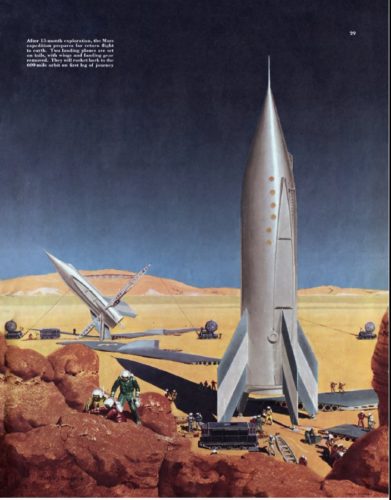
Bonestell’s visions are still coming to life. Here is an illustration he created for an article by Werner von Braun and Cornelius Ryan in Colliers Magazine, April 30, 1954:

Illustration of a Mars expedition landing site by Chesley Bonestell for Colliers Magazine, April 30, 1954. Via Sept/Oct. 2013 issue of Horizons, the newsletter for the Houston chapter of the AIAA

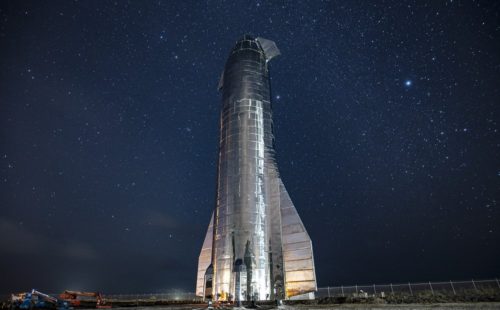
And here is a full-scale 1st-gen prototype of the Starship, a fully reusable space transport currently in development by SpaceX:

The Starship Mk-1 prototype on display at the SpaceX Boca Chica, Texas facility in 2019. Credits: SpaceX

And a SpaceX illustrator’s vision of Starships at a Mars settlement:

Starships at a Mars settlement. Credits: SpaceX

=== Amazon Ad ===

A Chesley Bonestell Space Art Chronology

The Space Show this week – March.16.2020

The guests and topics of discussion on The Space Show this week:

1. Monday, March 16, 2020; 7 pm PDT (9 pm CDT, 10 pm EDT): No special programming these two days this week.

2. Tuesday, March 17, 2020; 7 pm PDT (9 pm CDT, 10 pm EDT): We welcome back Jose Ocasio-Christian and Micah Walter-Range of Caelus for updates and COVID 19 and the space industry.

3. Wednesday, March 18, Hotel Mars TBA pre-recorded. See upcoming show menu on the home page for program details.

4. Thursday, March 19, 2020; 7-8:30 pm PDT (9-10:30 pm CDT, 10-11:30 pm EDT): No special show today.

5. Friday, March 20, 2020; 9:30-11 am PDT (11:30 am -1 PM CDT, 12:30-2 pm EDT): We welcome Dan Oltrogge, Director of the Center for Space Standards and Innovation.

6. Sunday, March 22, 2020; 12-1:30 pm PDT (3-4:30 pm EDT, 2-3:30 pm CDT): Welcome to OPEN LINES. We want to hear from you so call and let us know what is on your mind. Call and talk to another listener too.

Some recent shows:

** Sun, 03/15/2020 – Barry DiGregorio discussed “his book [Discovery on Vera Rubin Ridge: Trace Fossils on Mars?– Amazon commission link] and the possibility of trace fossils on Mars”.
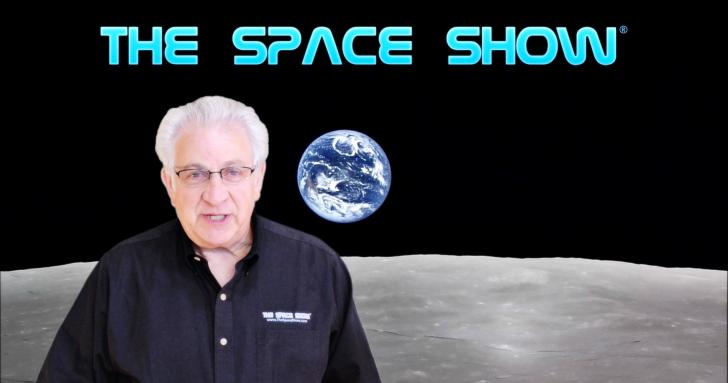
** Wed, 03/11/2020 – Professor Madhu Thangavelu of USC talked “about his past and now current space design class focusing on returning to the Moon”.

** Hotel Mars/TheSpace Show – Wed, 03/11/2020 – John Batchelor and Dr. David Livingston “discussed the impact of Covid-19 on upcoming space conferences and potential economic concerns for NewSpace”.

** See also:
* The Space Show Archives
* The Space Show Newsletter
* The Space Show Shop

The Space Show is a project of the One Giant Leap Foundation.

The Space Show - David Livingston
The Space Show – David Livingston

=== Amazon Ad ===

Imagined Life: A Speculative Scientific Journey among the Exoplanets
in Search of Intelligent Aliens, Ice Creatures, and Supergravity Animals

Videos: “Space to Ground” ISS report – Mar.14.2020

Here is the latest episode in NASA’s Space to Ground weekly report on activities related to the International Space Station:

** Down to Earth – Tip Of The Iceberg

In this episode of “Down to Earth – Tip of the Iceberg,“ NASA astronaut Nick Hague shares how his time living and working in space changed his perception of life back on Earth. #SpaceStation20th

** Expedition 62 Inflight with Martin Van Buren High School – March 13, 2020

Aboard the International Space Station, Expedition 62 Flight Engineer Jessica Meir of NASA discussed life and research on the orbital outpost during an in-flight educational event March 13 with students at the Martin Van Buren High School in Queens Village, New York. Meir is in the final month of a six-and-a-half-month mission on the station, planning for a return to Earth in mid-April. During her mission, the crew in space has supported hundreds of research investigations, and she conducted three spacewalks with astronaut Christina Koch, including the first all-woman spacewalk Oct. 18, 2019.

** Expedition 63 Video File – Soyuz Qualification Training – March 13, 2020

Expedition 63 Space Station Crew Undergoes Final Training Outside Moscow Expedition 63 Soyuz Commander Anatoly Ivanishin of Roscosmos, Flight Engineers Ivan Vagner of Roscosmos and Chris Cassidy of NASA and their backups, Sergei Ryzhikov and Andrei Babkin of Roscosmos and Steve Bowen of NASA, conducted final qualification training for their upcoming International Space Station mission at the Gagarin Cosmonaut Training Center in Star City, Russia March 11 and 12. Ivanishin, Vagner and Cassidy are scheduled to launch on April 9 from the Baikonur Cosmodrome in Kazakhstan in the Soyuz MS-16 spacecraft for a six-month mission on the International Space Station.

** NASA Live: Earth Views from the Space Station – The ESA HDEV (High Definition Earth Viewing) camera originally used for the ISS live view streaming stopped working in July 2019.

Currently, live views from the ISS are streaming from an external camera mounted on the ISS module called Node 2. Node 2 is located on the forward part of the ISS. The camera is looking forward at an angle so that the International Docking Adapter 2 (IDA2) is visible. If the Node 2 camera is not available due to operational considerations for a longer period of time, a continuous loop of recorded HDEV imagery will be displayed. The loop will have “Previously Recorded” on the image to distinguish it from the live stream from the Node 2 camera.

=== Amazon Ad ===

Outpost in Orbit:
A Pictorial & Verbal History of the Space Station

=== Amazon Ad ===

Alcohol in Space:
Past, Present and Future

Everyone can participate in space