This week’s Space to Ground report on recent developments with the Int. Space Station:
Here is a video about a high school student competition to develop tasty foods for the ISS crew:
NASA Commentator Lori Meggs at the Marshall Space Flight Center speaks with a team from Huntsville, Alabama that competed in NASA’S Culinary Challenge. The competition invited high school students from all across the country to develop a recipe for flight: a meal that astronauts would enjoy in space, but which also met the many dietary restrictions for crew members on orbit.
A couple of major milestones in NewSpace last week.
On Friday, SpaceX launched the THAICOM-8 communications satellite with a Falcon 9 rocket. After separating from the second stage, the first stage booster of the Falcon returned to earth for a successful landing on the platform of a special ship that maintains a fixed position autonomously. This is the third successful booster landing at sea. (There was also a successful booster return for a landing on the ground at Cape Canaveral last December.)
Here is a sped-up video from a camera attached to the first stage:
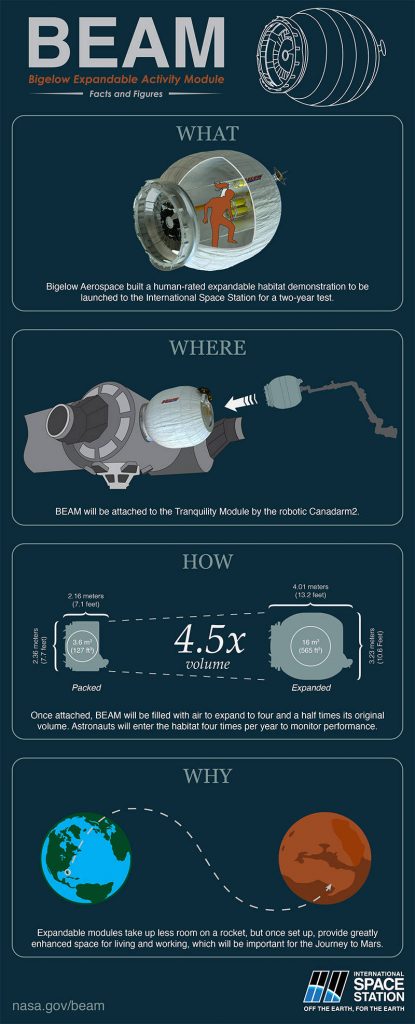
On April 8th, a SpaceX Dragon spaceship delivered a load of cargo to the Int. Space Station. An important item in that cargo was an experimental habitat module in the unpressurized “trunk” section of the Dragon. This module is called the Bigelow Expandable Activity Module or BEAM. It was built by Bigelow Aerospace, which is developing expandable structures that can be launched in compressed mode and then expanded to a size much bigger than could be launched directly.
On April 16th, astronauts aboard the ISS used a robotic arm to extract the BEAM from the Dragon and attached it to a ISS module. Here is a time lapse video showing the extraction and berthing:
Here is a video showing how you can create an origami version of BEAM:
Download the printable BEAM module paper and crew procedures with full instructions: http://www.nasa.gov/mission_pages/sta… to view or download the ‘crew procedures,’ which contain step by step instructions on how to print and fold your BEAM module. This video will walk you through folding a paper module in real-time.
A group of astronomers last year proposed a 11.7 meter diameter multi-mirror space telescope that could image planets around other stars: From Cosmic Birth to Living Earths (See also the detailed study in the AURA report (pdf))
The High Definition Space Telescope (HDST) would be sensitive to light at UV through near-infrared wavelengths, viewing the universe from the second Earth-Sun Lagrange point (L2), one million miles from the Earth. Its segmented mirror would be folded into either a current or future heavy-lift rocket, before being launched and deployed at its final home.
In its mission to discover and study Earth-like planets orbiting Sun-like stars, HDST will directly image exoplanets — including planets that may be as much as 10 billion times fainter than their host star — by carefully suppressing the star’s light. HDST’s exquisite image quality at visible wavelengths (with more than 25 times the resolving power of the Hubble Space Telescope) and high sensitivity all the way into the ultraviolet part of the spectrum (100 times more sensitive than Hubble), combined with a versatile set of imaging and spectroscopic instruments, will trigger profound breakthroughs in astrophysics.
Like Hubble and JWST, HDST would operate as a general observatory, supporting a broad range of investigations beyond its core exoplanet mission.
The HDST mirror array in comparison to the Hubble space telescope mirror and the James Webb Space Telescope
HDST‘s primary goal is to find and characterize dozens of Earth-like exoplanets. A sample of dozens of exoEarths opens up the opportunity to identify truly Earth-like worlds with rocky surfaces and oceans, amidst a complex zoo of other varieties of terrestrial planets.
With this large sample, observing telltale signs of life in the planets’ atmospheres becomes possible. If life is rare, HDST will take us from our current complete ignorance of the occurrence rate of inhabited worlds to a first constraint, potentially showing how remarkable our own existence is.
If life is common, a large sample of terrestrial worlds with highly unusual atmospheric chemistry will secure our belief that life of some kind exists beyond the Earth, regardless of possible false positives. Whatever the outcome, HDST will change how we see our place in the Universe.
A view of the telescope folded up inside the fairing of a Delta IV Heavy rocket:
A folded 11 m primary mirror, constructed with 54 1.3 m segments, is shown inside a Delta 4-H shroud.
![20151222-beam-01[3]](http://hobbyspace.com/Blog/wp-content/uploads/2016/05/20151222-beam-013.jpg)
![fig_5-1[1]](http://hobbyspace.com/Blog/wp-content/uploads/2016/05/fig_5-11.jpg)
![fig_5-2[1]](http://hobbyspace.com/Blog/wp-content/uploads/2016/05/fig_5-21.jpg)