Category Archives: Space Systems

FISO: On-Orbit Servicing + To Mars via 6 not-so-easy pieces + Solar sails

Catching up with recent presentations to the Future In-Space Operations (FISO) study group. The presentation materials are  posted in the FISO Working Group Presentations Archive for the following 3 talks.

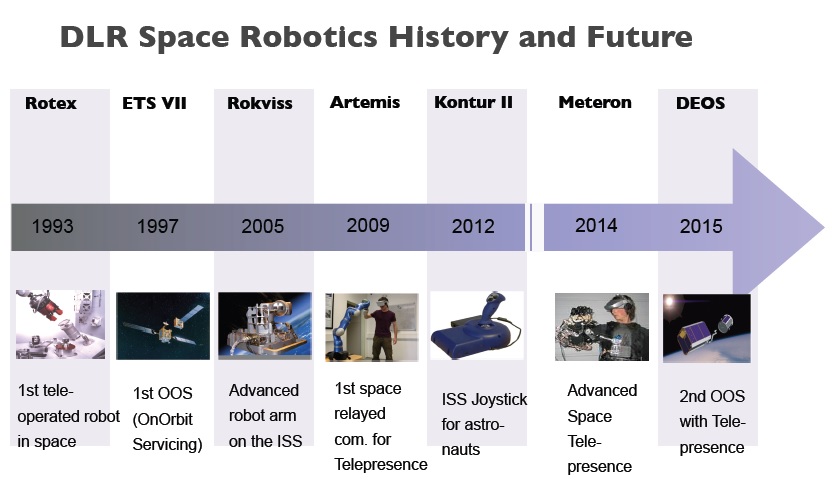
* On-Orbit Servicing: Telepresence and the DEOS Simulator, Jordi Artigas , DLR  – May.7.14

  • An overview of the German space agency (DLR)  in-space robotics projects, past and present. An intro to telepresence
  • Artigas_5-7-14.pdf – slides
  • Artigas.mp3 – audio

A timeline of DLR space robotics projects:

Timeline

====

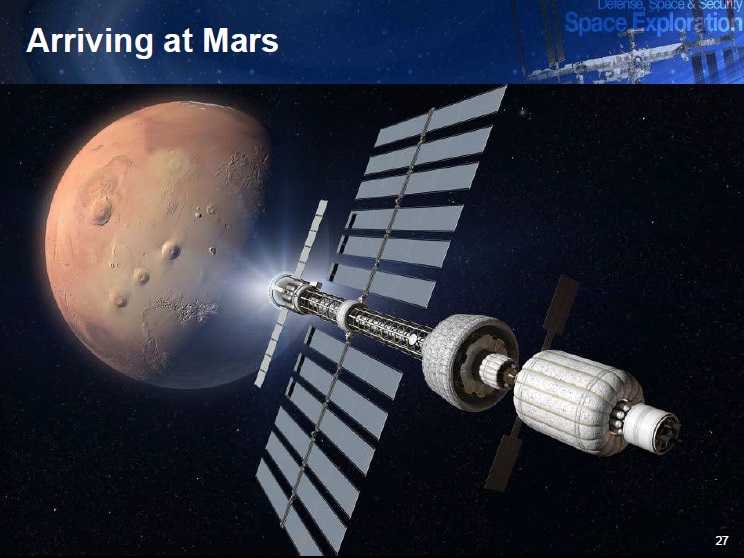
* Mission to Mars Using Six ‘Not So Easy’ Pieces, Mike Raftery, Boeing- May 14, 2014

SEPatMars

====

* Solar Sail Description and Space Weather (and Other) Mission Capabilities, Bruce Campbell , (formally ATK, GSFC) – May 21, 2014

  • An overview of the basics of solar sails, types of solar sails, a review of previous, current and future projects
  • Campbell_5-21-14.pdf – slides
  • Campbell.mp3 – audio

SizeComparisons

Sunday webinar on artificial gravity via rotation with tethers

On Sunday May 25th,  The Space Show will present a special video webinar program on the topic of using rotation to provide artificial gravity. Joe Carroll will discuss his ideas on using tethers for such rotating systems.

WEBINAR: The Sunday, May 25, 2014 program from 1-3 PM PDT, (4-6 PM EDT, 3-5 PM CDT): This is our first WEBINAR for 2014. Our guest of honor is Joe Carroll and I will be assisted on the panel with Dr. John Jurist and Dr. Jim Logan. Joe is updating us on his partial gravity work which was the topic of an earlier webinar in May 2011. You can listen to the audio only for this show as you would any Space Show program. If you want to see the live webinar, go to our private UStream Space Show channel, www.ustream.tv/channel/the-space-show. Note that this show will archive audio and video simultaneously. The video of our webinar will be on our private Space Show Vimeo channel. Watch for details.

Joe Carroll has worked since 1981 on advanced space transportation, mostly involving long tethers. He led the development of the Small Expendable Deployment System (SEDS), which demonstrated controlled deorbit without rockets in 1993 and also flew successfully on SEDS-2 in 1994, and TiPS in 1996. He also developed the deployer and wire for the Plasma Motor Generator (PMG), which demonstrated electrodynamic thrust in orbit.  He has also worked on unmanned and manned reentry vehicle concepts for NASA and several startups. His main current work is on electrodynamic tethers.

Here is a paper by Carroll : Design Concepts for a Manned Artificial Gravity Research Facility, by Joseph A Carroll, Tether Applications, Inc., USA (pdf).

[ Update: Some additional material has been made available for the show:

]

Here are articles from Robert Walker who examines Carroll’s tether concept. Walker includes several animations showing how a crew capsule and its spent upper stage could be tethered together to provide a spin gravity system at low cost:

Here, for example, is an animation of a Soyuz spacecraft that is tethered to its upper stage.

For lunar gravity level:

Joe Caroll suggests a 600 meter tether. The final stage weighs a third of the weight of the Soyuz. This puts the centre of gravity of the assembly 150 meters away from the Soyuz, and 450 meters away from the final stage. 

This lets you generate artificial lunar gravity with spin rate of 1 rpm.

At that rotation rate the Soyuz has delta v of 15.6 m/sec, the final stage travels at three times that speed, and the speed of the Soyuz relative to the final stage is four times that, 62.4 m/sec.

Video: Space to Ground report on ISS

Here is NASA’s latest Space to Ground weekly video update on what’s been happening aboard the International Space Station:

NASA green-lights citizen science group’s effort to contact & redirect ISEE-3 spacecraft

I’ve written about the ISEE-3 Reboot Project effort by a private non-profit group to reconnect with NASA’s 35 year old International Sun-Earth Explorers (ISSE) spacecraft and direct it back to its original solar science mission. The group recently carried out a successful crowd-funding campaign to pay for the initial phase of the project. NASA has now given them the green-light to communicate with and take control of the spacecraft:

NASA Signs Agreement with Citizen Scientists Attempting
to Communicate with Old Spacecraft

NASA has given a green light to a group of citizen scientists attempting to breathe new scientific life into a more than 35-year old agency spacecraft.

The agency has signed a Non-Reimbursable Space Act Agreement (NRSAA) with Skycorp, Inc., in Los Gatos, California, allowing the company to attempt to contact, and possibly command and control, NASA’s International Sun-Earth Explorer-3 (ISEE-3) spacecraft as part of the company’s ISEE-3 Reboot Project. This is the first time NASA has worked such an agreement for use of a spacecraft the agency is no longer using or ever planned to use again.

international_cometary_explorer_isee3_art[1]International Sun-Earth Explorer-3 (ISEE-3)

The NRSAA details the technical, safety, legal and proprietary issues that will be addressed before any attempts are made to communicate with or control the 1970’s-era spacecraft as it nears the Earth in August.

“The intrepid ISEE-3 spacecraft was sent away from its primary mission to study the physics of the solar wind extending its mission of discovery to study two comets.” said John Grunsfeld, astronaut and associate administrator for the Science Mission Directorate at NASA headquarters in Washington. “We have a chance to engage a new generation of citizen scientists through this creative effort to recapture the ISEE-3 spacecraft as it zips by the Earth this summer.”

Launched in 1978 to study the constant flow of solar wind streaming toward Earth, ISEE-3 successfully completed its prime mission in 1981. With remaining fuel and functioning instruments, it then was redirected to observe two comets. Following the completion of that mission, the spacecraft continued in orbit around the sun. It is now making its closest approach to Earth in more than 30 years.

The goal of the ISEE-3 Reboot Project is to put the spacecraft into an orbit at   a gravitationally stable point between Earth and the sun known as Lagrangian 1 (L1). Once safely back in orbit, the next step would be to return the spacecraft to operations and use its instruments as they were originally designed. ISEE-3’s close approach in the coming weeks provides optimal conditions to attempt communication. If communications are unsuccessful, the spacecraft will swing by the moon and continue to orbit the sun.

NASA has shared technical data with these citizen scientists to help them communicate with and return data from ISEE-3. The contributions of any citizen science provided by the spacecraft, if it is successfully recovered, depend on the current condition of its instruments. New data resulting from the project will be shared with the science community and the public, providing a unique tool for teaching students and the public about spacecraft operations and data gathering. The data also will provide valuable information about the effects of the space environment on the 36-year old spacecraft.

The ISEE-3 mission opened new pathways for scientific exploration, helping scientists better understand the sun-Earth system, which at its most turbulent can affect satellites around Earth and disrupt our technological infrastructure.

To learn more about the ISEE-3 Reboot Project, visit: http://spacecollege.org/isee3

To learn more about ISEE-3, visit: http://go.nasa.gov/1mSskQs
Space settlement – enabled by commercial drive and in-situ resources

The Guardian has an article and a gallery of illustrations on the theme of space settlement:

===

Space settlement will require living off whatever land is at hand: In-Situ Resources A Key To Deep Space Exploration – Aviation Week.