Chandra Clarke explains what citizen science is all about in this recent TEDx talk: Citizen science explained – Citizen Science Center
Chandra Clarke explains what citizen science is all about in this recent TEDx talk: Citizen science explained – Citizen Science Center
A message from Planetary Resources:
Be an Asteroid Hunter in NASA’s
First Asteroid Grand Challenge Contest Series
NASA’s Asteroid Data Hunter contest series will offer $35,000 in awards over the next six months to citizen scientists who develop improved algorithms that can be used to identify asteroids.
This contest series is being conducted in partnership with Planetary Resources Inc. of Bellevue, Wash. The first contest in the series will kick off on March 17. Prior to the kick off, competitors can create an account on the contest series website and learn more about the rules and different phases of the contest series by going to: http://bit.ly/AsteroidHunters
Managed by the NASA Tournament Lab, the entire contest series runs through August and is the first contest series contributing to the agency’s Asteroid Grand Challenge.
“For the past three years, NASA has been learning and advancing the ability to leverage distributed algorithm and coding skills through the NASA Tournament Lab to solve tough problems,” said Jason Crusan, NASA Tournament Lab director. “We are now applying our experience with algorithm contests to helping protect the planet from asteroid threats through image analysis.”
The Asteroid Data Hunter contest series challenges participants to develop significantly improved algorithms to identify asteroids in images captured by ground-based telescopes. The winning solution must increase the detection sensitivity, minimize the number of false positives, ignore imperfections in the data, and run effectively on all computer systems.
“Protecting the planet from the threat of asteroid impact means first knowing where they are,” said Jenn Gustetic, Prizes and Challenges Program executive. “By opening up the search for asteroids, we are harnessing the potential of innovators and makers and citizen scientists everywhere to help solve this global challenge.”
Gustetic and Jason Kessler, Grand Challenges Program executive, will host a panel March 10 at the South by Southwest Festival in Austin, Texas titled “Are We Smarter than the Dinosaurs?” to talk about how open innovation can meaningfully engage people in discussions on and research into space exploration and help us solve problems of global importance. They will provide an outline of the Asteroid Data Hunter contest series and other efforts to detect asteroid threats, as well as ideas for mitigating these threats.
“Current asteroid detection initiatives are only tracking one percent of the estimated objects that orbit the Sun. We are excited to partner with NASA in this contest to help increase the quantity and knowledge about asteroids that are potential threats, human destinations, or resource rich.” said Chris Lewicki, President and Chief Engineer of the asteroid mining company Planetary Resources, Inc. “Applying distributed algorithm and coding skills to the extensive NASA-funded Catalina Sky Survey data set will yield important insights into the state of the art in detecting asteroids.”
Through NASA’s asteroid initiative, the agency seeks to enhance its ongoing work in the identification and characterization of near-Earth objects for further scientific investigation. This work includes locating potentially hazardous asteroids and identifying those viable for redirection to a stable lunar orbit for future exploration by astronauts. The Asteroid Grand Challenge, one part of the asteroid initiative, expands the agency’s efforts beyond traditional boundaries and encourages partnerships and collaboration with a variety of organizations.
The algorithm contests are managed and executed by NASA’s Center of Excellence for Collaborative Innovation (CoECI). CoECI was established at the request of the White House Office of Science and Technology Policy to advance NASA open innovation efforts and extend that expertise to other federal agencies. CoECI uses the NASA Tournament Lab (NTL) for its advanced algorithmic and software development contests. Through its contract with Harvard Business School in association with Harvard’s Institute of Quantitative Social Science, NTL uses the topcoder platform to enable a community of more than 600,000 designers, developers and data scientists to create the most innovative, efficient and optimized solutions for specific, real-world challenges faced by NASA.
For more information on NASA’s Center of Excellence for Collaborative Innovation, visit: http://www.nasa.gov/coeci
For more information on Planetary Resources, Inc., visit: http://www.planetaryresources.com
For more information on NASA’s asteroid initiative, visit: http://www.nasa.gov/asteroidinitiative
Sky and Telescope magazine backs Uwingu’s Mars Crater naming project: Name a Mars Crater with Uwingu – SkyandTelescope.com.
It’s for a cause. Also unlike the name-a-star scams, Uwingu’s name-a-crater scheme isn’t purely for profit. Half the proceeds go to the Uwingu Fund, which promises to support space education and research. The other half goes to running the company, which has no paid staff and a few paid contractors, such as for website development.
So far, the Uwingu Fund has funded eight starter grants of at least $1,000 each, including grants to the Astronomers Without Borders, the International Dark Sky Association, and the Galileo Teacher Training Program. (The fund also supported SETI’s Allen Telescope Array as part of the Indiegogo campaign.)
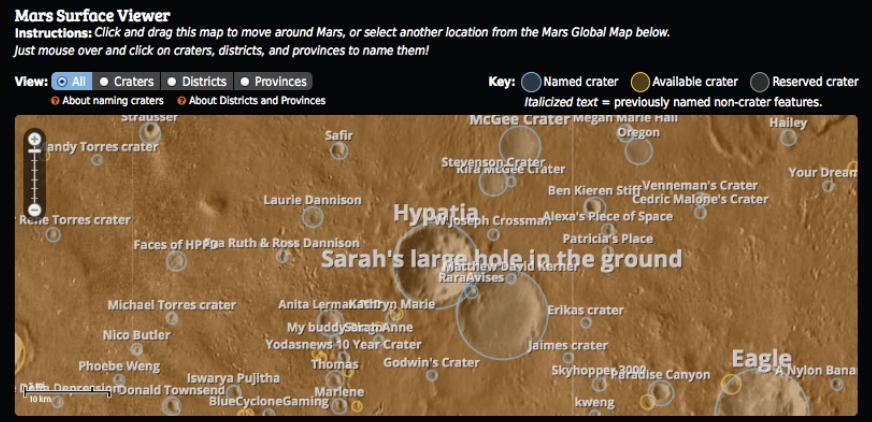
An announcement from Uwingu concerning a partnership with Mars One and the new Mars Crater Naming Project (see earlier posting):
Private Mars One Human and Lander Missions to Use Uwingu Name Maps
Private Mars One Mars Lander Mission to Carry
Uwingu Mars Crater Names Map to Mars
Today, Uwingu and the Mars One project announced a landmark partnership: All robotic and human Mars One missions will carry Uwingu’s Mars Crater Map to Mars, and use these feature names as a part of Mars One mission operations. In exchange, a portion of Uwingu Fund revenues generated by Mars feature naming at Uwingu’s web site (www.uwingu.com) will help fund Mars One missions.

Uwingu launched its Mars Crater Naming Project last week, giving anyone in the public the opportunity to name any of the approximately 500,000 scientifically identified craters on Mars. Proceeds from this project will help create up to $10M in Uwingu grants to Mars One and other space projects, to individual space researchers, and to space educators.
Says Uwingu founder and CEO Dr. Alan Stern, a planetary scientist and the former head of NASA’s science program, “This partnership catapults Uwingu’s Mars crater naming database and Mars maps into the forefront of Mars exploration. Every person who names craters on Mars will now know that their crater names are to be used in the exploration and eventual settlement of Mars.”
Bas Lansdorp, Mars One Co-Founder and CEO, said: ”We’re very enthusiastic about the partnership with Uwingu. Like Mars One, Uwingu gives everyone around the world the opportunity to participate in space exploration. The name you choose will go down in history, travelling on board our 2018 mission lander and will be used by our future astronauts. What an amazing opportunity!”
===
And here’s the Mars One version of the announcement:
Mars One partners with Uwingu Mars Crater Naming Project
Amersfoort, 3rd March 2014 – Today, the Mars One project and Uwingu are excited to announce a landmark partnership. Mars One will utilize the soon-to-be-developed Uwingu Mars Map in all its missions and will land that map on Mars on its first unmanned Mars lander.
Uwingu launched its Mars Crater Naming Project last week giving the public the opportunity to name approximately 500,000 scientifically identified craters on Mars by the end of 2014. The goal of the project is to engage the audience in Mars exploration and to generate a new funding stream for private space related projects in the field of space exploration, space research, or space education. The audience can participate in Mars exploration through Uwingu by naming Mars craters, resulting in a Mars Map. Mars One’s human mission to Mars is one of the projects already supported by Uwingu.
Bas Lansdorp, Mars One Co-Founder and CEO said: “We’re very enthusiastic about the partnership with Uwingu. Like Mars One, Uwingu gives everyone around the world the opportunity to participate in Mars exploration. The name you choose will go down in history, traveling to Mars on board our 2018 lander and will be used by our future astronauts. What an amazing opportunity!”
Everyone around the world can help name craters on Mars through Uwingu’s website (www.uwingu.com). Mars One will carry a digital copy of the resulting Mars Map on board its 2018 unmanned Mars Lander and will use the Uwingu crater names as part of Mars One mission operations.
Uwingu founder and CEO Dr. Alan Stern, a planetary scientist and the former head of NASA’s science program, said about the Mars One – Uwingu partnership, “This partnership catapults Uwingu’s Mars crater naming database and Mars maps into the forefront of private Mars exploration! Every person who names craters on Mars at www.uwingu.com will now know that their crater names are planned to be used in the exploration and hoped for settlement of Mars. At Uwingu, we are very excited about actually flying our map to Mars in 2018.”
About Mars One
Mars One is a not-for-profit foundation that will establish permanent human life on Mars. Human settlement on Mars is possible today with existing technologies. Mars One’s mission plan integrates components that are well tested and readily available from industry leaders worldwide. The first footprint on Mars and lives of the crew thereon will captivate and inspire generations. It is this public interest that will help finance this human mission to Mars.
About Uwingu
Uwingu is a small company, consisting of prominent astronomers, planetary scientists, former space program executives, and educators. Uwingu’s mission is to create new ways for people to personally connect with space exploration and astronomy. Uwingu launched a series of projects that will earn revenue to generate a new, private sector funding stream for space projects of all kinds, which they call The Uwingu Fund. The Uwingu Fund will provide grants to those that propose meritorious projects to us in space exploration, space research, or space education. More information about Uwingu can be found at: www.uwingu.com.
Stephen Murphey of DIY Rocket Science was on The Space Show last week to talk about a number of topics related to public participation in space such as building cubesats and pocketqube sats, open source hardware, crowdfunding, 3D printing, high-altitude ballooning, and more : Stephen Murphy, Friday, 2-28-14 – Thespaceshow’s Blog
===
The Institute of Astronomy and Astrophysics at Academia Sinica (ASIAA) of Taiwan and Zooniverse are holding a workshop this week in Taipai: Workshop on Citizen Science in Astronomy – Zooniverse.
The goal for the event is to
bring together for a week computer scientists, machine learning experts, and the scientists from astronomy and planetary science based citizen science projects with the goal of taking the first steps towards addressing the critical questions and issues that citizen science will need to solve in order to cope with the petabtye data deluge from the the next generation observatories and space missions like the Square Kilometer Array (SKA) and the Large Synoptic Survey Telescope (LSST).