Category Archives: Astronomy

ESO: New galactic survey measuring dark matter distribution

Here’s the latest ESO (European Southern Observatory) report:

Huge New Survey to Shine Light on Dark Matter

The first results have been released from a major new dark matter survey of the southern skies using ESO’s VLT Survey Telescope (VST) at the Paranal Observatory in Chile. The VST KiDS survey will allow astronomers to make precise measurements of dark matter, the structure of galaxy halos, and the evolution of galaxies and clusters. The first KiDS results show how the characteristics of the observed galaxies are determined by the invisible vast clumps of dark matter surrounding them.
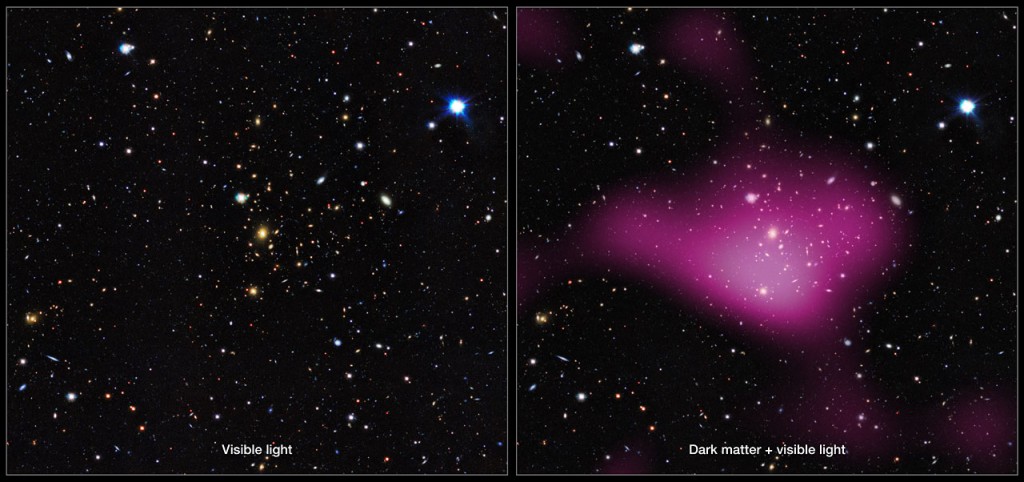
The first results have been released from a major new dark matter survey of the southern skies using ESO’s VLT Survey Telescope (VST) at the Paranal Observatory in Chile. The project, known as the Kilo-Degree Survey (KiDS), uses imaging from the VST and its huge camera, OmegaCAM to analyse images of over two million galaxies. The KiDS team studied the distortion of light emitted from these galaxies, which bends as it passes massive clumps of dark matter during its journey to Earth. From the gravitational lensing effect, these groups turn out to contain around 30 times more dark than visible matter. Left, a group of galaxies mapped by KiDS. Right, the same area of sky, but with the invisible dark matter rendered in pink. Credit: Kilo-Degree Survey Collaboration/A. Tudorica & C. Heymans/ESO

Around 85% of the matter in the Universe is dark [1], and of a type not understood by physicists. Although it doesn’t shine or absorb light, astronomers can detect this dark matter through its effect on stars and galaxies, specifically from its gravitational pull. A major project using ESO’s powerful survey telescopes is now showing more clearly than ever before the relationships between this mysterious dark matter and the shining galaxies that we can observe directly [2].

The project, known as the Kilo-Degree Survey (KiDS), uses imaging from the VLT Survey Telescope and its huge camera, OmegaCAM. Sited at ESO’s Paranal Observatory in Chile, this telescope is dedicated to surveying the night sky in visible light — and it is complemented by the infrared survey telescope VISTA. One of the major goals of the VST is to map out dark matter and to use these maps to understand the mysterious dark energy that is causing our Universe’s expansion to accelerate.

The best way to work out where the dark matter lies is through gravitational lensing — the distortion of the Universe’s fabric by gravity, which deflects the light coming from distant galaxies far beyond the dark matter. By studying this effect it is possible to map out the places where gravity is strongest, and hence where the matter, including dark matter, resides.

As part of the first cache of papers, the international KiDS team of researchers, led by Koen Kuijken at the Leiden Observatory in the Netherlands [3], has used this approach to analyse images of over two million galaxies, typically 5.5 billion light-years away [4]. They studied the distortion of light emitted from these galaxies, which bends as it passes massive clumps of dark matter during its journey to Earth.

The first results come from only 7% of the final survey area and concentrate on mapping the distribution of dark matter in groups of galaxies. Most galaxies live in groups — including our own Milky Way, which is part of the Local Group — and understanding how much dark matter they contain is a key test of the whole theory of how galaxies form in the cosmic web. From the gravitational lensing effect, these groups turn out to contain around 30 times more dark than visible matter.

“Interestingly, the brightest galaxy nearly always sits in the middle of the dark matter clump,” says Massimo Viola (Leiden Observatory, the Netherlands) lead author of one of the first KiDS papers.

“This prediction of galaxy formation theory, in which galaxies continue to be sucked into groups and pile up in the centre, has never been demonstrated so clearly before by observations,” adds Koen Kuijken.

The findings are just the start of a major programme to exploit the immense datasets coming from the survey telescopes and the data are now being made available to scientists worldwide through the ESO archive.

The KiDS survey will help to further expand our understanding of dark matter. Being able to explain dark matter and its effects would represent a major breakthrough in physics.
 

ESO: Huge gamma-ray bursts linked to super magnetized neutron stars

A new report from ESO (European Southern Observatory):

Biggest Explosions in the Universe Powered by Strongest Magnets
Some long-duration gamma-ray bursts are driven by magnetars

Observations from ESO’s La Silla and Paranal Observatories in Chile have for the first time demonstrated a link between a very long-lasting burst of gamma rays and an unusually bright supernova explosion. The results show that the supernova was not driven by radioactive decay, as expected, but was instead powered by the decaying super-strong magnetic fields around an exotic object called a magnetar. The results will appear in the journal Nature on 9 July 2015.

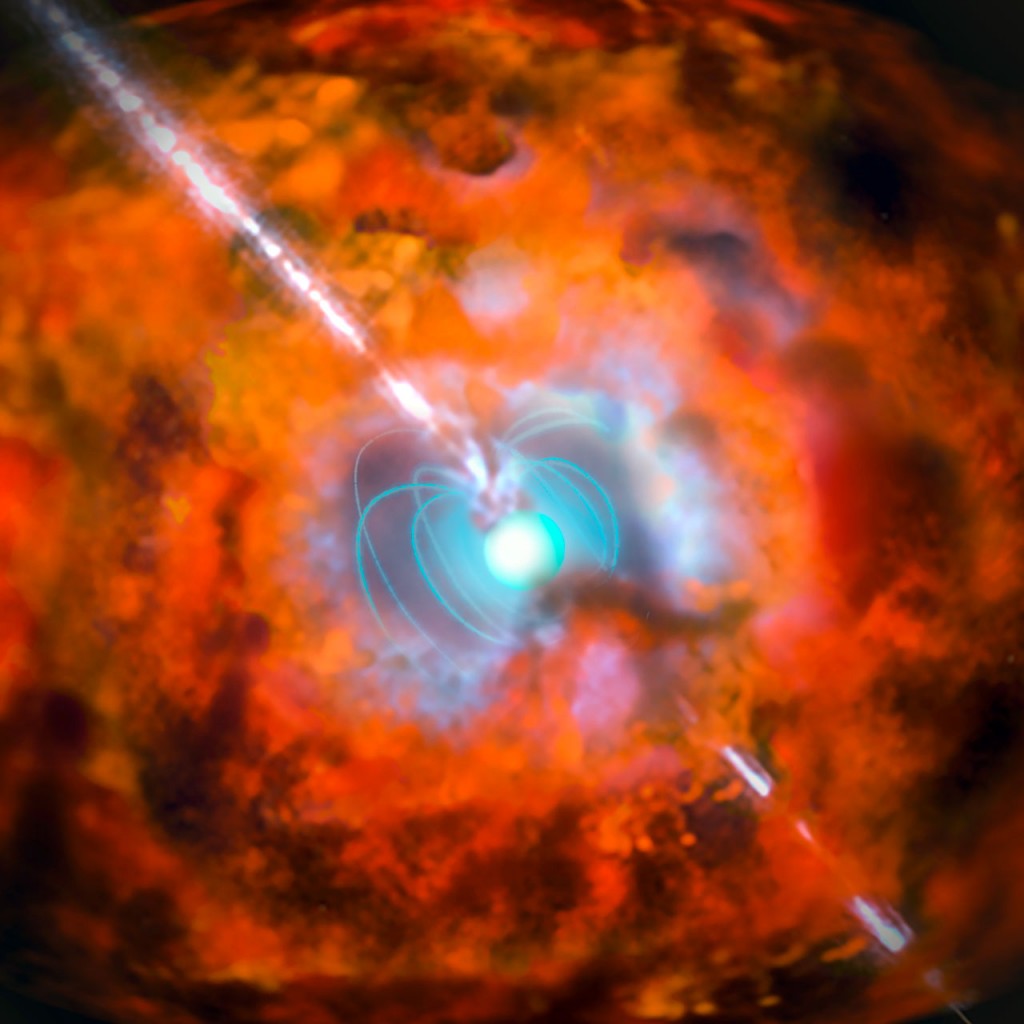
This artist’s impression shows a supernova and associated gamma-ray burst driven by a rapidly spinning neutron star with a very strong magnetic field — an exotic object known as a magnetar. Observations from ESO’s La Silla and Paranal Observatories in Chile have for the first time demonstrated a link between a very long-lasting burst of gamma rays and an unusually bright supernova explosion. The results show that the supernova following the burst GRB 111209A was not driven by radioactive decay, as expected, but was instead powered by the decaying super-strong magnetic fields around a magnetar.

Gamma-ray bursts (GRBs) are one of the outcomes associated with the biggest explosions to have taken place since the Big Bang. They are detected by orbiting telescopes that are sensitive to this type of high-energy radiation, which cannot penetrate the Earth’s atmosphere, and then observed at longer wavelengths by other telescopes both in space and on the ground.

GRBs usually only last a few seconds, but in very rare cases the gamma rays continue for hours [1]. One such ultra-long duration GRB was picked up by the Swift satellite on 9 December 2011 and named GRB 111209A. It was both one of the longest and brightest GRBs ever observed.

As the afterglow from this burst faded it was studied using both the GROND instrument on the MPG/ESO 2.2-metre telescope at La Silla and also with the X-shooter instrument on the Very Large Telescope (VLT) at Paranal. The clear signature of a supernova, later named SN 2011kl, was found. This is the first time that a supernova has been found to be associated with an ultra-long GRB [2].

The lead author of the new paper, Jochen Greiner from the Max-Planck-Institut für extraterrestrische Physik, Garching, Germany explains:

“Since a long-duration gamma-ray burst is produced only once every 10 000–100 000 supernovae, the star that exploded must be somehow special. Astronomers had assumed that these GRBs came from very massive stars — about 50 times the mass of the Sun — and that they signalled the formation of a black hole. But now our new observations of the supernova SN 2011kl, found after the GRB 111209A, are changing this paradigm for ultra-long duration GRBs.”

In the favoured scenario of a massive star collapse (sometimes known as a collapsar) the week-long burst of optical/infrared emission from the supernova is expected to come from the decay of radioactive nickel-56 formed in the explosion [3]. But in the case of GRB 111209A the combined GROND and VLT observations showed unambiguously for the first time that this could not be the case [4]. Other suggestions were also ruled out [5].

The only explanation that fitted the observations of the supernova following GRB 111209A was that it was being powered by a magnetar — a tiny neutron star spinning hundreds of times per second and possessing a magnetic field much stronger than normal neutron stars, which are also known as radio pulsars [6]. Magnetars are thought to be the most strongly magnetised objects in the known Universe. This is the first time that such an unambiguous connection between a supernova and a magnetar has been possible.

Paolo Mazzali, co-author of the study, reflects on the significance of the new findings:

“The new results provide good evidence for an unexpected relation between GRBs, very bright supernovae and magnetars. Some of these connections were already suspected on theoretical grounds for some years, but linking everything together is an exciting new development.”

“The case of SN 2011kl/GRB 111209A forces us to consider an alternative to the collapsar scenario. This finding brings us much closer to a new and clearer picture of the workings of GRBs,” concludes Jochen Greiner.

Public Telescope: Private sector initiative aims to make a space observatory available for all

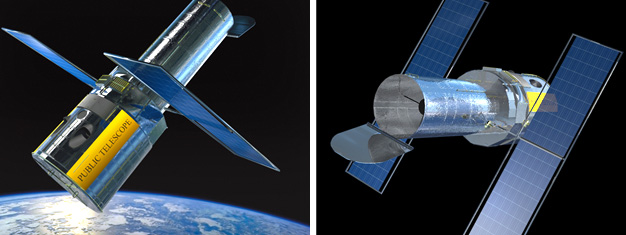
The Public Telescope is a German private initiative to develop, launch, and operate a space-based observatory that would be dedicated for the use of the general public, students, as well as professional astronomers. They are seeking private backing as well as public funding. (I cannot find a total estimated cost of the observatory.)  User fees would finance the operation of the telescope. The article – astrofactum: The first Public Space Telescope – SpaceOps Journal – July.2014 – describes the overall plan.

They recently obtained an EU grant:

astrofactum receives EU funding for
space telescope project Public Telescope

astrofactum GmbH, Institute for Astronomy and Space Technology receives support from the European Union for the development of their project Public Telescope.The Public Telescope project is a private sector initiative to develop and build a commercial space telescope, which can be used by anyone.

Public-Space-Telescope[1]

The support of the project by the European Union is carried out within the EU funding program Horizon 2020 (SME Instrument 1st funding level), which has set itself the objective of strengthening the competitiveness of innovative European companies in global competition. The European Commission refers to the winners of the funding program as the most innovative European companies with the most innovative ideas.

The first stage of European funding amounting to 50,000 euros will be used to substantiate the commercial use model for the space telescope as part of its feasibility study. Subsequently further funding from the same EU program will be applied for to develop the necessary infrastructure for the satellite and the marketing.

“The support of the project by the European Commission is an important signal to potential new investors. We are delighted with the esteem and the confidence that the European Commission puts into the Public Telescope project. “says Heiko Wilkens, project initiator of Public Telescope.

Project Public Telescope

astrofactum offers with the Public Telescope project for the first time ever access to astronomical observations with a space telescope (80 cm) for the target groups science, amateur astronomy, education as well as to astronomy interested persons. The monitoring capacity can be used via an online platform. Monitoring projects of scientists will be individually supervised by the astrofactum science team.

Public-Space-Telescope-2[1]

For science the Space Telescope will close the gap in the ultraviolet range (UV) between the Hubble telescope (operational end in 2020 at the very latest) and future UV missions. The start of the operational service is planned from 2025. Access to the UV spectral region (observation only outside the atmosphere possible) is for astrophysical research in virtually all areas of fundamental importance.

Public Telescope represents a further advantage for international scientific enterprises whose countries are not involved in astronomical space missions and thus are limited in using existing space capabilities for research purposes.

The Space Telescope offers next to science also to amateur astronomy and education (students) an astronomical instrument outside the earth’s atmosphere. Observations of planets, nebulae, galaxies and many other objects can be carried out outside the earth’s atmosphere in an interference-free picture quality without the limitations of air and light pollution, air turbulence or the filter effect.

New for both target groups (amateur astronomy and education) is the first-time access and the related observation possibilities of objects in the UV spectral range.

Space Arts: Astrophotographer Scott Nammacher + UK Space Agency awarding creative arts grants

Scott Nammacher is a prolific astrophotographer who is profiled in this article:  White Plains artist keeps eye on universe – Lohud.com.

Check out the wonderful gallery of astronomical images on his website: Starmere

===

The UK Space Agency is sponsoring a Announcement of Opportunity: Arts and Creative Technology – Publications – GOV.UK.

From the announcement document (pdf):

The upcoming flight of Tim Peake to the International Space Station has boosted interest in human spaceflight in the UK. The current scheme, however, looks beyond this one mission: the Agency is seeking original ideas which give new perspectives on science, technology and exploration in a sociocultural context.

Awards are available from £10k up to a maximum of £50k. The Agency expects to make between 1 and 5 awards.

What we are looking for

Creative work which responds to space science and technology in new and interesting ways. Funding may be matched from other sources or be used to fund one part of a larger project.

Proposals are welcome in these areas:

• Visual arts
• Video games
• Creative technology + immersive media

Some examples of effective work in this field could include: Elizabeth Price’s SUNLIGHT; Superflux’s Mangala For All ; Helen White’s Solar Wind Chime. (NB these are illustrative only of the breadth and diversity of possible approaches.)