Category Archives: Astronomy

ESO: First detection of Lithium ejected from a nova

A new report from ESO (European Southern Observatory):

First Detection of Lithium from an Exploding Star

The chemical element lithium has been found for the first time in material ejected by a nova. Observations of Nova Centauri 2013 made using telescopes at ESO’s La Silla Observatory, and near Santiago in Chile, help to explain the mystery of why many young stars seem to have more of this chemical element than expected. This new finding fills in a long-missing piece in the puzzle representing our galaxy’s chemical evolution, and is a big step forward for astronomers trying to understand the amounts of different chemical elements in stars in the Milky Way.
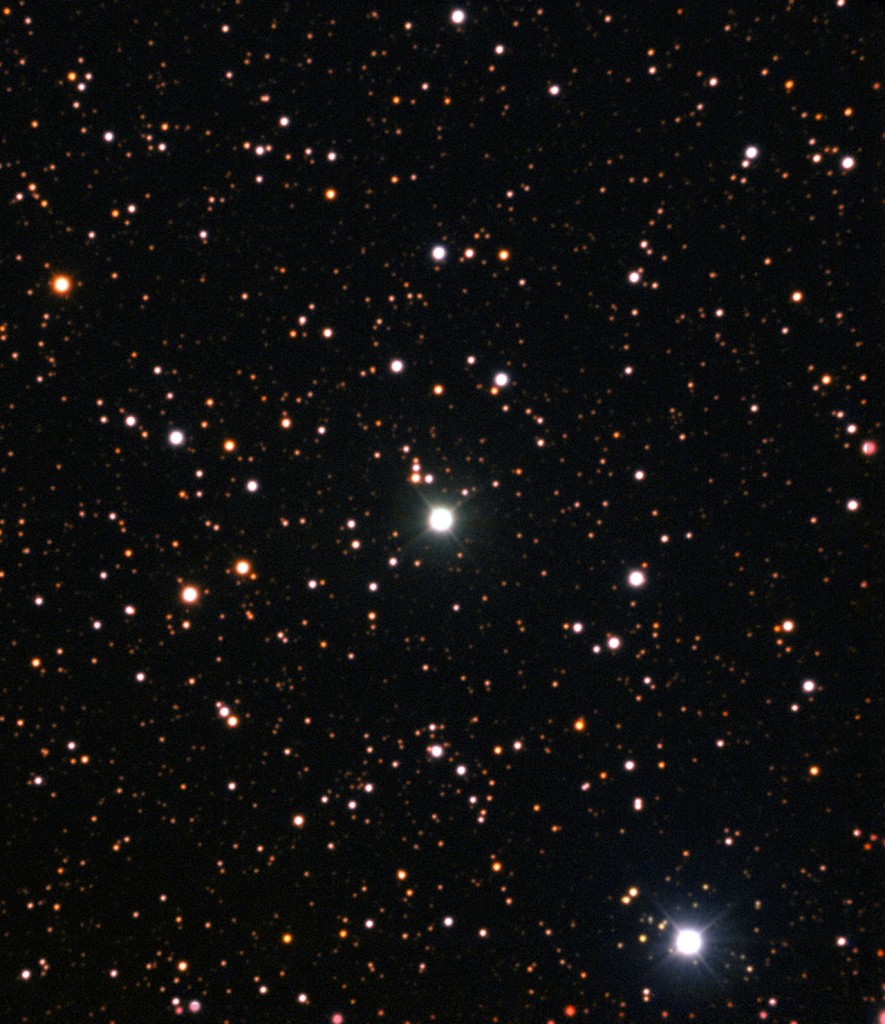
eso1531a[1]

This image from the New Technology Telescope at ESO’s La Silla Observatory shows Nova Centauri 2013 in July 2015 as the brightest star in the centre of the picture. This was more than eighteen months after the initial explosive outburst. This nova was the first in which evidence of lithium has been found. Credit: ESO

The light chemical element lithium is one of the few elements that is predicted to have been created by the Big Bang, 13.8 billion years ago. But understanding the amounts of lithium observed in stars around us today in the Universe has given astronomers headaches. Older stars have less lithium than expected [1], and some younger ones up to ten times more [2].

Since the 1970s, astronomers have speculated that much of the extra lithium found in young stars may have come from novae — stellar explosions that expel material into the space between the stars, where it contributes to the material that builds the next stellar generation. But careful study of several novae has yielded no clear result up to now.
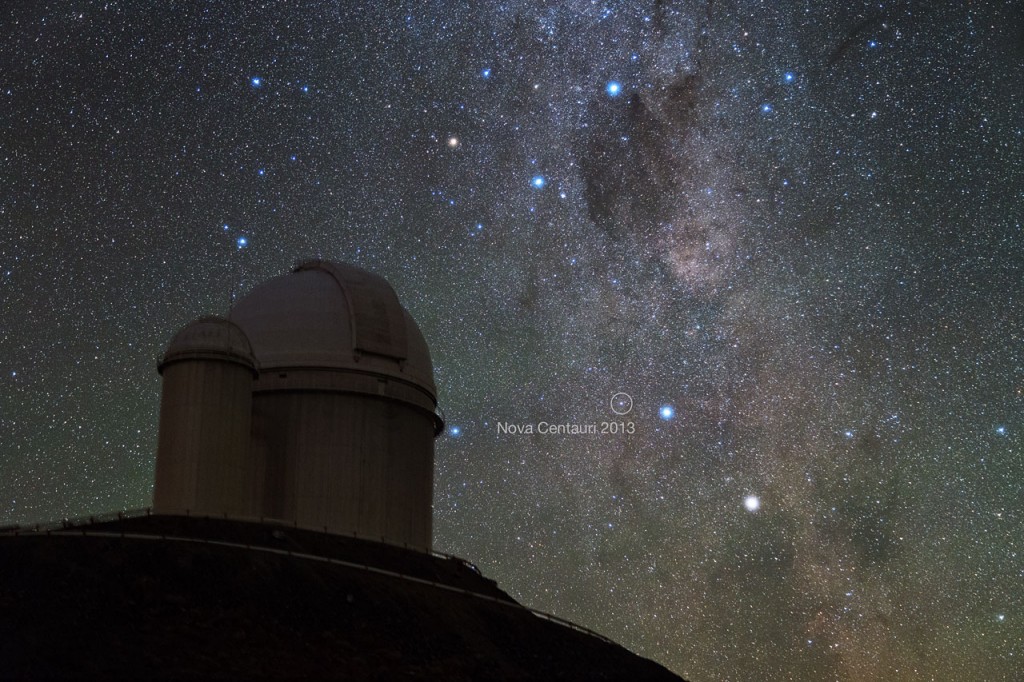
Alpha and Beta Centauri, two of the brightest stars in the southern sky, had a new companion in late 2013 — the naked eye Nova Centauri 2013. This photo was taken by ESO Photo Ambassador Yuri Beletsky at ESO's La Silla Observatory in the Chilean Atacama Desert in the morning hours of Monday 9 December 2013. The nova was discovered by John Seach from Australia on 2 December 2013 as it approached naked eye brightness. Nova Centaurus 2013 is the brightest nova to have occurred so far this millennium. This particular event is known as a classical nova, and is not to be confused with a supernova. Classical novae occur in binary star systems when hydrogen gas from the orbiting stellar partner is accreted onto the surface of the main star, causing a runaway thermonuclear event resulting in the brightening of the main star. In a classical novae the main star is not destroyed as is the case in a supernova. Instead, the star is dramatically brightened, and there is a simultaneous expansion of a debris shell. The nova appears in the picture just to the left of Beta Centauri, the bluer and higher of the two bright stars in the lower-right part of the image. The Southern Cross and the Coal Sack Nebula are also captured near the top of the picture. In front at the left is the ESO 3.6-metre telescope, inaugurated in 1976, it currently operates with the HARPS spectrograph, the most prolific exoplanet hunting machine in the world. Located 600 km north of Santiago, at 2400 m altitude in the outskirts of the Chilean Atacama Desert, La Silla was first ESO site in Chile and the largest observatory of its time. Links  Image of Nova Centauri 2013 (non-annotated)
Alpha and Beta Centauri, two of the brightest stars in the southern sky, had a new companion in late 2013 — the naked eye Nova Centauri 2013. This photo was taken by ESO Photo Ambassador Yuri Beletsky at ESO’s La Silla Observatory in the Chilean Atacama Desert in the morning hours of Monday 9 December 2013. The nova was discovered by John Seach from Australia on 2 December 2013 as it approached naked eye brightness. Nova Centaurus 2013 is the brightest nova to have occurred so far this millennium. This particular event is known as a classical nova, and is not to be confused with a supernova. Classical novae occur in binary star systems when hydrogen gas from the orbiting stellar partner is accreted onto the surface of the main star, causing a runaway thermonuclear event resulting in the brightening of the main star. In a classical novae the main star is not destroyed as is the case in a supernova. Instead, the star is dramatically brightened, and there is a simultaneous expansion of a debris shell. The nova appears in the picture just to the left of Beta Centauri, the bluer and higher of the two bright stars in the lower-right part of the image. The Southern Cross and the Coal Sack Nebula are also captured near the top of the picture. In front at the left is the ESO 3.6-metre telescope, inaugurated in 1976, it currently operates with the HARPS spectrograph, the most prolific exoplanet hunting machine in the world. Located 600 km north of Santiago, at 2400 m altitude in the outskirts of the Chilean Atacama Desert, La Silla was first ESO site in Chile and the largest observatory of its time. Links Image of Nova Centauri 2013 (non-annotated)

A team led by Luca Izzo (Sapienza University of Rome, and ICRANet, Pescara, Italy) has now used the FEROS instrument on the MPG/ESO 2.2-metre telescope at the La Silla Observatory, as well the PUCHEROS spectrograph on the ESO 0.5-metre telescope at the Observatory of the Pontificia Universidad Catolica de Chile in Santa Martina near Santiago, to study the nova Nova Centauri 2013 (V1369 Centauri). This star exploded in the southern skies close to the bright star Beta Centauri in December 2013 and was the brightest nova so far this century — easily visible to the naked eye [3].

The very detailed new data revealed the clear signature of lithium being expelled at two million kilometres per hour from the nova [4]. This is the first detection of the element ejected from a nova system to date.

This video sequence starts from a wide field view of the Milky Way and closes in on the bright and famous pair of stars Alpha and Beta Centauri. Nova Centauri 2013 exploded close to Beta Centauri in the sky in late 2013 and careful study of the light from this star has revealed the first traces of the element lithium ever found in a nova. The final image in the zoom is a closeup of the nova taken using the New Technology Telescope at ESO’s La Silla Observatory in July 2015. The nova is the brightest star close to the centre of the picture and is much fainter than it was at maximum light, when it could be seen with the naked eye.

Credit: ESO/Digitized Sky Survey 2/N. Risinger (skysurvey.org). Music: Johan B. Monell (www.johanmonell.com).

Co-author Massimo Della Valle (INAF–Osservatorio Astronomico di Capodimonte, Naples, and ICRANet, Pescara, Italy) explains the significance of this finding:

“It is a very important step forward. If we imagine the history of the chemical evolution of the Milky Way as a big jigsaw, then lithium from novae was one of the most important and puzzling missing pieces. In addition, any model of the Big Bang can be questioned until the lithium conundrum is understood.”

The mass of ejected lithium in Nova Centauri 2013 is estimated to be tiny (less than a billionth of the mass of the Sun), but, as there have been many billions of novae in the history of the Milky Way, this is enough to explain the observed and unexpectedly large amounts of lithium in our galaxy.
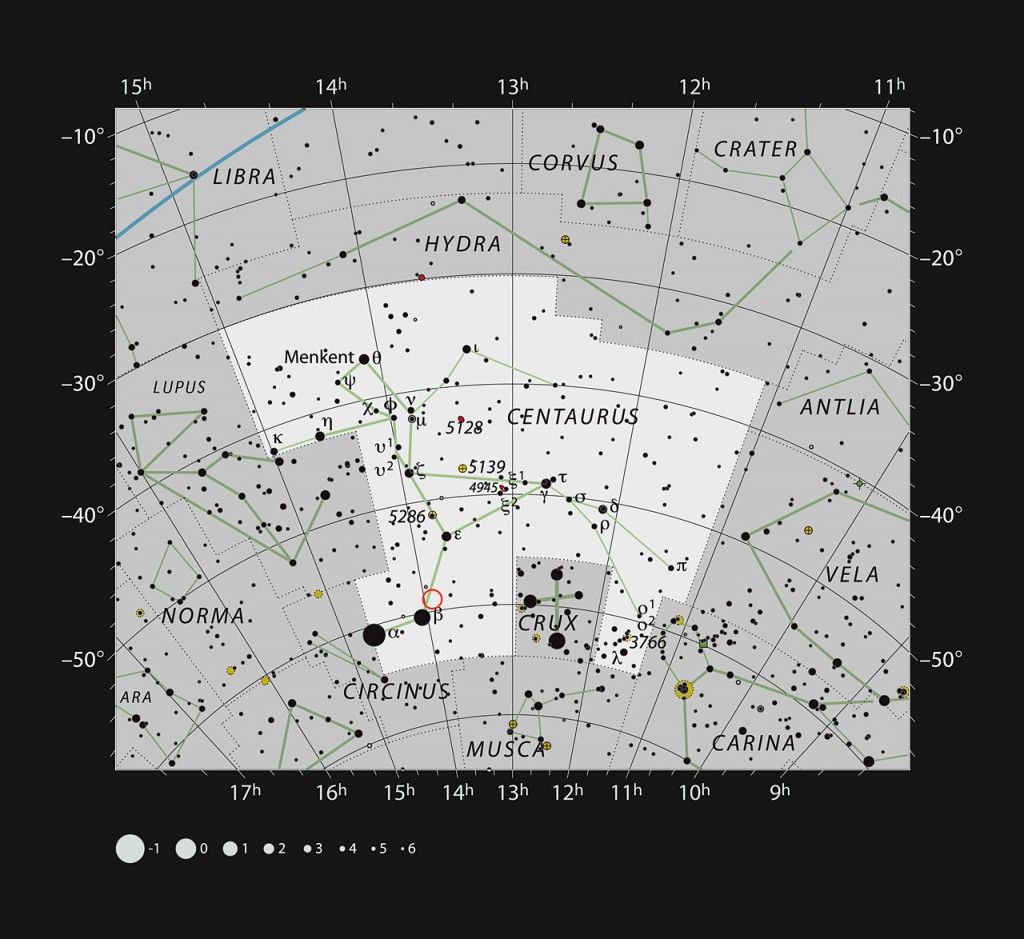
This chart shows the location of Nova Centauri 2013 (red circle) in the constellation of Centaurus (The Centaur). All the stars easily seen with the naked eye on a dark clear night are shown. The nova erupted in late 2013 and was visible without a telescope. Careful study of the light from this nova has revealed the first traces of the element lithium ever found in a nova.

Authors Luca Pasquini (ESO, Garching, Germany) and Massimo Della Valle have been looking for evidence of lithium in novae for more than a quarter of a century. This is the satisfying conclusion to a long search for them. And for the younger lead scientist there is a different kind of thrill:

“It is very exciting,” says Luca Izzo, “to find something that was predicted before I was born and then first observed on my birthday in 2013!”


Videos: TMRO Spacepods – ISS resupply, Pluto history, Mariner 4, & Rocket industry update

Catching up on recent TMRO.tv Spacepod webcasts:

* Everything Will Be Alright – SpacePod 07/07/15

TMRO’s Space Mike covers the recent success of the Progress resupply ship as well as some of the first political rhetoric after the Falcon 9 launch failure.

* How Pluto Was Discovered – Space Pod 07/10/15

TMRO Chief Astronomer Jared Head goes over the history of Pluto, just in time for next week’s New Horizons flyby.

* Retro Space Data – Mariner 4 – Space Pod 07/20/15

This week Ariel Waldman talks about how impatient NASA JPL employees visualized the very first image of Mars from space using colored pastels and a paint-by-number scheme.

* Meanwhile, in the Rocket Industry – SpacePod 07/21/15

With all the excitement over Pluto lately, there may have been a few notable rocket industry updates you may have missed.

* The Pluto “Planet” Problem – Space Pod 07/24/15

TMRO Chief Astronomer Jared Head takes a look at the recent decision to reclassify Pluto to dwarf planet and if recent New Horizons data may be enough to reverse that decision.

TMRO Space Pods are crowd funded shows. If you like this episode consider contributing to help us to continue to improve. Head over tohttp://www.patreon.com/spacepod for information, goals and reward levels. Don’t forget to check out our weekly live show campaign as well over at http://www.patreon.com/tmro

Constellation Supply Co. brings space themes to its ceramic products

Evan Dohrmann is a ceramics expert, an astronomy buff, and founder of the new startup Constellation Supply Co. He contacted me about his company’s first product: The Little Dripper Coffee Brewer, whose launch is backed by a successful Kickstarter soon to end.

The pledge rewards include a badge “inspired by the mission patches worn by intrepid space explorers” –

6d7a520364b170becef868462efead4e_original

– and a limited edition glow in the dark star chart constellation star chart –

Constellation_Poster_crop

Evan describes the poster to me as follows:

1. Innovative Design – The poster is inspired by the works of astrophysicist Donald H. Menzel and author H.A. Rey, and is designed and printed in the U.S.A. (Portland, Oregon).
2. Glow In the Dark – A glow in the dark poster is appealing to kids and adults alike.
3. Celebrate Science and Astronomy – Constellation Supply Co. is a ceramics business first and foremost, however we’ve chosen to celebrate our love of astronomy in everything we do. We believe this is something your followers will appreciate.

Nice to see Evan finding ways to combine his ceramics business with his interest in space and astronomy.


ESO: ALMA detects galaxies forming in early universe for the first time

A new report form ESO (European Space Observatory):

ALMA Witnesses Assembly of Galaxies
in the Early Universe for the First Time

The Atacama Large Millimeter/submillimeter Array (ALMA) has been used to detect the most distant clouds of star-forming gas yet found in normal galaxies in the early Universe. The new observations allow astronomers to start to see how the first galaxies were built up and how they cleared the cosmic fog during the era of reionisation. This is the first time that such galaxies are seen as more than just faint blobs.

This view is a combination of images from ALMA and the Very Large Telescope. The central object is a very distant galaxy, labelled BDF 3299, which is seen when the Universe was less than 800 million years old. The bright red cloud just to the lower left is the ALMA detection of a vast cloud of material that is in the process of assembling the very young galaxy.

When the first galaxies started to form a few hundred million years after the Big Bang, the Universe was full of a fog of hydrogen gas. But as more and more brilliant sources — both stars and quasars powered by huge black holes — started to shine they cleared away the mist and made the Universe transparent to ultraviolet light [1]. Astronomers call this the epoch of reionisation, but little is known about these first galaxies, and up to now they have just been seen as very faint blobs. But now new observations using the power of ALMA are starting to change this.

A team of astronomers led by Roberto Maiolino (Cavendish Laboratory and Kavli Institute for Cosmology, University of Cambridge, United Kingdom) trained ALMA on galaxies that were known to be seen only about 800 million years after the Big Bang [2]. The astronomers were not looking for the light from stars, but instead for the faint glow of ionised carbon [3]coming from the clouds of gas from which the stars were forming. They wanted to study the interaction between a young generation of stars and the cold clumps that were assembling into these first galaxies.

They were also not looking for the extremely brilliant rare objects — such as quasars and galaxies with very high rates of star formation — that had been seen up to now. Instead they concentrated on rather less dramatic, but much more common, galaxies that reionised the Universe and went on to turn into the bulk of the galaxies that we see around us now.

From one of the galaxies — given the label BDF 3299 — ALMA could pick up a faint but clear signal from the glowing carbon. However, this glow wasn’t coming from the centre of the galaxy, but rather from one side.

Co-author Andrea Ferrara (Scuola Normale Superiore, Pisa, Italy) explains the significance of the new findings:

“This is the most distant detection ever of this kind of emission from a ‘normal’ galaxy, seen less than one billion years after the Big Bang. It gives us the opportunity to watch the build-up of the first galaxies. For the first time we are seeing early galaxies not merely as tiny blobs, but as objects with internal structure!”

The astronomers think that the off-centre location of the glow is because the central clouds are being disrupted by the harsh environment created by the newly formed stars — both their intense radiation and the effects of supernova explosions — while the carbon glow is tracing fresh cold gas that is being accreted from the intergalactic medium.

By combining the new ALMA observations with computer simulations, it has been possible to understand in detail key processes occurring within the first galaxies. The effects of the radiation from stars, the survival of molecular clouds, the escape of ionising radiation and the complex structure of the interstellar medium can now be calculated and compared with observation. BDF 3299 is likely to be a typical example of the galaxies responsible for reionisation.

“We have been trying to understand the interstellar medium and the formation of the reionisation sources for many years. Finally to be able to test predictions and hypotheses on real data from ALMA is an exciting moment and opens up a new set of questions.This type of observation will clarify many of the thorny problems we have with the formation of the first stars and galaxies in the Universe,” adds Andrea Ferrara.

Roberto Maiolino concludes:

“This study would have simply been impossible without ALMA, as no other instrument could reach the sensitivity and spatial resolution required. Although this is one of the deepest ALMA observations so far it is still far from achieving its ultimate capabilities. In future ALMA will image the fine structure of primordial galaxies and trace in detail the build-up of the very first galaxies.”

Notes
[1] Neutral hydrogen gas very efficiently absorbs all the high-energy ultraviolet light emitted by young hot stars. Consequently, these stars are almost impossible to observe in the early Universe. At the same time, the absorbed ultraviolet light ionises the hydrogen, making it fully transparent. The hot stars are therefore carving transparent bubbles in the gas. Once all these bubbles merge to fill all of space, reionisation is complete and the Universe becomes transparent.

[2] They had redshifts ranging from 6.8 to 7.1.

[3] Astronomers are particularly interested in ionised carbon as this particular spectral line carries away most of the energy injected by stars and allows astronomers to trace the cold gas out of which stars form. Specifically, the team were looking for the emission from singly ionised carbon (known as [C II]). This radiation is emitted at a wavelength of 158 micrometres, and by the time it is stretched by the expansion of the Universe arrives at ALMA at just the right wavelength for it to be detected at a wavelength of about 1.3 millimetres.

ESO: Exoplanet found similar to Jupiter in mass and distance from its star

A new report from ESO (European Southern Observatory):

Jupiter Twin Discovered Around Solar Twin

An international group of astronomers has used the ESO 3.6-metre telescope to identify a planet just like Jupiter orbiting at the same distance from a Sun-like star, HIP 11915. According to current theories, the formation of Jupiter-mass planets plays an important role in shaping the architecture of planetary systems. The existence of a Jupiter-mass planet in a Jupiter-like orbit around a Sun-like star opens the possibility that the system of planets around this star may be similar to our own Solar System. HIP 11915 is about the same age as the Sun and, furthermore, its Sun-like composition suggests that there may also be rocky planets orbiting closer to the star.

eso1529a[1]

An artist’s impression showing a newly discovered Jupiter twin gas giant orbiting the solar twin star, HIP 11915. The planet is of a very similar mass to Jupiter and orbits at the same distance from its star as Jupiter does from the Sun. This, together with HIP 11915’s Sun-like composition, hints at the possibility of the system of planets orbiting HIP 11915 bearing a resemblance to our own Solar System, with smaller rocky planets orbiting closer to the host star. Credit: ESO/L. Benassi
Click for larger image.

So far, exoplanet surveys have been most sensitive to planetary systems that are populated in their inner regions by massive planets, down to a few times the mass of the Earth [1]. This contrasts with our Solar System, where there are small rocky planets in the inner regions and gas giants like Jupiter farther out.

According to the most recent theories, the arrangement of our Solar System, so conducive to life, was made possible by the presence of Jupiter and the gravitational influence this gas giant exerted on the Solar System during its formative years. It would seem, therefore, that finding a Jupiter twin is an important milestone on the road to finding a planetary system that mirrors our own.

A Brazilian-led team has been targeting Sun-like stars in a bid to find planetary systems similar to our Solar System. The team has now uncovered a planet with a very similar mass to Jupiter [2], orbiting a Sun-like star, HIP 11915, at almost exactly the same distance as Jupiter. The new discovery was made using HARPS, one of the world’s most precise planet-hunting instruments, mounted on the ESO 3.6-metre telescope at the La Silla Observatory in Chile.

Although many planets similar to Jupiter have been found [3] at a variety of distances from Sun-like stars, this newly discovered planet, in terms of both mass and distance from its host star, and in terms of the similarity between the host star and our Sun, is the most accurate analogue yet found for the Sun and Jupiter.

The planet’s host, the solar twin HIP 11915, is not only similar in mass to the Sun, but is also about the same age. To further strengthen the similarities, the composition of the star is similar to the Sun’s. The chemical signature of our Sun may be partly marked by the presence of rocky planets in the Solar System, hinting at the possibility of rocky planets also around HIP 11915.

According to Jorge Melendez, of the Universidade de São Paulo, Brazil, the leader of the team and co-author of the paper,“the quest for an Earth 2.0, and for a complete Solar System 2.0, is one of the most exciting endeavors in astronomy. We are thrilled to be part of this cutting-edge research, made possible by the observational facilities provided by ESO.” [4]

Megan Bedell, from the University of Chicago and lead author of the paper, concludes: “After two decades of hunting for exoplanets, we are finally beginning to see long-period gas giant planets similar to those in our own Solar System thanks to the long-term stability of planet hunting instruments like HARPS. This discovery is, in every respect, an exciting sign that other solar systems may be out there waiting to be discovered.”

Follow-up observations are needed to confirm and constrain the finding, but HIP 11915 is one of the most promising candidates so far to host a planetary system similar to our own.