Category Archives: Astronomy

Video: New trailer for “In Saturn’s Rings”

Here’s a new trailer for the In Saturn’s Rings film (see earlier post about their Kickstarter). Watch it in full screen mode:

Caption:

Back our Kickstarter (http://qr.net/saturn) to help us get a full orchestral score, IMAX® mastering services & global music rights – music will be performed by my hometown Greensboro Symphony Orchestra. http://www.greensborosymphony.org/

This is the newest teaser for “In Saturn’s Rings”, a giant screen space film for IMAX®, giant screen and fulldome theaters distributed by BIG & Digital, coming summer 2014. This DIY, not-for-profit all-volunteer film is from Greensboro, NC, USA filmmaker Stephen van Vuuren with tons of help from volunteer image processors around the world.

Created entirely from real photographs using photoanimation and multiplane photoanimation. No computer-generated images, painting, cloning, tweening, morphing, texture maps, camera projection or 3D models used. Even the “stargate” titles are created using photos – an 8000 photo mosaic of all-sky zoomed really fast to give blurred appearance.

Music for teaser is stock music from Neumann Films but has been customized to fit. http://neumannfilms.net/. Please back our Kickstarter (http://qr.net/saturn) to help us get the music we need so it can be seen in the widest number of theaters.

To watch in 4K, choose “original” under quality settings (you need a fast computer and a 4K monitor to view it full rez).

http://www.insaturnsrings.com/
https://www.facebook.com/insaturnsrin…
https://twitter.com/insaturnsrings

The film is 100% created using only flat 2D photographs (often hundreds or thousands per frame) stitched together for massive hundred megapixel+ resolutions that are scaled and zoomed using techniques developed by the filmmaker, based on Ken Burns and 2.5D photo animation processes.

A computer is actually not even required to do this – it could all be done exactly using photoanimation techniques from 100 years ago (http://en.wikipedia.org/wiki/Photoani…).

For booking/leasing info: http://www.biganddigital.com/

IMAX® is a registered trademark of IMAX® Inc.
“Citizen Science in Astronomy” – Zooniverse conference, Taipai, Taiwan, Mar.3-7.2013

The Zooniverse  citizen science organization will hold the Citizen Science in Astronomy conference in Taipai, Taiwan in March 3-7, 2014: Announcing the Citizen Science in Astronomy Workshop – Zooniverse

Citizen science – the involvement of hundreds of thousands of people in the research process – is a radical response to the challenge of dealing with the greatly increased size of modern datasets. The combined assessment of many non-expert human classifiers with minimal training often equal or improves that of a trained expert and in many cases outperform the best automated algorithms. As astronomical surveys and observations have continued to grow towards the petabyte scale, online citizen science projects have proven quite successful in enlisting the general public to mine these rich datasets from searching for exoplanets to identifying gravitational lenses.

The aim of this workshop is to bring together astronomers, computer scientists, and machine learning experts to focus on developing, for a citizen science approach to current and future astronomical datasets, new and improved data reduction techniques and algorithms to assess volunteer behavior and direct effort more efficiently. Such efforts are critical in coping with data from the next generation of experiments and instruments, including the Large Synoptic Survey Telescope (LSST), Hyper-Suprime Cam (HSC), and the Square Kilometer Array (SKA).

ESA Video: Guide to our Galaxy

ESA released this video Guide to our Galaxy:

Caption:

This virtual journey shows the different components that make up our home galaxy, the Milky Way, which contains about a hundred billion stars.

It starts at the black hole at the centre of the Milky Way and with the stars that orbit around it, before zooming out through the central Galactic Bulge, which hosts about ten billion stars.

The journey continues through a younger population of stars in the stellar disc, home to most of the Milky Way’s stars, and which is embedded in a slightly larger gaseous disc. Stars in the disc are arranged in a spiral arm pattern and orbit the centre of the Galaxy.

The discs and bulge are embedded in the stellar halo, a spherical structure that consists of a large number of globular clusters – the oldest population of stars in the Galaxy – as well as many isolated stars. An even larger halo of invisible dark matter is inferred by its gravitational effect on the motions of stars in the Galaxy.

Looking at a face-on view of the Galaxy we see the position of our Sun, located at a distance of about 26 000 light-years from the Galactic Centre.

Finally, the extent of the stellar survey conducted by ESA’s Hipparcos mission is shown, which surveyed more than 100 000 stars up to 300 light-years away from the Sun. In comparison, ESA’s Gaia survey will study one billion stars out to 30 000 light-years away.

Comet ISON update

It appears that Comet ISON has  fragmented a bit as it approaches the sun: Comet ISON unfolds its wings – Astronomy.com

In an update from Rick Boozer (see earlier post) he says,

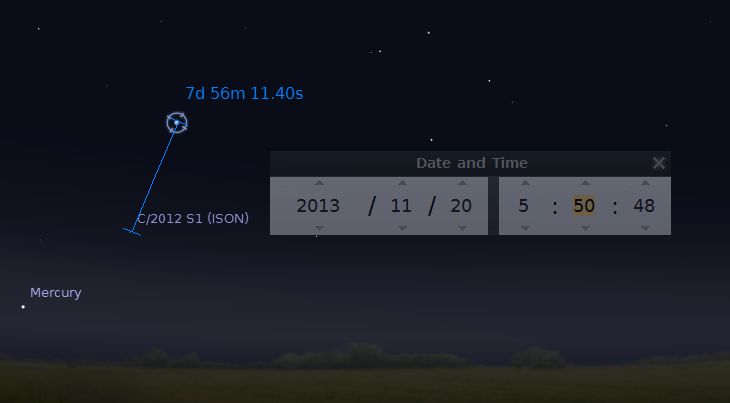
Comet ISON is really moving fast.  It appeared brighter, longer this morning. Farther from Spica at approximately 8 degrees distance. See attached image I obtained while running Stellarium using distance measuring tool.

ISON_2013-11-20

Latest on Comet ISON

Comet ISON has gotten much brighter recently (see posts here and here). It’s visible with binoculars and in some conditions by naked eye. Updates on visibility can be found at:

Rick Boozer tells me that he saw it today:

Caught my first sighting of Comet ISON about 1.5 4.5 degrees below and to the left of Spica this morning at about 5:50 AM with my binos from fairly light polluted home in Greer, SC.  Saw coma and brightest part of tail pointing away from the direction of the Sun.  If I had been at my weekend home in the NC mountains, I think I could have seen it naked eye.  Weather was too bad this past weekend to try it at NC.

Also, Mercury was very bright below and to the left of the comet.