NASA JPL tells what’s up in the sky to see for the month of February:
NASA JPL tells what’s up in the sky to see for the month of February:
Zooniverse has opened a new citizen science program called Disk Detective:
Scientists are combing our galaxy looking for stars that could be harbouring planet-forming disks. They need your help to explain this puzzling part of stellar evolution!
What is WISE looking for?
WISE is a NASA mission surveying the whole sky in infrared. This project is looking at stars to find dusty debris disks, similar to our asteroid field. These disks suggest that these stars are in the early stages of forming planetary systems. Learning more about these stars can tell us how our Solar System formed.
How will my contribution help?
Computers often confuse debris disks around stars with other astronomical objects. We need your help to sort out what stars actually have these disks from Galaxies and Nebulae.
Read about the project here: Disk Detective: The Newest Astronomy Citizen Science Project – astrobites
Via SpaceX (SpaceX) on Twitter comes a pointer to this rather humbling depiction of our place in the universe:
From the caption:
The Known Universe takes viewers from the Himalayas through our atmosphere and the inky black of space to the afterglow of the Big Bang. Every star, planet, and quasar seen in the film is possible because of the world’s most complete four-dimensional map of the universe, the Digital Universe Atlas that is maintained and updated by astrophysicists at the American Museum of Natural History. The new film, created by the Museum, is part of an exhibition, Visions of the Cosmos: From the Milky Ocean to an Evolving Universe, at the Rubin Museum of Art in Manhattan through May 2010.
Data: Digital Universe, American Museum of Natural History
http://www.haydenplanetarium.org/univ…
Though not actually imaging its surface, I still find it amazing that the surface of an object the size and distance of a brown dwarf can now be studied:
First Weather Map of Brown Dwarf
ESO’s VLT charts surface of nearest brown dwarf
ESO’s Very Large Telescope has been used to create the first ever map of the weather on the surface of the nearest brown dwarf to Earth. An international team has made a chart of the dark and light features on WISE J104915.57-531906.1B, which is informally known as Luhman 16B and is one of two recently discovered brown dwarfs forming a pair only six light-years from the Sun. The new results are being published in the 30 January 2014 issue of the journal Nature.
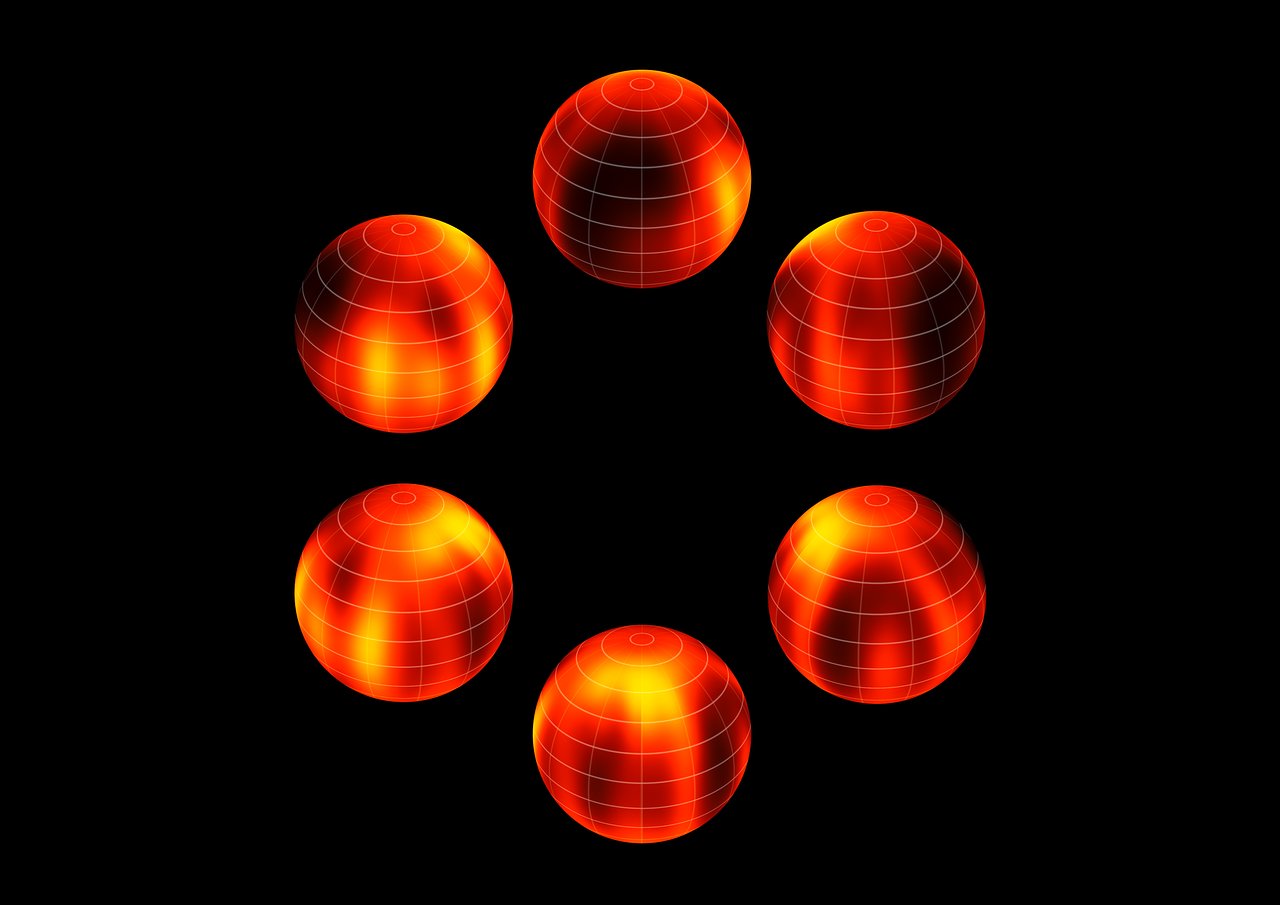
Brown dwarfs fill the gap between giant gas planets, such as Jupiter and Saturn, and faint cool stars. They do not contain enough mass to initiate nuclear fusion in their cores and can only glow feebly at infrared wavelengths of light. The first confirmed brown dwarf was only found twenty years ago and only a few hundred of these elusive objects are known.
The closest brown dwarfs to the Solar System form a pair called Luhman 16AB [1] that lies just six light-years from Earth in the southern constellation of Vela (The Sail). This pair is the third closest system to the Earth, after Alpha Centauri and Barnard’s Star, but it was only discovered in early 2013. The fainter component, Luhman 16B, had already been found to be changing slightly in brightness every few hours as it rotated — a clue that it might have marked surface features.
Now astronomers have used the power of ESO’s Very Large Telescope (VLT) not just to image these brown dwarfs, but to map out dark and light features on the surface of Luhman 16B.
Ian Crossfield (Max Planck Institute for Astronomy, Heidelberg, Germany), the lead author of the new paper, sums up the results:
“Previous observations suggested that brown dwarfs might have mottled surfaces, but now we can actually map them. Soon, we will be able to watch cloud patterns form, evolve, and dissipate on this brown dwarf — eventually, exometeorologists may be able to predict whether a visitor to Luhman 16B could expect clear or cloudy skies.”
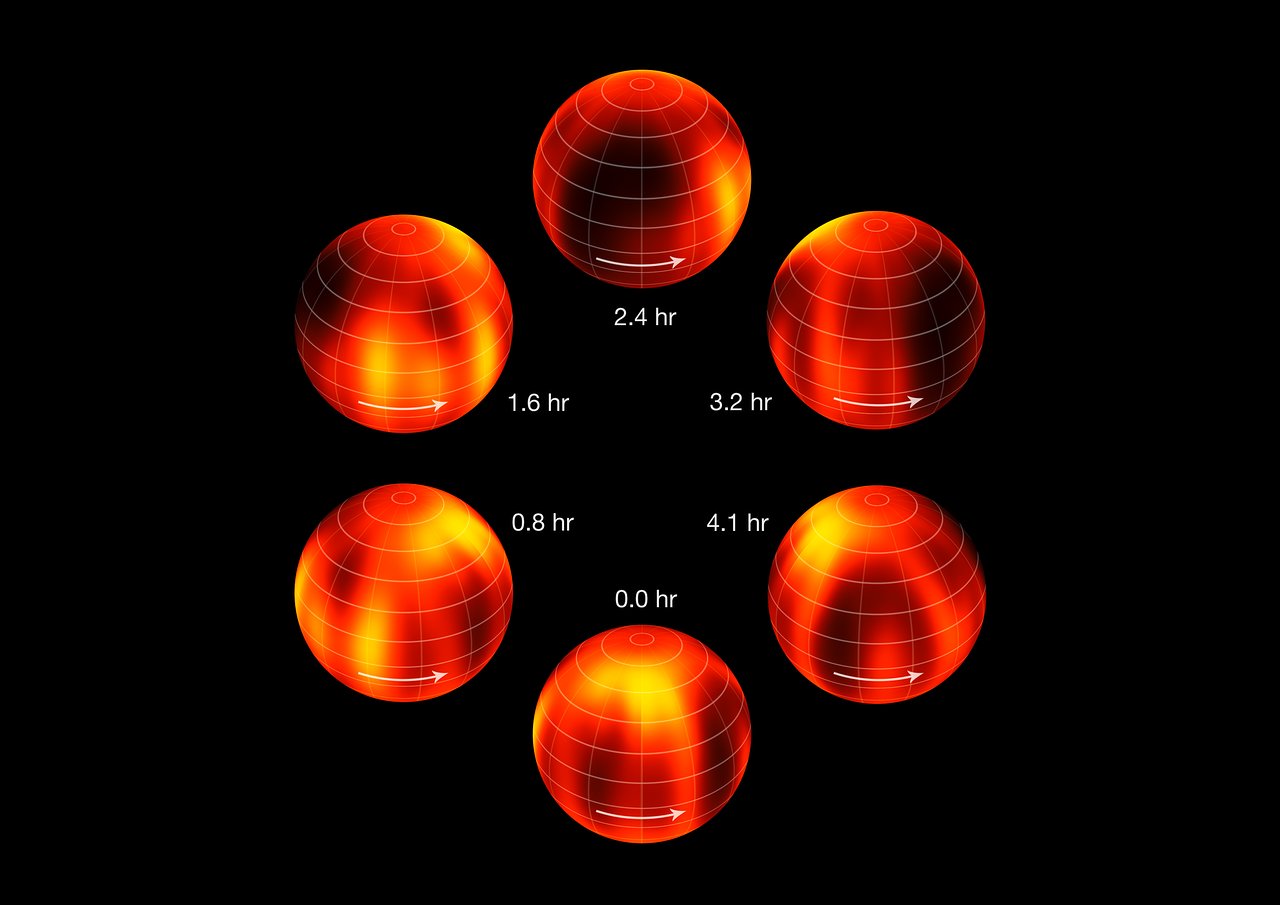
To map the surface the astronomers used a clever technique. They observed the brown dwarfs using the CRIRES instrument on the VLT. This allowed them not just to see the changing brightness as Luhman 16B rotated, but also to see whether dark and light features were moving away from, or towards the observer. By combining all this information they could recreate a map of the dark and light patches of the surface.
 Click to Enlarge
 The figure shows the object at six equally spaced times as it rotates
once on its axis. Credit: ESO/I. Crossfield
The atmospheres of brown dwarfs are very similar to those of hot gas giant exoplanets, so by studying comparatively easy-to-observe brown dwarfs [2] astronomers can also learn more about the atmospheres of young, giant planets — many of which will be found in the near future with the new SPHERE instrument that will be installed on the VLT in 2014.
Crossfield ends on a personal note: “Our brown dwarf map helps bring us one step closer to the goal of understanding weather patterns in other solar systems. From an early age I was brought up to appreciate the beauty and utility of maps. It’s exciting that we’re starting to map objects out beyond the Solar System!”
—-
Find more images here.
A rare supernova was observed last night in a relatively close galaxy – Messier 82 (M82) – “just” 11.4 million light years away. The supernova is visible in amateur grade telescopes”
Here is a comparison before and after from the Remanzacco Observatory :
