[ Update: What’s Up: March 2021 Skywatching Tips from NASA – NASA JPL
What are some skywatching highlights in April 2021? Look for the rosy arch known as the Belt of Venus at sunset, then find the constellation Leo overhead on April evenings. Also, check out Jupiter and Saturn with the Moon on April 6. Additional information about topics covered in this episode of What’s Up, along with still images from the video, and the video transcript, are available at https://solarsystem.nasa.gov/whats-up….
Clear April nights are filled with starry creatures. Near the Big Dipper, you will find several interesting binary stars. You can also spot galaxies like the Pinwheel Galaxy, M82, and M96—the last of which is an asymmetric galaxy that may have been gravitationally disrupted by encounters with its neighbors. Keep watching for space-based views of these celestial objects.
What can you see in the night sky tonight? Astronomers Pete Lawrence and Paul Abel guide us through April’s night sky highlights and reveal the stars, constellations and planets worth looking out for over the coming weeks.
** What’s in the Night Sky April 2021 #WITNS – Alyn Wallace
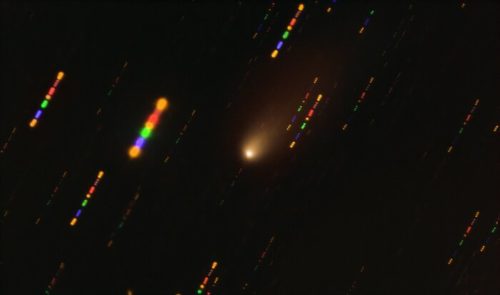
This image was taken with the FORS2 instrument on ESO’s Very Large Telescope in late 2019, when comet 2I/Borisov passed near the Sun. Since the comet was travelling at breakneck speed, around 175 000 kilometres per hour, the background stars appeared as streaks of light as the telescope followed the comet’s trajectory. The colours in these streaks give the image some disco flair and are the result of combining observations in different wavelength bands, highlighted by the various colours in this composite image.
New observations with the European Southern Observatory’s Very Large Telescope (ESO’s VLT) indicate that the rogue comet 2I/Borisov, which is only the second and most recently detected interstellar visitor to our Solar System, is one of the most pristine ever observed. Astronomers suspect that the comet most likely never passed close to a star, making it an undisturbed relic of the cloud of gas and dust it formed from.
2I/Borisov was discovered by amateur astronomer Gennady Borisov in August 2019 and was confirmed to have come from beyond the Solar System a few weeks later.
“2I/Borisov could represent the first truly pristine comet ever observed,”
says Stefano Bagnulo of the Armagh Observatory and Planetarium, Northern Ireland, UK, who led the new study published today in Nature Communications. The team believes that the comet had never passed close to any star before it flew by the Sun in 2019.
Bagnulo and his colleagues used the FORS2 instrument on ESO’s VLT, located in northern Chile, to study 2I/Borisov in detail using a technique called polarimetry [1]. Since this technique is regularly used to study comets and other small bodies of our Solar System, this allowed the team to compare the interstellar visitor with our local comets.
The team found that 2I/Borisov has polarimetric properties distinct from those of Solar System comets, with the exception of Hale–Bopp. Comet Hale–Bopp received much public interest in the late 1990s as a result of being easily visible to the naked eye, and also because it was one of the most pristine comets astronomers had ever seen. Prior to its most recent passage, Hale–Bopp is thought to have passed by our Sun only once and had therefore barely been affected by solar wind and radiation. This means it was pristine, having a composition very similar to that of the cloud of gas and dust it — and the rest of the Solar System — formed from some 4.5 billion years ago.
By analysing the polarisation together with the colour of the comet to gather clues on its composition, the team concluded that 2I/Borisov is in fact even more pristine than Hale–Bopp. This means it carries untarnished signatures of the cloud of gas and dust it formed from.
“The fact that the two comets are remarkably similar suggests that the environment in which 2I/Borisov originated is not so different in composition from the environment in the early Solar System,”
says Alberto Cellino, a co-author of the study, from the Astrophysical Observatory of Torino, National Institute for Astrophysics (INAF), Italy.
Olivier Hainaut, an astronomer at ESO in Germany who studies comets and other near-Earth objects but was not involved in this new study, agrees.
“The main result — that 2I/Borisov is not like any other comet except Hale–Bopp — is very strong,” he says, adding that “it is very plausible they formed in very similar conditions.”
[..] Ludmilla Kolokolova, of the University of Maryland in the US, who was involved in the Nature Communications research [explains,]
“The arrival of 2I/Borisov from interstellar space represented the first opportunity to study the composition of a comet from another planetary system and check if the material that comes from this comet is somehow different from our native variety,”
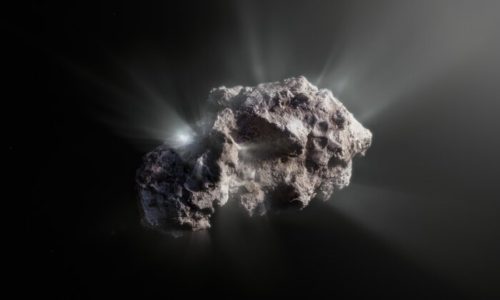
This image shows an artist’s impression of what the surface of the 2I/Borisov comet might look like. 2I/Borisov was a visitor from another planetary system that passed by our Sun in 2019, allowing astronomers a unique view of an interstellar comet. While telescopes on Earth and in space captured images of this comet, we don’t have any close-up observations of 2I/Borisov. It is therefore up to artists to create their own ideas of what the comet’s surface might look like, based on the scientific information we have about it.
Bagnulo hopes astronomers will have another, even better, opportunity to study a rogue comet in detail before the end of the decade.
“ESA is planning to launch Comet Interceptor in 2029, which will have the capability of reaching another visiting interstellar object, if one on a suitable trajectory is discovered,”
he says, referring to an upcoming mission by the European Space Agency.
An origin story hidden in the dust
Even without a space mission, astronomers can use Earth’s many telescopes to gain insight into the different properties of rogue comets like 2I/Borisov.
“Imagine how lucky we were that a comet from a system light-years away simply took a trip to our doorstep by chance,”
says Bin Yang, an astronomer at ESO in Chile, who also took advantage of 2I/Borisov’s passage through our Solar System to study this mysterious comet. Her team’s results are published in Nature Astronomy.
Yang and her team used data from the Atacama Large Millimeter/submillimeter Array (ALMA), in which ESO is a partner, as well as from ESO’s VLT, to study 2I/Borisov’s dust grains to gather clues about the comet’s birth and conditions in its home system.
They discovered that 2I/Borisov’s coma — an envelope of dust surrounding the main body of the comet — contains compact pebbles, grains about one millimetre in size or larger. In addition, they found that the relative amounts of carbon monoxide and water in the comet changed drastically as it neared the Sun. The team, which also includes Olivier Hainaut, says this indicates that the comet is made up of materials that formed in different places in its planetary system.
The observations by Yang and her team suggest that matter in 2I/Borisov’s planetary home was mixed from near its star to further out, perhaps because of the existence of giant planets, whose strong gravity stirs material in the system. Astronomers believe that a similar process occurred early in the life of our Solar System.
While 2I/Borisov was the first rogue comet to pass by the Sun, it was not the first interstellar visitor. The first interstellar object to have been observed passing by our Solar System was ʻOumuamua, another object studied with ESO’s VLT back in 2017. Originally classified as a comet, ʻOumuamua was later reclassified as an asteroid as it lacked a coma.
Notes
[1] Polarimetry is a technique to measure the polarisation of light. Light becomes polarised, for example, when it goes through certain filters, like the lenses of polarised sunglasses or cometary material. By studying the properties of sunlight polarised by a comet’s dust, researchers can gain insights into the physics and chemistry of comets.
3. Wednesday, Mar.31 2021, 1:30 pm PDT (3:30 CDT, 4:30 pm EDT): Hotel Mars – Dr. Haym Benaroya, of Rutgers University will talk with John Batchelor and Dr. David Livingston about the latest developments in lunar habitats, returning to the Moon and more.
4. Thursday, Apr. 1, 2021; 6:30-8:90 pm PDT (8:30-10:00 pm CDT, 9:30-11:00 pm EDT): A San Francisco AIAA Chapter webinar featuring an interview with Dr. David Livingston about The Space Show with Kim Holderand John Jossy. For registration and details for “The Space Show Behind The Scenes” program, see The Space Show website Upcoming Show Menu for April 1, 2021.
5. Friday, Apr.2, 2021; 9:30-11 am PDT (11:30 am-1 pm CDT, 12:30-2 pm EDT): We welcome Bruce Pittman back to the program to discuss his proposal, “Spacecraft Nation: A Toolkit for Building Back Better Using Space“.
6. Sunday, Apr.4, 2021; 12-1:30 pm PDT (3-4:30 pm EDT, 2-3:30 pm CDT): No program today as this is Easter Sunday.
** Wednesday, Mar.24.2021 – Hotel Mars – The Space Show/John Bachelor Show – Anatoly Zak of RussianSpaceWeb.com talked with John Batchelor and Dr. David Livingston about “the Perseverance on mars, the upcoming helicopter flight in the thin Martian atmosphere, Curiosity progress, plus we talked about the ISS leak in the Russian segment, the effort to repair it, the materials used in the repair, the impact of the leak on the remaining life of the ISS and related items. In the second segment, we discussed the agreement with China and Russia on establishing a lunar base together in the not too distant future.”
** Tuesday, Mar.23.2021 – Robert Zimmerman “returned for a two hour plus discussion ranging from the Mars rovers, especially Perseverance, to NASA marketing policy for Mars and the rover missions, to suborbital tourism, SpaceX, Blue Origin and Virgin news plus more.”
A sampling of links to recent space policy, politics, and government (US and international) related space news and resource items that I found of interest (find previous space policy roundups here):
1) An ambitious deployment plan laid out by CGSTL … 2) Media report on the quality control at Xingyun … 3) Daxing aerospace base … 4) Haisi-1 Ever Given Shot … 5) 2 New Tianwen-1 Mars Shots
** In Conversation with the UK’s Leading Space Commanders – War Studies KCL
The Freeman Air and Space Institute, King’s College London, in partnership with Airbus, were delighted to host the first ever in conversation event between the UK’s leading space commanders.
It was a unique first opportunity to hear from Air Vice-Marshal Paul Godfrey, the inaugural commander of the newly established Space Command, launching on 1 April 2021, as he discussed with Air Vice-Marshal Harvey Smyth, Ministry of Defence Director Space, their vision for the future of UK military in space.
A panel of experts on space from industry, politics, the military and research, put their questions to the two commanders.
After nearly 60 years, the Outer Space Treaty continues to hold one of the only explicit arms-control provisions for space in international law: Article IV prohibits the placement in orbit of nuclear weapons or other weapons of mass destruction.
Today, however, there is a growing probability that conflict will emerge in space with conventional weapons, potentially in destructive or catastrophic ways. Will the Outer Space Treaty be sufficient to prevent conflict in space? Will the absence of greater prohibitions lead to the placement of conventional weapons in orbit? What paths are available to prevent the degradation of space through war?
Moderator and panelists:
Daniel Porras , Director of Strategic Partnerships and Communications at the Secure World Foundation, Non-resident Fellow at the UN Institute for Disarmament Research
Paul Meyer, Canadian Ambassador and Permanent Representative (retired) to the United Nations and to the Conference on Disarmament in Geneva , International Security and Adjunct Professor of International Studies at Simon Fraser University
Andrei Belousov, Deputy Permanent Representative of the Russian Federation to the United Nations Office at Geneva
Patricia Lewis, Director of the International Security Programme and Research Director of Conflict, Science & Transformation at Chatham House
Carine Claeys, EU Special Envoy for Space in the European External Action Service (EEAS)
SWF Executive Director Peter Martinez and Director of Strategic Partnerships and Communications Daniel Porras spoke on a panel, hosted by the Space Court Foundation, on the various “silos” that exist within the space community and how these groups might come together to develop a responsive governance framework for space.
In this week’s Space Cafè WebTalk, Nikolai Khlystov, Lead, Shaping the Future of Mobility and Space at World Economic Forum, Geneva, Switzerland talked about ways and initiatives that support sustainable peace in space.
President Biden nominated Bill Nelson to be the new NASA Administrator, so I check in on some of my past thoughts on NASA Administrators and Jim Bridenstine, talk about Bill Nelson’s history in space policy, and what the future may hold under a Bill Nelson NASA.
** Hotel Mars – The Space Show/John Bachelor Show – Wed. Mar.24.2021 – Anatoly Zak of www.russianspaceweb.com talked with John Batchelor and Dr. David Livingston about “the Perseverance on mars, the upcoming helicopter flight in the thin Martian atmosphere, Curiosity progress, plus we talked about the ISS leak in the Russian segment, the effort to repair it, the materials used in the repair, the impact of the leak on the remaining life of the ISS and related items. In the second segment, we discussed the agreement with China and Russia on establishing a lunar base together in the not too distant future.”
** The Space Show – Tuesday, Mar.23.2021 – Robert Zimmerman “returned for a two hour plus discussion ranging from the Mars rovers, especially Perseverance, to NASA marketing policy for Mars and the rover missions, to suborbital tourism, SpaceX, Blue Origin and Virgin news plus more.”
Here is the latest episode in NASA’s Space to Ground weekly report on activities related to the International Space Station:
** NASA ScienceCasts: Observing Lightning from the International Space Station – ScienceAtNASA
Colorful bursts of energy above thunderstorms called transient luminous events can be observed from the International Space Station. Instruments on the station are helping scientists study these particle outbursts, which may prove useful to better understand our climate, weather, and the behaviors of storms. Space Station Research & Tech: https://www.nasa.gov/iss-science
** Vice President Kamala Harris Calls NASA Astronauts Shannon Walker and Kate Rubins – NASA
U.S. Vice President Kamala Harris placed a special phone call to Shannon Walker and Kate Rubins aboard the International Space Station to find out what it’s like to do science in space. During the month of March, NASA celebrates and pays tribute to the many women who have played an essential role in shaping the history of the agency. Learn more about Shannon Walker by visiting: https://www.nasa.gov/astronauts/biogr… Learn more about Kate Rubins by visiting: https://www.nasa.gov/astronauts/biogr…
** Expedition 64 Inflight Event with Discovery Channel – March 26, 2021 – NASA Video
Aboard the International Space Station, Expedition 64 Flight Engineers Victor Glover of NASA and Soichi Noguchi of the Japan Aerospace Exploration Agency (JAXA) discussed their mission and their upcoming return to Earth aboard the SpaceX Crew Dragon “Resilience” during an in-flight interview March 26 with the Discovery Channel. Along with Glover and Noguchi, Flight Engineers Mike Hopkins and Shannon Walker of NASA launched last November aboard “Resilience” and are in the final weeks of their planned six-month mission, headed for a return to Earth in late April.
** Expedition 65 Vande Hei Live Shots March 23, 2021 – NASA Video
NASA astronaut Mark Vande Hei participated in media interviews on March 23, 2021 from the Gagarin Cosmonaut Training Center in Star City, Russia. Vande Hei, along with cosmonauts Oleg Novitskiy and Pyotr Dubrov of the Russian space agency Roscosmos, is scheduled to launch to the space station Friday, April 9, on the Soyuz MS-18 spacecraft from the Baikonur Cosmodrome in Kazakhstan. This will be his second spaceflight.
** ISS Moon Transit – Photographing the International Space Station. – Russell Discombe
In this video I head out with a friend to capture the ISS transiting the moon. I use my Sony a7iii, Sony 200-600mm lens and I discuss the settings used and record the moment that the ISS passes in front of the moon. The International Space Station flies 400 km high at 28,800 km/h (15,500 MPH). It only takes 92 minutes to make a complete circuit of Earth…the ISS goes around the Earth every 92 minutes! Astronauts working and living on the Station experience 16 sunrises and sunsets each day. This image consists of 20 images that were taken within a 2 second window.