All posts by TopSpacer

Space policy roundup – July.26.2021

A sampling of links to recent space policy, politics, and government (US and international) related space news and resource items that I found of interest (find previous space policy roundups here):

International space

Webcasts:

** Episode 44: Let’s Talk About Astronauts – Space Thoughts (YouTube) – Space Law & Policy Solutions/Michael Listner

Discussing some of the issues around the use of the word “astronaut” as it relates to commercial space activities.

** Episode 43 – Update: ViaSat Motion to Stay – Space Thoughts (YouTube) – Space Law & Policy Solutions/Michael Listner

Update on the Order issued on ViaSat’s Motion to Stay (Preliminary Injunction) in D.C. Court of Appeals.

** Stellar Decisis – Case No. 1 –  Space Court Foundation – YouTube

Stellar Decisis examines how courts in the not too distant future might handle disputes in space, using real international law to argue hypothetical but plausible cases involving future space activity. In the premiere of the pilot episode, one nation uses its nuclear arsenal to destroy an asteroid threatening Earth in the year 2050, with the unfortunate consequence of raining radioactive debris down on the far side of the Moon. A mix of governments and private companies file claims against that nation for damages suffered by lunar industry, and bring the first case to call for the Space Court.

Special Guest Justices: President Dr. Alissa Haddaji, Justice David Koplow, and Justice Chris Newman, PhD.
Advocate for the Applicant: Ryan Noble
Advocate for the Respondent: Jessica Noble

** Chongqing Builds Space-based Solar Power Base, EO Analytics Startups & Henan Disaster Relief Effort – Dongfang Hour – YouTube

Hello and welcome to another episode of the Dongfang Hour China Space News Roundup! A kind reminder that we cover a lot more stories every week in our Newsletter (newsletter.dongfanghour.com). This week, we discuss:

1) China officially kicks off the construction of the country’s first space-based solar power industry base in Chongqing
2) Chinese Earth observation data analytics startups participate in Henan disaster relief effort after the recent floods
3) A new series of Yaogan satellites launched on board a Long March 2C, with Tianqi-15 as secondary payload.

** The Space Show – Sunday, July.25.2021 – Dr. Kelly Weinersmith talked about “the future of humans in space, settlement, space tourism, policy, suborbital and more“.

** The Space Show – Friday, July.23.2021 – Andrew Chaikin talked about “his new space book folio, Apollo 15, space tourism, commercial space and more“.

** The Space Show – Tuesday, July.21.2021 – Rand Simberg discussed

the significance of July 20th, 52 years ago with Apollo. We talked about www.evoloterra. com (see blog to hear the show referenced) Blue Orgin and their flight earlier in the day, suborbital companies, going to space for the wrong and right reasons and much more.

** The Space Cafe Podcast #32: Jacques Arnould, a tricky question for the entire space industry – SpaceWatch.Global

Jacques Arnould is paid to ask uncomfortable questions. As an ethicist at the French space agency CNES, Jacques puts his fingers on places that people sometimes like to ignore: such as the question: why we do what we do. Why money is spent on this mission and not on another, and above all, why we want to do spaceflight in the first place.

** E67: Building Normentum – Norms of Behavior in Space – Aerospace Corp Space Policy (Vimeo) – Center for Space Policy & Strategy (CSPS)

** Edmund Burke – What Does It Take To Get On The Test Launch Schedule At Vandenberg AFB? – CSP S02E81 – Cold Star Technologies – YouTube

What does it take to get on the test launch schedule at Vandenberg Air Force Base? How do so many organizations unnecessarily delay their time because of unexpected but avoidable issues? Edmund Burke of Space Information Labs joins host Jason Kanigan on the Cold Star Project to explain range safety compliance – happenings, trends, success, and failure. We discuss:

– The shift to Autonomous Flight Termination and Space Based Range
– Brief explanation of flight termination systems
– Advantages and necessity of intelligent lithium battery systems
– RadTol BMS, and radiation tolerant avionics
– Testing and documentation required to fly (RCC 319-19)
– A decade of watching companies fall short on promises because the didn’t understand what it takes
– Danger of vertical integration for startups
– Important lessons learned.

Edmund Burke served as an Air Force Program Manager and Project Director for many years prior to founding Space Information Laboratories in 2004. He served as the Space Lift Range System, Range Instrumentation and Metric Track lead for both Vandenberg AFB and Cape Canaveral, FL.

** Space Café WebTalk – Thomas Schildknecht – 1. June 2021 – spacewatch. global – News Room – YouTube

In this week’s Space Café WebTalk Prof. Thomas Schildknecht, Director of Swiss Optical Ground Station and Geodynamics Observatory Zimmerwald and Vice-Director of Astronomical Institute of the University of Bern, Switzerland, talked about Sustainability beyond (our) planet protection from the perspective of an astronomer.

Human-caused climate change, global pandemics, ocean acidification and species extinctions may eventually threaten the collapse of humanity, while others argue that for political or economic reasons we should allow industrial development to continue without restrictions.

Can we afford that?

What role plays space?

** July 23, 2021 Zimmerman/Batchelor podcast – Behind The Black/Robert Zimmerman

** July 21, 2021 Zimmerman/Batchelor podcast – Behind The Black/Robert Zimmerman

====
=== Amazon Ad ===

Asteroids: How Love, Fear, and Greed
Will Determine Our Future in Space

===

America’s New Destiny in Space

===

Rise of the Space Age Millennials:
The Space Aspirations of a Rising Generation

The Space Show this week – July.26.2021

The guests and topics of discussion on The Space Show this week:

1. Tuesday, July. 27, 2021; 7 pm PDT (9 pm CDT, 10 pm EDT): We welcome back Robert Zimmerman for a comprehensive space policy discussion on multiple topics and stories.

2. Wednesday, July. 28, 2021: Hotel Mars TBA pre-recorded. John Batchelor and Dr. David Livingston will talk with Dr. Michael Hecht, principal investigator for the MOXIE payload on NASA’s Mars 2020 Rover (Perseverance) mission .

3. Friday, July.30, 2021; 9:30-11 am PDT (11:30 am-1 pm CDT, 12:30-2 pm EDT): We welcome the CEO of Ramon Space, Avi Shabtai, to talk about commercial space, super computing and more.

4. Sunday, Aug.1, 2021; 12-1:30 pm PDT (3-4:30 pm EDT, 2-3:30 pm CDT): We welcome Dr. Jonathan McDowell, astrophysicist at the Harvard-Smithsonian Center for Astrophysics, to discuss commercial space, suborbital, astrophysics and more.

Some recent shows:

**  Sunday, July.25.2021 – Dr. Kelly Weinersmith talked about “the future of humans in space, settlement, space tourism, policy, suborbital and more“.

** Friday, July.23.2021 – Andrew Chaikin talked about “his new space book folio, Apollo 15, space tourism, commercial space and more“.

** Tuesday, July.21.2021 – Rand Simberg discussed “the significance of July 20th, 52 years ago with Apollo. We talked about www.evoloterra. com (see blog to hear the show referenced) Blue Orgin and their flight earlier in the day, suborbital companies, going to space for the wrong and right reasons and much more.”

** See also:
* The Space Show Archives
* The Space Show Newsletter
* The Space Show Shop

The Space Show is a project of the One Giant Leap Foundation.

The Space Show - David Livingston
The Space Show – Dr. David Livingston

=== Amazon Ads ===

Test Gods:
Virgin Galactic and the Making of a Modern Astronaut

====

Amazon Unbound:
Jeff Bezos and the Invention of a Global Empire

===

Conscious Choice:
The Origins of Slavery in America and
Why it Matters Today and
for Our Future in Outer Space

ESO: Moon-forming disk observed around exoplanet

A new report from the European Southern Observatory (ESO):

Astronomers make first clear detection of a moon-forming disc around an exoplanet

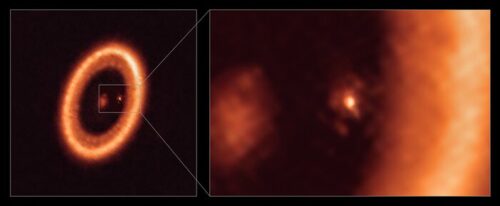
This image, taken with the Atacama Large Millimeter/submillimeter Array (ALMA), in which ESO is a partner, shows wide (left) and close-up (right) views of the moon-forming disc surrounding PDS 70c, a young Jupiter-like planet nearly 400 light-years away. The close-up view shows PDS 70c and its circumplanetary disc centre-front, with the larger circumstellar ring-like disc taking up most of the right-hand side of the image. The star PDS 70 is at the centre of the wide-view image on the left. Two planets have been found in the system, PDS 70c and PDS 70b, the latter not being visible in this image. They have carved a cavity in the circumstellar disc as they gobbled up material from the disc itself, growing in size. In this process, PDS 70c acquired its own circumplanetary disc, which contributes to the growth of the planet and where moons can form. This circumplanetary disc is as large as the Sun-Earth distance and has enough mass to form up to three satellites the size of the Moon.

Using the Atacama Large Millimetre/submillimeter Array (ALMA), in which the European Southern Observatory (ESO) is a partner, astronomers have unambiguously detected the presence of a disc around a planet outside our Solar System for the first time. The observations will shed new light on how moons and planets form in young stellar systems.

“Our work presents a clear detection of a disc in which satellites could be forming,”

says Myriam Benisty, a researcher at the University of Grenoble, France, and at the University of Chile, who led the new research published today in The Astrophysical Journal Letters.

“Our ALMA observations were obtained at such exquisite resolution that we could clearly identify that the disc is associated with the planet and we are able to constrain its size for the first time,”

she adds.

The disc in question, called a circumplanetary disc, surrounds the exoplanet PDS 70c, one of two giant, Jupiter-like planets orbiting a star nearly 400 light-years away. Astronomers had found hints of a “moon-forming” disc around this exoplanet before but, since they could not clearly tell the disc apart from its surrounding environment, they could not confirm its detection — until now.

In addition, with the help of ALMA, Benisty and her team found that the disc has about the same diameter as the distance from our Sun to the Earth and enough mass to form up to three satellites the size of the Moon.

But the results are not only key to finding out how moons arise.

“These new observations are also extremely important to prove theories of planet formation that could not be tested until now,”

says Jaehan Bae, a researcher from the Earth and Planets Laboratory of the Carnegie Institution for Science, USA, and author on the study.

Planets form in dusty discs around young stars, carving out cavities as they gobble up material from this circumstellar disc to grow. In this process, a planet can acquire its own circumplanetary disc, which contributes to the growth of the planet by regulating the amount of material falling onto it. At the same time, the gas and dust in the circumplanetary disc can come together into progressively larger bodies through multiple collisions, ultimately leading to the birth of moons.

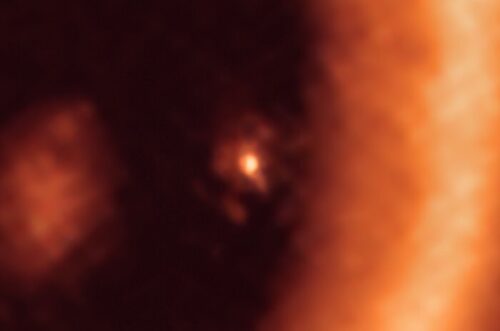
This image, taken with the Atacama Large Millimeter/submillimeter Array (ALMA), in which ESO is a partner, shows a close-up view on the moon-forming disc surrounding PDS 70c, a young Jupiter-like gas giant nearly 400 light-years away. It shows this planet and its disc centre-front, with the larger circumstellar ring-like disc taking up most of the right-hand side of the image. The dusty circumplanetary disc is as large as the Sun-Earth distance and has enough mass to form up to three satellites the size of the Moon.

But astronomers do not yet fully understand the details of these processes.

“In short, it is still unclear when, where, and how planets and moons form,”

explains ESO Research Fellow Stefano Facchini, also involved in the research.

“More than 4000 exoplanets have been found until now, but all of them were detected in mature systems. PDS 70b and PDS 70c, which form a system reminiscent of the Jupiter-Saturn pair, are the only two exoplanets detected so far that are still in the process of being formed,”

explains Miriam Keppler, researcher at the Max Planck Institute for Astronomy in Germany and one of the co-authors of the study [1].

“This system therefore offers us a unique opportunity to observe and study the processes of planet and satellite formation,”

Facchini adds.

PDS 70b and PDS 70c, the two planets making up the system, were first discovered using ESO’s Very Large Telescope (VLT) in 2018 and 2019 respectively, and their unique nature means they have been observed with other telescopes and instruments many times since [2].

The latest high resolution ALMA observations have now allowed astronomers to gain further insights into the system. In addition to confirming the detection of the circumplanetary disc around PDS 70c and studying its size and mass, they found that PDS 70b does not show clear evidence of such a disc, indicating that it was starved of dust material from its birth environment by PDS 70c.

An even deeper understanding of the planetary system will be achieved with ESO’s Extremely Large Telescope (ELT), currently under construction on Cerro Armazones in the Chilean Atacama desert.

“The ELT will be key for this research since, with its much higher resolution, we will be able to map the system in great detail,”

says co-author Richard Teague, a researcher at the Center for Astrophysics | Harvard & Smithsonian, USA. In particular, by using the ELT’s Mid-infrared ELT Imager and Spectrograph (METIS), the team will be able to look at the gas motions surrounding PDS 70c to get a full 3D picture of the system.

Notes

[1] Despite the similarity with the Jupiter-Saturn pair, note that the disc around PDS 70c is about 500 times larger than Saturn’s rings.

[2] PDS 70b was discovered using the Spectro-Polarimetric High-contrast Exoplanet REsearch (SPHERE) instrument, while PDS 70c was found using the VLT’s Multi Unit Spectroscopic Explorer (MUSE). The two-planet system has been investigated using the X-shooter instrument too, also installed on ESO’s VLT.

Links

=== Amazon Ads ===

Stellaris: People of the Stars

===

More Things in the Heavens:
How Infrared Astronomy Is Expanding
Our View of the Universe

Videos: “Space to Ground” + Other ISS reports – July.16.2021

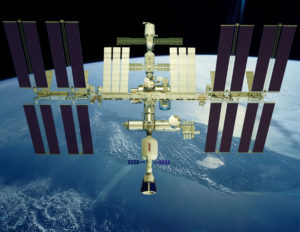
Here is the latest episode in NASA’s Space to Ground weekly report on activities related to the International Space Station:

** Space is Spicier: Peppers Growing on Station – NASA’s Kennedy Space Center

On July 12, NASA astronaut Shane Kimbrough on the International Space Station added water to NASA’s Plant Habitat-04 (PH-04) experiment in the Advanced Plant Habitat (APH), the largest of NASA’s three plant growth chambers on the orbiting laboratory. This activated the experiment, which contains 48 Hatch chili pepper seeds recently sent to station. Astronauts on station and a team of researchers at Kennedy will work together to monitor the peppers’ growth for about four months before harvesting them. This will be one of the longest and most challenging plant experiments attempted aboard the orbital lab. The crew plans to eat some of the peppers and send the rest back to Earth for analysis. Some of the data collected from PH-04 will include the astronauts’ take on flavor and texture of the peppers, along with Scoville measurements to assess the spiciness of the peppers. A research team monitoring a control experiment on the ground at Kennedy will collect similar information for comparison. SpaceX’s 22nd commercial resupply services mission in June delivered PH-04 to the space station. Read the full feature and the fact sheet about the PH-04 experiment. Follow progress on social media. Feature: https://www.nasa.gov/feature/chile-pe… Fact Sheet: https://www.nasa.gov/content/plant-ha…

For information on the NuMex pepper Hatch Valley video footage, please contact New Mexico TRUE at www.newmexico.org

** Cool Flames Created Aboard International Space Station – July 14, 2021 – NASA Video

The hot flame created during a test for the Cool Flames Investigation with Gases experiment is shown burning. After the flame appears to extinguish, a cool flame is created. While too faint to be visible in real time during space station testing, the research team uncovered the presence of cool flames in the data.

** Expedition 65 Inflight with Harlem Link Education Group – July 9, 2021 – NASA Video

Aboard the International Space Station, ISS Expedition 65 Commander Aki Hoshide of the Japan Aerospace Exploration Agency (JAXA) and NASA Flight Engineer Shane Kimbrough answered pre-recorded questions from Harlem Link charter school students in New York July 8 in an educational in-flight events. The students represent all five boroughs of New York, ranging in age from pre-kindergarten to fifth grade. Hoshide and Kimbrough launched in April on the SpaceX Crew Dragon “Endeavour” for a planned six-month mission.

** Space Station Crew Answers Questions From New York State Students – NASA Video

Expedition 65 – NASA Astronaut Megan McArthur and ESA Astronaut Thomas Pesquet answer questions from the Children’s Museum of Saratoga.

** ‘Intelligent’ robotic arm to launch with new space station module – VideoFromSpace

European Robotic Arm (ERA) will be able to “move back and forward by itself, hand-over-hand between fixed base-points,” according to ESA, It will be launched to the International Space Station along with the ‘Nauka’ Russian Multipurpose Laboratory Module.

** WATCH Earth Images from the International Space Station.- July 12, 2021 – space googlevesaire

** Spacewalk season timelapse, episode 3 – European Space Agency, ESA

Timelapse video made during ESA astronaut Thomas Pesquet’s second mission to the International Space Station, “Alpha”. ESA astronaut Thomas Pesquet and @NASA astronaut Shane Kimbrough performed three spacewalks in the span of 10 days to install two new solar arrays that will generate more electricity on the International Space Station. The third and final spacewalk for the duo happened on June 25 to finish installing the second pair of new solar arrays. This spacewalk proceeded without problems, and the two new solar arrays are already working and supplying power to the Space Station. The design of the new solar arrays will be used to power the lunar Gateway that will be built in an orbit around the Moon – the next outpost in space for the agencies that run the International Space Station. …

** Science so cool it is freezing! – European Space Agency, ESA

Interviews with the “Cold Stowage” team at @NASA‘s Kennedy Space Center in Florida, USA, that ensure science on the International Space Station stays cool. Many experiments run on the Space Station require freezing samples for analysis later on Earth, or are sent into space frozen and thawed out in orbit. The European-built MELFI (Minus Eighty Lab Freezer for ISS) keeps these samples at the right temperature. From a virus to algae or muscle biopsies, many samples have been sent and stored in space over a decade years that the freezers have been operating. The technology behind keeping the science cool in space has found its way back to Earth too, limiting losses when transporting liquid gas in tankers. Built by ESA and transferred to NASA and @JAXA | 宇宙航空研究開発機構, MELFI is a versatile storage freezer. The four compartments can be set at different temperatures ranging from −98 °C to +4 °C to preserve biological samples such as blood and urine that will be returned to Earth.

====

=== Amazon Ads ===

LEGO Ideas International Space Station Building Kit,
Adult Set for Display,
Makes a Great Birthday Present
(864 Pieces)

====

Outpost in Orbit:
A Pictorial & Verbal History of the Space Station

ESO: Galactic star formation seen vividly in VLT/ALMA images

A new report from the European Southern Observatory (ESO):

Galactic fireworks:
new ESO images reveal stunning features of nearby galaxies

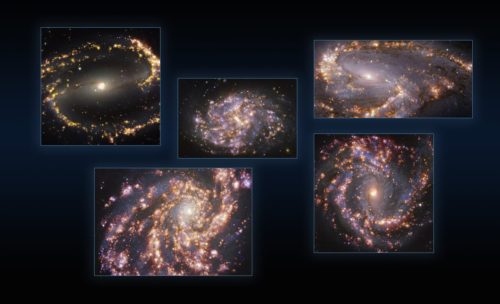
This image combines observations of the nearby galaxies NGC 1300, NGC 1087, NGC 3627 (top, from left to right), NGC 4254 and NGC 4303 (bottom, from left to right) taken with the Multi-Unit Spectroscopic Explorer (MUSE) on ESO’s Very Large Telescope (VLT). Each individual image is a combination of observations conducted at different wavelengths of light to map stellar populations and warm gas. The golden glows mainly correspond to clouds of ionised hydrogen, oxygen and sulphur gas, marking the presence of newly born stars, while the bluish regions in the background reveal the distribution of slightly older stars.   The images were taken as part of the Physics at High Angular resolution in Nearby GalaxieS (PHANGS) project, which is making high-resolution observations of nearby galaxies with telescopes operating across the electromagnetic spectrum.

A team of astronomers has released new observations of nearby galaxies that resemble colourful cosmic fireworks. The images, obtained with the European Southern Observatory’s Very Large Telescope (ESO’s VLT), show different components of the galaxies in distinct colours, allowing astronomers to pinpoint the locations of young stars and the gas they warm up around them. By combining these new observations with data from the Atacama Large Millimeter/submillimeter Array (ALMA), in which ESO is a partner, the team is helping shed new light on what triggers gas to form stars.

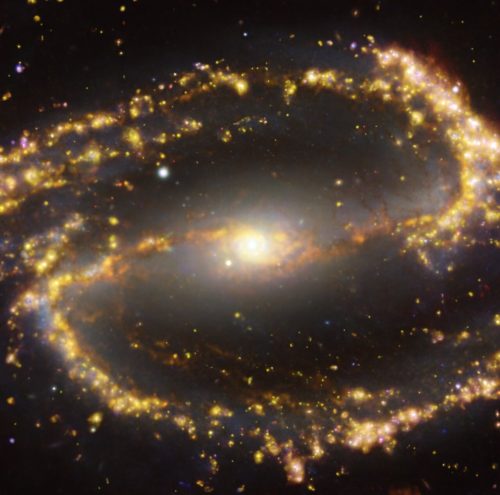
This image of the nearby galaxy NGC 1300 was obtained by combining observations taken with the Multi-Unit Spectroscopic Explorer (MUSE) on ESO’s Very Large Telescope (VLT) and with the Atacama Large Millimeter/submillimeter Array (ALMA), in which ESO is a partner. NGC 1300 is a spiral galaxy, with a bar of stars and gas at its centre, located approximately 61 million light-years from Earth in the constellation Eridanus. The image is a combination of observations conducted at different wavelengths of light to map stellar populations and gas. ALMA’s observations are represented in brownish-orange tones and highlight the clouds of cold molecular gas that provide the raw material from which stars form. The MUSE data show up mainly in gold and blue. The bright golden glows map warm clouds of mainly ionised hydrogen, oxygen and sulphur gas, marking the presence of newly born stars, while the bluish regions reveal the distribution of slightly older stars.  The image was taken as part of the Physics at High Angular resolution in Nearby GalaxieS (PHANGS) project, which is making high resolution observations of nearby galaxies with telescopes operating across the electromagnetic spectrum.

Astronomers know that stars are born in clouds of gas, but what sets off star formation, and how galaxies as a whole play into it, remains a mystery. To understand this process, a team of researchers has observed various nearby galaxies with powerful telescopes on the ground and in space, scanning the different galactic regions involved in stellar births.

“For the first time we are resolving individual units of star formation over a wide range of locations and environments in a sample that well represents the different types of galaxies,”

says Eric Emsellem, an astronomer at ESO in Germany and lead of the VLT-based observations conducted as part of the Physics at High Angular resolution in Nearby GalaxieS (PHANGS) project.

“We can directly observe the gas that gives birth to stars, we see the young stars themselves, and we witness their evolution through various phases.” 

Emsellem, who is also affiliated with the University of Lyon, France, and his team have now released their latest set of galactic scans, taken with the Multi-Unit Spectroscopic Explorer (MUSE) instrument on ESO’s VLT in the Atacama Desert in Chile. They used MUSE to trace newborn stars and the warm gas around them, which is illuminated and heated up by the stars and acts as a smoking gun of ongoing star formation.

The new MUSE images are now being combined with observations of the same galaxies taken with ALMA and released earlier this year. ALMA, which is also located in Chile, is especially well suited to mapping cold gas clouds — the parts of galaxies that provide the raw material out of which stars form.

By combining MUSE and ALMA images astronomers can examine the galactic regions where star formation is happening, compared to where it is expected to happen, so as to better understand what triggers, boosts or holds back the birth of new stars. The resulting images are stunning, offering a spectacularly colourful insight into stellar nurseries in our neighbouring galaxies.

“There are many mysteries we want to unravel,”

says Kathryn Kreckel from the University of Heidelberg in Germany and PHANGS team member.

“Are stars more often born in specific regions of their host galaxies — and, if so, why? And after stars are born how does their evolution influence the formation of new generations of stars?”

Astronomers will now be able to answer these questions thanks to the wealth of MUSE and ALMA data the PHANGS team have obtained. MUSE collects spectra — the “bar codes” astronomers scan to unveil the properties and nature of cosmic objects — at every single location within its field of view, thus providing much richer information than traditional instruments. For the PHANGS project, MUSE observed 30 000 nebulae of warm gas and collected about 15 million spectra of different galactic regions. The ALMA observations, on the other hand, allowed astronomers to map around 100 000 cold-gas regions across 90 nearby galaxies, producing an unprecedentedly sharp atlas of stellar nurseries in the close Universe.

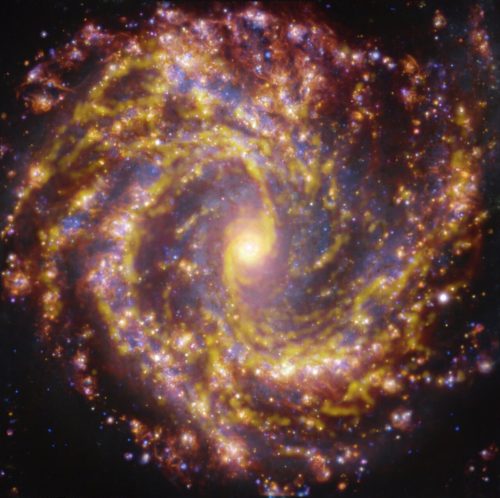
This image of the nearby galaxy NGC 4303 was obtained by combining observations taken with the Multi-Unit Spectroscopic Explorer (MUSE) on ESO’s Very Large Telescope (VLT) and with the Atacama Large Millimeter/submillimeter Array (ALMA), in which ESO is a partner. NGC 4303 is a spiral galaxy, with a bar of stars and gas at its centre, located approximately 55 million light-years from Earth in the constellation Virgo. The image is a combination of observations conducted at different wavelengths of light to map stellar populations and gas. ALMA’s observations are represented in brownish-orange tones and highlight the clouds of cold molecular gas that provide the raw material from which stars form. The MUSE data show up mainly in gold and blue. The bright golden glows map warm clouds of mainly ionised hydrogen, oxygen and sulphur gas, marking the presence of newly born stars, while the bluish regions reveal the distribution of slightly older stars.    The image was taken as part of the Physics at High Angular resolution in Nearby GalaxieS (PHANGS) project, which is making high-resolution observations of nearby galaxies with telescopes operating across the electromagnetic spectrum.

In addition to ALMA and MUSE, the PHANGS project also features observations from the NASA/ESA Hubble Space Telescope. The various observatories were selected to allow the team to scan our galactic neighbours at different wavelengths (visible, near-infrared and radio), with each wavelength range unveiling distinct parts of the observed galaxies.

“Their combination allows us to probe the various stages of stellar birth — from the formation of the stellar nurseries to the onset of star formation itself and the final destruction of the nurseries by the newly born stars — in more detail than is possible with individual observations,”

says PHANGS team member Francesco Belfiore from INAF-Arcetri in Florence, Italy.

“PHANGS is the first time we have been able to assemble such a complete view, taking images sharp enough to see the individual clouds, stars, and nebulae that signify forming stars.”

The work carried out by the PHANGS project will be further honed by upcoming telescopes and instruments, such as NASA’s James Webb Space Telescope. The data obtained in this way will lay further groundwork for observations with ESO’s future Extremely Large Telescope (ELT), which will start operating later this decade and will enable an even more detailed look at the structures of stellar nurseries.

“As amazing as PHANGS is, the resolution of the maps that we produce is just sufficient to identify and separate individual star-forming clouds, but not good enough to see what’s happening inside them in detail,”

pointed out Eva Schinnerer, a research group leader at the Max Planck Institute for Astronomy in Germany and principal investigator of the PHANGS project, under which the new observations were conducted.

“New observational efforts by our team and others are pushing the boundary in this direction, so we have decades of exciting discoveries ahead of us.”

[ See also these interactive comparisons of galaxy images with and without the ALMA radio array data:

]

Links

=== Amazon Ads ===

The Planet Factory:
Exoplanets and the Search for a Second Earth

===

Interstellar
(Original Motion Picture Soundtrack)
[Expanded Edition]