A sampling of recent articles, videos, and images dealing with space transport:
** Blue Origin’s BE7 lunar lander engine was fired successfully this week:
First hotfire of our #BE7 lunar landing engine just yesterday at Marshall Space Flight Center. Data looks great and hardware is in perfect condition. Test went full planned duration – 35 seconds. Kudos to the whole @BlueOrigin team and grateful to @NASA_Marshall for all the help! pic.twitter.com/cTjjrngumY
— Jeff Bezos (@JeffBezos) June 20, 2019
** Jeff Bezos described his goals for Blue Origin during an on-stage interview held at the recent JFK Space Summit in the JFK Library in Massachusetts.
- Fireside Chat with Jeff Bezos and Caroline Kennedy | JFK Library
- Jeff Bezos: Blue Origin will refuel lunar lander with moon ice – CNBC
** Spinlaunch awarded a Dept. of Defense contract for delivery of payloads to low earth orbit with the company’s catapult style launch system, which is currently in development at the New Mexico spaceport.
- SpinLaunch Secures First Contract for Revolutionary New Space Launch Services – Spinlaunch PR/Business Wire
- Secretive Startup SpinLaunch Gets 1st Launch Contract for US Military | Space.com
- SpinLaunch: Kinetic Energy-based System for Orbiting Satellites – Leonard David
From the PR:
LONG BEACH, Calif.–Jonathan Yaney, founder and CEO of SpinLaunch, has announced that the company has been awarded a responsive launch prototype contract from the Department of Defense (DOD), facilitated by the Defense Innovation Unit (DIU).
SpinLaunch is developing a kinetic energy-based launch system that will provide the world’s lowest-cost orbital launch services for the rapidly growing small satellite industry. In 2018, the company received $40 million in a Series A financing round from Airbus Ventures, Google Ventures and Kleiner Perkins.
The recently published State of the Space Industrial Base states that the future and growth of the U.S. space economy is “critically dependent on continuing reductions in the costs and risks associated with launch. There is a bifurcation of launch providers between lower-cost, ‘bulk’ carriers…and higher-cost, ‘niche’ providers offering lower lift-mass, but launch to a specific orbit.”
“SpinLaunch fills this gap by providing dedicated orbital launch with high frequency at a magnitude lower cost than any current ‘niche’ launch system,” stated Yaney. “This will truly be a disruptive enabler for the emerging commercial space industry. There is a promising market surge in the demand for LEO constellations of inexpensive small satellites for disaster monitoring, weather, reconnaissance, communications and other services.”
In January 2019, SpinLaunch moved from Silicon Valley to its new 140,000 square foot headquarters in Long Beach, California and last month broke ground on a new $7 million test facility on 10 acres at New Mexico’s Spaceport America. First kinetic energy flight tests are expected to occur early 2020 and the company has announced its plans for first launch by 2022.
Few technical details are known publicly about the Spinlaunch system. This image was released with the PR but it’s difficult to decipher. It appears to show the launch projectile attached to the rotating mechanism that will bring the projectile up to a significant fraction of orbital velocity.
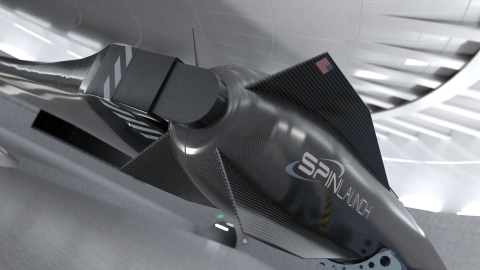
See also the Spinlaunch Fact Sheet (pdf) –
Due to its unique technology, SpinLaunch is able to offer readily-available, low cost, dedicated launches at high frequencies. SpinLaunch is working to provide up to five launches per day at a price of $250,000 / launch.
** Orbit Fab‘s satellite water propulsion initiative begins with water sent to the ISS: Orbit Fab Becomes the First Private Company to Supply the International Space Station with Water – Orbit Fab
Within a year of securing venture funding, Orbit Fab has launched their hardware twice to the International Space Station (ISS) and supplied the station with water. Following the success of the multi-day microgravity refueling demonstration, Kenneth Shields, COO of the ISS U.S. National Laboratory, said in a statement, “With their recent successful completion of in-orbit water transfer operations aboard the space station, Orbit Fab became the first private company to supply the ISS with water using its own proprietary refueling equipment and processes. This concept of operations was not previously conceived of in the original design of the ISS, thus demonstrating NASA’s flexibility and desire to accommodate private sector clients who are utilizing the ISS U.S. National Laboratory as a steppingstone to an industrialized Low Earth Orbit.”
Using water as an in-space propellant has the advantage of being a very safe substance, which is important on the station where NASA is extremely cautious about such things.
Water was used for this propellant transfer demonstration as it is one of the most inert and easy to handle propellants available. Several companies offer satellite thrusters that use water as a propellant, among them is OrbitFab co-founder Daniel Faber’s former company, Deep Space Industries, which was recently acquired by Bradford Space. Orbit Fab plans on offering a variety of storable propellants on orbit, including water, xenon, green monopropellants, hydrazine, NTO, and hydrogen peroxide.
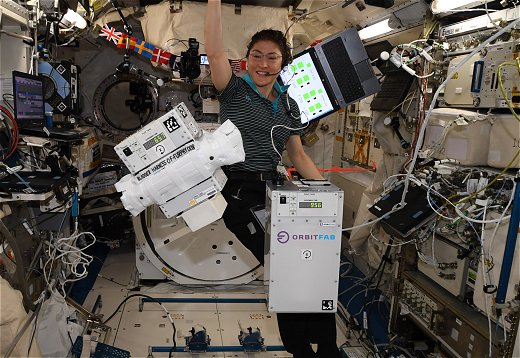
Details on the hardware used to transfer water to a spacecraft are available at:
** The window for the next Rocket Lab Electron launch opens on June 27th.
The Make It Rain mission will launch multiple spacecraft as part of a rideshare flight procured by Spaceflight. The launch window will open in late June, with launch taking place from Rocket Lab Launch Complex 1 on New Zealand’s Māhia Peninsula.
The mission is named ‘Make it Rain’ in a nod to the high volume of rainfall in Seattle, where Spaceflight is headquartered, as well in New Zealand where Launch Complex 1 is located. Among the payloads on the mission for Spaceflight are BlackSky’s Global-4 satellite and Melbourne Space Program’s ACRUX-1 CubeSat.
** Ariane V successfully launches two satellites to GEO:
- Enhancing telecom: Arianespace’s Ariane 5 delivers T-16 and EUTELSAT 7C to geostationary transfer orbit – Arianespace
- Two commercial broadcast satellites launched on Ariane 5 rocket – Spaceflight Now
** Commercial launch industry must deal with the double challenges of the introduction of lower priced reusable rocket flight services and a drop in the number of orders for big GEO communications satellites:
- July 2019 – Reusable Rockets: Where are They Going Next? | Via Satellite
- July 2019 – How Launch Providers are Standing Out in a New Commercial Market | Via Satellite
It’s been a little more than three years since Space X launched the Falcon 9 reusable rocket booster B1021 on a mission to the International Space Station (ISS) in April 2016. When the rocket came back to Earth, it became the first to land vertically on a ship at sea, and then the first to be flown again, on a March 2017 SES-10 mission. Shortly before then, in November 2015, Blue Origin launched its suborbital New Shepard booster, and successfully achieved a powered vertical soft landing.
Such demonstrations have proven that it is possible to bring big payloads into Low Earth Orbit (LEO) — and potentially do so at a fraction of the cost of expendable launches.
“The big factor here is time,” notes Marco Caceres, an analyst with Reston, Va.-based consultancy Teal Group. “When you have an expendable launch vehicle, everything is brand new and you have to test everything. And typically, you don’t launch more than once a month. With reusability your check out time is less, because everything tends to work. As long as there are no cracks, you’re going to launch again within a couple of weeks.”
** Student rocket teams battle it out at the Spaceport America Cup competition in New Mexico:
- 3rd Spaceport America Cup draws rocketeers from 14 countries – Las Cruces Sun News
- Spaceport America Cup boosts serious scientific research – Las Cruces Sun News
** EXOS Aerospace sets June 30th for next SARGE launch from Spaceport America. This will be the third flight of the reusable sounding rocker.
** Sweden’s arctic Esrange spaceport will support reusable rocket operations:
- Swedish Space Corporation to introduce a new service for easy access to space – SubOrbital Express – SSC – Swedish Space Corporation
- Swedish Space Corporation to introduce SubOrbital Express – SpaceWatch.Global
SSC is currently developing Esrange Space Center in northern Sweden with new capabilities and services. A testbed for reusable rockets is currently being established, and SSC aims at launching small satellites in a couple of years. In addition, SSC is now introducing a new flight ticket service for suborbital space flights, accessible and affordable for both current and new types of customers. The new concept introduces both the opportunity to fly fractional payloads, ranging from only a few kg up to 800 kg, and a substantially more frequent flight schedule. The flight ticket service is carried out jointly between SSC and DLR MORABA within the EuroLaunch partnership.
Swedish Space Corporation SSC has been launching more than 560 suborbital rockets from Esrange Space Center since the 1966. At Esrange, SSC also operates one of the world largest ground stations for satellite control and data reception. This legacy gives SSC a unique position in the European space community.
For scientists and researchers using microgravity as a tool, the new flight ticket concept SubOrbital Express covers a complete set of services ranging from a flight ticket including launch, quick and safe land recovery to customized services such as design and development of experiment payload modules.
The Spaceport Sweden project is a separate initiative aimed towards suborbital space tourism. The goal is to enable spaceflight participants one day to view the aurora from a Virgin Galactic SpaceShipTwo or other high altitude vehicle.
** Boeing aims to start Spaceliner crew spacecraft missions to the ISS this fall, starting with an uncrewed flight in September. An item today about a recent test:
Instant convertible…Minutes after launch, when above the atmosphere, the #Starliner Ascent Cover is jettisoned to reduce weight and uncover the docking system. This is how the @BoeingSpace test team makes sure it works…. pic.twitter.com/TIbEzDgBYP
— Christopher Ferguson (@Astro_Ferg) June 22, 2019
** SpaceX:
*** Falcon Heavy set for launch on Monday evening from Pad 39A at Cape Kennedy Space Center during a 4 hour window that opens at 11:30 pm EDT (0330 GMT on 25th). A successful static firing of the engines took place last Wednesday:
Static fire of Falcon Heavy complete—targeting June 24 launch of STP-2 from Launch Complex 39A in Florida → https://t.co/QjQ85Pfc1O
— SpaceX (@SpaceX) June 20, 2019
The mission will be unusually demanding: SpaceX fires Falcon Heavy’s 27 booster engines ahead of “most difficult launch ever” – Teslarati.
SpaceX has a webpage dedicated to the STP-2 Mission:
…this mission will deliver 24 satellites to space on the DoD’s first ever SpaceX Falcon Heavy launch vehicle. The STP-2 mission will be among the most challenging launches in SpaceX history with four separate upper-stage engine burns, three separate deployment orbits, a final propulsive passivation maneuver and a total mission duration of over six hours. In addition, the U.S. Air Force plans to reuse side boosters from the Arabsat-6A Falcon Heavy launch, recovered after a return to launch site landing, making it the first reused Falcon Heavy ever flown for the U.S. Air Force.
Weather conditions look promising: Falcon Heavy L-2 Weather Forecast: 70% Chance Favorable – SpaceX/NASA.
The SpaceX webcast will presumably start at least 15 minutes before liftoff.
The 24 payloads include four NASA sponsored spacecraft. So NASA TV is providing coverage of the launch: Coverage Set for NASA Tech Missions Launching on SpaceX Falcon Heavy | NASA.
This includes a “prelaunch NASA technology show […] scheduled for Sunday, June 23 at noon from Kennedy. NASA will stream the briefing live at https://www.nasa.gov/live“.
The platform for the center core to land on will be placed at “more than 1240 km (770 mi) off the coast of Florida”: A SpaceX surprise: Falcon Heavy booster landing to smash distance record – Teslarati
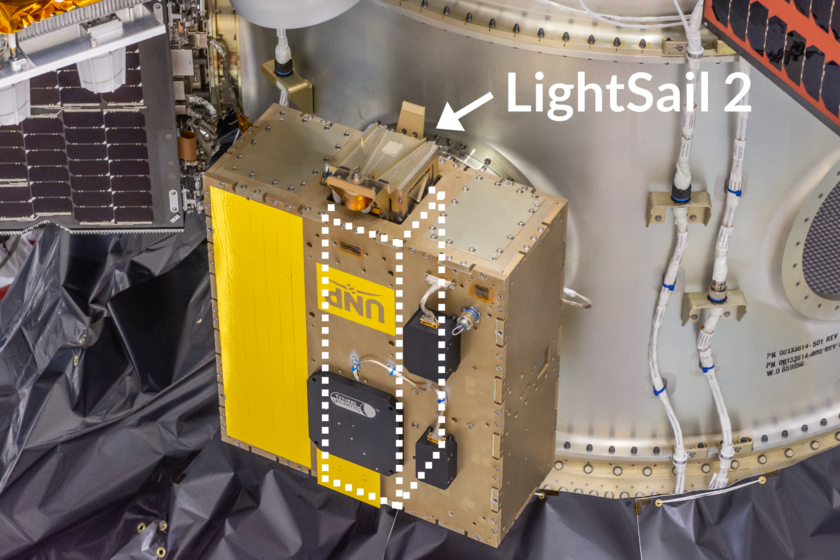
The payloads include university and private spacecraft such as the Planetary Society’s LightSail-2 solar sailing demonstrator: Here’s Our First Look at LightSail 2 Installed on SpaceX’s Falcon Heavy Rocket | The Planetary Society
*** First Crew Dragon flight to the ISS no earlier than November 15th according to the latest schedule.
- SpaceX’s Crew Dragon gets tentative NASA target for first astronaut launch – Teslarati
- NASA boss says ‘no doubt’ SpaceX explosion delays flight program – Reuters
*** SpaceX has a third GPS launch set for December: SpaceX on track for US Air Force Falcon 9 mission later this year – Teslarati
Reading between the lines, the US Air Force has effectively confirmed that GPS III Space Vehicle 03 (SV03) – the third GPS III satellite built by Lockheed Martin – is ready for launch aboard a SpaceX Falcon 9 rocket, scheduled no earlier than December 2019.
*** Starhopper still awaits the Raptor engine needed to do low altitude test flights. Preparation of the engines at the McGregor test site is taking longer than expected. It appears that first hops may not take place till July.
*** Starhopper preps and construction of the Starship orbital demostrators can often be viewed via these sources:
- LabPadre (@LabPadre) | Twitter
- LabPadre – YouTube
- Mary (@BocaChicaGal) | Twitter
- Austin Barnard🚀 (@austinbarnard45) | Twitter
- TomCross (@_TomCross_) | Twitter
- Chris B – NSF (@NASASpaceflight) | Twitter
A recent Starhopper tank test:
A new structure is in construction at the Boca Chica facility:
The crews @ #SpaceX were hard at work today, with the continuation of polishing of the nosecone for #StarShip. Meanwhile it appeared that SpaceX was getting ready to move another section(unknown to where, 4th image). The barrier still developing and #StarHopper under the☀️ pic.twitter.com/8Nq2j1axK6
— Austin Barnard🚀 (@austinbarnard45) June 20, 2019
Driving through Boca Chica @SpaceX pic.twitter.com/86qamHC1uU
— TomCross (@_TomCross_) June 21, 2019
NSF Member Popsa with photos of SpaceX’s East Coast Prototype Starship:
Looks like they are polishing that one too, but is already winning the “Shiny!” stakes.https://t.co/BpVyQs6e7M pic.twitter.com/b86Q0U5yug
— Chris B – NSF (@NASASpaceflight) June 21, 2019
====


 , plus the untold story of Dr. Conrad Lau in developing Lunar Orbital Rendezvous (LOR”.
 , plus how best to do space plus lots more”.