All posts by TopSpacer

ESO: Telescopes observe final moments of a star eaten by a black hole

A new report from the European Southern Observatory (ESO):

Death by Spaghettification:
ESO Telescopes Record Last Moments of Star Devoured by a Black Hole
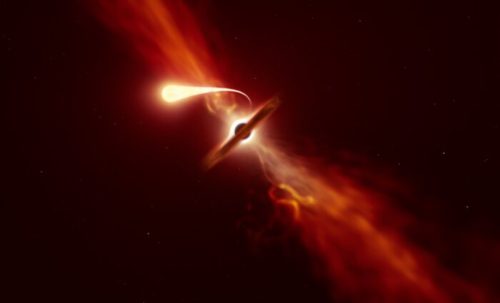
This illustration depicts a star (in the foreground) experiencing spaghettification as it’s sucked in by a supermassive black hole (in the background) during a ‘tidal disruption event’. In a new study, done with the help of ESO’s Very Large Telescope and ESO’s New Technology Telescope, a team of astronomers found that when a black hole devours a star, it can launch a powerful blast of material outwards.Credits ESO

Using telescopes from the European Southern Observatory (ESO) and other organisations around the world, astronomers have spotted a rare blast of light from a star being ripped apart by a supermassive black hole. The phenomenon, known as a tidal disruption event, is the closest such flare recorded to date at just over 215 million light-years from Earth, and has been studied in unprecedented detail. The research is published today in Monthly Notices of the Royal Astronomical Society.

“The idea of a black hole ‘sucking in’ a nearby star sounds like science fiction. But this is exactly what happens in a tidal disruption event,”

says Matt Nicholl, a lecturer and Royal Astronomical Society research fellow at the University of Birmingham, UK, and the lead author of the new study. But these tidal disruption events, where a star experiences what’s known as spaghettification as it’s sucked in by a black hole, are rare and not always easy to study. The team of researchers pointed ESO’s Very Large Telescope (VLT) and ESO’s New Technology Telescope (NTT) at a new flash of light that occurred last year close to a supermassive black hole, to investigate in detail what happens when a star is devoured by such a monster.

Astronomers know what should happen in theory.

“When an unlucky star wanders too close to a supermassive black hole in the centre of a galaxy, the extreme gravitational pull of the black hole shreds the star into thin streams of material,”

explains study author Thomas Wevers, an ESO Fellow in Santiago, Chile, who was at the Institute of Astronomy, University of Cambridge, UK, when he conducted the work. As some of the thin strands of stellar material fall into the black hole during this spaghettification process, a bright flare of energy is released, which astronomers can detect.

Although powerful and bright, up to now astronomers have had trouble investigating this burst of light, which is often obscured by a curtain of dust and debris. Only now have astronomers been able to shed light on the origin of this curtain.

“We found that, when a black hole devours a star, it can launch a powerful blast of material outwards that obstructs our view,” 

explains Samantha Oates, also at the University of Birmingham. This happens because the energy released as the black hole eats up stellar material propels the star’s debris outwards.

The discovery was possible because the tidal disruption event the team studied, AT2019qiz, was found just a short time after the star was ripped apart.

“Because we caught it early, we could actually see the curtain of dust and debris being drawn up as the black hole launched a powerful outflow of material with velocities up to 10 000 km/s,” says Kate Alexander, NASA Einstein Fellow at Northwestern University in the US. “This unique ‘peek behind the curtain’ provided the first opportunity to pinpoint the origin of the obscuring material and follow in real time how it engulfs the black hole.”

The team carried out observations of AT2019qiz, located in a spiral galaxy in the constellation of Eridanus, over a 6-month period as the flare grew in luminosity and then faded away.

“Several sky surveys discovered emission from the new tidal disruption event very quickly after the star was ripped apart,” says Wevers. “We immediately pointed a suite of ground-based and space telescopes in that direction to see how the light was produced.”

Multiple observations of the event were taken over the following months with facilities that included X-shooter and EFOSC2, powerful instruments on ESO’s VLT and ESO’s NTT, which are situated in Chile. The prompt and extensive observations in ultraviolet, optical, X-ray and radio light revealed, for the first time, a direct connection between the material flowing out from the star and the bright flare emitted as it is devoured by the black hole.

“The observations showed that the star had roughly the same mass as our own Sun, and that it lost about half of that to the monster black hole, which is over a million times more massive,”

says Nicholl, who is also a visiting researcher at the University of Edinburgh.

The research helps us better understand supermassive black holes and how matter behaves in the extreme gravity environments around them. The team say AT2019qiz could even act as a ‘Rosetta stone’ for interpreting future observations of tidal disruption events. ESO’s Extremely Large Telescope (ELT), planned to start operating this decade, will enable researchers to detect increasingly fainter and faster evolving tidal disruption events, to solve further mysteries of black hole physics.

Links

=== Amazon Ad ===

Imagined Life: A Speculative Scientific Journey among the Exoplanets
in Search of Intelligent Aliens, Ice Creatures, and Supergravity Animals


Videos: “Space to Ground” + Other ISS reports – Oct.9.2020

Here is the latest episode in NASA’s Space to Ground weekly report on activities related to the International Space Station:

** Rocket Ranch Episode 24: Space Lullaby – NASA’s Kennedy Space Center

Astronaut Chris Hadfield’s cover of David Bowie’s Space Oddity that he recorded while on the International Space Station has over 47 million views. Now retired, the veteran of three spaceflights and first Canadian to walk in space has given a lot of thought to the future of space exploration and what it can mean for all of us. Hear from him now on this episode of the Rocket Ranch.

** NASA Television Video File – Expedition 64 Pre Launch Baikonur Activities – October 8, 2020 – NASA Video

At the Baikonur Cosmodrome in Kazakhstan, the International Space Station’s Expedition 64 crew, Soyuz Commander Sergey Ryzhikov of Roscosmos, Flight Engineers Sergey Kud-Sverchkov of Roscosmos and Kate Rubins of NASA and their backups, Oleg Novitskiy and Petr Dubrov of Roscosmos and Mark Vande Hei of NASA, participated in a variety of activities Sept. 27-Oct. 7 as they prepared for the upcoming mission. Ryzhikov, Kud-Sverchkov and Rubins are set to launch Oct. 14 from Baikonur in the Soyuz MS-17 spacecraft for a six-month mission on the International Space Station. The footage includes the crew’s arrival in Baikonur, their Soyuz fit check in the Cosmodrome’s Integration Facility, the ceremonial Cosmonaut Hotel flag-raising ceremony and other training milestones.

** Expedition 63 Astronaut Chris Cassidy speaks with Time Magazine – October 5, 2020 – NASA Video

Aboard the International Space Station, Expedition 63 Commander Chris Cassidy of NASA discussed his mission and future space exploration during an in-flight event Oct. 6 with TIME Magazine’s “TIME 100 Talks” series. Cassidy is in the final weeks of his six-and-a-half month mission on the station, heading for a return to Earth Oct. 22 aboard a Russian Soyuz spacecraft.

** Northrop Grumman’s Cygnus 14 Rendezvous and Capture – October 5, 2020 – NASA Video

Loaded with almost four tons of supplies and scientific experiments, Northrop Grumman’s unpiloted Cygnus cargo ship arrived at the International Space Station Oct. 5, four days after launching from the Wallops Flight Facility, Virginia atop the company’s Antares rocket. Named the “SS Kalpana Chawla” in honor of the late NASA astronaut who lost her life in the Columbia accident in February 2003, Cygnus was captured by Expedition 63 Commander Chris Cassidy of NASA using the station’s Canadian-built robotic arm. Ground controllers then installed Cygnus to the Earth-facing port of the Unity module where it will reside until mid-December.

** How to use the Bathroom in Space – NASA Johnson

One of the most frequent questions we get about life on Space Station is how to use the toilet…Here’s a quick look at the answer! -Expedition 63 Commander Chris Cassidy

=== Amazon Ads ===

Outpost in Orbit:
A Pictorial & Verbal History of the Space Station

======

LEGO Ideas International Space Station Building Kit,
Adult Set for Display,
Makes a Great Birthday Present
(864 Pieces)

======

NASA competition seeks innovative lunar power systems ideas

NASA opens a public competition for innovations in power systems for lunar exploration:

NASA Seeks Ideas from the Public
for Powering Exploration on the Moon

NASA’s Watts on the Moon Challenge — the agency’s newest public prize competition — is now open and accepting submissions. NASA invites innovative minds from across the United States to provide ideas for sustainable energy storage, distribution, and management on the lunar surface.

As part of the Artemis program, NASA will send astronauts to new areas of the Moon including the lunar South Pole, and prepare for human exploration of Mars. As noted in the agency’s recent lunar surface report, sustainable missions will require an unprecedented capacity for power. Astronauts will need a continuous supply of power from multiple sources to live and work on the Moon for long periods. A flexible and robust system for surface power is key to safe and robust lunar exploration.

“Operating throughout the lunar night creates some of the most demanding energy storage and thermal management challenges in our exploration of the solar system,” said Walt Engelund, the deputy associate administrator for programs within NASA’s Space Technology Mission Directorate. “We are calling on the public for their fresh ideas to help us innovate power solutions for the Moon.”

The Goal

On much of the Moon’s surface, daylight lasts a little over 14 Earth days, followed by 14 days of darkness and extremely cold temperatures. State-of-the-art power systems cannot operate in such harsh conditions. While sunlight is more available at the lunar poles, there are irregular periods of darkness and locations, like within craters, where the Sun never shines.Existing state-of-the-art power systems cannot operate in such harsh conditions or are too heavy and bulky for flight.

NASA is developing technologies to provide sustainable power through the extreme environments of the lunar night, including fission surface power, solar power, and regenerative fuel cells. The Watts on the Moon Challenge complements those efforts by focusing on technologies to distribute, manage, and store energy generated by different sources.

Similarly, terrestrial energy needs, utility business models, and customer demands for renewable energy are evolving to necessitate new solutions for power distribution, power management, energy storage, and thermal storage. Not only could novel solutions make a difference in lunar and space exploration, but technologies discovered during NASA’s Watts on the Moon competition could help facilitate new power options on Earth.

“We are excited about leading this challenge and being at the forefront of solutions for powering operations on the Moon and potentially improving life here on Earth,” said  Marla Pérez-Davis, director for NASA’s Glenn Research Center in Cleveland. “Here at Glenn, and at our satellite facility, NASA’s Plum Brook Station in Sandusky, Ohio, we are conducting research and technology development in power systems for aerospace applications. This competition will take the next step by generating new ideas for ways to distribute, manage, and store that energy on the surface of the Moon.”

The Competition

The Watts on the Moon competition will take place over multiple phases. For Phase 1 of the competition, participants will design a flexible and robust system capable of addressing one or more of three hypothetical mission activities similar to a real lunar mission. Solutions to this challenge will advance technology by developing energy distribution, management, and storage that can facilitate initial human presence on the Moon.

Individuals and teams interested in participating in the challenge can register and submit concept designs until 5 p.m. EDT on March 25, 2021. Winners will be awarded a portion of the $500,000 prize purse.

Depending on the outcome of the design competition, a second phase could task participants to build working prototypes that demonstrate their solutions. Phase 2 prizes are expected to total $4.5 million and could involve testing at a NASA or third-party facility.

The Watts on the Moon Challenge is managed by Glenn, and is part of NASA’s Centennial Challenges, based at NASA’s Marshall Space Flight Center in Huntsville, Alabama. Centennial Challenges is a part of the Prizes and Challenges program within NASA’s Space Technology Mission Directorate. NASA Centennial Challenges has contracted HeroX to support the execution of this challenge.

To learn more about the challenge and register to participate, visit: nasa.gov/wattson

For more information about NASA’s Prizes and Challenges, visit:  https://www.nasa.gov/solve/index.html

=== Amazon Ad ===

Space Is Open for Business:
The Industry That Can Transform Humanity

Space In Miniature Tech Report 4 – Energiya Buran

Michael Mackowski of Space in Miniature sent me an announcement of his latest report:

Space In Miniature Tech Report 4 – Energiya Buran
Reference Book for Model Builders

The fourth installment in the Space In Miniature (SIM) short-form “Tech Reports” series of reference booklets for spacecraft modelers is now available. The 30-page digital publication, SIM Tech Report #4 – Energiya Buran,  describes in detail how the author, Michael Mackowski, built six different model kits of the old Soviet Union’s Energiya Buran heavy lift rocket and orbiter.

The Buran program, with its associated Energiya heavy booster, was the Soviet response to the United States Space Shuttle. The Energiya booster was only launched twice, in 1987 and 1988.

A total of six different kits in two scales are included in this book, which is loaded with over 70 photos of work in progress of the following subjects:

  • 1/288 Energiya Buran (STC Start)
  • 1/288 Energiya Polyus (STC Start)
  • 1/288 Energia Buran (Master Modell)
  • 1/144 Energia Buran (Anigrand)
  • 1/144 Buran (Rho Models)
  • 1/144 Buran (Ark)

The SIM Tech Reports cover topics that are too short or too narrow in subject matter for full length printed books. These are also distributed only as electronic (pdf) copies, which can be printed by the customer. It allows the use of color illustrations, and customers get their books via a simple download. The pdf download sells for $7.00 and is available at spaceinminiature.com.

===

Check out videos of SIM projects on Michael Mackowski’s YouTube channel. It includes several videos about the Energiya Buran project, e.g.

=== Amazon Ad ===

LEGO Ideas International Space Station Building Kit,
Adult Set for Display,
Makes a Great Birthday Present
(864 Pieces)

Space policy roundup – Oct.5.2020

A sampling of links to recent space policy, politics, and government (US and international) related space news and resource items that I found of interest (find previous space policy roundups here):

International space

Webcasts:

** E35 – Evolving STEM Education (with Lael Woods and Special Guests) – Aerospace Corp – Center for Space Policy & Strategy (CSPS)

** Charity Weeden – Orbital Environmental Management And In-Space logistics With Astroscale – CSPS02E63 – Cold Star Technologies – YouTube

VP Global Space Policy of Astroscale US, Charity Weeden is on the Cold Star Project to share her background and the organization’s vision for space. Orbital environmental management and in-space logistics are two key areas Astroscale is developing capabilities and influence in. With host Jason Kanigan, Charity discusses:

-the vision, mission and organization of Astroscale
– how the technical, business and policy areas interlink through the organization’s efforts
– why space debris is a problem, and what we can do about it
– her background and how she arrived at the VP Global Space Policy role
– what her typical day looks like what COMSTAC is, and her role as chair
– looking forward to working in cislunar space and its implications
– the costs of decommissioning and the ways these costs are currently hidden.

** Sun. Oct.5.2020 – The Space Show – Dr. Robert (Sam) Wilson of The Aerospace Corp talked about his paper, The Value Of Space.

** Thurs. Oct.1.2020 – Dr. Robert Zubrin talked about the Mars Society 2020 virtual conference (Thurs. – Sun., Oct. 15-18, 2020) and more.

** Space Café Podcast Episode 012 Featuring Chris Lee Is Now Available – SpaceWatch.Global

Chris Lee has just retired from his position as Chief Scientist of the UK Space Agency and, after 40 years in the space industry, can now finally retire to do what he enjoys most: space travel. Chris has had a career in some of the most dramatic and legendary missions in space travel. Hubble, Beagle2, Exomars to name a few. Now that he has retired, he can talk freely about his 40 years of passion. Also about why he thinks ESA could have a great future.

** Podcast: Space Law Advisor Chris Johnson – Ex Terra

This week on the Ex Terra podcast, we talk with Chris Johnson about some of the legal aspects of space commerce. Chris Johnson is the Space Law Advisor for the Secure World Foundation, and a Professor of Law (Adjunct) at the Georgetown University Law Center where he co-teaches the Space Law Seminar. He is also a Faculty Member at the International Space University, and a member of the International Institute of Space Law (IISL). Mr. Johnson has written widely on space law and policy issues, and represents the Secure World Foundation at the Legal Subcommittee of the United Nations Committee on the Peaceful Uses of Outer Space (COPUOS).

** Episode 24 What’s Hot 3rd Quarter 2020 – Space Thoughts/Michael Listner, Space Law & Policy Solutions

** September 30, 2020 Zimmerman/Batchelor podcast

** October 2, 2020 Zimmerman/Batchelor podcast

====

=== Amazon Ad ===

Space Is Open for Business:
The Industry That Can Transform Humanity