3. Wednesday, Mar.31 2021, 1:30 pm PDT (3:30 CDT, 4:30 pm EDT): Hotel Mars – Dr. Haym Benaroya, of Rutgers University will talk with John Batchelor and Dr. David Livingston about the latest developments in lunar habitats, returning to the Moon and more.
4. Thursday, Apr. 1, 2021; 6:30-8:90 pm PDT (8:30-10:00 pm CDT, 9:30-11:00 pm EDT): A San Francisco AIAA Chapter webinar featuring an interview with Dr. David Livingston about The Space Show with Kim Holderand John Jossy. For registration and details for “The Space Show Behind The Scenes” program, see The Space Show website Upcoming Show Menu for April 1, 2021.
5. Friday, Apr.2, 2021; 9:30-11 am PDT (11:30 am-1 pm CDT, 12:30-2 pm EDT): We welcome Bruce Pittman back to the program to discuss his proposal, “Spacecraft Nation: A Toolkit for Building Back Better Using Space“.
6. Sunday, Apr.4, 2021; 12-1:30 pm PDT (3-4:30 pm EDT, 2-3:30 pm CDT): No program today as this is Easter Sunday.
** Wednesday, Mar.24.2021 – Hotel Mars – The Space Show/John Bachelor Show – Anatoly Zak of RussianSpaceWeb.com talked with John Batchelor and Dr. David Livingston about “the Perseverance on mars, the upcoming helicopter flight in the thin Martian atmosphere, Curiosity progress, plus we talked about the ISS leak in the Russian segment, the effort to repair it, the materials used in the repair, the impact of the leak on the remaining life of the ISS and related items. In the second segment, we discussed the agreement with China and Russia on establishing a lunar base together in the not too distant future.”
** Tuesday, Mar.23.2021 – Robert Zimmerman “returned for a two hour plus discussion ranging from the Mars rovers, especially Perseverance, to NASA marketing policy for Mars and the rover missions, to suborbital tourism, SpaceX, Blue Origin and Virgin news plus more.”
A sampling of links to recent space policy, politics, and government (US and international) related space news and resource items that I found of interest (find previous space policy roundups here):
1) An ambitious deployment plan laid out by CGSTL … 2) Media report on the quality control at Xingyun … 3) Daxing aerospace base … 4) Haisi-1 Ever Given Shot … 5) 2 New Tianwen-1 Mars Shots
** In Conversation with the UK’s Leading Space Commanders – War Studies KCL
The Freeman Air and Space Institute, King’s College London, in partnership with Airbus, were delighted to host the first ever in conversation event between the UK’s leading space commanders.
It was a unique first opportunity to hear from Air Vice-Marshal Paul Godfrey, the inaugural commander of the newly established Space Command, launching on 1 April 2021, as he discussed with Air Vice-Marshal Harvey Smyth, Ministry of Defence Director Space, their vision for the future of UK military in space.
A panel of experts on space from industry, politics, the military and research, put their questions to the two commanders.
After nearly 60 years, the Outer Space Treaty continues to hold one of the only explicit arms-control provisions for space in international law: Article IV prohibits the placement in orbit of nuclear weapons or other weapons of mass destruction.
Today, however, there is a growing probability that conflict will emerge in space with conventional weapons, potentially in destructive or catastrophic ways. Will the Outer Space Treaty be sufficient to prevent conflict in space? Will the absence of greater prohibitions lead to the placement of conventional weapons in orbit? What paths are available to prevent the degradation of space through war?
Moderator and panelists:
Daniel Porras , Director of Strategic Partnerships and Communications at the Secure World Foundation, Non-resident Fellow at the UN Institute for Disarmament Research
Paul Meyer, Canadian Ambassador and Permanent Representative (retired) to the United Nations and to the Conference on Disarmament in Geneva , International Security and Adjunct Professor of International Studies at Simon Fraser University
Andrei Belousov, Deputy Permanent Representative of the Russian Federation to the United Nations Office at Geneva
Patricia Lewis, Director of the International Security Programme and Research Director of Conflict, Science & Transformation at Chatham House
Carine Claeys, EU Special Envoy for Space in the European External Action Service (EEAS)
SWF Executive Director Peter Martinez and Director of Strategic Partnerships and Communications Daniel Porras spoke on a panel, hosted by the Space Court Foundation, on the various “silos” that exist within the space community and how these groups might come together to develop a responsive governance framework for space.
In this week’s Space Cafè WebTalk, Nikolai Khlystov, Lead, Shaping the Future of Mobility and Space at World Economic Forum, Geneva, Switzerland talked about ways and initiatives that support sustainable peace in space.
President Biden nominated Bill Nelson to be the new NASA Administrator, so I check in on some of my past thoughts on NASA Administrators and Jim Bridenstine, talk about Bill Nelson’s history in space policy, and what the future may hold under a Bill Nelson NASA.
** Hotel Mars – The Space Show/John Bachelor Show – Wed. Mar.24.2021 – Anatoly Zak of www.russianspaceweb.com talked with John Batchelor and Dr. David Livingston about “the Perseverance on mars, the upcoming helicopter flight in the thin Martian atmosphere, Curiosity progress, plus we talked about the ISS leak in the Russian segment, the effort to repair it, the materials used in the repair, the impact of the leak on the remaining life of the ISS and related items. In the second segment, we discussed the agreement with China and Russia on establishing a lunar base together in the not too distant future.”
** The Space Show – Tuesday, Mar.23.2021 – Robert Zimmerman “returned for a two hour plus discussion ranging from the Mars rovers, especially Perseverance, to NASA marketing policy for Mars and the rover missions, to suborbital tourism, SpaceX, Blue Origin and Virgin news plus more.”
Here is the latest episode in NASA’s Space to Ground weekly report on activities related to the International Space Station:
** NASA ScienceCasts: Observing Lightning from the International Space Station – ScienceAtNASA
Colorful bursts of energy above thunderstorms called transient luminous events can be observed from the International Space Station. Instruments on the station are helping scientists study these particle outbursts, which may prove useful to better understand our climate, weather, and the behaviors of storms. Space Station Research & Tech: https://www.nasa.gov/iss-science
** Vice President Kamala Harris Calls NASA Astronauts Shannon Walker and Kate Rubins – NASA
U.S. Vice President Kamala Harris placed a special phone call to Shannon Walker and Kate Rubins aboard the International Space Station to find out what it’s like to do science in space. During the month of March, NASA celebrates and pays tribute to the many women who have played an essential role in shaping the history of the agency. Learn more about Shannon Walker by visiting: https://www.nasa.gov/astronauts/biogr… Learn more about Kate Rubins by visiting: https://www.nasa.gov/astronauts/biogr…
** Expedition 64 Inflight Event with Discovery Channel – March 26, 2021 – NASA Video
Aboard the International Space Station, Expedition 64 Flight Engineers Victor Glover of NASA and Soichi Noguchi of the Japan Aerospace Exploration Agency (JAXA) discussed their mission and their upcoming return to Earth aboard the SpaceX Crew Dragon “Resilience” during an in-flight interview March 26 with the Discovery Channel. Along with Glover and Noguchi, Flight Engineers Mike Hopkins and Shannon Walker of NASA launched last November aboard “Resilience” and are in the final weeks of their planned six-month mission, headed for a return to Earth in late April.
** Expedition 65 Vande Hei Live Shots March 23, 2021 – NASA Video
NASA astronaut Mark Vande Hei participated in media interviews on March 23, 2021 from the Gagarin Cosmonaut Training Center in Star City, Russia. Vande Hei, along with cosmonauts Oleg Novitskiy and Pyotr Dubrov of the Russian space agency Roscosmos, is scheduled to launch to the space station Friday, April 9, on the Soyuz MS-18 spacecraft from the Baikonur Cosmodrome in Kazakhstan. This will be his second spaceflight.
** ISS Moon Transit – Photographing the International Space Station. – Russell Discombe
In this video I head out with a friend to capture the ISS transiting the moon. I use my Sony a7iii, Sony 200-600mm lens and I discuss the settings used and record the moment that the ISS passes in front of the moon. The International Space Station flies 400 km high at 28,800 km/h (15,500 MPH). It only takes 92 minutes to make a complete circuit of Earth…the ISS goes around the Earth every 92 minutes! Astronauts working and living on the Station experience 16 sunrises and sunsets each day. This image consists of 20 images that were taken within a 2 second window.
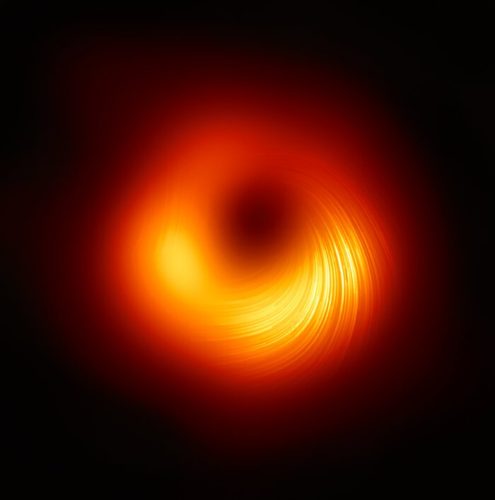
The Event Horizon Telescope (EHT) collaboration, who produced the first ever image of a black hole released in 2019, has today a new view of the massive object at the centre of the Messier 87 (M87) galaxy: how it looks in polarised light. This is the first time astronomers have been able to measure polarisation, a signature of magnetic fields, this close to the edge of a black hole. This image shows the polarised view of the black hole in M87. The lines mark the orientation of polarisation, which is related to the magnetic field around the shadow of the black hole.
The Event Horizon Telescope (EHT) collaboration, who produced the first ever image of a black hole, has today revealed a new view of the massive object at the centre of the Messier 87 (M87) galaxy: how it looks in polarised light. This is the first time astronomers have been able to measure polarisation, a signature of magnetic fields, this close to the edge of a black hole. The observations are key to explaining how the M87 galaxy, located 55 million light-years away, is able to launch energetic jets from its core.
“We are now seeing the next crucial piece of evidence to understand how magnetic fields behave around black holes, and how activity in this very compact region of space can drive powerful jets that extend far beyond the galaxy,”
says Monika Mościbrodzka, Coordinator of the EHT Polarimetry Working Group and Assistant Professor at Radboud University in the Netherlands.
On 10 April 2019, scientists released the first ever image of a black hole, revealing a bright ring-like structure with a dark central region — the black hole’s shadow. Since then, the EHT collaboration has delved deeper into the data on the supermassive object at the heart of the M87 galaxy collected in 2017. They have discovered that a significant fraction of the light around the M87 black hole is polarised.
“This work is a major milestone: the polarisation of light carries information that allows us to better understand the physics behind the image we saw in April 2019, which was not possible before,”
explains Iván Martí-Vidal, also Coordinator of the EHT Polarimetry Working Group and GenT Distinguished Researcher at the University of Valencia, Spain. He adds that
“unveiling this new polarised-light image required years of work due to the complex techniques involved in obtaining and analysing the data.”
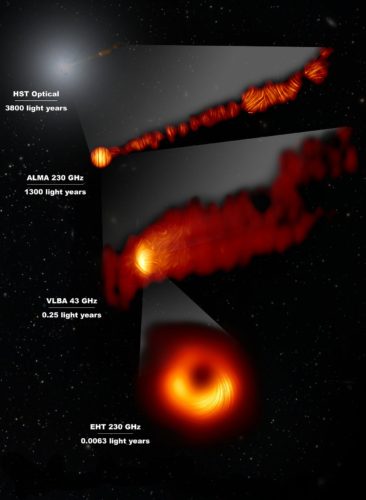
This composite image shows three views of the central region of the Messier 87 (M87) galaxy in polarised light and one view, in the visible wavelength, taken with the Hubble Space Telescope. The galaxy has a supermassive black hole at its centre and is famous for its jets, that extend far beyond the galaxy. The Hubble image at the top captures a part of the jet some 6000 light years in size. One of the polarised-light images, obtained with the Chile-based Atacama Large Millimeter/submillimeter Array (ALMA), in which ESO is a partner, shows part of the jet in polarised light. This image captures the part of the jet, with a size of 6000 light years, closer to the centre of the galaxy. The other polarised light images zoom in closer to the supermassive black hole: the middle view covers a region about one light year in size and was obtained with the National Radio Astronomy Observatory’s Very Long Baseline Array (VLBA) in the US. The most zoomed-in view was obtained by linking eight telescopes around the world to create a virtual Earth-sized telescope, the Event Horizon Telescope or EHT. This allows astronomers to see very close to the supermassive black hole, into the region where the jets are launched. The lines mark the orientation of polarisation, which is related to the magnetic field in the regions imaged. The ALMA data provides a description of the magnetic field structure along the jet. Therefore the combined information from the EHT and ALMA allows astronomers to investigate the role of magnetic fields from the vicinity of the event horizon (as probed with the EHT on light-day scales) to far beyond the M87 galaxy along its powerful jets (as probed with ALMA on scales of thousand of light-years). The values in GHz refer to the frequencies of light at which the different observations were made. The horizontal lines show the scale (in light years) of each of the individual images.
Light becomes polarised when it goes through certain filters, like the lenses of polarised sunglasses, or when it is emitted in hot regions of space where magnetic fields are present. In the same way that polarised sunglasses help us see better by reducing reflections and glare from bright surfaces, astronomers can sharpen their view of the region around the black hole by looking at how the light originating from it is polarised. Specifically, polarisation allows astronomers to map the magnetic field lines present at the inner edge of the black hole.
“The newly published polarised images are key to understanding how the magnetic field allows the black hole to ‘eat’ matter and launch powerful jets,”
says EHT collaboration member Andrew Chael, a NASA Hubble Fellow at the Princeton Center for Theoretical Science and the Princeton Gravity Initiative in the US.
The bright jets of energy and matter that emerge from M87’s core and extend at least 5000 light-years from its centre are one of the galaxy’s most mysterious and energetic features. Most matter lying close to the edge of a black hole falls in. However, some of the surrounding particles escape moments before capture and are blown far out into space in the form of jets.
Astronomers have relied on different models of how matter behaves near the black hole to better understand this process. But they still don’t know exactly how jets larger than the galaxy are launched from its central region, which is comparable in size to the Solar System, nor how exactly matter falls into the black hole. With the new EHT image of the black hole and its shadow in polarised light, astronomers managed for the first time to look into the region just outside the black hole where this interplay between matter flowing in and being ejected out is happening.
The observations provide new information about the structure of the magnetic fields just outside the black hole. The team found that only theoretical models featuring strongly magnetised gas can explain what they are seeing at the event horizon.
“The observations suggest that the magnetic fields at the black hole’s edge are strong enough to push back on the hot gas and help it resist gravity’s pull. Only the gas that slips through the field can spiral inwards to the event horizon,”
explains Jason Dexter, Assistant Professor at the University of Colorado Boulder, US, and Coordinator of the EHT Theory Working Group.
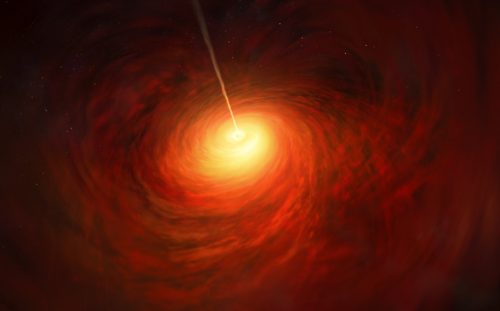
This artist’s impression depicts the black hole at the heart of the enormous elliptical galaxy Messier 87 (M87). This black hole was chosen as the object of paradigm-shifting observations by the Event Horizon Telescope. The superheated material surrounding the black hole is shown, as is the relativistic jet launched by M87’s black hole.
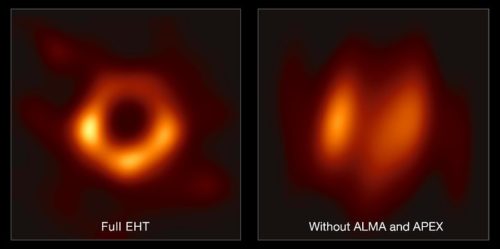
To observe the heart of the M87 galaxy, the collaboration linked eight telescopes around the world — including the northern Chile-based Atacama Large Millimeter/submillimeter Array (ALMA) and the Atacama Pathfinder EXperiment (APEX), in which the European Southern Observatory (ESO) is a partner — to create a virtual Earth-sized telescope, the EHT. The impressive resolution obtained with the EHT is equivalent to that needed to measure the length of a credit card on the surface of the Moon.
“With ALMA and APEX, which through their southern location enhance the image quality by adding geographical spread to the EHT network, European scientists were able to play a central role in the research,” … “With its 66 antennas, ALMA dominates the overall signal collection in polarised light, while APEX has been essential for the calibration of the image.”
[says Ciska Kemper, European ALMA Programme Scientist at ESO.]
“ALMA data were also crucial to calibrate, image and interpret the EHT observations, providing tight constraints on the theoretical models that explain how matter behaves near the black hole event horizon,”
adds Ciriaco Goddi, a scientist at Radboud University and Leiden Observatory, the Netherlands, who led an accompanying study that relied only on ALMA observations.
The EHT setup allowed the team to directly observe the black hole shadow and the ring of light around it, with the new polarised-light image clearly showing that the ring is magnetised. The results are published today in two separate papers in The Astrophysical Journal Letters by the EHT collaboration. The research involved over 300 researchers from multiple organisations and universities worldwide.
“The EHT is making rapid advancements, with technological upgrades being done to the network and new observatories being added. We expect future EHT observations to reveal more accurately the magnetic field structure around the black hole and to tell us more about the physics of the hot gas in this region,”
concludes EHT collaboration member Jongho Park, an East Asian Core Observatories Association Fellow at the Academia Sinica Institute of Astronomy and Astrophysics in Taipei.
This image shows the contribution of ALMA and APEX to the EHT. The left hand image shows a reconstruction of the black hole image using the full array of the Event Horizon Telescope (including ALMA and APEX); the right-hand image shows what the reconstruction would look like without data from ALMA and APEX. The difference clearly shows the crucial role that ALMA and APEX played in the observations.
1. Monday, Mar. 22, 2021; 7 pm PDT (9 pm CDT, 10 pm EDT: No program today.
2. Tuesday, Mar. 23, 2021; 7 pm PDT (9 pm CDT, 10 pm EDT): We welcome back Robert Zimmerman for updates on commercial space and other important and timely news events & stories.
3. Wednesday, Mar. 24, 2021: Hotel Mars TBA pre-recorded. See upcoming show menu on the home page for program details.
4. Thursday, Mar. 25, 2021; 7-8:30 pm PDT (9-10:30 pm CDT, 10-11:30 pm EDT): No program today.
6. Sunday, Mar.28, 2021; 12-1:30 pm PDT (3-4:30 pm EDT, 2-3:30 pm CDT): We welcome back both Leonard David and Barbara Sprungman-David for special news and policy insights only possible with these guests.
Some recent shows:
** Mar.21.2021 – Open Lines program– David Livingston says, “Robert Jacobson started us out with another NewSpace Commercial Space Report plus we took several callers on various topics.”