Space policy roundup – March 3.14

Selection of space policy/politics related posts:

MESSENGER Mercury mission team wins NSS Space Pioneer Award

An announcement from the National Space Society and ISDC 2014:

MESSENGER Team Wins National Space Society’s Space Pioneer Award
for Science and Engineering  

PioneerTrophy_608

Washington DC – March 3, 2014:  The National Space Society takes great pleasure in awarding its 2014 Space Pioneer Award for the Science and Engineering category to the (Mercury) MESSENGER Team.  MESSENGER stands for MErcury Surface, Space ENvironment, GEochemistry, and Ranging.  This spacecraft entered an orbit around the planet Mercury and conducted an extensive scientific survey of the entire planet, the first human object to do so.  With this award, NSS recognizes both the importance of the first dedicated probe to orbit Mercury and the significance of the scientific results already released.

The National Space Society will present the Space Pioneer Award to MESSENGER project representatives Drs. Sean C. Solomon, Larry R. Nittler and Ralph McNutt at NSS’s annual conference, the 2014 International Space Development Conference (ISDC).  The conference will be held at the Sheraton Gateway Hotel in Los Angeles, CA.  The ISDC will run from May 14-18, 2014.

MessengerPatch_606

About the MESSENGER Team:

The Principal Investigator for the Messenger Team is Dr. Sean C. Solomon. He also directs the prestigious Lamont-Doherty Earth Observatory at Columbia University.  Dr. Larry R. Nittler is MESSENGER’s Deputy Principal Investigator. Dr. Ralph McNutt is MESSENGER’s Project Scientist. The historic achievements of the MESSENGER Team (after construction and launch of the spacecraft) include successfully placing the spacecraft accurately into its intended orbit around Mercury on March 18, 2011, after a series of six critical flybys of the Earth, Venus, and Mercury itself.  Besides the critical contribution of accurately mapping Mercury’s surface, the science results have confirmed the presence of water ice and organic chemicals at the poles, and the fact that Mercury’s magnetic field is offset to the north substantially from its equator.

About the MESSENGER Mission:

MESSENGER confirmed suspicions of major regional volcanism and mapped global patterns of thrust fault scarps that show Mercury has contracted several times more than Mariner 10 data indicated.  Global elemental and mineralogical mapping confirmed Mercury has a low-iron crustal mineralogy, but unexpectedly showed sulfur, potassium and other volatile elements are abundant, upsetting high temperature models of Mercury’s formation.  MESSENGER has discovered pitted “hollows” with bright halos, found in many craters, which appear to involve volatile loss but their formation mechanism remains enigmatic.

About the Space Pioneer Award: 

The Space Pioneer Award consists of a silvery pewter Moon globe cast by the Baker Art Foundry in Placerville, California, from a sculpture originally created by Don Davis, the well-known space and astronomical artist.  The globe, as shown at right, which represents multiple space mission destinations and goals, sits freely on a brass support with a wooden base and brass plaque, which are created by Michael Hall’s Studio Foundry of Driftwood, TX. There are several different categories under which the award is presented each year, starting in 1988.  The NSS Awards Committee has been chaired by John Strickland since 2007 and its members seek prestigious award candidates on a continual basis.

About the ISDC: 
The International Space Development Conference (ISDC) is the annual conference of the National Space Society bringing together NSS leaders and members with leading managers, engineers, scientists, educators, and businessmen from civilian, military, commercial, entrepreneurial, and grassroots advocacy space sectors.
About the National Space Society: 
NSS is an independent non-profit educational membership organization dedicated to the creation of a spacefaring civilization.  NSS is widely acknowledged as the preeminent citizen’s voice on space, with thousands of members and supporters, and over 50 chapters in the United States and around the world.  The Society publishes Ad Astra magazine, an award-winning periodical chronicling the most important developments in space.  To learn more, visit www.nss.org.

The Space Show this week

The guests and topics for The Space Show this week:

1. Monday, March 3, 2014, 2-3:30 PM PST (5-6:30 PM EST, 4-5:30 PM CST): We welcome back DR. JJEFF BELL. Dr. Bell will give us his assessment of space projects and ideas.

2. Tuesday, March 4, 2014:, 7-8:30 PM PST (10-11:30 PM EST, 9-10:30 PM CST): OPEN LINES. This is going to be the only Open Lines show for March. All STEM and Space calls welcome along with first time callers.

3. Friday, March 7, 2014, 9:30-11 AM PST (12:30-2 PM EST; 11:30 AM-1 PM CST): We welcome back DRAGOS BRATASANU to discuss why aerospace & aviation projects fail & why we fail in the management of these projects. Check The Space Show blog in advance of this program as Dragos is gifting to us a free chapter in his book on this subject. I will have the chapter uploaded to the blog on Thursday.

4. Sunday, March 9, 2014, 12-1:30 PM PST (3-4:30 PM EST, 2-3:30 PM CST). DR. GIL LEVIN returns to discuss the latest news with his Mars Viking Lander Labeled Release experiments and searching for some sort of life on Mars.

See also:
/– The Space Show on Vimeo – webinar videos
/– The Space Show’s Blog – summaries of interviews.
/– The Space Show Classroom Blog – tutorial programs

The Space Show is a project of the One Giant Leap Foundation.

Mars One to use Uwingu name maps

An announcement from Uwingu concerning a partnership with Mars One and the new Mars Crater Naming Project (see earlier posting):

Private Mars One Human and Lander Missions to Use Uwingu Name Maps
Private Mars One Mars Lander Mission to Carry
Uwingu Mars Crater Names Map to Mars

Today, Uwingu and the Mars One project announced a landmark partnership: All robotic and human Mars One missions will carry Uwingu’s Mars Crater Map to Mars, and use these feature names as a part of Mars One mission operations. In exchange, a portion of Uwingu Fund revenues generated by Mars feature naming at Uwingu’s web site (www.uwingu.com) will help fund Mars One missions.

mars-naming-project-impact

Uwingu launched its Mars Crater Naming Project last week, giving anyone in the public the opportunity to name any of the approximately 500,000 scientifically identified craters on Mars. Proceeds from this project will help create up to $10M in Uwingu grants to Mars One and other space projects, to individual space researchers, and to space educators.

Says Uwingu founder and CEO Dr. Alan Stern, a planetary scientist and the former head of NASA’s science program, “This partnership catapults Uwingu’s Mars crater naming database and Mars maps into the forefront of Mars exploration. Every person who names craters on Mars will now know that their crater names are to be used in the exploration and eventual settlement of Mars.”

Bas Lansdorp, Mars One Co-Founder and CEO,  said: ”We’re very enthusiastic about the partnership with Uwingu. Like Mars One, Uwingu gives everyone around the world the opportunity to participate in space exploration. The name you choose will go down in history, travelling on board our 2018 mission lander and will be used by our future astronauts. What an amazing opportunity!”

MarsSurfaceViewerMars Surface Viewer

===

And here’s the Mars One version of the announcement:

Mars One partners with Uwingu Mars Crater Naming Project

Amersfoort, 3rd March 2014 – Today, the Mars One project and Uwingu are excited to announce a landmark partnership. Mars One will utilize the soon-to-be-developed Uwingu Mars Map in all its missions and will land that map on Mars on its first unmanned Mars lander.

Uwingu launched its Mars Crater Naming Project last week giving the public the opportunity to name approximately 500,000 scientifically identified craters on Mars by the end of 2014. The goal of the project is to engage the audience in Mars exploration and to generate a new funding stream for private space related projects in the field of space exploration, space research, or space education. The audience can participate in Mars exploration through Uwingu by naming Mars craters, resulting in a Mars Map. Mars One’s human mission to Mars is one of the projects already supported by Uwingu.

Bas Lansdorp, Mars One Co-Founder and CEO said: “We’re very enthusiastic about the partnership with Uwingu. Like Mars One, Uwingu gives everyone around the world the opportunity to participate in Mars exploration. The name you choose will go down in history, traveling to Mars on board our 2018 lander and will be used by our future astronauts. What an amazing opportunity!”
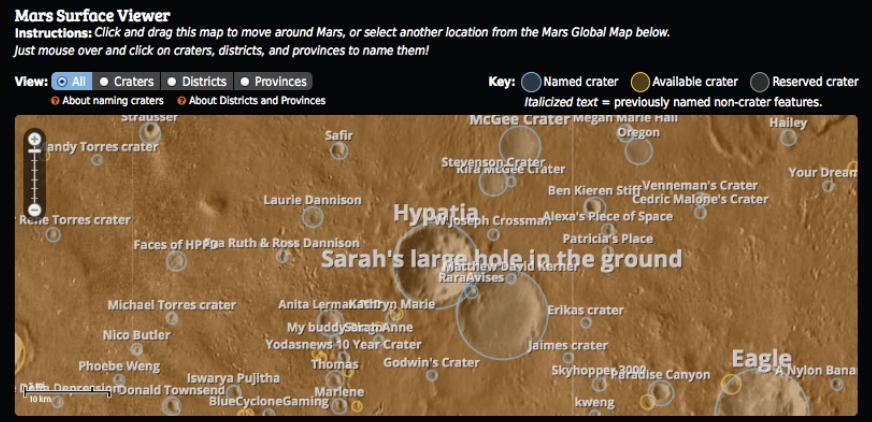
Everyone around the world can help name craters on Mars through Uwingu’s website (www.uwingu.com). Mars One will carry a digital copy of the resulting Mars Map on board its 2018 unmanned Mars Lander and will use the Uwingu crater names as part of Mars One mission operations.

Uwingu founder and CEO Dr. Alan Stern, a planetary scientist and the former head of NASA’s science program, said about the Mars One – Uwingu partnership, “This partnership catapults Uwingu’s Mars crater naming database and Mars maps into the forefront of private Mars exploration! Every person who names craters on Mars at www.uwingu.com will now know that their crater names are planned to be used in the exploration and hoped for settlement of Mars. At Uwingu, we are very excited about actually flying our map to Mars in 2018.”

About Mars One

Mars One is a not-for-profit foundation that will establish permanent human life on Mars. Human settlement on Mars is possible today with existing technologies. Mars One’s mission plan integrates components that are well tested and readily available from industry leaders worldwide. The first footprint on Mars and lives of the crew thereon will captivate and inspire generations. It is this public interest that will help finance this human mission to Mars.

About Uwingu

Uwingu is a small company, consisting of prominent astronomers, planetary scientists, former space program executives, and educators. Uwingu’s mission is to create new ways for people to personally connect with space exploration and astronomy. Uwingu launched a series of projects that will earn revenue to generate a new, private sector funding stream for space projects of all kinds, which they call The Uwingu Fund. The Uwingu Fund will provide grants to those that propose meritorious projects to us in space exploration, space research, or space education. More information about Uwingu can be found at: www.uwingu.com.

Everyone can participate in space