FISO: Defending the earth from asteroids – Bill Ailor of Aerospace Corp.

The latest presentation to the Future In-Space Operations (FISO) study group is now posted in the FISO Working Group Presentations Archive. Both slides and videos (zip) and audio (mp3) are available for the talk, Defending the Earth From Asteroids: Meeting the Challenges of Planetary Defense, by Bill Ailor of Aerospace Corp, March 12, 2014.

Ailor reviews what’s known about the asteroids and near earth objects, their threats to earth, how a NEO threat could be diverted, and legal/policy issues.

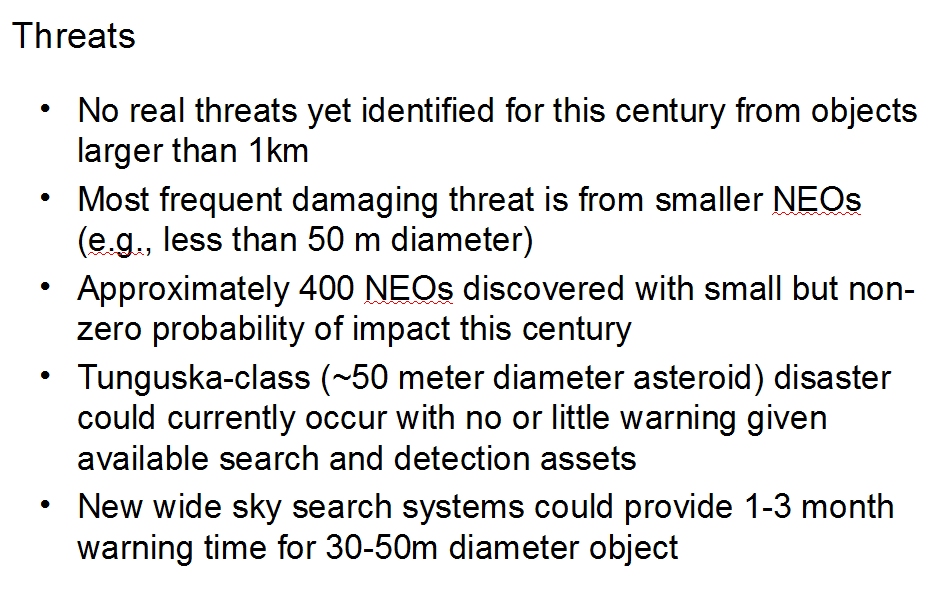
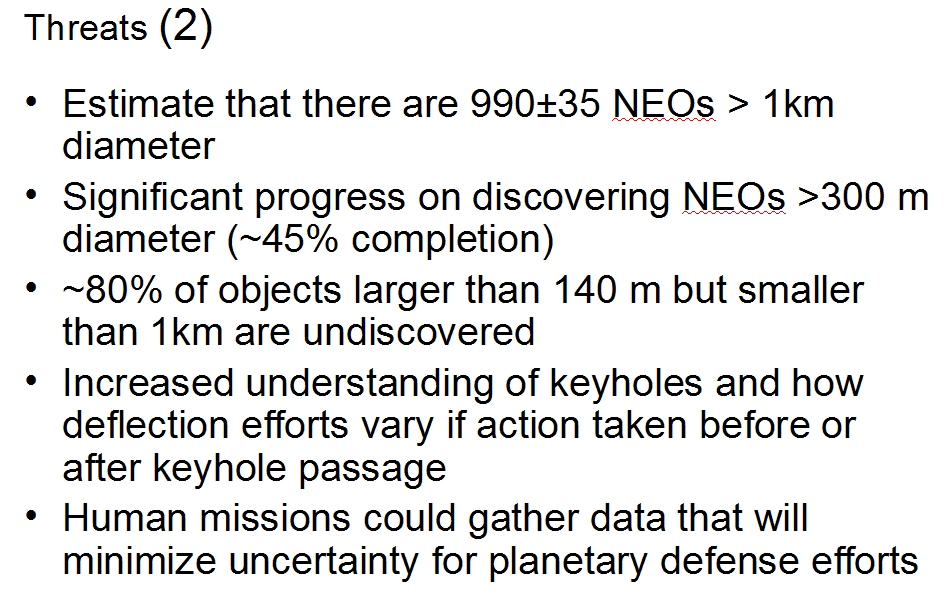
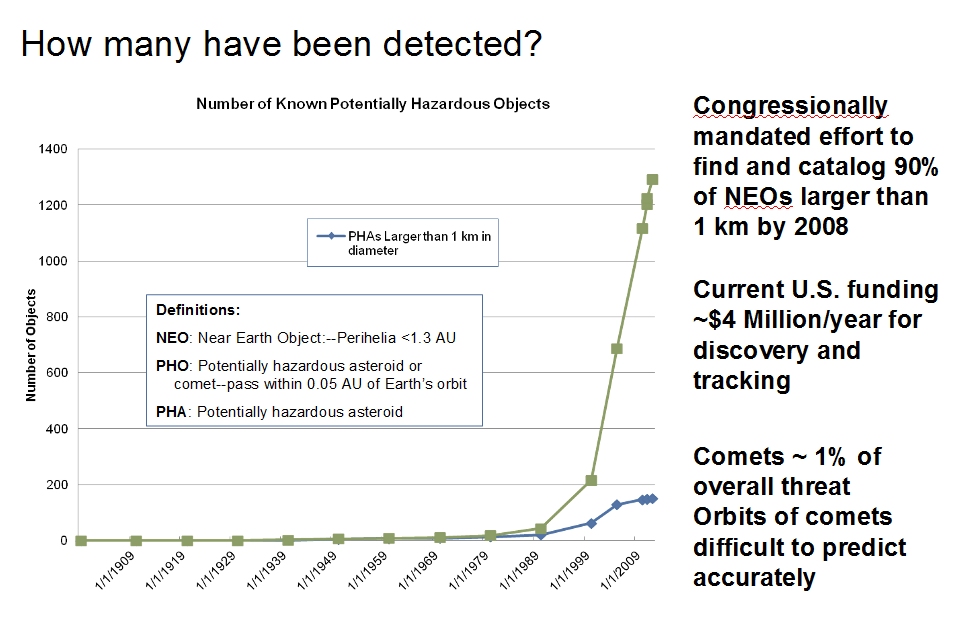
A sample of his slides:

SizesTable

HowManyDetected

Threats

Threats2


Summary


“Live from Space” – Nat. Geo. to broadcast Friday from the ISS

This Friday (8 p.m. EDT/5 p.m. PDT) the National Geographic Channel will broadcast Live From Space –

National Geographic Channel is taking viewers around the world—literally—in this spectacular two-hour television event broadcasting LIVE from the International Space Station (ISS) and Mission Control in Houston, Texas.

Made in collaboration with NASA, we’ll go into orbit with astronauts Rick Mastracchioand Koichi Wakata as they fly at 17,500 mph nearly 250 miles above the earth’s surface on the International Space Station, while astronaut Mike Massimino joins host Soledad O’Brien on the ground at Mission Control in Houston.

From space, Mastracchio and Wakata will give viewers a fully guided tour, showing us how they live for months in microgravity. They’ll conduct never-before-broadcast experiments that demonstrate the real-world value of the science conducted on the floating laboratory.

Plus get ready for stunning shots of Earth, from sunset and sunrise, to city lights and green aurora, to lightning storms and shooting stars. You’ve never seen our planet like this before.

Two items about the show:

Video: Trailer for “Back to the Moon for Good”

The Google Lunar XPRIZE has created a Fulldome Planetarium Show titled, Back To The Moon For Good.

In case you haven’t heard, the Moon is trending again… and in a big way. Like in the glory days of the 1960s and 1970s, our big white space neighbor is enjoying the attention of lunar explorers. Only this time, they’re going back to the moon for good.

The educational 24-minute Google Lunar XPRIZE fulldome planetarium show, Back To The Moon For Good, chronicles teams around the world competing for the largest incentivized prize in history, by landing a robotic spacecraft on the Moon for the first time in more than 40 years.

Here is a trailer:


Nearing near real time earth observation

The Weather Channel looks at the new earth observation capabilities of the Skybox Imaging satellites, which make short video clips in addition to high res images:

Venus Express sees a glory

A post by ESA about a recent observation from the Venus Express orbiter:

Venus glory 

A rainbow-like feature known as a ‘glory’ has been seen by ESA’s Venus Express orbiter in the atmosphere of our nearest neighbour – the first time one has been fully imaged on another planet.

Rainbows and glories occur when sunlight shines on cloud droplets – water particles in the case of Earth. While rainbows arch across wide swathes of the sky, glories are typically much smaller and comprise a series of coloured concentric rings centred on a bright core.

False colour composite of a ‘glory’ seen on Venus on 24 July 2011. The
image is composed of three images at ultraviolet, visible, and near-infrared
wavelengths from the Venus Monitoring Camera. The images were taken
10 seconds apart and, due to the motion of the spacecraft, do not overlap
perfectly. The glory is 1200 km across, as seen from the
spacecraft, 6000 km away.

Glories are only seen when the observer is situated directly between the Sun and the cloud particles that are reflecting sunlight. On Earth, they are often seen from aeroplanes, surrounding the shadow of the aircraft on the clouds below, or around the shadow of climbers atop misty mountain peaks.

A glory requires two characteristics: the cloud particles are spherical, and therefore most likely liquid droplets, and they are all of a similar size.

Venus glory details
Three images showing the glory at ultraviolet (left,) visible (centre) and
near-infrared (right) wavelengths as taken by the Venus Monitoring Camera.
The feature was observed on 24 July 2011 and measures 1200 km
across, as seen from the spacecraft, 6000 km away

The atmosphere of Venus is thought to contain droplets rich in sulphuric acid. By imaging the clouds with the Sun directly behind the Venus Express spacecraft, scientists hoped to spot a glory in order to determine important characteristics of the cloud droplets.

They were successful. The glory in the images here was seen at the Venus cloud tops, 70 km above the planet’s surface, on 24 July 2011. It is 1200 km wide as seen from the spacecraft, 6000 km away.

From these observations, the cloud particles are estimated to be 1.2 micrometres across, roughly a fiftieth of the width of a human hair.

The fact that the glory is 1200 km wide means that the particles at the cloud tops are uniform on this scale at least.

The variations of brightness of the rings of the observed glory is different than that expected from clouds of only sulphuric acid mixed with water, suggesting that other chemistry may be at play.

One idea is that the cause is the “UV-absorber”, an unknown atmospheric component responsible for mysterious dark markings seen in the cloud tops of Venus at ultraviolet wavelengths. More investigation is needed to draw a firm conclusion.

Everyone can participate in space