ICE/ISEE-3 spacecraft signals picked up by amateur space radio buffs

I posted earlier about attempts to reawaken the 36 year old ISEE-3 spacecraft and return it to useful science work.  Emily Lakdawalla writes that amateur space radio enthusiasts have actually been able to receive its signals: ICE/ISEE-3 update: Amateurs detect its signal while professionals study contacting it – The Planetary Society.

When the spacecraft was repurposed from its original space weather mission to chasing down a comet, it’s name was changed to the International Cometary Explorer (ICE).

international_cometary_explorer_isee3_art[1]International Cometary Explorer – NASA

Video: Chris Hadfield’s TED talk

Canadian astronaut and space singing star Chris Hadfield talks about living in space in this TED talk: Chris Hadfield: What I learned from going blind in space – Talk Video – TED –

Several space auctions coming up

I’ve recently pointed to two auctions coming up of space memorabilia/collectibles (see posts here and here). Robert Pearlman finds seven in the next three months: Spring space sales: Space history artifacts and astronaut mementos up for auction – collectSPACE.

See also the collectSPACE – space history, memorabilia and artifacts event calendar.

It appears like the interest in such items is increasing. I’ve long thought that many baby boomers who grew up in the post-Sputnik “Space Age” of the 1960s would become nostalgic for those days and start  collecting space memorabilia as a hobby in their retirement. Can’t prove this is actually happening but it’s a good a theory as any!

===

See also the Spacefest VI (a HobbySpace advertiser) in Pasadena, California May 8-11, 2014. There will be a memorabilia auction and also an exhibit hall with space memorabilia and collectibles as well as space art.

Marshall Institute panel discussion: Human settlements in space

The Marshall Institute will hold a discussion panel on April 17th in Washington D.C. on the topic of space settlement in large in-space habitats:  Human Settlement in Space: Bases in Near Space – Marshall Institute.

Mankind has long dreamed of settling on celestial bodies – the moon, other planets and space stations.  The Obama Administration’s goal of visiting an asteroid, plans by other nations to land on the Moon, and emergence of many private space travel initiatives, demonstrate the increased interest in creating a long-term human presence in space.

The complexities of establishing permanent space stations or space colonies resemble those for lunar or Martian colonies, but present additional challenges.  Building and life-support materials will be brought from planetary surfaces and space bodies, requiring new transportation and processing technologies; rights to and ownership of space resources will be debated; and new laws and political structures will be needed to suit this new environment.

(Usually “near space” refers to high altitudes reached by balloons and sounding rockets but here they are referring to space but near earth as opposed to the surface of the Moon or Mars.)

Date/Time: Date(s) – 4/17/20141:00 pm – 2:30 pm
Location: TechAmerica Space Enterprise Council

The speakers are:

  • Rosanna Sattler, Partner, Posternak Blankstein & Lund, LLP
  • Cheryl L. B. Reed, Program Development Manager, Applied Physics Laboratory, Johns Hopkins University
  • Martin Elvis, Astrophysicist, Harvard-Smithsonian Center for Astrophysics

Too bad they don’t also have a representative from one of the organizations that have long advocated in-space habitats such as the National Space Society, the Space Frontier Foundation, or the Space Studies Institute, which was founded by the late Gerard O’Neill, a pioneer in the design of in-space habitats.


First images from the UV telescope on Chang’e-3 lander

International Lunar Observatory Association (ILOA) has been collaborating with

the National Astronomical Observatories -Chinese Academy of Sciences (NAOC) & China National Space Administration (CNSA) to conduct Galaxy Imaging with the Lunar Ultraviolet Telescope aboard the Chang’e-3 lunar lander currently at Sinus Iridum on the lunar surface. In September 2012, ILOA signed a MoU with the NAOC-CAS. This was followed up with a MOU between ILOA and CNSA in August 2013. In exchange for the use of the Chang’e-3 LUT, ILOA will provide observation time to NAOC during its ILO-X and ILO-1 missions.

 – Mission Update January 2014: The start of permanet human operations on the Moon – ILOA.

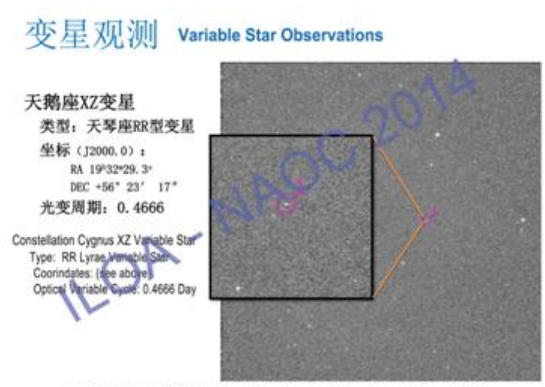
Today they released for the first time some of the images captured by the LUT on the Chang’e 3 lander : Astronomy from the Moon: ILOA Acquires Exclusive Images from Chang’e-3 Lunar Ultraviolet / Optical Telescope.

Professor Jianyan Wei, principal investigator of the  LUT instrument, indicated that the testing and commissioning phase is complete and all the telescope systems are operating nominally. He reports that the LUT already has captured over 22,000 astronomical images. The 150-mm diameter, near ultraviolet telescope is the payload that has operated the longest and obtained the most data since the 14 December 2013 Moon landing of Chang’e-3.

While the telescope is small and won’t compete with the major UV space observatories, it is still an interesting demo. UV astronomy must be done outside of the earth’s atmosphere and someday UV astronomy might be one of the tasks for a lunar base.

VariableStarObsrvations

Everyone can participate in space