ISEE-3: Livecast of lunar fly-by on Aug.10 + New Google interactive site

Google is teaming with the ISEE-3 Reboot Project:

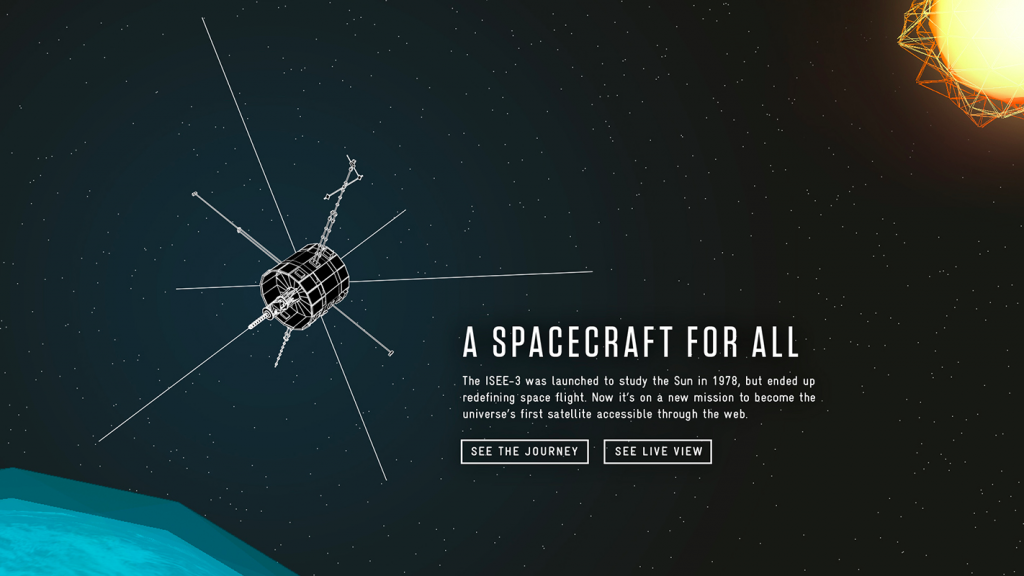
Google’s paired up with the team behind the first ever crowd-funded citizen space mission to launch SpacecraftForAll.com   an interactive, multimedia resource for citizen scientists and space fanatics to access all the data collected by the ISEE-3 spacecraft.

The SpacecraftForAll site, tuned for the Google Chrome browser, is a

Chrome Experiment from Google – huge fans of open-source technology – weaving vivid storytelling with the latest web technologies (like WebGL interactive graphics) to create a hub for the data via the web.

For the upcoming fly-by of the Moon:

Tune in on Sunday, August 10 at 10:30am PT/1:30pm ET for the ISEE-3 Reboot Team’s livecast of the satellite’s lunar flyby, live from McMoon’s at NASA’s Ames Research Center.

Here’s a screen capture from – SpacecraftForAll  :

SpacecraftForAll_screencap

Driving a robot on the ground from the ISS

Telerobotics, i.e. controlling a robot from a distance, could be useful in space for, say, asteroid sampling in which an astronaut in a nearby spacecraft controls a robot on the surface of the object. A mission to Mars might initially involve astronauts remaining in orbit while controlling robots on the surface. A demonstration of a telerobotic operation was carried out this week using the Int. Space Station:

Gerst drives car-sized rover from space

8 August 2014: Looking down from orbit, ESA astronaut Alexander Gerst steered ESA’s Eurobot rover through a series of intricate manoeuvres on the ground yesterday, demonstrating a new space network that could connect astronauts to vehicles on alien worlds.

During an intense 90-minute live link on 7 August, Alex used a dedicated controller laptop on the International Space Station to operate Eurobot, relying on video and data feedback to feed commands from 400 km up, orbiting at 28 000 km/h.

The link was provided by a new network that stores commands when signals are interrupted if direct line of sight with Earth or the surface unit is lost, forwarding them once contact is re-established.

In the future, controlling robots on Mars or the Moon will require a sort of ‘space Internet’ to send telecommands and receive data. Such networks must also accommodate signal delays across vast distances, considering that astronauts and rovers on Mars will have to be linked with mission controllers on Earth.

Yesterday’s demonstration was the second in a series of experiments under the Meteron project, following the 2012 test by NASA astronaut Sunita Williams, who used an initial version of the network by steering a model rover at ESA’s ESOC operations centre in Darmstadt, Germany.

“This was the first time Eurobot was controlled from space as part of an experiment to validate communication and operations technologies that will ultimately be used for future human exploration missions,” noted Kim Nergaard, head of Advanced Mission Concepts at ESOC.

Rover driving license

During the session, which started at 16:35 GMT (18:35 CEST), Alexander Gerst commanded Eurobot to move and take pictures based on telemetry and pictures streaming to the Station from the rover.

Eurobot was inching around a test facility at ESA’s ESTEC technology centre in Noordwijk, the Netherlands, while ‘ground control’ was at ESOC and the disruption-tolerant network was routed via Belgium’s Station User Support and Operations Centre in Brussels, and NASA.

Ready to Rove

Simulations to prepare for yesterday’s link included live connections between Darmstadt, Noordwijk and Brussels to the Space Station throughout July.

“Today’s result is even better than the simulations we conducted,” said Daniela Taubert, Meteron’s operations coordinator. “The whole experiment ran extremely smoothly. Alex was faster and more efficient that we had expected.”

William Carey, ESA’s Meteron project engineer, agreed: “It is great to have a hands-on test of part of ESA’s long-term strategy to send humans and robots to explore our Solar System.”

Future space exploration will most likely involve sending robotic explorers to check out alien surfaces before landing humans. To prepare for this, ESA is running the Meteron human–robot exploration programme: Multi-Purpose End-To-End Robotic Operations Network.

More images of the team and activities at ESOC via Flickr.

Video: Space to Ground – ISS update

Here’s the latest episode of NASA’s Space to Ground weekly report on activities aboard the Int. Space Station:

ISEE-3 citizen science mission

Since my last post on the ISEE-3 Reboot Project, the team determined that it was impossible to restart the propulsion system due to the absence of the nitrogen pressurant gas needed to force fuel into the thrusters. They spacecraft therefore cannot be put into an orbit in the Earth-Moon system and will instead continue on its orbit around the sun.

The rest of the spacecraft system, including science instruments, are in good shape.  So they plan to continue the project, focusing on carrying out citizen science activities with the data from the spacecraft:

From the latter posting:

While our original goal was to place ISEE-3 in a L-1 “halo” orbit, it will now do a flyby of the Moon and resume an orbit around the sun – an orbit nearly identical to Earth’s. We have begun the process of shutting down systems that are no longer needed and reconfiguring ISEE-3 to maximize science operations. We are also implementing plans that will allow us to listen to its science data no matter where it goes.

We will be beginning the “ISEE-3 Interplanetary Citizen Science Mission” on 10 August 2014 as the spacecraft flies by the Moon. We have a functional space craft that can do science and is already returning new data. All of our original citizen science objectives remain unchanged and are ready for implementation. In fact, we’ll be announcing some new partnerships shortly that will serve to turbocharge our efforts in this regard.

This will be the first citizen science, crowd funded, crowd sourced, interplanetary space science mission. A more detailed summary of recent activities and our partnership team will be posted at http://spacecollege.org/isee3

—

Here is a new update from today: ISEE-3 Science Status Report 7 August 2014 – Space College

—

Update: See post here about the fly-by livecast and the Google SpacecraftForAll.com site.

New Horizons probe sees Charon orbiting Pluto

The  New Horizons spacecraft is steadily closing in on Pluto as it heads for a fly-by next July. The spacecraft can now distinguish Pluto from its moon Charon with its long range camera.

New Horizons Spies Charon Orbiting Pluto

PR_E12_proper_nosat_3fpsPluto and Charon dance in this sequence of images taken
over 6 days. (Large image)

Like explorers of old peering through a shipboard telescope for a faint glimpse of their destination, NASA’s New Horizons spacecraft is taking a distant look at the Pluto system – in preparation for its historic encounter with the planet and its moons next summer.

“Filmed” with New Horizons’ best onboard telescope – the Long Range Reconnaissance Imager (LORRI) – this movie covers Pluto and almost one full rotation of its largest moon, Charon. The 12 images that make up the movie were taken July 19-24, from a distance ranging from about 267 million to 262 million miles (429 million to 422 million kilometers). Charon is orbiting approximately 11,200 miles (about 18,000 kilometers) above Pluto’s surface.

New Horizons snapped this image sequence as part of the mission’s first optical navigation campaign. The mission team uses these “op nav” images – which focus on Pluto’s position against a backdrop of stars – to fine-tune the distance that New Horizons will fly past Pluto and its moons. New Horizons is aiming for a precise close-approach point near Pluto in July 2015, so these and images to come – which help navigators and mission designers to get a better fix on Pluto’s position – are critical to planning the encounter operations.

Pluto’s four smaller satellites (Nix, Hydra, Styx and Kerberos) are too faint to be seen in these distant images, but will begin to appear in images taken next year as the spacecraft speeds closer to its target.

“The image sequence showing Charon revolving around Pluto set a record for close range imaging of Pluto—they were taken from 10 times closer to the planet than the Earth is,” says New Horizons mission Principal Investigator Alan Stern, of the Southwest Research Institute, Boulder, Colo. “But we’ll smash that record again and again, starting in January, as approach operations begin.

“We are really excited to see our target and its biggest satellite in motion from our own perch,” he adds, “less than a year from the historic encounter ahead!”

As August begins, New Horizons is near the end of its final pre-Pluto annual systems checkout and instrument calibration before Pluto arrival. The New Horizons mission operations team at the Johns Hopkins Applied Physics Laboratory in Laurel, Maryland, will put the spacecraft back into hibernation on August 29 – just four days after New Horizons crosses the orbit of Neptune on August 25.

That final “rest” lasts only until December 6, when New Horizons will stay wake for two years of Pluto encounter preparations, flyby operations, and data downlinks. Distant-encounter operations begin January 4, 2015.

===

See also New Horizons spies Pluto and Charon, July 2014 – The Planetary Society
Everyone can participate in space