Space music: “Reach Beyond the Stars”

Here’s a new space rallying song “Reach Beyond the Stars” , written by Mark R. Goujon and sung by Jason Wyatt: Check Out “Reach Beyond the Stars” – The Mars Society

From the caption:

Motivational song about never quitting and reaching for your dreams

Singer: Jason Wyatt
Songwriter: Mark R. Goujon
Publisher: Get Your Gouj On Music Company

Studio: Watershed Recording Studio, Nashville
Melody: John Darnall
Mix: Jim Dineen

Musicians:
Mark Burchfield
Dave Cleveland
Jeff King
Michael Payne
Jeff Roach
Wanda Vick
Scott Williamson

Available for Digital Download and Streaming at: iTunes, Amazon MP3, Google Play, Shazam, Spotify and more.

License for TV, Film and Commercials: www.goujonmusic.com

Hire For Live Performance:  www.jasonwyattproductions.com

GoFast 2014 rocket reaches record altitude for amateur team

The CSXT (Civilian Space eXploration Team) on May 17, 2004 became the first amateur group to send a rocket t o space (i.e. greater than 100 km or 62 miles) when their GoFast rocket reach 115 km (72 miles) high.  

A new GoFast rocket was launched on July 14th this year and it broke their old record by reaching 117.6 km (73.1 miles) high. Here is a compilation of clips from cameras on the vehicle:

From the caption:

GoFast 2014 Space Launch Team

The GoFast 2014 rocket officially set a new world record on July 14, 2014 as the highest and fastest amateur rocket ever launched into space.

Analysis of the data from the recovered military grade Inertial Measurement Unit (IMU) that flew onboard shows that the GoFast rocket reached 385,800 feet above mean sea level (73.1 miles) and hit a top speed of 3,580 miles per hour. The old record held by the CSXT’s GoFast 2004 rocket was 72 miles with a top speed of 3,420 mph.

The GoFast 2014 IMU had flown successfully on four commercial space missions at White Sands Missile Range (WSMR) in New Mexico and was calibrated using C-Band transponder US Army radar tracking data prior to its flight into space on the GoFast rocket July 14, 2014. Statistical analysis of the WSMR flights and the GoFast 2014 launch verifies the 73.1 miles attained by the GoFast rocket has a variation of 0.6 miles with a confidence level of 95%.

Congratulations to everyone for a job well done! Thank you so much for everyone’s participation and endless hours making this launch a success.

GoFast 2014 list of accomplishments;

• World record highest altitude rocket launch
• World record fastest speed rocket launch
• First photo taken from space onboard an amateur rocket
• Second amateur rocket in history to reach space

Update Aug.31.2014:  Here’s a photo of the CSXT group that launched the GoFast 2014 rocket:

CSXT group shot

2014 Space Elevator Conference – Aug.22-24, Museum of Flight, Seattle, WA

An announcement from the International Space Elevator Consortium (ISEC) about the upcoming Space Elevator Conference:

The International Space Elevator Consortium (ISEC) is proud
to announce the 2014 Space Elevator Conference!
This annual event will be held at the Museum of Flight in Seattle, Washington
from Friday, August 22nd through Sunday, August 24th.

Seattle, WA, August 18th, 2014 – Come experience learning, brainstorming, and international collaboration in an atmosphere of history, invention, and discovery! In addition to the 3-day conference, a Family Science Fest will be held on Saturday, August 23rd.

3-Day Technical Conference

ISEC is very pleased to announce that long-time science journalist Leonard David will give the Keynote address at this year’s conference. We are very excited to have Mr. David with us this year and we’re sure that his insights will be fascinating.

The theme of this year’s conference is “Space Elevator Architectures and Roadmaps.” Papers will be presented on this topic and other space-elevator related topics. There will be mini-workshops on Research Activities and Global Cooperation, Marine Node Design Concepts, and Space Elevator Architectures and Roadmaps as well as the ever popular Shotgun Science Session where all conference attendees can present their ideas in five minutes or less.

Family Science Fest

The Family Science Fest on Saturday, August 23rd will also be held at the Museum of Flight. This event is open to the public (no registration required) and is included in the museum admission price. The Family Science Fest includes Space Elevator 101 and 201 presentations, a youth robotics competition, exhibits from science organizations and clubs, and much more.

More details of the conference program and the Family Science Fest events are posted at spaceelevatorconference.org, including information on registration for the technical conference and lodging. Registration for the technical conference closes August 15th.

The Space Elevator is one of the most magnificent Engineering projects ever conceived. It promises abundant access to space and a multitude of benefits for humanity. Come to the conference and hear presentations and join discussions with people who are working to make space elevators a reality!

About The International Space Elevator Consortium (ISEC): The International Space Elevator Consortium (ISEC) is composed of individuals and organizations from around the world who share a vision of humanity in space. Our Vision is a world with inexpensive, safe, routine, and efficient access to space for the benefit of all mankind. Our Mission is to promote the development, construction and operation of a Space Elevator (SE) Infrastructure as a revolutionary and efficient way to space for all humanity.

To learn more about ISEC, please visit our website at www.isec.org.

Uwingu launches “Beam Me to Mars” project

An announcement from Uwingu:

Uwingu Launches “Beam Me to Mars” Project
First opportunity for the people of Earth to radio personal
messages and pictures to Mars!

Boulder, Colorado – 19 August 2014 – Space company Uwingu announced today the launch of a project allowing anyone, anywhere to be a part of a global ”shout-out” of messages from the people of Earth to Mars on November 28th. The project is called ”Beam Me to Mars“.

Logo_FInal

Beam Me to Mars (hashtag #BeamMe2Mars) celebrates the 50th anniversary of the start of humankind’s exploration of Mars with the launch of NASA’s Mariner 4 – the first successful Mars mission – on November 28th, 1964.

Beam Messages can be as simple as a name, or can be more elaborate, including text and even images. Anyone can send messages to Mars, and people can send as many as they want, there is no limit. Pricing begins at $5. To be included in the transmission messages and pictures must be submitted to Uwingu’s web site at www.uwingu.com by 5 November 2014.

Uwingu’s Beam Me transmission will be sent on November 28th. All messages will be sent at a rate of 1 million bits per second to Mars by Uwingu’s Beam Me transmission partner, satellite communications provider Universal Space Network (http://www.sscspace.com/universalspacenetwork).

Mariner 4 (http://en.wikipedia.org/wiki/Mariner_4) took almost 8 months to reach Mars in 1964-1965, but our 21st century Beam Me to Mars messages will arrive at the speed of light – just 15 minutes after they are sent!

Beam Me to Mars is the first opportunity for the people of Earth to radio personal messages and pictures to Mars.

Although no one is living on Mars yet to receive the Beam Me messages, here on Earth people will hear the messages loud and clear: All Beam Me messages will be delivered by hand to Congress, to NASA, and to the United Nations.

Moreover, the entire Beam Me message archive is searchable for free from Uwingu’s web site, and all the messages can be freely socially shared with friends, relatives, or anyone on social networks.
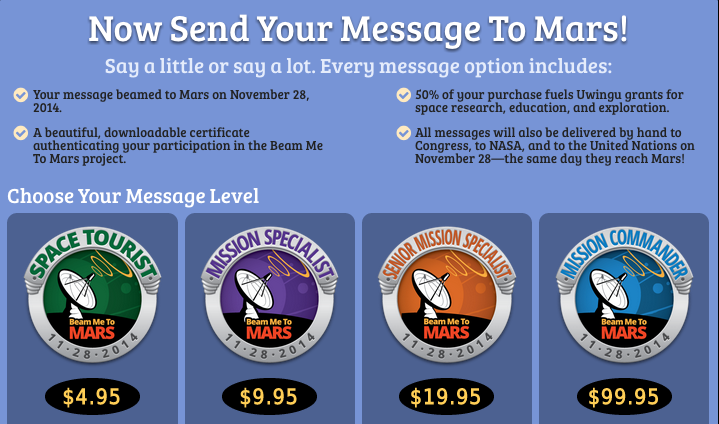
BeamMeToMarsPurchaseOptions[1]

Said Uwingu CEO and planetary scientist Dr. Alan Stern, “Come and celebrate the exploration of Mars in this very special, first of a kind 21st century interplanetary social movement! What will kids and adults say to Mars, about Mars, about space exploration’s past and future, about their hopes and dreams? We’re going to find out with a societal selfie we’re beaming to Mars!”

As with all Uwingu projects, half the proceeds fuel grants that Uwingu makes to further space research, education, and exploration; the other half fuels new Uwingu projects.

[See also the Beam Me To Mars FAQ – Uwingu.]

About Uwingu: Uwingu (which means “sky” in Swahili, and is pronounced “oo-wing-g0o”) was founded in 2012 and consists of a team of leading astronomers, planetary scientists, former space program executives and educators. Uwingu is a for-profit company dedicated to creating new ways for people to personally connect with space exploration and education while also raising funds to support non-profit organizations working space exploration and astronomy. A pioneer in this industry, Uwingu is currently creating the first crowd-sourced map of Mars. Since the project began in February 2014, individuals have named over 12,000 craters and the Uwingu Fund has already allocated over $100,000 for grants. Visit Uwingu’s website to learn more at www.uwingu.com.

Citizen science: Help classify ISS nighttime images of earth

The Cities at Night from the ISS program has organized a citizen science campaign to classify images taken of earth by astronauts on the ISS at night: Image overload: Help us, NASA says – CNN.com

The images come from the gallery of 1.8M images in the The Gateway to Astronaut Photography of Earth collection at Johnson Space Center. The campaign is called Project: Dark Skies ISS.

Right now there are around 1,800,000 images at the Johnson Space Center database (The Gateway of the Astronauts). Around 1,200,000 images were taken aboard the ISS (date 02/20/2014). However, the number of classified images is much smaller, and there is no archive of georeferenced images. There is already a project to classify the daytime images (Image detective), but the techniques used in that project are not useful for the classification of nighttime images. The patterns on Earth are not the same during the day and night, which is why another technique is needed to classify these nighttime images.

Our main objective is to study light pollution that comes from cities. We want to stop the waste of energy and the destruction of the mighty ecosystem.

Your collaboration is really important because algorithms cannot distinguish between stars, cities, and other objects (i.e. moon). Thus, we need your help to assess the light pollution in our world!

For more information, please contact www.citiesatnight.org or Twitter handle: @cities4tnight.

Also you can contribute on our other apps Lost at night (find unlocated images) and NightCitiesISS (Georeference known cities). Also you can track the project’s updates at our blog.

This CNN video shows a sample of earth images in the gallery:

Everyone can participate in space