A film about an ennobling obsession and deep true art:
- Everything is incredible – Aeon Video
- Everything is Incredible, Film About a Disabled Honduran Man Who Has Been Building A Homemade Helicopter for 50 Years – laughingsquid.com
A film about an ennobling obsession and deep true art:
NASA’s Dawn spacecraft is closing in on Ceres, the largest object in the asteroid belt and now classified as a dwarf planet:
Dawn Delivers New Image of Ceres
NASA’s Dawn spacecraft closes in on Ceres, new images show the dwarf planet at 27 pixels across, about three times better than the calibration images taken in early December. These are the first in a series of images that will be taken for navigation purposes during the approach to Ceres.

Over the next several weeks, Dawn will deliver increasingly better and better images of the dwarf planet, leading up to the spacecraft’s capture into orbit around Ceres on March 6. The images will continue to improve as the spacecraft spirals closer to the surface during its 16-month study of the dwarf planet.
“We know so much about the solar system and yet so little about dwarf planet Ceres. Now, Dawn is ready to change that,” said Marc Rayman, Dawn’s chief engineer and mission director, based at NASA’s Jet Propulsion Laboratory in Pasadena, California.
The best images of Ceres so far were taken by NASA’s Hubble Space Telescope in 2003 and 2004. This most recent images from Dawn, taken January 13, 2015, at about 80 percent of Hubble resolution, are not quite as sharp. But Dawn’s images will surpass Hubble’s resolution at the next imaging opportunity, which will be at the end of January.
“Already, the [latest] images hint at first surface structures such as craters,” said Andreas Nathues, lead investigator for the framing camera team at the Max Planck Institute for Solar System Research, Gottingen, Germany.]

Ceres is the largest body in the main asteroid belt, which lies between Mars and Jupiter. It has an average diameter of 590 miles (950 kilometers), and is thought to contain a large amount of ice. Some scientists think it’s possible that the surface conceals an ocean.
Dawn’s arrival at Ceres will mark the first time a spacecraft has ever visited a dwarf planet.
“The team is very excited to examine the surface of Ceres in never-before-seen detail,” said Chris Russell, principal investigator for the Dawn mission, based at the University of California, Los Angeles. “We look forward to the surprises this mysterious world may bring.”
The spacecraft has already delivered more than 30,000 images and many insights about Vesta, the second most massive body in the asteroid belt. Dawn orbited Vesta, which has an average diameter of 326 miles (525 kilometers), from 2011 to 2012. Thanks to its ion propulsion system, Dawn is the first spacecraft ever targeted to orbit two deep-space destinations.
JPL manages the Dawn mission for NASA’s Science Mission Directorate in Washington. Dawn is a project of the directorate’s Discovery Program, managed by NASA’s Marshall Space Flight Center in Huntsville, Alabama. The University of California at Los Angeles (UCLA) is responsible for overall Dawn mission science. Orbital Sciences Corp. in Dulles, Virginia, designed and built the spacecraft. UCLA is responsible for overall Dawn mission science. The Dawn framing cameras were developed and built under the leadership of the Max Planck Institute for Solar System Research, Gottingen, Germany, with significant contributions by German Aerospace Center (DLR), Institute of Planetary Research, Berlin, and in coordination with the Institute of Computer and Communication Network Engineering, Braunschweig. The Framing Camera project is funded by the Max Planck Society, DLR, and NASA/JPL. The Italian Space Agency and the Italian National Astrophysical Institute are international partners on the mission team.
More information about Dawn is online at dawn.jpl.nasa.gov.
The guests and topics on The Space Show this week:
1. Monday, Jan. 19, 2015: 2:00-3:30PM PST (5:00-& 6:30 PM EST, 4:00-5:30 PM CST): We welcome back DR. PAUL SPUDIS on a variety of topics including his latest blog posts, www.spudislunarresources.com/blog.
2. Tuesday, Jan. 20, 2015:,7-8:30 PM PST (10-11:30 PM EST, 9-10:30 PM CST): We welcome ANDREW RADER to the program. He is a spacecraft engineer with a PhD from MIT in Aerospace Engineering, and a background in space human factors and systems engineering. He has experience on over a dozen space missions, and has authored nine papers on space design, with specific emphasis on performance vs. cost optimization. Andrew produces a space, science, history, and sci-fi YouTube channel with over 3 million views, which features a video lecture series on spacecraft engineering from MIT. He also designs educational science and history games at www.newhorizongames.com, and is the author of the book: ‘Leaving Earth: Why one-way to Mars makes sense’.
3. Friday, Jan. 23, 2015; 9:30 -11 AM PST (12:30-2 PM EST; 11:30-1 PM CST): DR. GIL LEVIN returns to The Space Show. Dr. Levin’s experiments on the Mars Viking 1976 missions searched for life on Mars.
4. Sunday, January 25, 2015: 12-1:30 PM PST (3-4:30 PM EST, 2-3:30 PM CST): OPEN LINES. All space, STEM, and first time callers are welcome.
See also:
/– The Space Show on Vimeo – webinar videos
/– The Space Show’s Blog – summaries of interviews.
/– The Space Show Classroom Blog – tutorial programs
The Space Show is a project of the One Giant Leap Foundation.
NASA JPL reports on what the Curiosity rover will be up to next:
Crystal-Rich Rock ‘Mojave’ is Next Mars Drill Target
A rock target where NASA’s Curiosity Mars rover is using its sample-collection drill this week may have a salty story to tell.
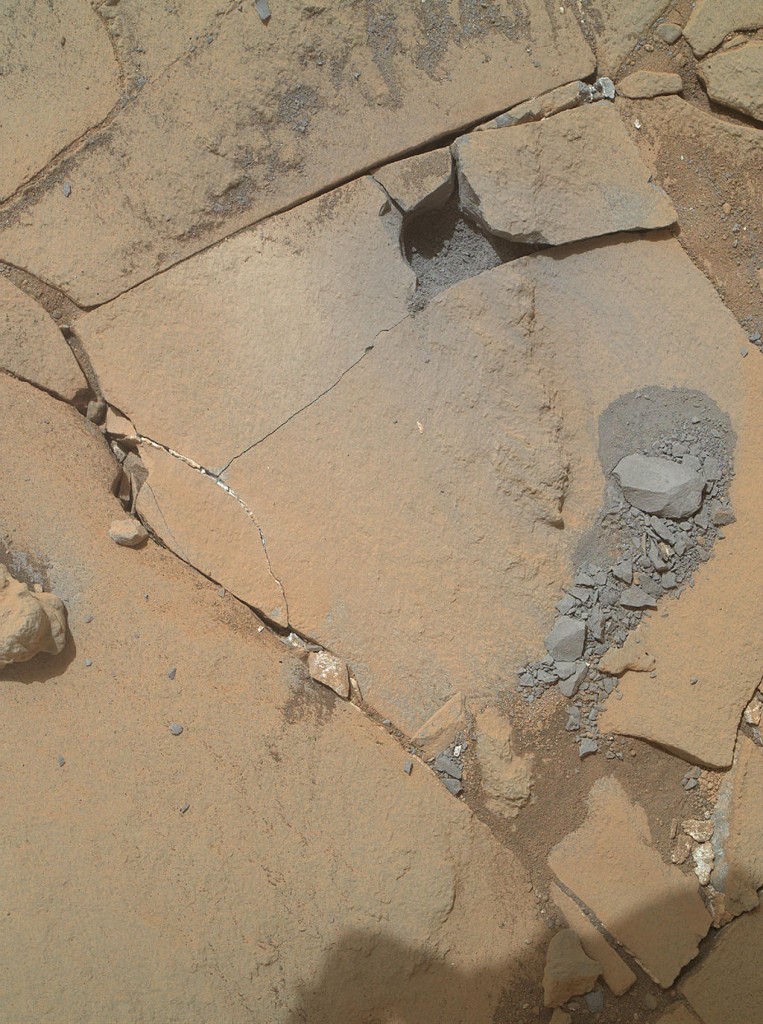
This view from the Mars Hand Lens Imager (MAHLI) camera on the arm of NASA’s Curiosity Mars rover shows some of the outcome from a shallow-depth, mini-drill test to assess whether a rock target called “Mojave” is appropriate for full-depth drilling to collect a sample. It was taken on Jan. 13, 2015, during the 867th Martian day, or sol, of Curiosity’s work on Mars. [Continue…]
This target, called “Mojave,” displays copious slender features, slightly smaller than grains of rice, that appear to be mineral crystals. A chance to learn their composition prompted the Curiosity science team to choose Mojave as the next rock-drilling target for the 29-month-old mission investigating Mars’ Gale Crater. The features might be a salt mineral left behind when lakewater evaporated.
This week, Curiosity is beginning a “mini-drill” test to assess the rock’s suitability for deeper drilling, which collects a sample for onboard laboratory analysis.
A week long pause in science operations to install a new version of rover flight software is scheduled to begin early next week, possibly before completion of the drilling and sample delivery. This is the fourth new version of the onboard software since the rover’s August 2012 landing.
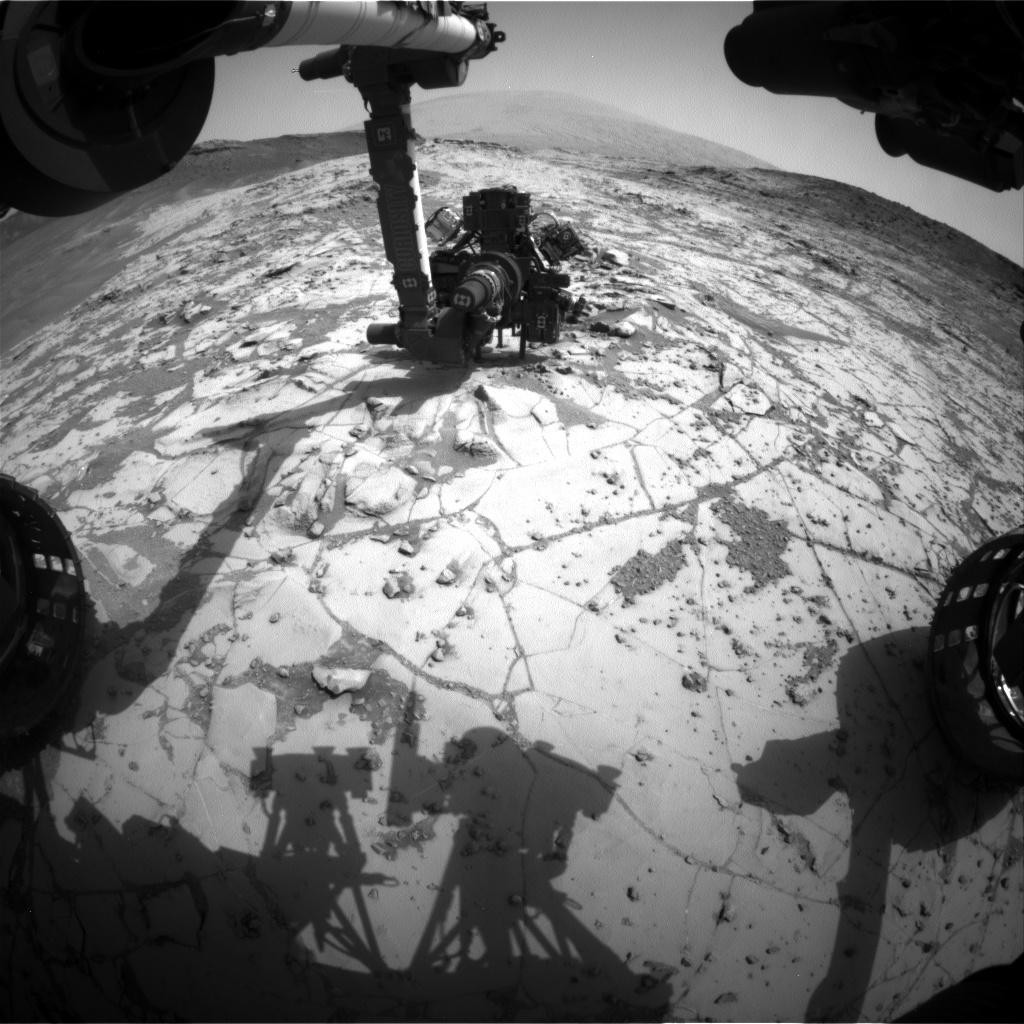
This view from the wide-angle Hazard Avoidance Camera (Hazcam) on the front of NASA’s Curiosity Mars Rover shows the rover’s drill in position for a mini-drill test to assess whether a rock target called “Mojave” is appropriate for full-depth drilling to collect a sample. It was taken on Jan. 13, 2015, during the 867th Martian day, or sol, of Curiosity’s work on Mars. [Continue…]
The Mojave drilling begins Curiosity’s third round of investigating the basal layer of Mount Sharp exposed at an area called “Pahrump Hills.” In the first round, the rover drove about 360 feet (110 meters) and scouted sites ranging about 30 feet (9 meters) in elevation. Then it followed a similar path, investigating selected sites in more detail. That second pass included inspection of Mojave in November 2014 with the dust-removal brush, close-up camera and Alpha Particle X-Ray Spectrometer on the rover’s arm. The results put Mojave at the head of the list of targets for the rover’s most intensive inspection, using laboratory instruments that ingest powdered rock collected by the drill.
“The crystal shapes are apparent in the earlier images of Mojave, but we don’t know what they represent,” said Curiosity Project Scientist Ashwin Vasavada at NASA’s Jet Propulsion Laboratory, Pasadena, California. “We’re hoping that mineral identifications we get from the rover’s laboratory will shed more light than we got from just the images and bulk chemistry.”
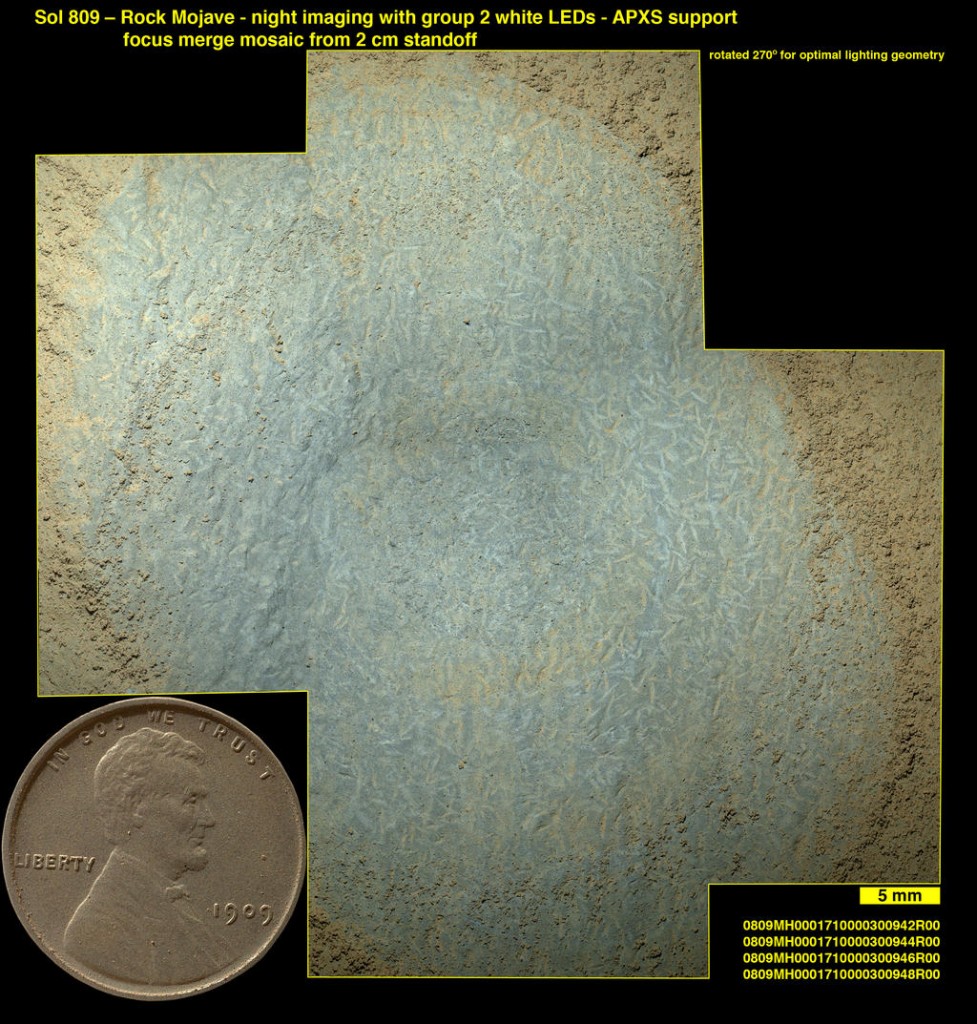
Curiosity’s Chemistry and Mineralogy instrument, or CheMin, can identify specific minerals in rock powder from a drilled sample. Analysis of the drill hole and drill tailings may also reveal whether the crystals are only at the surface, like a salty crust, or are also deeper in the rock.
“There could be a fairly involved story here,” Vasavada said. “Are they salt crystals left from a drying lake? Or are they more pervasive through the rock, formed by fluids moving through the rock? In either case, a later fluid may have removed or replaced the original minerals with something else.”
Curiosity’s work at Pahrump Hills may include drilling one or more additional rocks before heading to higher layers of Mount Sharp.
Next week’s planned software revision, like the mission’s earlier ones, adds protections against vulnerabilities identified in rover testbed activities on Earth. It also adds improvements to make planning drives more efficient.
“The files have already been uplinked and are sitting in the rover’s file system to be ready for the installation,” said JPL’s Danny Lam, the deputy engineering operations chief leading the upgrade process.
One change in the new software is to enable use of the rover’s gyroscope-containing “inertial measurement unit” at the same time as the rover’s drill, for better capability to sense slippage of the rover during a drilling operation. Another is a set of improvements to the rover’s ability to autonomously identify and drive in good terrain.
NASA’s Mars Science Laboratory Project is using Curiosity to assess ancient habitable environments and major changes in Martian environmental conditions. JPL, a division of the California Institute of Technology in Pasadena, built the rover and manages the project for NASA’s Science Mission Directorate in Washington.
For more information about Curiosity, visit: www.nasa.gov/msl and mars.jpl.nasa.gov/msl/
You can follow the mission on Facebook and Twitter at: www.facebook.com/marscuriosity and www.twitter.com/marscuriosity
Rick Boozer on his Astro Maven blog has posted the fifth and final installment of Photometry with AIP4WIN: a Tutorial, which is aimed at astronomers both amateur and professional:
From Part 1:
The science of photometry can be used by both amateur astronomers and professionals for some very advanced scientific work. You can detect the light changes caused by eclipsing binary stars, plot the changes in luminosity of a variable star and even detect an exoplanet orbiting another star. This tutorial will be your step-by-step guide on how to employ the powerful Magnitude Measurement Tool that comes with the renowned astronomical imaging software known as AIP4WIN by Richard Berry and Robert Burnell. Special thanks to Mr. Berry for giving me permission to include screen images and extensive operating details from AIP4WIN.