Photos of where ‘The Martian’ Mark Watney traveled + “Red Planet” miniseries on Mars colonization to debut in 2016

As mentioned here several times, Andy Weir’s book The Martian is a terrifically readable and scientifically accurate account of an astronaut’s struggles to survive alone on Mars. It will be out as a movie in the fall but you should read it first. Here are beautiful photos of the locations on Mars that the character Mark Watney traversed during his excursions:  Real places the main character in ‘The Martian’ went on Mars – Business Insider.

===

National Geographic will sponsor a miniseries dramatization on the settling of the Red Planet:

National Geographic Channel, Imagine Entertainment and RadicalMedia
Embark On A Quest To Mars In A Groundbreaking, Global Miniseries Event:
Red Planet

BEVERLY HILLS, Calif., July 29, 2015 /PRNewswire-USNewswire/ — Of all the planets in our solar system, none has captured our collective imagination like Mars — a mysterious, indelible part of our zeitgeist. And now National Geographic Channel (NGC); Academy Award- and Emmy-winning producers Brian Grazer, Ron Howard and Michael Rosenberg of Imagine Entertainment; and Justin Wilkes and Dave O’Connor of RadicalMedia have joined forces to launch us into outer space with the global event series Red Planet.

Slated to premiere on the National Geographic Channel in 171 countries and 44 languages in 2016, Red Planet — which is set in 2032 and the present day — will be a unique hybrid of scripted and unscripted elements. The series will tell the epic story of the thrilling quest to colonize Mars and the first manned mission in 2032 with dramatic scripted drama and feature film-caliber visual effects, intercut with documentary verité and interviews from present-day scientists and innovators who are leading the research and development of space technology, preparing the way for our 2032 mission.

“With Imagine and RadicalMedia, we plan to tell a deeply human story of the first manned mission to Mars, that is cinematic in both scope and storytelling,” said Courteney Monroe, CEO, National Geographic Channels. “We hope to spark the curiosity of viewers by not only transporting them to another planet, but by embedding them with today’s leaders who are revolutionizing space technology.”

“We stand on the grandest stage of all time — the dark void of interplanetary space — with the brightest 21st century visionaries to light our way,” said Grazer. “By blending awe-inspiring imagery and narrative with present-day footage and interviews, we hope that Red Planet will change the way we see our place in the cosmos and the mysteries that lie beyond.”

“As humans, we possess boundless curiosities and an unparalleled spirit of adventure,” said Howard. “These intrepid explorers — following in the footsteps of pioneers before them — will spark our imaginations as we weave together the stories of both the past and the present Mars visionaries, along with the historical perspective on Mars.”

“How we’ll get to Mars, why we’re going and what happens when we get there are questions playing out in the minds of today’s greatest innovators, technologists and dreamers,” added RadicalMedia President Wilkes. “Our cameras will be there to capture the cutting-edge technology, design, science and ideas at the cusp of transforming not only Mars, but our own world as well.”
ESO: First detection of Lithium ejected from a nova

A new report from ESO (European Southern Observatory):

First Detection of Lithium from an Exploding Star

The chemical element lithium has been found for the first time in material ejected by a nova. Observations of Nova Centauri 2013 made using telescopes at ESO’s La Silla Observatory, and near Santiago in Chile, help to explain the mystery of why many young stars seem to have more of this chemical element than expected. This new finding fills in a long-missing piece in the puzzle representing our galaxy’s chemical evolution, and is a big step forward for astronomers trying to understand the amounts of different chemical elements in stars in the Milky Way.

eso1531a[1]

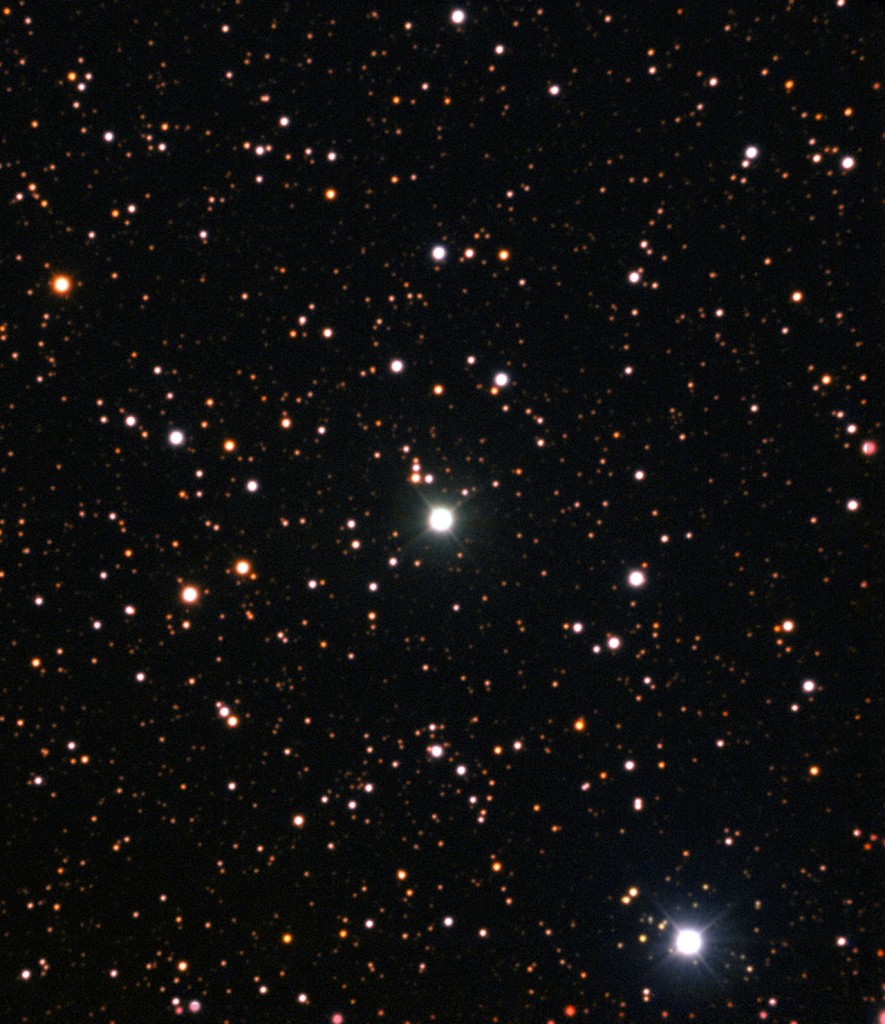
This image from the New Technology Telescope at ESO’s La Silla Observatory shows Nova Centauri 2013 in July 2015 as the brightest star in the centre of the picture. This was more than eighteen months after the initial explosive outburst. This nova was the first in which evidence of lithium has been found. Credit: ESO

The light chemical element lithium is one of the few elements that is predicted to have been created by the Big Bang, 13.8 billion years ago. But understanding the amounts of lithium observed in stars around us today in the Universe has given astronomers headaches. Older stars have less lithium than expected [1], and some younger ones up to ten times more [2].

Since the 1970s, astronomers have speculated that much of the extra lithium found in young stars may have come from novae — stellar explosions that expel material into the space between the stars, where it contributes to the material that builds the next stellar generation. But careful study of several novae has yielded no clear result up to now.

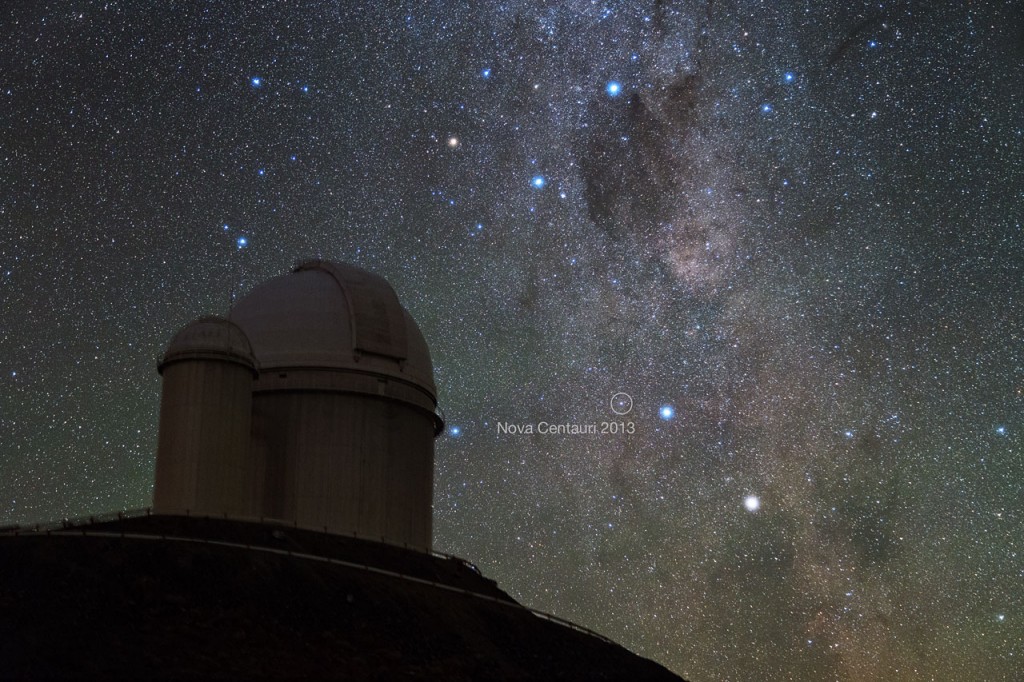
Alpha and Beta Centauri, two of the brightest stars in the southern sky, had a new companion in late 2013 — the naked eye Nova Centauri 2013. This photo was taken by ESO Photo Ambassador Yuri Beletsky at ESO's La Silla Observatory in the Chilean Atacama Desert in the morning hours of Monday 9 December 2013. The nova was discovered by John Seach from Australia on 2 December 2013 as it approached naked eye brightness. Nova Centaurus 2013 is the brightest nova to have occurred so far this millennium. This particular event is known as a classical nova, and is not to be confused with a supernova. Classical novae occur in binary star systems when hydrogen gas from the orbiting stellar partner is accreted onto the surface of the main star, causing a runaway thermonuclear event resulting in the brightening of the main star. In a classical novae the main star is not destroyed as is the case in a supernova. Instead, the star is dramatically brightened, and there is a simultaneous expansion of a debris shell. The nova appears in the picture just to the left of Beta Centauri, the bluer and higher of the two bright stars in the lower-right part of the image. The Southern Cross and the Coal Sack Nebula are also captured near the top of the picture. In front at the left is the ESO 3.6-metre telescope, inaugurated in 1976, it currently operates with the HARPS spectrograph, the most prolific exoplanet hunting machine in the world. Located 600 km north of Santiago, at 2400 m altitude in the outskirts of the Chilean Atacama Desert, La Silla was first ESO site in Chile and the largest observatory of its time. Links  Image of Nova Centauri 2013 (non-annotated)
Alpha and Beta Centauri, two of the brightest stars in the southern sky, had a new companion in late 2013 — the naked eye Nova Centauri 2013. This photo was taken by ESO Photo Ambassador Yuri Beletsky at ESO’s La Silla Observatory in the Chilean Atacama Desert in the morning hours of Monday 9 December 2013. The nova was discovered by John Seach from Australia on 2 December 2013 as it approached naked eye brightness. Nova Centaurus 2013 is the brightest nova to have occurred so far this millennium. This particular event is known as a classical nova, and is not to be confused with a supernova. Classical novae occur in binary star systems when hydrogen gas from the orbiting stellar partner is accreted onto the surface of the main star, causing a runaway thermonuclear event resulting in the brightening of the main star. In a classical novae the main star is not destroyed as is the case in a supernova. Instead, the star is dramatically brightened, and there is a simultaneous expansion of a debris shell. The nova appears in the picture just to the left of Beta Centauri, the bluer and higher of the two bright stars in the lower-right part of the image. The Southern Cross and the Coal Sack Nebula are also captured near the top of the picture. In front at the left is the ESO 3.6-metre telescope, inaugurated in 1976, it currently operates with the HARPS spectrograph, the most prolific exoplanet hunting machine in the world. Located 600 km north of Santiago, at 2400 m altitude in the outskirts of the Chilean Atacama Desert, La Silla was first ESO site in Chile and the largest observatory of its time. Links Image of Nova Centauri 2013 (non-annotated)

A team led by Luca Izzo (Sapienza University of Rome, and ICRANet, Pescara, Italy) has now used the FEROS instrument on the MPG/ESO 2.2-metre telescope at the La Silla Observatory, as well the PUCHEROS spectrograph on the ESO 0.5-metre telescope at the Observatory of the Pontificia Universidad Catolica de Chile in Santa Martina near Santiago, to study the nova Nova Centauri 2013 (V1369 Centauri). This star exploded in the southern skies close to the bright star Beta Centauri in December 2013 and was the brightest nova so far this century — easily visible to the naked eye [3].

The very detailed new data revealed the clear signature of lithium being expelled at two million kilometres per hour from the nova [4]. This is the first detection of the element ejected from a nova system to date.

This video sequence starts from a wide field view of the Milky Way and closes in on the bright and famous pair of stars Alpha and Beta Centauri. Nova Centauri 2013 exploded close to Beta Centauri in the sky in late 2013 and careful study of the light from this star has revealed the first traces of the element lithium ever found in a nova. The final image in the zoom is a closeup of the nova taken using the New Technology Telescope at ESO’s La Silla Observatory in July 2015. The nova is the brightest star close to the centre of the picture and is much fainter than it was at maximum light, when it could be seen with the naked eye.

Credit: ESO/Digitized Sky Survey 2/N. Risinger (skysurvey.org). Music: Johan B. Monell (www.johanmonell.com).

Co-author Massimo Della Valle (INAF–Osservatorio Astronomico di Capodimonte, Naples, and ICRANet, Pescara, Italy) explains the significance of this finding:

“It is a very important step forward. If we imagine the history of the chemical evolution of the Milky Way as a big jigsaw, then lithium from novae was one of the most important and puzzling missing pieces. In addition, any model of the Big Bang can be questioned until the lithium conundrum is understood.”

The mass of ejected lithium in Nova Centauri 2013 is estimated to be tiny (less than a billionth of the mass of the Sun), but, as there have been many billions of novae in the history of the Milky Way, this is enough to explain the observed and unexpectedly large amounts of lithium in our galaxy.

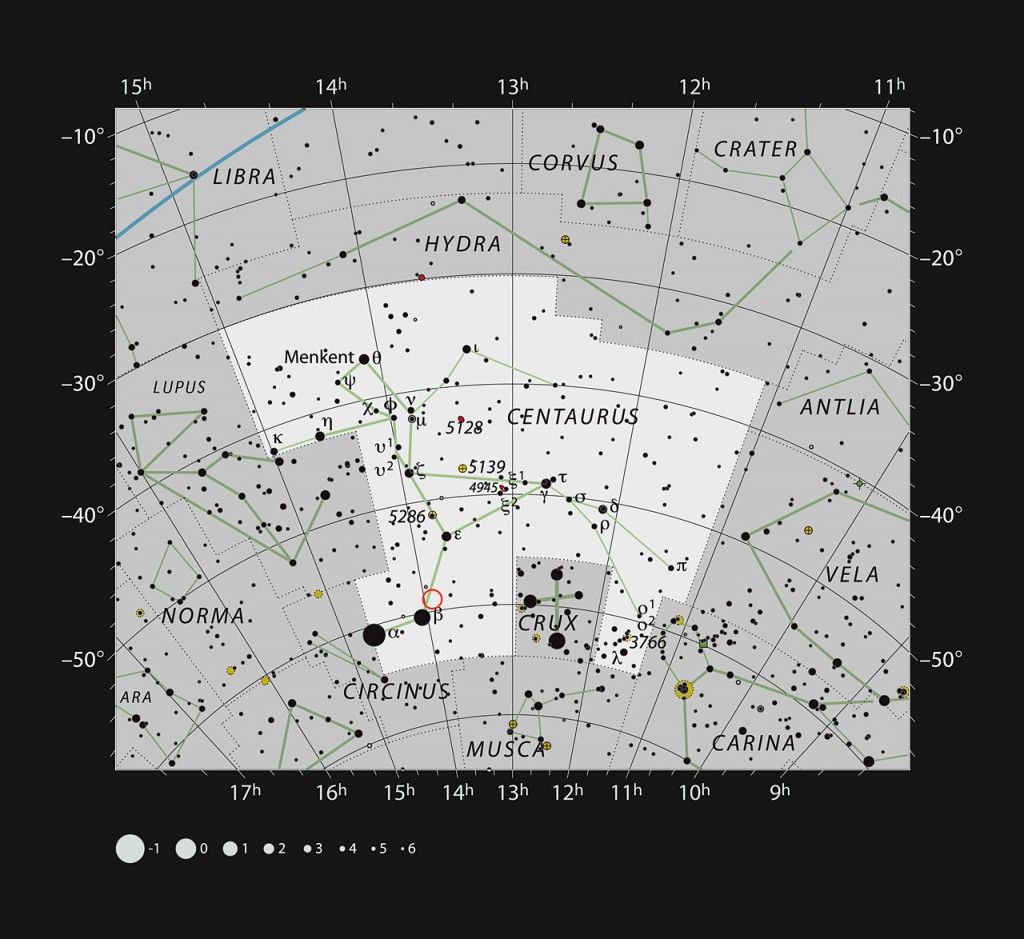
This chart shows the location of Nova Centauri 2013 (red circle) in the constellation of Centaurus (The Centaur). All the stars easily seen with the naked eye on a dark clear night are shown. The nova erupted in late 2013 and was visible without a telescope. Careful study of the light from this nova has revealed the first traces of the element lithium ever found in a nova.

Authors Luca Pasquini (ESO, Garching, Germany) and Massimo Della Valle have been looking for evidence of lithium in novae for more than a quarter of a century. This is the satisfying conclusion to a long search for them. And for the younger lead scientist there is a different kind of thrill:

“It is very exciting,” says Luca Izzo, “to find something that was predicted before I was born and then first observed on my birthday in 2013!”


2015 Space Elevator Conference – Seattle, Washington, Aug.21-23

An announcement from the International Space Elevator Consortium (ISEC) about their upcoming annual conference:

The International Space Elevator Consortium (ISEC) is proud
to announce the 2015 Space Elevator Conference!
This annual event will be held at the Museum of Flight in Seattle,
Washington from Friday, August 21st through Sunday, August 23rd.

Seattle, WA, July 27, 2015 – Come experience learning, brainstorming, and international collaboration in an atmosphere of history, invention, and discovery! A Family Science Fest day will be held in conjunction with the conference.

3-Day Technical Conference

The twin themes of this year’s conference are “Carbon Nanotube Tensile Strength Progress” & “Marine Node Design Characteristics”. Papers will be presented on these and other space-elevator related topics. There will be mini-workshops on Research Activities and Global Cooperation, Marine Node Design Concepts, and Space Elevator Architectures and Roadmaps as well as the ever popular Shotgun Science Session and “Elevator Speech” competition.

ISEC is very pleased to announce that Mr. Mark Haase, PhD student (Chemical Engineering) at the University of Cincinnati will give the Keynote address at this year’s conference. His talk will address:

“Advanced Materials are critical for the development of the Space Elevator. Most prominently, the elevator cable will require a material with a much greater tensile strength than current materials. Carbon nanotubes are an exciting material for this purpose, showing high tensile strength at the nanoscale. Despite this promise, they have not yet achieved the needed strength. Nonetheless, meaningful progress has been made.

In this presentation, we will consider the recent progress in high strength materials; focusing on carbon nanotubes, but also considering other materials. We will also consider the progress in other properties of these materials, such as conductivity. While these properties are not directly related to the development of the Space Elevator Tether, they are likely to be important in the design and development of other elevator technologies.

Further, demand for these properties in other sectors will drive broader material development, making them important in enabling technologies.”

We are very excited to have Mr. Haase with us this year and we’re sure that his insights will be fascinating.

Family Science Fest

The Family Science Fest on Saturday, August 22nd will also be held at the Museum of Flight. This event is open to the public (no registration required) and is included in the museum admission price. The Family Science Fest includes Space Elevator 101 and 201 presentations, a youth robotics competition, exhibits from science organizations and clubs, and much more.

More details of the conference program and the Family Science Fest events are posted at http://spaceelevatorconference.org, including information on registration for the technical conference and lodging. Registration for the technical conference closes August 15th.

The Space Elevator is one of the most magnificent Engineering projects ever conceived. It promises abundant access to space and a multitude of benefits for humanity. Come to the conference and hear presentations and join discussions with people who are working to make space elevators a reality!

About The International Space Elevator Consortium (ISEC)

The International Space Elevator Consortium (ISEC) is composed of individuals and organizations from around the world who share a vision of humanity in space. Our Vision is a world with inexpensive, safe, routine, and efficient access to space for the benefit of all mankind. Our Mission is to promote the development, construction and operation of a Space Elevator (SE) Infrastructure as a revolutionary and efficient way to space for all humanity.

To learn more about ISEC, please visit our website at http://www.isec.org.

The Space Show this week – July.27.15

The guests and topics of discus ion on The Space Show this week:

1. Monday, July 27, 2015: 2-3:30 PM PDT (5-6:30 PM EDT; 4-5:30 PM CDT): We welcome DR. ROBERT PAPPALARDO of JPL who is heading up the NASA Europa mission.

2. Tuesday, July 28, 2015:,7-8:30 PM PDT (10-11:30 PM EST, 9-10:30 PM CDT): We welcome MICHAEL MACKOWSKI, author of Adventures in Space Advocacy

3. Friday, July 24, 2015; 9:30 -11 AM PDT (12:30-2 PM EDT; 11:30-1 PM CDT): We welcome DR. JULIE ROBINSON, NASA JSC & ISS Chief Scientist. We will be discussing the Twins Study along with other relevant issues.

4. Sunday, August 2, 2015: 12-1:30 PM PDT (3-4:30 PM EDT, 2-3:30 PM CDT): OPEN LINES. First time callers welcome, all space and STEM topics welcome.

See also:
/– The Space Show on Vimeo – webinar videos
/– The Space Show’s Blog – summaries of interviews.
/– The Space Show Classroom Blog – tutorial programs

The Space Show is a project of the One Giant Leap Foundation.

Videos: TMRO Spacepods – ISS resupply, Pluto history, Mariner 4, & Rocket industry update

Catching up on recent TMRO.tv Spacepod webcasts:

* Everything Will Be Alright – SpacePod 07/07/15

TMRO’s Space Mike covers the recent success of the Progress resupply ship as well as some of the first political rhetoric after the Falcon 9 launch failure.

* How Pluto Was Discovered – Space Pod 07/10/15

TMRO Chief Astronomer Jared Head goes over the history of Pluto, just in time for next week’s New Horizons flyby.

* Retro Space Data – Mariner 4 – Space Pod 07/20/15

This week Ariel Waldman talks about how impatient NASA JPL employees visualized the very first image of Mars from space using colored pastels and a paint-by-number scheme.

* Meanwhile, in the Rocket Industry – SpacePod 07/21/15

With all the excitement over Pluto lately, there may have been a few notable rocket industry updates you may have missed.

* The Pluto “Planet” Problem – Space Pod 07/24/15

TMRO Chief Astronomer Jared Head takes a look at the recent decision to reclassify Pluto to dwarf planet and if recent New Horizons data may be enough to reverse that decision.

TMRO Space Pods are crowd funded shows. If you like this episode consider contributing to help us to continue to improve. Head over tohttp://www.patreon.com/spacepod for information, goals and reward levels. Don’t forget to check out our weekly live show campaign as well over at http://www.patreon.com/tmro

Everyone can participate in space