New Worlds 2015 Conference to focus on colonizing the Moon, Mars and Free Space

An announcement from the New Worlds Institute:

Space Settlers Wanted
New Worlds 2015 Conference to Focus on
Colonizing the Moon, Mars and Free Space
Austin Texas  |  October 16 & 17

“New Worlds 2015 is going to be something new in the space field, something that steps out of the airlock of what a space event is supposed to be ”
— Rick Tumlinson

Recently billionaires such as Jeff Bezos of Amazon, PayPal billionaire Elon Musk, Paul Allen of MicroSoft, Richard Branson and many others have begun to build spaceships designed to carry regular people into space. Some such as Musk declare outright that they intend to put the first settlers on Mars. Joining them are national entities like the United Arab Emirates who just announced a multi-billion dollar space program aimed at the Red Planet, China which is designing its own Moon base plans, and other countries and projects to be announced soon. NASA is also rapidly moving towards supporting the opening of space to citizens as a focus of its human spaceflight program.

Register Now for New Worlds 2015
Special Early Bird Pricing Still Available

Elon Musk says he’ll be landing on Mars by 2030,” Meagan Crawford, New Worlds Executive Director added. She continued: “The premise of the Institute and New Worlds Conference is that while these bright minds work to build new space ships to carry people out into space, someone needs to focus on what we will do when we get there – how we will live, prosper and create the next level of human civilization.”

Featured talks on colonizing the Moon, Mars and Free Space, space solar power, the space station and its relevance to colonizing the solar system will join presentations by New Space start ups and businesses leaders working to create a space economy. Stories from real space fliers and astronauts will be interspersed between sessions by top experts in such areas as biology, engineering, design, science and space systems. Short, high-level talks on such things as life extension, farming on Mars, the military in space, and genetic engineering will round out the event. On Friday parallel events will include workshops on crowdsourcing settlement solutions, empowering women in space and other important aspects of the space revolution.

“The age of human space exploration is just beginning and this event is a sampler of the different ideas and opportunities the Institute will be looking to cultivate, It’s a starting point for professionals and students to tell the community their dreams” said Jay Milla, Executive Producer of the event. “We’re also including art, music and various workshops for people to ‘think tank’ what is to come. Your crazy idea is welcome here!”

New Worlds 2015 will feature a student competition called “Cities in Space” in which middle and high school students will create 3D or video models of a 10,000 person colony. Students of all ages are encouraged to attend and participate in both the conference sessions and the cultural events such as the art show and the concert. The New Worlds Institute is offering extreme discounts to students, with prices starting at just $15 a day, to encourage the active participation of the future space settlers. Students are encouraged register now to reserve this special discounted price.

The New Worlds Institute announced today it’s inaugural event, to be held in the Palmer Event Center in Austin, Texas October 16-17. New Worlds 2015 is a different kind of space event. The renaissance affair will be a conference, a gathering of minds, a series of workshops, an art exhibit, a cultural experience, a concert, and most importantly, it will be an all-inclusive discussion about humanity’s future as we migrate to new worlds.

The core premise of the event and the organization is that the first settlers of the Solar System are alive right now, and it is time to begin to focus on the technologies, tools and culture they will need to open the frontier. This is the purpose of New Worlds 2015.

“New Worlds 2015 is going to be something new in the space field, something that steps out of the airlock of what a space event is supposed to be,” said Rick Tumlinson, Founder of the New Worlds Institute. “Our goal is to take the serious core of science and engineering we will need to build new communities in space and wrap it in a cultural experience that is fun, challenging and generally mind blowing.”

Learn More about VIP and Sponsorship packages;
designed for space enthusiasts and small businesses

While the Institute itself intends to focus on serious research into the technologies and engineering challenges needed to create real human cities in space, the group believes that there also needs to be a cultural element included in what it calls the “breakout”. Thus the event will feature such unusual elements as an art show and a rock concert/dance party featuring the techno-rock band Arc Attack, known for using Tesla coils and amazing lightning effects in its show, complimented by performance artists Nadis Warriors and The Clergy.

The New Worlds Institute is producing this event as the first in a series of social gatherings and conferences meant to engage the public, the business world and the scientific community in a constructive dialog about not just how we get there, but how we stay. The two-day event will highlight concepts and ideas about building the first human communities on the Moon, Mars and in the free space between worlds.

“New Worlds 2015 is an experiment,” said Tumlinson. “Space has been boring too long. Our goal is to plant the seeds of a new and dynamic space culture that will begin to grow in the years ahead so those who will literally build the first human space colonies can be ready when the space ships are ready to carry them out there. It may sound crazy, just as 20 years before the MayFlower saying you might go across the ocean and start a new community in that New World sounded crazy. But it will also be incredibly fun.”

Register now to reserve our special early bird pricing of just $275 for both days (including lunch and admission to the Lift Off! concert on Friday night). Click here to learn more about the event, including location details, speakers, discussion topics, the student competition and more. VIP packages and small business sponsorship opportunities are available online or by contacting us directly. Please contact us to learn more about our corporate level sponsorship options and partnership opportunities.

Rosetta spots jet outburst from Comet 67P/C-G

The latest images from Rosetta at Comet 67P/Churyumov–Gerasimenko:

Comet’s firework display ahead of perihelion

Outburst_in_action_node_full_image_2[1]
A short-lived outburst from Comet 67P/Churyumov–Gerasimenko was captured by Rosetta’s OSIRIS narrow-angle camera on 29 July 2015. The image at left was taken at 13:06 GMT and does not show any visible signs of the jet. It is very strong in the middle image captured at 13:24 GMT. Residual traces of activity are only very faintly visible in the final image taken at 13:42 GMT. The images were taken from a distance of 186 km from the centre of the comet. The jet is estimated to have a minimum speed of 10 m/s and originates from a location on the comet’s neck, in the rugged Anuket region. Larger image.
In the approach to perihelion over the past few weeks, Rosetta has been witnessing growing activity from Comet 67P/Churyumov–Gerasimenko, with one dramatic outburst event proving so powerful that it even pushed away the incoming solar wind.

The comet reaches perihelion on Thursday, the moment in its 6.5-year orbit when it is closest to the Sun. In recent months, the increasing solar energy has been warming the comet’s frozen ices, turning them to gas, which pours out into space, dragging dust along with it.

The period around perihelion is scientifically very important, as the intensity of the sunlight increases and parts of the comet previously cast in years of darkness are flooded with sunlight.

Although the comet’s general activity is expected to peak in the weeks following perihelion, much as the hottest days of summer usually come after the longest days, sudden and unpredictable outbursts can occur at any time – as already seen earlier in the mission.

On 29 July, Rosetta observed the most dramatic outburst yet, registered by several of its instruments from their vantage point 186 km from the comet. They imaged the outburst erupting from the nucleus, witnessed a change in the structure and composition of the gaseous coma environment surrounding Rosetta, and detected increased levels of dust impacts.

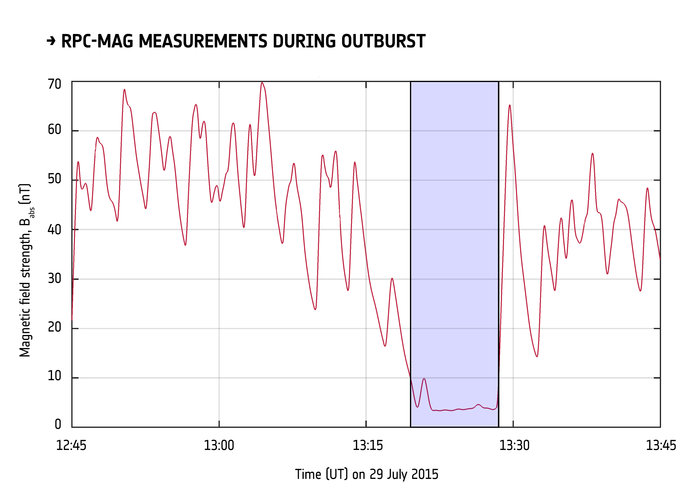
Perhaps most surprisingly, Rosetta found that the outburst had pushed away the solar wind magnetic field from around the nucleus.

Discovery_of_diamagnetic_cavity_node_full_image_2[1]
The decrease in magnetic field strength measured by Rosetta’s RPC-MAG instrument during the outburst event on 29 July 2015. This is the first time a ‘diamagnetic cavity’ has been detected at Comet 67P/Churyumov–Gerasimenko and is thought to be caused by an outburst of gas temporarily increasing the gas flux in the comet’s coma, and pushing the pressure-balance boundary between it and incoming solar wind farther from the nucleus than expected under ‘normal’ levels of activity.
A sequence of images taken by Rosetta’s scientific camera OSIRIS show the sudden onset of a well-defined jet-like feature emerging from the side of the comet’s neck, in the Anuket region. It was first seen in an image taken at 13:24 GMT, but not in an image taken 18 minutes earlier, and has faded significantly in an image captured 18 minutes later. The camera team estimates the material in the jet to be travelling at 10 m/s at least, and perhaps much faster.

“This is the brightest jet we’ve seen so far,” comments Carsten Güttler, OSIRIS team member at the Max Planck Institute for Solar System Research in Göttingen, Germany.

“Usually, the jets are quite faint compared to the nucleus and we need to stretch the contrast of the images to make them visible – but this one is brighter than the nucleus.”

Soon afterwards, the comet pressure sensor of ROSINA detected clear indications of changes in the structure of the coma, while its mass spectrometer recorded changes in the composition of outpouring gases.

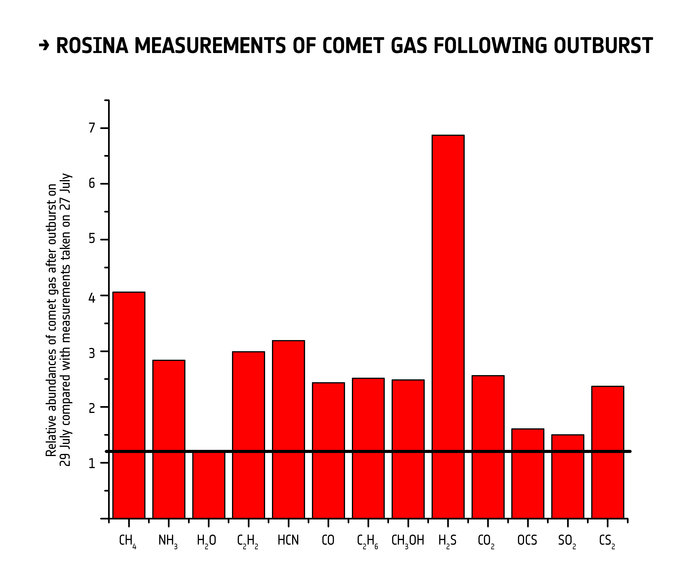
For example, compared to measurements made two days earlier, the amount of carbon dioxide increased by a factor of two, methane by four, and hydrogen sulphide by seven, while the amount of water stayed almost constant.

Gas_changes_during_29_July_outburst_node_full_image_2[1]
During an outburst of gas and dust from Comet 67P/Churyumov–Gerasimenko on 29 July 2015, Rosetta’s ROSINA instrument detected a change in the composition of gases compared with previous days. The graph shows the relative abundances of various gases after the outburst, compared with the measurements two days earlier. For example, the amount of carbon dioxide (CO2) increased by a factor of two, methane (CH4) by four, and hydrogen sulphide (H2S) by seven, while the amount of water (indicated by the horizontal black line) stayed almost constant.
“This first ‘quick look’ at our measurements after the outburst is fascinating,” says Kathrin Altwegg, ROSINA principal investigator at the University of Bern. “We also see hints of heavy organic material after the outburst that might be related to the ejected dust.“But while it is tempting to think that we are detecting material that may have been freed from beneath the comet’s surface, it is too early to say for certain that this is the case.”

Meanwhile, about 14 hours after the outburst, GIADA was detecting dust hits at rates of 30 per day, compared with just 1–3 per day earlier in July. A peak of 70 hits was recorded in one 4-hour period on 1 August, indicating that the outburst continued to have a significant effect on the dust environment for the following few days.

“It was not only the abundance of the particles, but also their speeds measured by GIADA that told us something ‘different’ was happening: the average particle speed increased from 8 m/s to about 20 m/s, with peaks at 30 m/s – it was quite a dust party!” says Alessandra Rotundi, principal investigator at the ‘Parthenope’ University of Naples, Italy.

Perhaps the most striking result is that the outburst was so intense that it actually managed to push the solar wind away from the nucleus for a few minutes – a unique observation made by the Rosetta Plasma Consortium’s magnetometer.

The solar wind is the constant stream of electrically charged particles that flows out from the Sun, carrying its magnetic field out into the Solar System. Earlier measurements made by Rosetta and Philae had already shown that the comet is not magnetised,  so the only source for the magnetic field measured around it is the solar wind.

29_July_outburst_context_node_full_image_2[1]
This image, taken on 12 April 2015 by the OSIRIS narrow-angle camera, identifies the source region of the outburst from Comet 67P/Churyumov–Gerasimenko observed by Rosetta’s instruments on 29 July.
But it doesn’t flow past unimpeded. Because the comet is spewing out gas, the incoming solar wind is slowed to a standstill where it encounters that gas and a pressure balance is reached.“The solar wind magnetic field starts to pile up, like a traffic jam, and eventually stops moving towards the comet nucleus, creating a magnetic field-free region on the Sun-facing side of the comet called a ‘diamagnetic cavity’,” explains Charlotte Götz, magnetometer team member at the Institute for Geophysics and extraterrestrial Physics in Braunschweig, Germany.

Diamagnetic cavities provide fundamental information on how a comet interacts with the solar wind, but the only previous detection of one associated with a comet was made at about 4000 km from Comet Halley as ESA’s Giotto flew past in 1986.

Rosetta’s comet is much less active than Halley, so scientists expected to find a much smaller cavity around it, up to a few tens of kilometres at most, and prior to 29 July, had not observed any sign of one.

But, following the outburst on that day, the magnetometer detected a diamagnetic cavity extending out at least 186 km from the nucleus. This was likely created by the outburst of gas, which increased the neutral gas flux in the comet’s coma, forcing the solar wind to ‘stop’ further away from the comet and thus pushing the cavity boundary outwards beyond where Rosetta was flying at the time.

“Finding a magnetic field-free region anyway in the Solar System is really hard, but here we’ve had it served to us on a silver platter – this is a really exciting result for us,” adds Charlotte.

“We’ve been moving Rosetta out to distances of up to 300 km in recent weeks to avoid problems with navigation caused by dust, and we had considered that the diamagnetic cavity was out of our grasp for the time being. But it seems that the comet has helped us by bringing the cavity to Rosetta,” says Matt Taylor, Rosetta Project Scientist.

“This is a fantastic multi-instrument event which will take time to analyse, but highlights the exciting times we’re experiencing at the comet in this ‘hot’ perihelion phase.”

ESO: Astronomers measure dying energy output of the universe

Here’s a new report from ESO (European Southern Observatory):

Charting the Slow Death of the Universe

An international team of astronomers studying more than 200 000 galaxies has measured the energy generated within a large portion of space more precisely than ever before. This represents the most comprehensive assessment of the energy output of the nearby Universe. They confirm that the energy produced in a section of the Universe today is only about half what it was two billion years ago and find that this fading is occurring across all wavelengths from the ultraviolet to the far infrared. The Universe is slowly dying.

This composite picture shows how a typical galaxy appears at different wavelengths in the GAMA survey. This huge project has measured the energy output of more than 200 000 galaxies and represents the most comprehensive assessment of the energy output of the nearby Universe. The results confirm that the energy produced in a section of the Universe today is only about half what it was two billion years ago and find that this fading is occurring across all wavelengths from the ultraviolet to the far infrared.

Click for larger image.

The study involves many of the world’s most powerful telescopes, including ESO’s VISTA and VST survey telescopes at the Paranal Observatory in Chile. Supporting observations were made by two orbiting space telescopes operated by NASA (GALEX and WISE) and another belonging to the European Space Agency (Herschel) .

The research is part of the Galaxy And Mass Assembly (GAMA) project, the largest multi-wavelength survey ever put together.

“We used as many space and ground-based telescopes as we could get our hands on to measure the energy output of over 200 000 galaxies across as broad a wavelength range as possible,” says Simon Driver (ICRAR, The University of Western Australia), who heads the large GAMA team.

The survey data, released to astronomers around the world today, includes measurements of the energy output of each galaxy at 21 wavelengths, from the ultraviolet to the far infrared. This dataset will help scientists to better understand how different types of galaxies form and evolve.

All the energy in the Universe was created in the Big Bang, with some portion locked up as mass. Stars shine by converting mass back into energy, as described by Einstein’s famous equation E=mc2 [2]. The GAMA study sets out to map and model all of the energy generated within a large volume of space today and at different times in the past.

“While most of the energy sloshing around in the Universe arose in the aftermath of the Big Bang, additional energy is constantly being generated by stars as they fuse elements like hydrogen and helium together,” Simon Driver says. “This new energy is either absorbed by dust as it travels through the host galaxy, or escapes into intergalactic space and travels until it hits something, such as another star, a planet, or, very occasionally, a telescope mirror.”

The fact that the Universe is slowly fading has been known since the late 1990s, but this work shows that it is happening across all wavelengths from the ultraviolet to the infrared, representing the most comprehensive assessment of the energy output of the nearby Universe.

“The Universe will decline from here on in, sliding gently into old age. The Universe has basically sat down on the sofa, pulled up a blanket and is about to nod off for an eternal doze,” concludes Simon Driver.

The team of researchers hope to expand the work to map energy production over the entire history of the Universe, using a swathe of new facilities, including the world’s largest radio telescope, the Square Kilometre Array, which is due to be built in Australia and South Africa over the next decade.

The team will present this work at the International Astronomical Union XXIX General Assembly in Honolulu, Hawaii, on Monday 10 August 2015.

Notes

[1] The telescopes and survey data used, in order of increasing wavelength, were: GALEX, SDSS, VST (KiDS survey), AAT,VISTA (VIKING survey)/UKIRT, WISE, Herschel (PACS/SPIRE).

[2] Much of the Universe’s energy output comes from nuclear fusion in stars, when mass is slowly converted into energy. Another major source is the very hot discs around black holes at the centres of galaxies, where gravitational energy is converted to electromagnetic radiation in quasars and other active galactic nuclei. Much longer wavelength radiation comes from huge dust clouds that are re-radiating the energy from stars within them.

Video: ISS astronauts sample locally grown lettuce

Today astronauts on the Int. Space Station sampled lettuce grown on the station:

—

Here’s an earlier NASA release about the project:

Crew Members Sample Leafy Greens Grown on Space Station

Fresh food grown in the microgravity environment of space officially is on the menu for the first time for NASA astronauts on the International Space Station. Expedition 44 crew members, including NASA’s one-year astronaut Scott Kelly, are ready to sample the fruits of their labor after harvesting a crop of “Outredgeous” red romaine lettuce Monday, Aug. 10, from the Veggie plant growth system on the nation’s orbiting laboratory.

The astronauts will clean the leafy greens with citric acid-based, food safe sanitizing wipes before consuming them. They will eat half of the space bounty, setting aside the other half to be packaged and frozen on the station until it can be returned to Earth for scientific analysis.

iss044e033362-veggie1_1[1]
Astronauts on the International Space Station are ready to sample their harvest of a crop of “Outredgeous” red romaine lettuce from the Veggie plant growth system that tests hardware for growing vegetables and other plants in space. Credits: NASA. Click for larger image.
NASA’s plant experiment, called Veg-01, is being used to study the in-orbit function and performance of the plant growth facility and its rooting “pillows,” which contain the seeds.

NASA is maturing Veggie technology aboard the space station to provide future pioneers with a sustainable food supplement – a critical part of NASA’s Journey to Mars. As NASA moves toward long-duration exploration missions farther into the solar system, Veggie will be a resource for crew food growth and consumption. It also could be used by astronauts for recreational gardening activities during deep space missions.

The first pillows were activated, watered and cared for by Expedition 39 flight engineer Steve Swanson in May 2014. After 33 days of growth, the plants were harvested and returned to Earth in October 2014. At NASA’s Kennedy Space Center in Florida, the plants underwent food safety analysis. The second Veg-01 plant pillows were activated by Kelly on July 8 and grew again for 33 days before being harvested. The seeds had been on the station for 15 months before being activated.

The Veggie system was developed by Orbital Technologies Corp. (ORBITEC) in Madison, Wisconsin, and tested at Kennedy before flight. Veggie, along with two sets of pillows containing the romaine seeds and one set of zinnias, was delivered to the station on the third cargo resupply mission by SpaceX in April 2014.

The collapsible and expandable Veggie unit features a flat panel light bank that includes red, blue and green LEDs for plant growth and crew observation. Using LED lights to grow plants was an idea that originated with NASA as far back as the late 1990s, according to Dr. Ray Wheeler, lead for Advanced Life Support activities in the Exploration Research and Technology Programs Office at Kennedy.

Wheeler worked with engineers and collaborators to help develop the Veggie unit from a Small Business Innovative Research project with ORBITEC. Dr. Gioia Massa is the NASA payload scientist for Veggie at Kennedy. Massa and others worked to get the flight unit developed and certified for use on the space station. The purple/pinkish hue surrounding the plants in Veggie is the result of a combination of the red and blue lights, which by design emit more light than the green LEDs. Green LEDS were added so the plants look like edible food rather than weird purple plants.

“Blue and red wavelengths are the minimum needed to get good plant growth,” Wheeler said. “They are probably the most efficient in terms of electrical power conversion. The green LEDs help to enhance the human visual perception of the plants, but they don’t put out as much light as the reds and blues.”

mars_food_production_bisected.jpg[1]
NASA plans to grow food on future spacecraft and on other planets as a food supplement for astronauts. Fresh food, such as vegetables, provide essential vitamins and nutrients that will help enable sustainable deep space pioneering. Credits: NASA. Click for large image.
Wheeler, Massa and Dr. Gary Stutte, all from Kennedy, previously investigated similar experiments to grow plants in the Habitat Demonstration Unit at NASA’s desert test site near Flagstaff, Arizona, in 2010 and 2011. Wheeler said Veggie will help NASA learn more about growing plants in controlled environment agriculture settings. Similar settings include vertical agriculture, which refers to stacking up shelves of plants that are grown hydroponically and then using electric light sources like red and blue LEDs. This kind of system is popular in some Asian countries and beginning to grow in the U.S.

“There is evidence that supports fresh foods, such as tomatoes, blueberries and red lettuce are a good source of antioxidants. Having fresh food like these available in space could have a positive impact on people’s moods and also could provide some protection against radiation in space,” Wheeler said.

After the first crop of lettuce was returned from the space station, Massa began working with a team of flight doctors and NASA safety representatives to get approval for the crew to eat the produce.

“Microbiological food safety analysis looks very good on the first Veg-01 crop of romaine lettuce,” Massa said.

Besides the nutritional benefits, could growing fresh produce in space also provide a psychological benefit? Alexandra Whitmire, a scientist at NASA’sJohnson Space Center in Houston is involved in research to answer that question.

Whitmire is the Behavioral Health and Performance Research scientist for NASA’s Human Research Program. Her team supports research related to reducing psychological risks on a Mars mission.

“The Veggie experiment is currently the only experiment we are supporting which involves evaluating the effects of plant life on humans in space,” Whitmire said.

Her team is focused on crew behavioral conditions, performance reduction, and team communication and psychosocial adaption.

“Future spaceflight missions could involve four to six crew members living in a confined space for an extended period of time, with limited communication,” Whitmire said. “We recognize it will be important to provide training that will be effective and equip the crew with adequate countermeasures during their mission.”

The countermeasures could include things like meaningful work. Habitat-related modifications also could include plant life. Whitmire said Earth studies have shown plants are associated with well-being and optimal performance. Plants potentially could serve as a countermeasure for long-duration exploration missions.

Massa agrees: “Besides having the ability to grow and eat fresh food in space, there also may be a psychological benefit. The crew does get some fresh fruits or vegetables, such as carrots or apples, when a supply ship arrives at the space station. But the quantity is limited and must be consumed quickly.”

Having something green and growing–a little piece of Earth–to take care of when living and working in an extreme and stressful environment could have tremendous value and impact.

“The farther and longer humans go away from Earth, the greater the need to be able to grow plants for food, atmosphere recycling and psychological benefits. I think that plant systems will become important components of any long-duration exploration scenario,” Massa said.

The system also may have implications for improving growth and biomass production on Earth, thus benefiting the average citizen. Massa said many of the lessons NASA is learning with Veggie could be applied in urban plant factories and other agriculture settings where light is provided by electrical light and water conservation is practiced.

“We hope to increase the amount and type of crop in the future, and this will allow us to learn more about growing plants in microgravity,” Massa said. “We have upcoming experiments that will look at the impacts of light quality on crop yield, nutrition and flavor, both on Earth and in space.”

The team at Kennedy and Johnson hope that Veggie and space gardening will become a valued feature of life aboard the space station and in the future on Mars.

For more information about Veggie, visit here.

Watch this video to learn more about growing plants in space.

The Space Show this week – Aug.10.15

The guests and topics of discussion on The Space Show this week:

1. Monday, August 10, 2015; : 2-3:30 PM PDT (5-6:30 PM EDT, 4-5:30 PM CDT): We welcome JEREMY STRAUB and several of his students to discuss their research on a wide range of space related topics including cybersecurity for spacecraft (an intrusion detection system and cryptography technique) to an attitude determination and control system component to image processing.

2. Tuesday, August 10, 2015, 7 PM PDT (10 PM EDT, 9 PM CDT): We welcome RUSSELL COX, CEO & Founder, The Lunar Initiatives. See www.LunarInitiatives.com.

3. Friday, August 14, 2015, 9:30-11 AM PDT (12:30-2 PM EDT, 11:30 AM – 1 PM CDT): We welcome back CHARLES MILLER to discuss the new Return to the Moon concept and architecture as described in the new report, “Economic Assessment and Systems Analysis of an Evolvable Lunar Architecture that Leverages Commercial Space Capabilities and Public-Private-Partnerships“. See www.nss.org/docs/EvolvableLunarArchitecture.pdf for further information.

4. Sunday, August 16:,12-1:30 PM PDT, (3-4:30 PM EDT, 2-3:30 PM CDT). Welcome to our OPEN LINES program. All space & STEM calls welcome. First time callers welcome.

See also:
/– The Space Show on Vimeo – webinar videos
/– The Space Show’s Blog – summaries of interviews.
/– The Space Show Classroom Blog – tutorial programs

The Space Show is a project of the One Giant Leap Foundation.

Everyone can participate in space