Hubble: “The wings of the butterfly’ – beautiful view of the Twin Jet Nebula

A release today from the Hubble Space Telescope team:

The wings of the butterfly

The Twin Jet Nebula, or PN M2-9, is a striking example of a bipolar planetary nebula. Bipolar planetary nebulae are formed when the central object is not a single star, but a binary system, Studies have shown that the nebula’s size increases with time, and measurements of this rate of increase suggest that the stellar outburst that formed the lobes occurred just 1200 years ago.
The Twin Jet Nebula, or PN M2-9, is a striking example of a bipolar planetary nebula. Bipolar planetary nebulae are formed when the central object is not a single star, but a binary system, Studies have shown that the nebula’s size increases with time, and measurements of this rate of increase suggest that the stellar outburst that formed the lobes occurred just 1200 years ago. Larger image

The shimmering colours visible in this NASA/ESA Hubble Space Telescope image show off the remarkable complexity of the Twin Jet Nebula. The new image highlights the nebula’s shells and its knots of expanding gas in striking detail. Two iridescent lobes of material stretch outwards from a central star system. Within these lobes two huge jets of gas are streaming from the star system at speeds in excess of one million kilometres per hour.

The cosmic butterfly pictured in this NASA/ESA Hubble Space Telescope image goes by many names. It is called the Twin Jet Nebula as well as answering to the slightly less poetic name of PN M2-9.

The M in this name refers to Rudolph Minkowski, a German-American astronomer who discovered the nebula in 1947. The PN, meanwhile, refers to the fact that M2-9 is a planetary nebula. The glowing and expanding shells of gas clearly visible in this image represent the final stages of life for an old star of low to intermediate mass. The star has not only ejected its outer layers, but the exposed remnant core is now illuminating these layers — resulting in a spectacular light show like the one seen here. However, the Twin Jet Nebula is not just any planetary nebula, it is a bipolar nebula.

Ordinary planetary nebulae have one star at their centre, bipolar nebulae have two, in a binary star system. Astronomers have found that the two stars in this pair each have around the same mass as the Sun, ranging from 0.6 to 1.0 solar masses for the smaller star, and from 1.0 to 1.4 solar masses for its larger companion. The larger star is approaching the end of its days and has already ejected its outer layers of gas into space, whereas its partner is further evolved, and is a small white dwarf.

The characteristic shape of the wings of the Twin Jet Nebula is most likely caused by the motion of the two central stars around each other. It is believed that a white dwarf orbits its partner star and thus the ejected gas from the dying star is pulled into two lobes rather than expanding as a uniform sphere. However, astronomers are still debating whether all bipolar nebulae are created by binary stars. Meanwhile the nebula’s wings are still growing and, by measuring their expansion, astronomers have calculated that the nebula was created only 1200 years ago.

Within the wings, starting from the star system and extending horizontally outwards like veins are two faint blue patches. Although these may seem subtle in comparison to the nebula’s rainbow colours, these are actually violent twin jets streaming out into space, at speeds in excess of one million kilometres per hour. This is a phenomenon that is another consequence of the binary system at the heart of the nebula. These jets slowly change their orientation, precessing across the lobes as they are pulled by the wayward gravity of the binary system.

The two stars at the heart of the nebula circle one another roughly every 100 years. This rotation not only creates the wings of the butterfly and the two jets, it also allows the white dwarf to strip gas from its larger companion, which then forms a large disc of material around the stars, extending out as far as 15 times the orbit of Pluto! Even though this disc is of incredible size, it is much too small to be seen on the image taken by Hubble.

An earlier image of the Twin Jet Nebula using data gathered by Hubble’s Wide Field Planetary Camera 2 was released in 1997. This newer version incorporates more recent observations from the telescope’s Space Telescope Imaging Spectrograph (STIS).

A version of this image was entered into the Hubble’s Hidden Treasures image processing competition, submitted by contestant Judy Schmidt.

This image shows the region of sky around the planetary nebula called the Twin Jet Nebula. The bipolar planetary nebula lies about 4200 light-years away.
This image shows the region of sky around the planetary nebula called the Twin Jet Nebula. The bipolar planetary nebula lies about 4200 light-years away. Larger image.

Dawn probe sends sharpest images yet of Ceres

The Dawn Mission posts new and sharper images of the Ceres dwarf planet in the asteroid belt:

Dawn Sends Sharper Scenes from Ceres

The closest-yet views of Ceres, delivered by NASA’s Dawn spacecraft, show the small world’s features in unprecedented detail, including Ceres’ tall, conical mountain; crater formation features and narrow, braided fractures.

The Lonely Mountain 

PIA19631-640x350[1]
NASA’s Dawn spacecraft spotted this tall, conical mountain on Ceres from a distance of 915 miles (1,470 kilometers). The mountain, located in the southern hemisphere, stands 4 miles (6 kilometers) high. Its perimeter is sharply defined, with almost no accumulated debris at the base of the brightly streaked slope with bright streaks. The image was taken on August 19, 2015. The resolution of the image is 450 feet (140 meters) per pixel. Full res jpeg.
“Dawn is performing flawlessly in this new orbit as it conducts its ambitious exploration. The spacecraft’s view is now three times as sharp as in its previous mapping orbit, revealing exciting new details of this intriguing dwarf planet,” said Marc Rayman, Dawn’s chief engineer and mission director, based at NASA’s Jet Propulsion Laboratory, Pasadena, California.

At its current orbital altitude of 915 miles (1,470 kilometers), Dawn takes 11 days to capture and return images of Ceres’ whole surface. Each 11-day cycle consists of 14 orbits. Over the next two months, the spacecraft will map the entirety of Ceres six times.

Urvara Peaks

PIA19632-640x350[1]
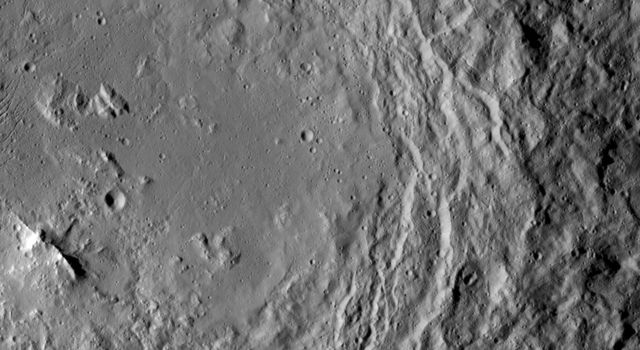
NASA’s Dawn spacecraft took this image that shows a mountain ridge, near lower left, that lies in the center of Urvara crater on Ceres. Urvara is an Indian and Iranian deity of plants and fields. The crater’s diameter is 101 miles (163 kilometers). This view was acquired on August 19, 2015, from a distance of 915 miles (1,470 kilometers). The resolution of the image is 450 feet (140 meters) per pixel. Full res jpeg.
The spacecraft is using its framing camera to extensively map the surface, enabling 3-D modeling. Every image from this orbit has a resolution of 450 feet (140 meters) per pixel, and covers less than 1 percent of the surface of Ceres.

At the same time, Dawn’s visible and infrared mapping spectrometer is collecting data that will give scientists a better understanding of the minerals found on Ceres’ surface.

Gaue Crater

PIA19633-640x350[1]
NASA’s Dawn Spacecraft took this image of Gaue crater, the large crater on the bottom, on Ceres. Gaue is a Germanic goddess to whom offerings are made in harvesting rye. The center of this crater is sunken in. Its diameter is 84 kilometers (52 miles). The resolution of the image is 450 feet (140 meters) per pixel. The image was taken from a distance of 915 miles (1,470 kilometers) on August 18, 2015. Full res jpeg.
Engineers and scientists will also refine their measurements of Ceres’ gravity field, which will help mission planners in designing Dawn’s next orbit — its lowest — as well as the journey to get there. In late October, Dawn will begin spiraling toward this final orbit, which will be at an altitude of 230 miles (375 kilometers).

Dawn is the first mission to visit a dwarf planet, and the first to orbit two distinct solar system targets. It orbited protoplanet Vesta for 14 months in 2011 and 2012, and arrived at Ceres on March 6, 2015.

Topographic Maps of Ceres’ East and West Hemispheres

PIA19607-640x350[1]
This pair of images shows color-coded maps from NASA’s Dawn mission, revealing the highs and lows of topography on the surface of dwarf planet Ceres. The map at left is centered on terrain at 60 degrees east longitude; the map at right is centered on 240 degrees east longitude. The color scale extends about 5 miles (7.5 kilometers) below the surface in indigo to 5 miles (7.5 kilometers) above the surface in white. The topographic map was constructed from analyzing images from Dawn’s framing camera taken from varying sun and viewing angles. The map was combined with an image mosaic of Ceres and projected as an orthographic projection. The well-known bright spots in the center of Ceres northern hemisphere in the image at right retain their bright appearance, although they are color-coded in the same green elevation of the crater floor in which they sit. Full res jpeg.
Dawn’s mission is managed by JPL for NASA’s Science Mission Directorate in Washington. Dawn is a project of the directorate’s Discovery Program, managed by NASA’s Marshall Space Flight Center in Huntsville, Alabama. UCLA is responsible for overall Dawn mission science. Orbital ATK Inc., in Dulles, Virginia, designed and built the spacecraft. The German Aerospace Center, Max Planck Institute for Solar System Research, Italian Space Agency and Italian National Astrophysical Institute are international partners on the mission team. For a complete list of mission participants, visit: dawn.jpl.nasa.gov/mission

More information about Dawn is available at the following sites:

Video: TMRO 8.24 – “How Masten Space will get us to the Moon and Mars”

The latest TMRO.tv live program included an interview with Dave Masten of Masten Space Systems of Mojave, California: How Masten Space will get us to the Moon and Mars – TMRO

This week we bring on Dave Masten, CTO of Masten Space Systems. Dave chats about the different vehicles Masten has created, what their purpose is and how each is a stepping stone to getting humans and payloads to the Moon, Mars and beyond!

In addition the show included:

In Space News we have:
* H-2B Launch with HTV
* Ariane V Launch with TV Satellites
* RS-25 Test Firing
* Water tanks removed from space shuttle for new use
* Astronauts eat Space Lettuce

TMRO Live is a crowd funded show. If you like this episode consider contributing to help us to continue to improve. Head over tohttp://www.patreon.com/tmro for information, goals and reward levels. Don’t forget to check out our Space Pod campaign as well over athttp://www.patreon.com/spacepod

The Space Show this week – Aug.24.15

The guests and topics of discussion on The Space Show this week:

1. Monday, August 17, 2015: 2-.We welcome Dr. Judy Curry to the show. Dr. Curry is the former Chair of the School of Earth and Atmospheric Sciences at Georgia Institute of Technology. She frequently testifies on climate change issues before Congress, has extensively published on the climate change topic, plus she is the recipient of many awards and honors.

2. Tuesday, August 25, 2015, 7 PM PDT (10 PM EDT, 9 PM CDT): We welcome back TIMOTHY DOOLEY regarding his short stories, “Tales From An Alternate History” which he publishes on his website Victorian Space Age.

3. Friday, August 28, 2015, 9:30-11 AM PDT (12:30-2 PM EDT, 11:30 AM – 1 PM CDT): We welcome DR. JENS BIELE of the German Space Agency to the show. Among the topics we will be discussing will be Rosetta/Philae with emphasis on the latter.

4. Sunday, August 30:,12-1:30 PM PDT, (3-4:30 PM EDT, 2-3:30 PM CDT). No show today as am heading to the AIAA Space 2015 in Pasadena.

See also:
/– The Space Show on Vimeo – webinar videos
/– The Space Show’s Blog – summaries of interviews.
/– The Space Show Classroom Blog – tutorial programs

The Space Show is a project of the One Giant Leap Foundation.

—

Don’t forget to contribute to The Space Show’s modernization campaign:

The Space Show website modernization campaign including the development of a fully searchable & archival quality database is underway. In the first week, we have brought in more than 30% of our campaign goal. Our more than 2,500 archived programs detail the history of all aspects of the space industry with guests from every segment of the industry and every space fairing country going back decades.

Our archives are THE GOLD STANDARD verbal history of space development, along with key words and soon to be fully searchable. For information & the PERKS (including Space Show sponsorship options) please visit our support website at www.supportthespaceshow.com.

From there you can link directly to our Indiegogo project. We need your help in doing this important website and archival modernization work. Thank you for your support. Don’t forget to share our campaign & information with your Facebook and other social media.

Here are the important sites for this campaign: [www.supportthespaceshow.com, Indiegogo project site, Our YouTube video. and Facebook.]

Video: One Direction’s ‘Drag Me Down’ filmed at JSC

The band One Direction releases a new video filmed at NASA Johnson Space Center: One Direction Are Made of the Right Stuff in Their ‘Drag Me Down’ Video: Watch – Billboard


Everyone can participate in space