Student CanSat competitions underway in US and Europe for 2016

The CanSat Competition involves student teams building soda can sized “satellites” that ride suborbital rockets to a high altitude and perform particular tasks such as atmospheric measurements. The program has been going on for several years in the US and is also now in Europe:

Getting ready for the European CanSat competitions 2016

15 September 2015: The ESA Education team has the pleasure to announce that preparations for the 2016 edition of the European CanSat competition are underway! The launch campaign will take place at the end of June 2016.

This will be the first time ESA assigns a space theme to the competition, which will be announced in the near future.

CanSats_2015_node_full_image_2[1]
Recovered CanSats from the launches
A CanSat is a simulation of a real satellite, integrated within the volume and shape of a soft drink can. The challenge for the students taking part in this competition is to fit all the major subsystems found in a satellite, such as power, sensors and a communication system, into this minimal volume. The CanSat is then launched to an altitude of a few hundred metres by a rocket, or dropped from a platform or captive balloon, where it carries out its scientific experiment and achieves a safe landing.

Before the official European CanSat competition takes place, several national CanSat competitions will be held in various ESA member states*. The winners of the national competitions will be able to participate in the European one. The national organisers are invited to send us the name of their national winning teams before 17 April 2016.

Details about the organisation of the national competitions are available on the CanSat website. Help and advice for the national organisers, the students and teachers, as well as guidelines and timetables will be published soon.
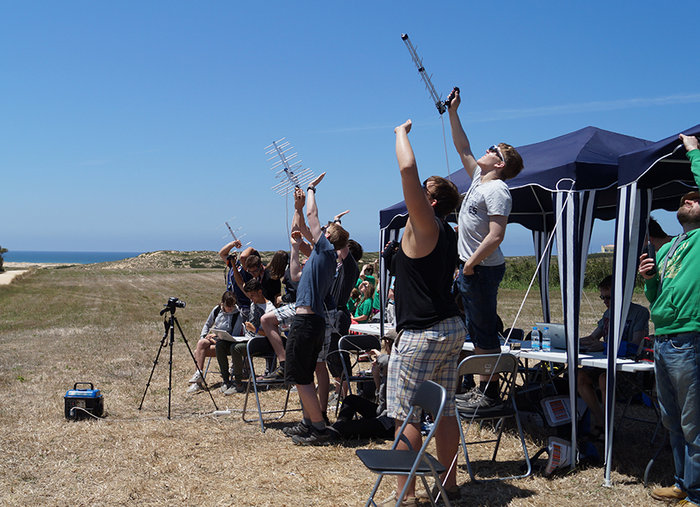
Students_tracking_their_CanSats_during_the_launch_node_full_image_2[1]
Students tracking their CanSats during the launch
The location of the European CanSat competition finals will be announced in the upcoming months. ESA will sponsor the launch and activities of the European finals as well as the accommodation of the teams who will be participating (maximum 4 students and 1 accompanying teacher per team). Travel expenses will have to be paid by the participants themselves. The student teams are requested to speak English, as all documentation and presentations that the students will have to prepare are in this language.

Several conditions have to be met in order to ensure that your team can be accepted for the European competition. One team must be composed of a maximum of four students. Each team needs to be supervised by a teacher or mentor. One teacher can be responsible for a maximum of one team. All students need to be enrolled in a secondary school located in one of ESA’s Member States*. At least 50% of the students included in a team must be of the nationality of the country of the school where they are enrolled, and be aged between 14 and 20. University students will not be accepted for this competition.

If you want more details about the national and European CanSat competitions, or if you wish to organise the national competition in your own country (if it’s not already organised there), then please contact us at cansat @ esa.int. We wish all participants the best of luck for this engaging challenge. Hope to see you at the next European CanSat competition!

The Space Show this week – Sept.14.15

The guests and topics of discusion on The Space Show this week:

1. Monday, Sept. 14, 2015: 2-3:30 PM PDT (5-6:30 PM EDT; 4-5:30 PM CDT): We welcome back DR. PAT HYNES to discuss the upcoming ISPCS Symposium in Las Cruces, NM Oct. 7-8, 2015. For more information, visit www.ispcs.com.

2. Tuesday, Sept. 15, 2015:,7-8:30 PM PDT (10-11:30 PM EST, 9-10:30 PM CDT): We welcome back ROBERT ZIMMERMAN for space industry news and updates. Visit his website, www.behindtheblack.com.

3. Friday, Sept. 18, 2015; 9:30 -11 AM PDT (12:30-2 PM EDT; 11:30-1 PM CDT): We welcome back JIM KERAVALA for updates with Shackleton Energy lunar updates.

4. Sunday, Sept. 20, 2015: 12-1:30 PM PDT (3-4:30 PM EDT, 2-3:30 PM CDT): We welcome back ANTHONY YOUNG who will be discussing his new book, The Twenty-First Century Commercial Space Imperative. See www.springer.com/us/book/9783319189284 for details.

See also:
/– The Space Show on Vimeo – webinar videos
/– The Space Show’s Blog – summaries of interviews.
/– The Space Show Classroom Blog – tutorial programs

The Space Show is a project of the One Giant Leap Foundation.

Video: TMRO 8.26 – Why Acronyms Seriously Suck

The latest TMRO.tv program is online: Why Acronyms Seriously Suck – TMRO

This week we explore our policy on no acronyms and make the case for eliminating their general usage when trying to explain aerospace to others.

In Space News we have:
* Secret China Launch
* Galileo launch o Soyuz
* Aerojet Rocketdyne bidding to buy United Launch Alliance for $2bn
* Boeing renames CST-100 (Crew Space Transportation) to ‘CST-100 Starliner’
* Firefly Space Systems tests rocket engine
* SpaceX released beautiful vidoes of Crew Dragon interior
* New Horizons starting data dump

TMRO Live is a crowd funded show. If you like this episode consider contributing to help us to continue to improve. Head over to http://www.patreon.com/tmro for information, goals and reward levels. Don’t forget to check out our Space Pod campaign as well over at http://www.patreon.com/spacepod

Videos: “The Martian” movie getting great reviews

“The Martian” – the movie will open nationwide on October 2nd but it had a preview at the Toronto International Film Festival this past week. The initial reviews are very positive:

(See the posts here about the book and the movie.)

Some photos from the premiere: “The Martian” Premiere – Flickr

And a NASA video:

The latest trailer was posted here. Below are three promotional videos that emulate NASA broadcasts before the Mars mission in the movie:

===

Everyone can participate in space