Here is NASA’s latest Space to Ground report on recent activities related to the Int. Space Station:
Here is NASA’s latest Space to Ground report on recent activities related to the Int. Space Station:
Here is a collection of recent TMRO.tv Space Pod short video reports:
* Galactic Exoplanet Party – Space Pod 08/14/15
TMRO Chief Astronomer Jared Head gives us a basic review of exoplanets and some of the techniques used to find them.
* The Next Generation of Space Access – Space Pod 09/01/15
This week Space Mike discusses several new rockets being developed all over the world, from China, Russia, India, Europe, and the United States.
* Meet the Starliner & New Space Station Crew Members – Space Pod 09/09/15
This week Space Mike discusses Boeing’s new name name for the CST-100, as well as their construction progress at Kennedy Space Center. Also some new astronauts have traveled to the Space Station for a Crew Replacement.
* Possible SLS Payloads Part 1 – SpacePod 09/15/15
This week, Space Mike talks about some of the possible payloads for the Space Launch system. Including Orion, Asteroid Redirect, and the Exploration Augmentation Module.
====
Support TMRO:
TMRO Space Pods are crowd funded shows. If you like this episode consider contributing to help us to continue to improve. Head over to http://www.patreon.com/spacepod for information, goals and reward levels. Don’t forget to check out our weekly live show campaign as well over athttp://www.patreon.com/tmro
A new set of impressive New Horizons images of the Pluto system have been released:
Pluto ‘Wows’ in Spectacular New Backlit Panorama
The latest images from NASA’s New Horizons spacecraft have scientists stunned – not only for their breathtaking views of Pluto’s majestic icy mountains, streams of frozen nitrogen and haunting low-lying hazes, but also for their strangely familiar, arctic look.


“In addition to being visually stunning, these low-lying hazes hint at the weather changing from day to day on Pluto, just like it does here on Earth,” said Will Grundy, lead of the New Horizons Composition team from Lowell Observatory, Flagstaff, Arizona.
Combined with other recently downloaded pictures, this new image also provides evidence for a remarkably Earth-like “hydrological” cycle on Pluto – but involving soft and exotic ices, including nitrogen, rather than water ice.


“Pluto is surprisingly Earth-like in this regard,” added Stern, “and no one predicted it.”

When I started HobbySpace in 1999, I was sure that reusable space vehicles would be flying regularly by now and taking lots of space tourists to orbit. I was also sure that collecting space memorabilia would become a popular activity and a lucrative business as Baby Boomers began to grow nostalgic for the Space Age era of their youth. Still waiting on those first two predictions but the third has worked out pretty much as expected : NASA memorabilia fetching high prices among collectors: Do not call it space junk – The Boston Globe.
[Larry] McGlynn, who owns an insurance company in Sudbury, is one of the foremost collectors and appraisers of NASA artifacts, and part of a burgeoning market for items that traveled to the final frontier. Over the past 20 years, the value of these items has exploded, McGlynn said; a star chart from Apollo 11 — the first lunar landing — that went for $500 in 1995 can command upward of $30,000 today.
The RR Auction house mentioned in the article currently has a handful of items in their Space section.
ESO (European Southern Observatory) releases a new report:
The Sculptor Dwarf Galaxy, pictured in this new image from the Wide Field Imager camera, installed on the 2.2-metre MPG/ESO telescope at ESO’s La Silla Observatory, is a close neighbour of our galaxy, the Milky Way. Despite their close proximity, both galaxies have very distinct histories and characters. This galaxy is much smaller and older than the Milky Way, making it a valuable subject for studying both star and galaxy formation in the early Universe. However, due to its faintness, studying this object is no easy task.
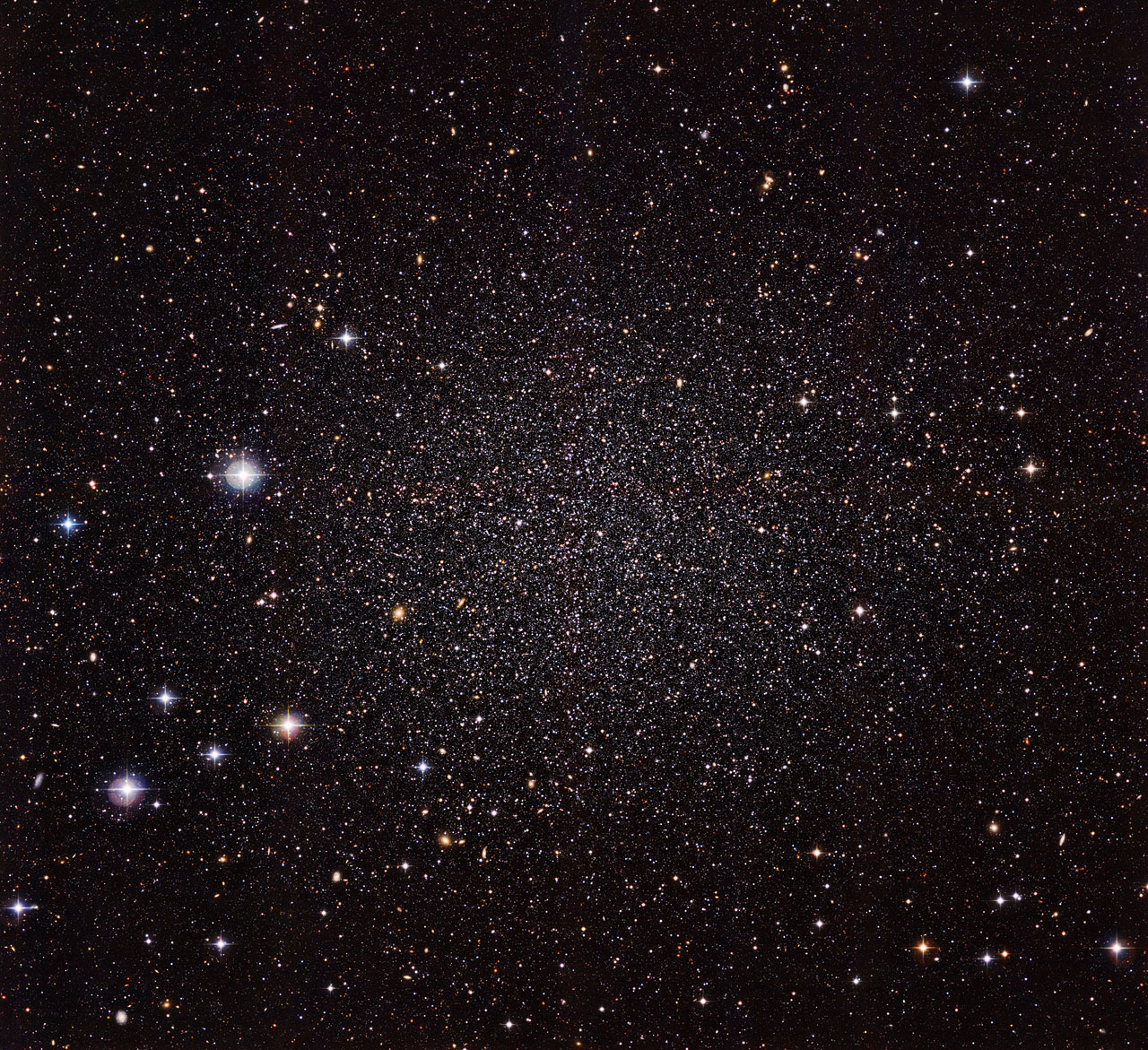
The Sculptor Dwarf Galaxy — also known as the Sculptor Dwarf Elliptical or the Sculptor Dwarf Spheroidal — is a dwarf spheroidal galaxy, and is one of the fourteen known satellite galaxies orbiting the Milky Way [1]. These galactic hitchhikers are located close by in the Milky Way’s extensive halo, a spherical region extending far beyond our galaxy’s spiral arms. As indicated by its name, this galaxy is located in the southern constellation of Sculptor and lies about 280 000 light-years away from Earth. Despite its proximity, the galaxy was only discovered in 1937, as its stars are faint and spread thinly across the sky.
Although difficult to pick out, the Sculptor Dwarf Galaxy was among the first faint dwarf galaxies found orbiting the Milky Way. The tiny galaxy’s shape intrigued astronomers at the time of its discovery, but nowadays dwarf spheroidal galaxies play a more important role in allowing astronomers to dig deeply into the Universe’s past.

Astronomers can determine the age of stars in the galaxy because their light carries the signatures of only a small quantity of heavy chemical elements. These heavy elements accumulate in galaxies with successive generations of stars. A low level of heavy elements thus indicates that the average age of the stars in the Sculptor Dwarf Galaxy is high.
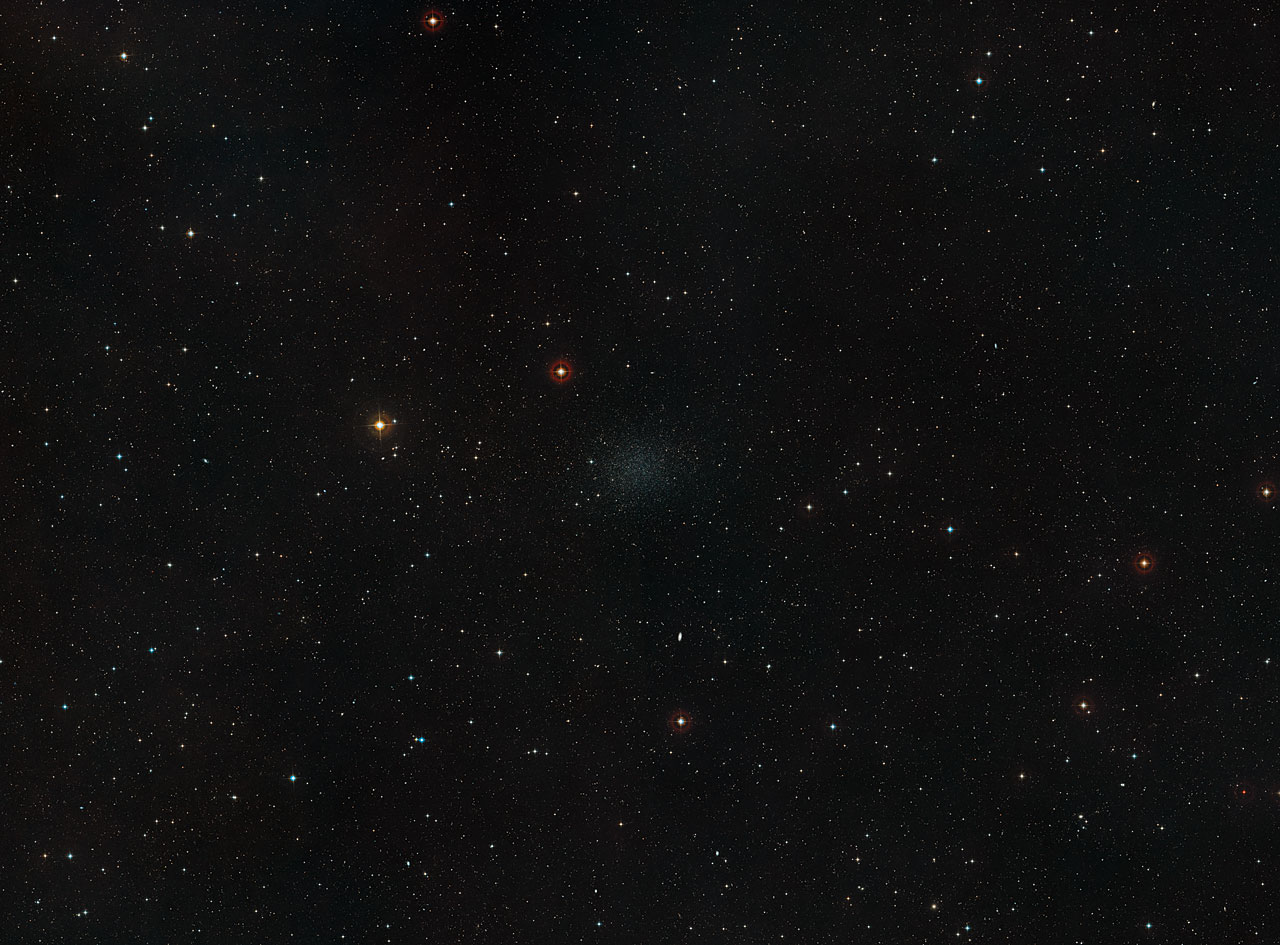
This quantity of old stars makes the Sculptor Dwarf Galaxy a prime target for studying the earliest periods of star formation. In a recent study, astronomers combined all the data available for the galaxy to create the most accurate star formation history ever determined for a dwarf spheroidal galaxy. This analysis revealed two distinct groups of stars in the galaxy. The first, predominant group is the older population, which is lacking in heavier elements. The second, smaller population, in contrast, is rich with heavy elements. Like young people crowding into city centres, this youthful stellar population is concentrated toward the galaxy’s core.
This video zoom takes a closer look at the Sculptor Dwarf Galaxy, pictured in new image from the Wide Field Imager camera, installed on the 2.2-metre MPG/ESO telescope at ESO’s La Silla Observatory. This elusive galaxy is a close neighbour of our galaxy, the Milky Way. Despite their proximity, both galaxies have very distinct histories and characters. This galaxy is much smaller, fainter and older than the Milky Way. It appears here as a rich cloud of faint stars at the centre of the image at the start, and completely fills the frame later on. Here and there much more distant galaxies can be spotted between the stars of the Sculptor Dwarf.
Credit: DSS, ESO. Music: Johan Monell (www.johanmonell.com)
The stars within dwarf galaxies like the Sculptor Dwarf Galaxy can exhibit complex star formation histories. But as most of these dwarf galaxies’ stars have been isolated from each other and have not interacted for billions of years, each collection of stars has charted its own evolutionary course. Studying the similarities in dwarf galaxies’ histories, and explaining the occasional outliers, will help to explain the development of all galaxies, from the most unassuming dwarf to the grandest spirals. There is indeed much for astronomers to learn from the Milky Way’s shy neighbours.
Notes
[1] This faint galaxy should not be confused with the much brighter Sculptor Galaxy (NGC 253) in the same constellation