The Space Show this week – Sept.28.15

The guests and topics of discussion on The Space Show this week:

SPECIAL TIME: 1. Monday, Sept. 28, 2015: 7-8:30 PM PDT (10-11:30 PM EST, 9-10:30 PM CDT): This program is a special Open Lines show. I will discuss my upcoming medical leave from the show, the progress we are making with the new website and archives, plus take all your questions and comments on space and STEM matters. Calling the show is much better than sending emails. Calls will receive priority over emails.

2. Tuesday, Sept. 23, 2015:,7-8:30 PM PDT (10-11:30 PM EST, 9-10:30 PM CDT): We welcome ALEXANDRA ABRAMS, the new communications officer for the Space Frontier Foundation. Ms. Abrams will be sharing guidelines, tools, and tips for better PR and communication regarding space matters.

3. Friday, Oct. 2, 2015; 9:30 -11 AM PDT (12:30-2 PM EDT; 11:30-1 PM CDT): No show as am doing post surgery recovery.

4. Sunday, Sept. 27, 2015: 12-1:30 PM PDT (3-4:30 PM EDT, 2-3:30 PM CDT): No show as am doing post surgery recovery.

See also:
/– The Space Show on Vimeo – webinar videos
/– The Space Show’s Blog – summaries of interviews.
/– The Space Show Classroom Blog – tutorial programs

The Space Show is a project of the One Giant Leap Foundation.
Xtronaut: the game of solar system exploration

Dante Lauretta  is a professor at the University of Arizona and the Principal Investigator for the OSIRIS-REx mission to return a sample of an asteroid back to earth. (Hear his recent interview SpaceGeeks Ep. 13: Dante’s Paradiso – SpaceNews.com .) He has developed a space themed board game called Xtronaut: Xtronaut: The game of solar system exploration – DC Newsroom

Rocket Science for Everyone!

Capturing the real-world thrill and challenges of planetary exploration, Xtronaut: The Game of Solar System Exploration gives 2 – 4 players ages 7 and up the chance to develop space missions and explore the solar system. The game is based on real planetary missions and rocket science. It also contains elements of politics and strategy that are inspired by the real-life situations that space missions face.

The crowd-funding campaign for it has exceeded its $15k goal by $6k with two weeks remaining: Xtronaut: The Game of Solar System Exploration by Dante Lauretta – Xtronaut Enterprises — Kickstarter.

And this video tells more about the game play:


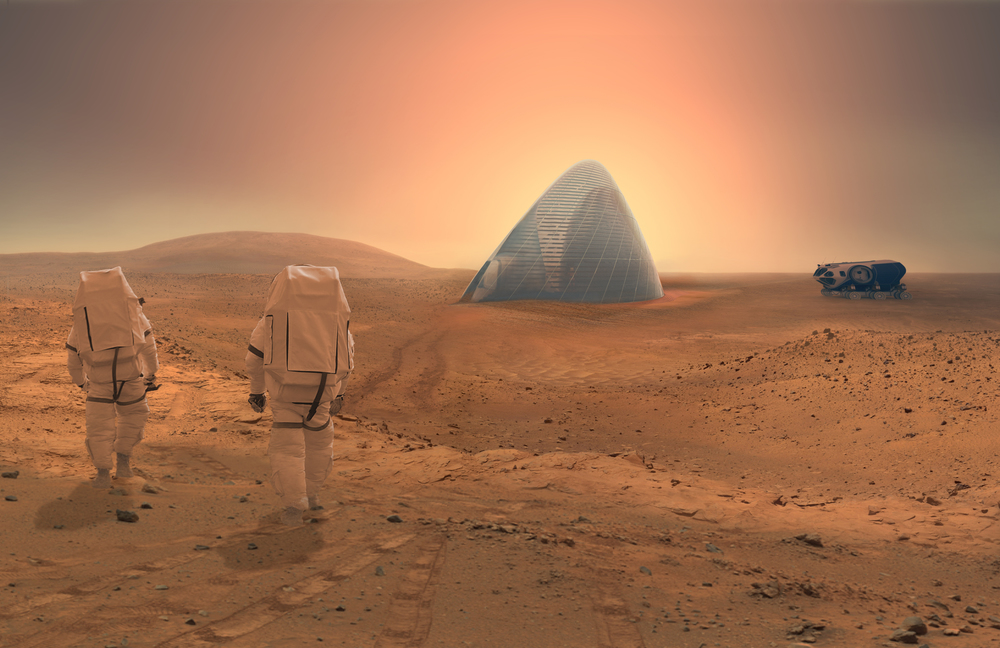
‘Mars Ice House’ wins the NASA 3D-Printed Habitat Challenge contest

NASA sponsored the NASA 3D-Printed Habitat Challenge in which entrant teams develop 3D printing systems and techniques for building habitats on Mars. Thirty finalists were chosen in August. See descriptions of each team’s concept at Design Competition Finalists.

At the Maker Faire underway this weekend in New York the teams displayed their designs and the winners were selected. Updates from the event were posted at 3DP Challenge (@3DPChallenge) – Twitter.

The grand prize winner was the Mars Ice House team – America Makes on Twitter:

JUST ANNCD: Team ICE HOUSE @s_e_arch winners of the $25k Grand Prize @3DPChallenge @NASAPrize @make #WMF2015 http://t.co/B39XlrDBvD

Check out their informative website.

Mars-Ice-House_Dusk+01_lr[1]A Mars team approaches their Ice House habitat. Credits Ice House Team.

mars_section+02_Rev1[1]Cross-section of the ice structure built with an additive printing system
around the lander module. Credits Ice House Team.

Wardroom[1]“Where the ice shell thins, large ETFE inflatable windows filled with
radiation shielding gas further expand the perceived volume and frame
views into the landscape.  Together, these features enable both collective
and private opportunities to contemplate the vista of the
extraordinary Martian terrain.”  Credits Ice House Team.

I’ve always like the idea of ice structures on the Moon and Mars since ice is both translucent, which adds light and color to one’s living environment, and an excellent radiation shielding material. With substantial water resources now believed to be available at the lunar poles, similar structures as the Ice House could be built on the Moon as well.

Supermoon eclipse tonight

There will be a lunar eclipse tonight that will particularly unusual. The Moon will be at the closest approach (perigee) of its orbit to earth when it can be as much as 14% bigger and 30% brighter than when the Moon is at its farthest distance (apogee) from earth. NASA TV to Provide Live Feed of Sunday’s Supermoon Eclipse – NASA

This video gives a brief description of this eclipse of a Supermoon:

Viewing info:

Sunday’s supermoon eclipse will last 1 hour and 11 minutes, and will be visible to North and South America, Europe, Africa, and parts of West Asia and the eastern Pacific. Weather permitting, you can see the supermoon after nightfall, and the eclipse will cast it into shadow beginning at 8:11 p.m. EDT. The total eclipse starts at 10:11 p.m. EDT, peaking at 10:47 p.m. EDT.

More on times and visibility at September 27 / September 28, 2015 — Total Lunar Eclipse – Where and when to see.

If you cannot go outside and see the eclipse directly, views of it will be available online:

Here’s a tutorial on lunar eclipses:

NASA news briefing to “Announce Mars Mystery Solved”

NASA is holding a press briefing on Monday to announce that a “Mars Mystery” has been “solved”. (See NASA statement below.) Here are some articles speculating as to what the announcement is about:

Here is NASA’s posting:

NASA to Announce Mars Mystery Solved

NASA will detail a major science finding from the agency’s ongoing exploration of Mars during a news briefing at 11:30 a.m. EDT on Monday, Sept. 28 at the James Webb Auditorium at NASA Headquarters in Washington. The event will be broadcast live on NASA Television and the agency’s website.

News conference participants will be:

  • Jim Green, director of planetary science at NASA Headquarters
  • Lujendra Ojha of the Georgia Institute of Technology in Atlanta
  • Mary Beth Wilhelm of NASA’s Ames Research Center in Moffett Field, California and the Georgia Institute of Technology
  • Alfred McEwen, principal investigator for the High Resolution Imaging Science Experiment (HiRISE) at the University of Arizona in Tucson

A brief question-and-answer session will take place during the event with reporters on site and by phone. Members of the public also can ask questions during the briefing using #AskNASA.

To participate in the briefing by phone, reporters must email their name, media affiliation and telephone number to Steve Cole at stephen.e.cole@nasa.gov by 9 a.m. EDT on Monday.

For NASA TV downlink information, schedules and to view the news briefing, visit: http://www.nasa.gov/nasatv

For more information about NASA’s journey to Mars: https://www.nasa.gov/topics/journeytomars

Everyone can participate in space