The Moonspike project made its debut last week. The project aims to build a low cost two-stage rocket and a spacecraft to send a “tiny” payload to the Moon. The group is led by Chris Larmour, who has run several technology companies, and Kristian von Bengtson, who is well-known as a co-founder of Copenhagen Suborbitals, an organization developing a rocket for carrying a single person on a suborbital space trip. While Copenhagen Suborbitals is a volunteer, non-profit, the Moonspike project is organized as the private company Moonspike, Ltd.
The goal is to impact this 1 gram “Lunar Penetrator” into the Moon’s surface:
The spike is titanium and the disk will hold a flash memory chip with digital photos and messages from backers of the project.
I’ve posted here many times about JP Aerospace, which has been flying high altitude balloons and airships for over 30 years. Founded and led by John Powell, the part professional, part volunteer organization has won USAF contracts, carried out multiple promotional flights for companies from around the world, and developed a number of innovations in the technology of Near Space.
Furthermore, JPA has a very active education program. Over 50,000 students have had their PongSats taken to the edge of space for free by JPA.
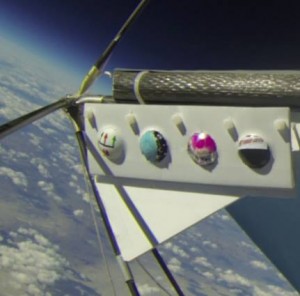
Four PongSats mounted on a JPA balloon structure
during a high-altitude flight in October 2014.
A PongSat is a ping-pong ball with a tiny experiment inside of it. A few years ago, JPA introduced the Mini-Cube, which provides a standardize plastic box structure, 5 cm to a side, in which more sophisticated and elaborate experiments can be enclosed and flown for a fee to Near Space.
A book written for secondary public and private school STEM instructors, home schooling, and undergraduate STEM courses of study explaining how to set up their own student focused “space program” utilizing the Mini-Cube Program. With this Informal STEM Project Based Learning Activity, students can have the unique, affordable, and challenging opportunity to send experiments via high altitude balloon to an altitude of 100,000 feet (20 miles or 32 km), commonly known as the “edge of space.” Utilizing the scientific method, team work, research, and communicating in writing the results and applications for peer review, students will participate in the full cycle of an actual experiment from the original question to the published results and conduct true science at the edge of space.
Utilizing the scientific method, team work, research, and communicating in writing the results and applications for peer review, students will participate in the full cycle of an actual experiment from the original question to the published results and conduct true science at the edge of space.
NASA’s New Horizons spacecraft has returned the best color and the highest resolution images yet of Pluto’s largest moon, Charon – and these pictures show a surprisingly complex and violent history.
Charon in Enhanced Color: NASA’s New Horizons captured this high-resolution enhanced color view of Charon just before closest approach on July 14, 2015. The colors are processed to best highlight the variation of Charon’s surface properties. (Larger image)At half the diameter of Pluto, Charon is the largest satellite relative to its planet in the solar system. Many New Horizons scientists expected Charon to be a monotonous, crater-battered world; instead, they’re finding a landscape covered with mountains, canyons, landslides, surface-color variations and more.
“We thought the probability of seeing such interesting features on this satellite of a world at the far edge of our solar system was low,” said Ross Beyer, an affiliate of the New Horizons Geology, Geophysics and Imaging (GGI) team from the SETI Institute and NASA Ames Research Center in Mountain View, California, “but I couldn’t be more delighted with what we see!”
Charon in Detail: Charon’s cratered uplands at the top are broken by series of canyons, and replaced on the bottom by the rolling plains of the informally named Vulcan Planum. (Larger image.)High-resolution images of the Pluto-facing hemisphere of Charon, taken by New Horizons as the spacecraft sped through the Pluto system on July 14, and transmitted to Earth on Sept. 21, reveal details of a belt of fractures and canyons just north of the moon’s equator. This great canyon system stretches across the entire face of Charon, more than a thousand miles, and probably around onto Charon’s far side. Four times as long as the Grand Canyon, and twice as deep in places, these faults and canyons indicate a titanic geological upheaval in Charon’s past.
Strikingly Different Worlds: A composite of enhanced color images highlights the striking differences between Pluto and Charon. (Larger image)“It looks like the entire crust of Charon has been split open,” said John Spencer, deputy lead for GGI at the Southwest Research Institute in Boulder, Colorado. “In respect to its size relative to Charon, this feature is much like the vast Valles Marineris canyon system on Mars.”
The team has also discovered that the plains south of the canyon, informally referred to as Vulcan Planum, have fewer large craters than the regions to the north, indicating that they are noticeably younger. The smoothness of the plains, as well as their grooves and faint ridges, are clear signs of wide-scale resurfacing.
One possibility for the smooth surface is a kind of cold volcanic activity, called cryovolcanism. “The team is discussing the possibility that an internal water ocean could have frozen long ago, and the resulting volume change could have led to Charon cracking open, allowing water-based lavas to reach the surface at that time,” said Paul Schenk, a New Horizons team member from the Lunar and Planetary Institute in Houston.
Even higher-resolution Charon images and composition data are still to come as New Horizons transmits data, stored on its digital recorders, over the next year – and as that happens, “I predict Charon’s story will become even more amazing!” said mission Project Scientist Hal Weaver, of the Johns Hopkins University Applied Physics Laboratory in Laurel, Maryland.
The New Horizons spacecraft is currently 3.1 billion miles (5 billion kilometers) from Earth, with all systems healthy and operating normally.
New Horizons is part of NASA’s New Frontiers Program, managed by the agency’s Marshall Space Flight Center in Huntsville, Alabama. APL designed, built, and operates the New Horizons spacecraft and manages the mission for NASA’s Science Mission Directorate. SwRI leads the science mission, payload operations, and encounter science planning.
Also, the space news covered in this show includes:
* Polar Satellite Launch Vehicle lofts Astronaut * Long March 3B Launch with communications satellite * Ariane 5 launch with Sky Muster and Arsat 2 * Soyuz-U launch with Progress resupply ship * Atlas V launch with Morelos 3 * NASA confirms intermittent water flows on Mars * Moon Express signs with Rocket Labs for launch services * Launch Pad Repairs Completed on Wallops Island * Blue Origin Completes 100+ Staged Combustion Tests of BE-4 Engine
You can support the show as follows:
TMRO Live is a crowd funded show. If you like this episode consider contributing to help us to continue to improve. Head over to http://www.patreon.com/tmro for information, goals and reward levels. Don’t forget to check out our Space Pod campaign as well over at http://www.patreon.com/spacepod
 The spike is titanium and the disk will hold a flash memory chip with digital photos and messages from backers of the project.