On Thursday, October 28th, the Cassini spacecraft passed safely through the misty icy plume that is emitted from the Saturn moon Enceladus. The goal was to obtain better measurements of the chemistry of the plume:
I’m told that the orientation data of the spacecraft could not be obtained in time so there is a some possible deviation with respect to the actual orientation during the flyby. The program will be updated when the data becomes available.
Astronomers using the VISTA telescope at ESO’s Paranal Observatory have discovered a previously unknown component of the Milky Way. By mapping out the locations of a class of stars that vary in brightness called Cepheids, a disc of young stars buried behind thick dust clouds in the central bulge has been found.
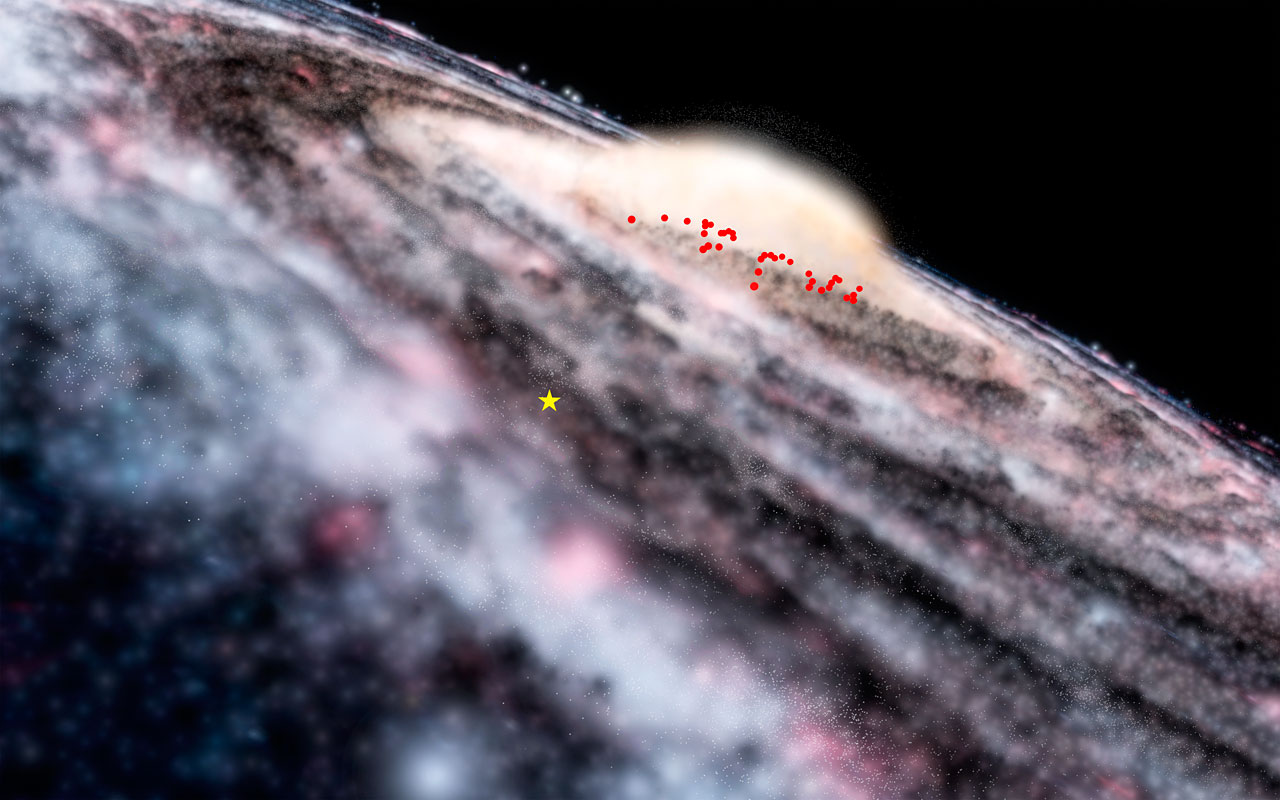
Astronomers using the VISTA telescope at ESO’s Paranal Observatory have discovered a previously unknown component of the Milky Way. By mapping out the locations of a class of stars that vary in brightness called Cepheids, a disc of young stars buried behind thick dust clouds in the central bulge has been found. This diagram shows the locations of the newly discovered Cepheids in an artist’s rendering of the Milky Way.
The Vista Variables in the Vía Láctea Survey (VVV)[1] ESO public survey is using the VISTA telescope at the Paranal Observatory to take multiple images at different times of the central parts of the galaxy at infrared wavelengths [2]. It is discovering huge numbers of new objects, including variable stars, clusters and exploding stars (eso1101, eso1128,eso1141).
Astronomers using the VISTA telescope at ESO’s Paranal Observatory have discovered a previously unknown component of the Milky Way. By mapping out the locations of a class of stars that vary in brightness called Cepheids, a disc of young stars buried behind thick dust clouds in the central bulge has been found.
This video shows the locations of the newly discovered Cepheids (red dots) in an artist’s rendering of the Milky Way. Credit: ESO/Microsoft Worldwide Telescope
A team of astronomers, led by Istvan Dékány of the Pontificia Universidad Católica de Chile, has now used data from this survey, taken between 2010 and 2014, to make a remarkable discovery — a previously unknown component of our home galaxy, the Milky Way.
“The central bulge of the Milky Way is thought to consist of vast numbers of old stars. But the VISTA data has revealed something new — and very young by astronomical standards!” says Istvan Dékány, lead author of the new study.
Analysing data from the survey, the astronomers found 655 candidate variable stars of a type called Cepheids. These stars expand and contract periodically, taking anything from a few days to months to complete a cycle and changing significantly in brightness as they do so.
The time taken for a Cepheid to brighten and fade again is longer for those that are brighter and shorter for the dimmer ones. This remarkably precise relationship, which was discovered in 1908 by American astronomer Henrietta Swan Leavitt, makes the study of Cepheids one of the most effective ways to measure the distances to, and map the positions of, distant objects in the Milky Way and beyond.
Astronomers using the VISTA telescope at ESO’s Paranal Observatory have discovered a previously unknown component of the Milky Way. By mapping out the locations of a class of stars that vary in brightness called Cepheids, a disc of young stars buried behind thick dust clouds in the central bulge has been found.
This video shows the locations of the newly discovered Cepheids (red dots) in an artist’s rendering of the Milky Way. Credit: ESO/Microsoft Worldwide Telescope
But there is a catch — Cepheids are not all the same — they come in two main classes, one much younger than the other. Out of their sample of 655 the team identified 35 stars as belonging to a sub-group called classical Cepheids — young bright stars, very different from the usual, much more elderly, residents of the central bulge of the Milky Way.
The team gathered information on the brightness, pulsation period, and deduced the distances of these 35 classical Cepheids. Their pulsation periods, which are closely linked to their age, revealed their surprising youth.
“All of the 35 classical Cepheids discovered are less than 100 million years old. The youngest Cepheid may even be only around 25 million years old, although we cannot exclude the possible presence of even younger and brighter Cepheids,” explains the study’s second author Dante Minniti, of the Universidad Andres Bello, Santiago, Chile.
The ages of these classical Cepheids provide solid evidence that there has been a previously unconfirmed, continuous supply of newly formed stars into the central region of the Milky Way over the last 100 million years. But, this wasn’t to be the only remarkable discovery from the survey’s dataset.
Mapping the Cepheids that they discovered, the team traced an entirely new feature in the Milky Way — a thin disc of young stars across the galactic bulge. This new component to our home galaxy had remained unknown and invisible to previous surveys as it was buried behind thick clouds of dust. Its discovery demonstrates the unique power of VISTA, which was designed to study the Milky Way’s deep structures by wide-field, high-resolution imaging at infrared wavelengths.
“This study is a powerful demonstration of the unmatched capabilities of the VISTA telescope for probing extremely obscured galactic regions that cannot be reached by any other current or planned surveys,” remarks Dékány.
“This part of the galaxy was completely unknown until our VVV survey found it!” adds Minniti.
Further investigations are now needed to assess whether these Cepheids were born close to where they are now, or whether they originate from further out. Understanding their fundamental properties, interactions, and evolution is key in the quest to understand the evolution of the Milky Way, and the process of galaxy evolution as a whole.
Notes
[1] The VVV survey is observing the central parts of our galaxy in five near-infrared bands. The total area of this survey is 520 square degrees and contains at least 355 open and 33 globular clusters. The VVV is multi-epoch in nature in order to detect a large number of variable objects and will provide more than 100 carefully spaced observations at different times for each part of the sky covered. A catalogue with about a billion point sources including about a million variable objects is expected. These will be used to create a three-dimensional map of the bulge of the Milky Way galaxy.
[2] The dust clouds in interstellar space absorb and scatter visible light very effectively and make them opaque. But at longer wavelengths, such as those observed by VISTA, the clouds are much more transparent, allowing the regions beyond the dust to be probed.
This week we look at why reusable rockets are not just for getting the cost of space flight down, but essential for the future of human colonization of the cosmos.
The space news topics reviewed:
* Space Launch System Design Review Completed * NASA Provides Daily Views of Earth Online (http://epic.gsfc.nasa.gov) * Orbital ATK ramps up Booster production for Space Launch System maiden flight * Snooze your way to Mars
TMRO comes via public support:
TMRO Live is a crowd funded show. If you like this episode consider contributing to help us to continue to improve. Head over to http://www.patreon.com/tmro for information, goals and reward levels. Don’t forget to check out our Space Pod campaign as well over at http://www.patreon.com/spacepod
The New Horizons probe, which is still returning data from its encounter with Pluto, will fly by another distant object on January 1, 2019 if everything goes as planned. The spacecraft has just carried out
the second in a series of four maneuvers propelling it toward an encounter with the ancient Kuiper Belt object 2014 MU69, a billion miles farther from the sun than Pluto.
On Course: Projected path of NASA’s New Horizons spacecraft toward 2014 MU69, which orbits in the Kuiper Belt about 1 billion miles beyond Pluto. Planets are shown in their positions on Jan. 1, 2019, when New Horizons is projected to reach the small Kuiper Belt object. NASA must approve an extended mission for New Horizons to study MU69.—
Meanwhile, the data from the flyby continues to flow back to earth. (It will take over a year to return all the data due to the low data transmission rate from the distant probe.) Here is a report on one of Pluto’s moons:
Images of Pluto’s tiny moon tiny Kerberos taken by NASA’s New Horizons spacecraft – and just sent back to Earth this week – complete the family portrait of Pluto’s moons.
Family Portrait of Pluto’s Moons: This composite image shows a sliver of Pluto’s large moon, Charon, and all four of Pluto’s small moons, as resolved by the Long Range Reconnaissance Imager (LORRI) on the New Horizons spacecraft. All the moons are displayed with a common intensity stretch and spatial scale (see scale bar). Charon is by far the largest of Pluto’s moons, with a diameter of 751 miles (1,212 kilometers). Nix and Hydra have comparable sizes, approximately 25 miles (40 kilometers) across in their longest dimension above. Kerberos and Styx are much smaller and have comparable sizes, roughly 6-7 miles (10-12 kilometers) across in their longest dimension. All four small moons have highly elongated shapes, a characteristic thought to be typical of small bodies in the Kuiper Belt. Image credit: NASA/Johns Hopkins University Applied Physics Laboratory/Southwest Research InstituteKerberos appears to be smaller than scientists expected and has a highly-reflective surface, counter to predictions prior to the Pluto flyby in July. “Once again, the Pluto system has surprised us,” said New Horizons Project Scientist Hal Weaver, of the Johns Hopkins University Applied Physics Laboratory in Laurel, Maryland.
The new data, downlinked from the New Horizons spacecraft on Oct. 20, show that Kerberos appears to have a double-lobed shape, with the larger lobe approximately 5 miles (8 kilometers) across and the smaller lobe approximately 3 miles (5 kilometers) across. Science team members speculate from its unusual shape that Kerberos could have been formed by the merger of two smaller objects. The reflectivity of Kerberos’s surface is similar to that of Pluto’s other small moons (approximately 50 percent) and strongly suggests Kerberos, like the others, is coated with relatively clean water ice.
Before the New Horizons encounter with Pluto, researchers had used Hubble Space Telescope images to “weigh” Kerberos by measuring its gravitational influence on its neighboring moons. That influence was surprisingly strong, considering how faint Kerberos was. They theorized that Kerberos was relatively large and massive, appearing faint only because its surface was covered in dark material. But the small, bright-surfaced, Kerberos now revealed by these new images show that that idea was incorrect, for reasons that are not yet understood.
“Our predictions were nearly spot-on for the other small moons, but not for Kerberos,” said New Horizons co-investigator Mark Showalter, of the SETI Institute in Mountain View, California. The new results are expected to lead to a better understanding of Pluto’s fascinating satellite system.
Kerberos Revealed. This image of Kerberos was created by combining four individual Long Range Reconnaissance Imager (LORRI) pictures taken on July 14, approximately seven hours before New Horizons’ closest approach to Pluto, at a range of 245,600 miles (396,100 km) from Kerberos. The image was deconvolved to recover the highest possible spatial resolution and oversampled by a factor of eight to reduce pixilation effects. Kerberos appears to have a double-lobed shape, approximately 7.4 miles (12 kilometers) across in its long dimension and 2.8 miles (4.5 kilometers) in its shortest dimension. Image credit: NASA/Johns Hopkins University Applied Physics Laboratory/Southwest Research Institute
NASA is accepting applications from graduate and undergraduate university students to fly their science and technology experiments to the edge of space on a scientific balloon mission.
Graduate and undergraduate university students are invited to compete for the opportunity to fly experiments to the edge of space aboard a high-altitude scientific balloon. Credits: NASANASA is planning for a fall 2016 launch for the next High Altitude Student Platform (HASP) mission, a joint project between NASA and the Louisiana Space Consortium (LaSPACE) in Baton Rouge.
“It’s incredibly rewarding to support the students flying these experiments, many of whom are getting their first real taste of hands-on engineering and science,” said Debbie Fairbrother, chief of NASA’s Balloon Program Office. “Programs like HASP are key to educating, training, and inspiring the next generation.”
A panel of experts from NASA’s Wallops Flight Facility in Virginia, Columbia Scientific Balloon Facility in Palestine, Texas, and LaSPACE will review the applications and select the finalists for the 2016 flight opportunity. The deadline for applications is Dec. 18. A question-and-answer teleconference for interested applicants is scheduled for Nov. 13. Interested school teams should contact Greg Guzik at guzik@phunds.phys.lsu.edu for more information.
HASP can support up to 12 student-built payloads. It houses and provides power, mechanical support, interfacing, data downlink and command uplink communications for the instruments. Launched from NASA’s balloon launch facility in Fort Sumner, New Mexico, flights typically last 12 to 15 hours, flying at an altitude of approximately 23 miles.
NASA’s scientific balloons offer low-cost, near-space access for payloads weighing up to 8,000 pounds to conduct technology demonstration tests as well as scientific investigations in fields such as astrophysics, heliophysics and atmospheric research. Depending on the goals and objectives of a specific mission, balloon flight durations can run hours to multiple days or weeks for longer-term tests and data collection.
Since 2006, the HASP program has selected more than 110 payloads for flights, involving more than 800 students from across the United States. Past student groups have flown instruments to flight test compact satellites and prototype long-range communication devices, perform space science experiments, sample particles at the edge of space, perform remote sensing experimentation, test rocket nozzles, and measure infrasound to correlate with geophysical events.