New Horizons: Latest results include possible ice volcanoes, geology ancient and young, spinning moons, and more

At an American Astronomical Society (AAS) Planetary Sciences Meeting today, the New Horizons team brought a truckload of results to present from the probe’s flyby of the Pluto system. Copies of their presentation slides are available at: Science Results from the New Horizons Encounter with Pluto – Presentations – New Horizons.

An overview of the findings was released:

At Pluto, New Horizons Finds Geology of All Ages,
Possible Ice Volcanoes, Insight into Planetary Origins

From possible ice volcanoes to geologically diverse surfaces to oddly behaving moons that could have formed through mergers of smaller moons, Pluto system discoveries continue to surprise scientists on NASA’s New Horizons mission team.

“The New Horizons mission has taken what we thought we knew about Pluto and turned it upside down,” said Jim Green, director of planetary science at NASA Headquarters in Washington. “It’s why we explore – to satisfy our innate curiosity and answer deeper questions about how we got here and what lies beyond the next horizon.”

Mountains1[1]
The informally named feature Wright Mons, located south of Sputnik Planum on Pluto, is an unusual feature that’s about 100 miles (160 kilometers) wide and 13,000 feet (4 kilometers) high. It displays a summit depression (visible in the center of the image) that’s approximately 35 miles (56 kilometers) across, with a distinctive hummocky texture on its sides. The rim of the summit depression also shows concentric fracturing. New Horizons scientists believe that this mountain and another, Piccard Mons, could have been formed by the ‘cryovolcanic’ eruption of ices from beneath Pluto’s surface. Credit: NASA/Johns Hopkins University Applied Physics Laboratory/Southwest Research Institute
The New Horizons team is discussing numerous findings at the 47th Annual Meeting of the Division for Planetary Sciences (DPS) of the American Astronomical Society (AAS) this week in National Harbor, Maryland. Just four months after the spacecraft encountered Pluto, science team members are presenting more than 50 reports on exciting discoveries.

CryoVolcanism_Mountains-Rt-txt[1]
Scientists using New Horizons images of Pluto’s surface to make 3-D topographic maps have discovered that two of Pluto’s mountains, informally named Wright Mons and Piccard Mons, could possibly be ice volcanoes. The color is shown to depict changes in elevation, with blue indicating lower terrain and brown showing higher elevation; green terrains are at intermediate heights. Credit: NASA/Johns Hopkins University Applied Physics Laboratory/Southwest Research Institute. Version with no captions.
“It’s hard to imagine how rapidly our view of Pluto and its moons are evolving as new data stream in each week. As the discoveries pour in from those data, Pluto is becoming a star of the solar system,” said mission Principal Investigator Alan Stern of the Southwest Research Institute, Boulder, Colorado. “Moreover, I’d wager that for most planetary scientists, any one or two of our latest major findings on one world would be considered astounding. To have them all is simply incredible.”

In one such discovery, New Horizons geologists have combined images of Pluto’s surface to make 3-D maps that indicate that two of Pluto’s most distinctive mountains could be cryovolcanoes—ice volcanoes that may have been active in the recent geological past.

The two cryovolcano candidates are large features measuring tens of miles (tens of kilometers) across and several miles or kilometers high. “These are big mountains with a large hole in their summit, and on Earth that generally means one thing—a volcano,” said Oliver White, New Horizons postdoctoral researcher with NASA’s Ames Research Center, Moffett Field, California. While their appearance is similar to volcanoes on Earth that spew molten rock, ice volcanoes on Pluto are expected to emit a somewhat melted slurry of substances such as water ice, nitrogen, ammonia, or methane on Pluto.

Pluto_Crater_Counts_rectangular_projection[1]
Locations of more than 1,000 craters mapped on Pluto by NASA’s New Horizons mission indicate a wide range of surface ages, which likely means that Pluto has been geologically active throughout its history. Credit: NASA/Johns Hopkins University Applied Physics Laboratory/Southwest Research Institute
White stresses that the team’s interpretation of these features as volcanoes is tentative. However, “If they are volcanic, then the summit depression would likely have formed via collapse as material is erupted from underneath. The strange hummocky texture of the mountain flanks may represent volcanic flows of some sort that have travelled down from the summit region and onto the plains beyond, but why they are hummocky, and what they are made of, we don’t yet know.”

If Pluto is proven to have volcanoes, it will provide an important new clue to its geologic and atmospheric evolution. “After all, nothing like this has been seen in the deep outer solar system,” said Jeffrey Moore, New Horizons Geology, Geophysics and Imaging team leader, also from NASA Ames.

Pluto’s Long History of Geologic Activity

Another of the more surprising findings from New Horizons is the wide range of surface ages found on Pluto, from ancient to intermediate to relatively young in geological terms. Crater counts used to determine surface unit ages indicate that Pluto has ancient surface areas dating to just after the formation of the planets, about 4 billion years ago. In addition, there’s a vast area that was geologically born “yesterday,” meaning it may have formed within the past 10 million years. This area – informally named Sputnik Planum – appears on the left side of Pluto’s “heart” and is completely impact-free in all images returned to date.

Scientists wondered if Sputnik Planum’s smooth, icy plains were an oddity; did a recent geological episode form the plains long after all other geologic activity ceased?

Apparently not. New data from crater counts reveal the presence of intermediate or “middle-aged” terrains on Pluto as well. This suggests that Sputnik Planum is not an anomaly—that Pluto has been geologically active throughout much of its more than 4-billion-year history. “We’ve mapped more than a thousand craters, which vary greatly in size and appearance,” said postdoctoral researcher Kelsi Singer, of the Southwest Research Institute (SwRI) in Boulder, Colorado. “Among other things, I expect cratering studies like these to give us important new insights into how this part of the solar system formed.”

Building Blocks of the Solar System

Crater counts are giving the New Horizons team insight into the structure of the Kuiper Belt itself. The dearth of smaller craters across Pluto and its large moon Charon indicate that the Kuiper Belt likely had fewer smaller objects than some models had predicted. This leads New Horizons scientists to doubt a longstanding model that all Kuiper Belt objects formed by accumulating much smaller objects of less than a mile wide. The absence of small craters on Pluto and Charon support other models theorizing that Kuiper Belt objects tens of miles across may have formed directly, at their current—or close to current—size.

In fact, the evidence that many Kuiper Belt objects could have been “born large” has scientists excited that New Horizons’ next potential target – the 30-mile-wide (40-50 kilometer wide) KBO named 2014 MU69 – which may offer the first detailed look at just such a pristine, ancient building block of the solar system.

Spinning, Merged Moons

The New Horizons mission is also shedding new light on Pluto’s fascinating system of moons and their unusual properties. For example, nearly every other moon in the solar system, including Earth’s moon, is in synchronous rotation, but not so of Pluto’s small moons. These small satellites are spinning much faster, with Hydra – the most distant moon – rotating an unprecedented 89 times during a single lap around Pluto. Scientists believe these spin rates could be chaotic (i.e., variable) because Charon exerts a strong torque that prevents each small moon from settling down into synchronous rotation, which means keeping one face toward the planet.

Most inner moons in the solar system keep one face pointed toward their central planet; this animation shows that certainly isn’t the case with the small moons of Pluto, which behave like spinning tops. Pluto is shown at center with, in order, from smaller to wider orbit: Charon, Styx, Nix, Kerberos and Hydra.  Credit: NASA/Johns Hopkins University Applied Physics Laboratory/Southwest Research Institute

Another oddity of Pluto’s moons: scientists expected the satellites to wobble, but not to this degree. “Pluto’s moons are behaving like spinning tops,” said co-investigator Mark Showalter of the SETI Institute in Mountain View, California.

Images of Pluto’s four smallest satellites also indicate that several of them could have been born from mergers of two or more former moons, suggesting the presence of more moons at some point. “We suspect from this that Pluto had more moons in the past, in the aftermath of the big impact that also created Charon,” said Showalter.

MergedBodies[1]
New Horizons data indicates that at least two (and possibly all four) of Pluto’s small moons may be the result of mergers between still smaller moons. If this discovery is borne out with further analysis, it could provide important new clues to the formation of the Pluto system. Credit: NASA/Johns Hopkins University Applied Physics Laboratory/Southwest Research Institute
Pluto’s Frigid, Extended Atmosphere

The New Horizons team is presenting new data at DPS that reveal Pluto’s upper atmosphere is significantly colder and therefore more compact than Earth-based models had indicated. As a result, scientists have discovered that Pluto’s atmospheric escape rate is thousands of times lower than had been thought. It now appears that Pluto’s atmosphere escapes by the same mechanism as do gases from the atmospheres of Earth and Mars – rather than the previously believed escape process that more resembled escape from cometary atmospheres.

New Horizons is part of NASA’s New Frontiers Program, managed by the agency’s Marshall Space Flight Center in Huntsville, Alabama. The Johns Hopkins University Applied Physics Laboratory in Laurel, Maryland, designed, built, and operates the New Horizons spacecraft and manages the mission for NASA’s Science Mission Directorate. The Southwest Research Institute leads the science mission, payload operations, and encounter science planning.

For more information on the New Horizons mission, including fact sheets, video and images, visit www.nasa.gov/newhorizons and pluto.jhuapl.edu.
The Space Show this week – Nov.9.2015

The guests and topics of discussion on The Space Show this week:

1. Monday, Nov. 9. 2015: 2-3:30 PM PST (5-6:30 PM EST; 4-5:30 PM CST): We welcome LEONARD DAVID & for the first time, SCOTT SACKNOFF regarding their new book, Space Careers. Check out www.spacebusiness.com/careers. Leonard and Scott will discuss other important space history and news items.

2. Tuesday, Nov. 10, 2015:,7-8:30 PM PST (10-11:30 PM EST, 9-10:30 PM CST): We welcome back DR. CHARLES LURIO of The Lurio Report.

3. Friday, Nov. 13, 2015; 9:30 -11 AM PST (12:30-2 PM EST; 11:30-1 PM CST) No show today due to my physical therapy appointment.

4. Sunday, Nov. 15, 2015: 12-1:30 PM PST (3-4:30 PM EST, 2-3:30 PM CST): We welcome HENRY KENYON to discuss his hybrid airship article in the October issue [pdf] of Aerospace America titled “New Life For An Old Hybrid.”

See also:
/– The Space Show on Vimeo – webinar videos
/– The Space Show’s Blog – summaries of interviews.
/– The Space Show Classroom Blog – tutorial programs

The Space Show is a project of the One Giant Leap Foundation.

Seeds descended from the Apollo 14 “Moon Trees” to go to the lunar surface

UK space activist Phill Parker sent the following announcement to me about his latest project:

UK Man to Send Apollo 14 Moon Trees Back to the Moon in 2017 –
This Time to Land on the Moon!

Apollo 14 launched in the late afternoon of January 31, 1971 on what was to be the third US manned trip to the lunar surface. Five days later astronauts Alan Shepard and Edgar Mitchell landed in their Lunar Module “Antares” and walked on the Moon at the Fra Mauro region exploring “Cone Crater” while their colleague and fellow astronaut, Stuart Roosa, a former U.S. Forest Service smoke jumper, orbited above the Moon in the command module “Kitty Hawk”.

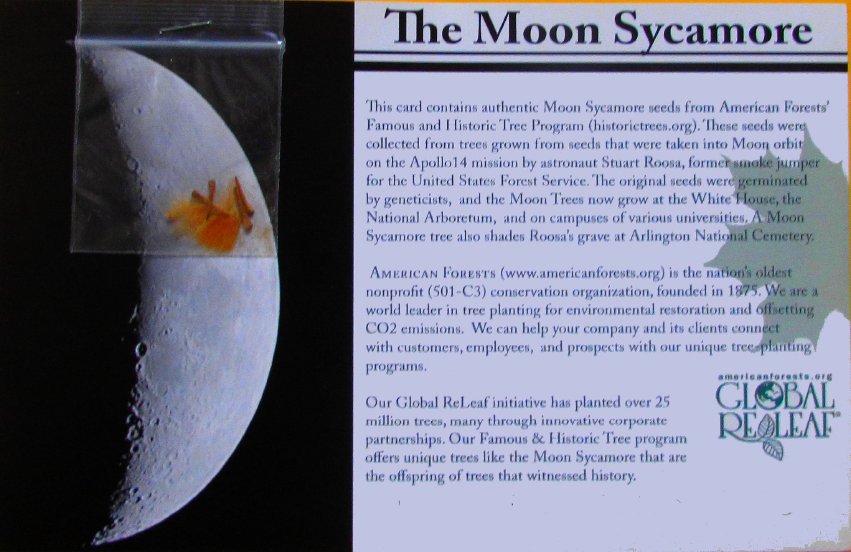
Packed in small containers in Roosa’s personal kit were hundreds of tree seeds, part of a joint NASA/USFS project. Upon return to Earth, the seeds were germinated by the US Forest Service. Known as the “Moon Trees“, the resulting seedlings were planted throughout the United States (often as part of the nation’s bicentennial in 1976) and some parts of the world. They stand as a tribute to astronaut Roosa and the Apollo program. [See NASA’s Moon Trees website.]

MoonSycamoreClick for larger image

The project began after Roosa was chosen for the Apollo 14 mission. Ed Cliff, Chief of the Forest Service, knew of Stuart Roosa from his days as a smoke jumper and contacted him about bringing seeds into space. Stan Krugman of the Forest Service was put in charge of the project and selected the seeds for the experiment. Seeds were chosen from five different types of trees: Loblolly Pine, Sycamore, Sweetgum, Redwood, and Douglas Fir. The seeds were classified and sorted, and control seeds were kept on Earth for later comparison.

Roosa carried about 400 – 500 seeds in his personal kit which stayed with him as he orbited the Moon in the command module “Kitty Hawk” in February, 1971. The seeds were then sent to the southern Forest Service station in Gulfport, Mississippi and to the western station in Placerville, California to attempt germination. Surprisingly, nearly all the seeds germinated successfully, and the Forest Service had some 420 to 450 seedlings after a few years (some from cuttings). Some of these were planted with their earth-bound counterparts as controls, (as would be expected, after over twenty years there is no discernible difference) but most were given away in 1975 and 1976 to many state forestry organizations to be planted as part of the nation’s bicentennial celebration.

1280px-The_Apollo_14_Prime_Crew_-_GPN-2000-001168Stuart Roosa, Alan Shepard, and Edgar Mitchell

Astronaut Stuart Roosa was born on 16 August 1933, in Durango, Colorado. He worked for the Forest Service in the early 1950’s as a smoke jumper fighting fires and later joined the US Air Force and became a test pilot. He was one of 19 people selected for the astronaut class of 1966 and was part of the astronaut support crew for Apollo 9. Following Apollo 14, Roosa was backup command module pilot for Apollo’s 16 and 17. He then worked on the Space Shuttle program until his retirement as a Colonel in the Air Force in 1976, the time when many of his trees were being planted.

Sadly, Stuart Roosa passed away in December, 1994. The Moon Trees continue to flourish, a living monument to our first visits to the Moon and a fitting memorial to Stuart Roosa.

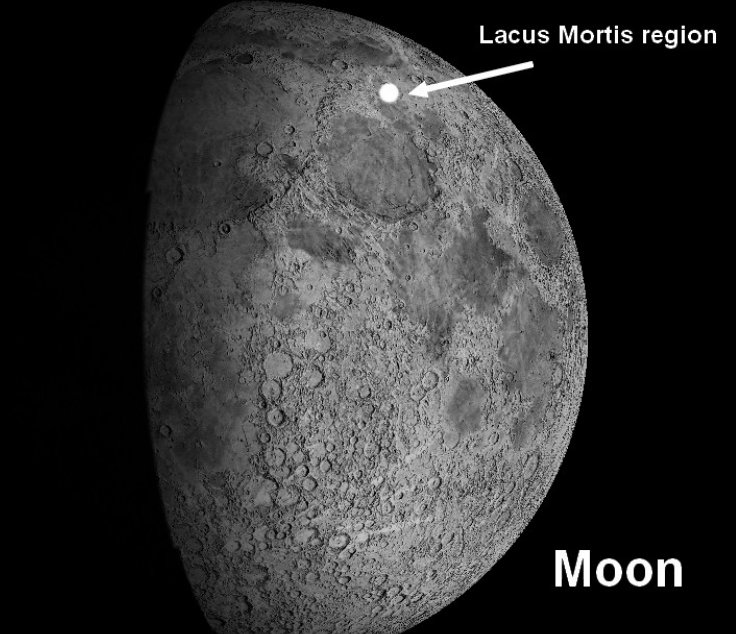
Now, nearly 45 years later since the original Apollo 14 Moon Tree seeds were flown around the Moon, spaceflight enthusiast Phill Parker – from Newcastleunder- Lyme, Staffordshie,UK – is flying some more Moon Tree generational Sycamore seeds from the original Moon Tree seeds back to the Moon in 2017 aboard the Astrobotic Griffin Moon Mission One. This will act as a further tribute to astronaut Stuart Roosa and the US Apollo Project . But this time not just to orbit the Moon but to actually land them on the surface of the Moon for the first time in the lunar region called Lacus Mortis!

PhillParkersMoonSycamoreSeedsPhill Parker’s Apollo 14 Moon Tree Generational
Sycamore seeds that are set to be flown aboard the
Astrobotic 
Griffin lunar lander in 2017.

The Griffin unmanned lunar lander will be launched by a SpaceX Falcon 9 rocket from Cape Canaveral, Florida in 2017.

LacusMortisRegionOnTheMoon

===

Phill Parker authored many Apollo manned lunar landing articles for the British Interplanetary Society in the 1960s-70s – several of which are cited in NASA’s official Apollo Bibliography and,additionally, founded the West European Space Colony Society in 1975 which later merged with the prestigious US National Space Society (NSS). He has produced many spaceflight exhibitions at museums in the UK and delivered over 750 talks on space missions across UK since 1964, as well as writing dozens of articles on spaceflight.

Videos: TMRO SpacePod reports – Gravity waves + International space cooperation

A couple of recent TMRO.tv SpacePod short video reports:

* The Waves of Gravity – SpacePod 11/6/15

* International Space Cooperation Moves Forward – Space Pod 11/01/15

Everyone can participate in space