1. Monday, Dec. 7, 2015: 2-3:30 PM PST (5-6:30 PM EST; 4-5:30 PM CST): We welcome back Dr. DR. MARC RAYMAN re the NASA Dawn Mission. Dr. Rayman will discuss the latest news from this mission..
2. Tuesday, Dec. 8, 2015:,7-8:30 PM PST (10-11:30 PM EST, 9-10:30 PM CST): We welcome MICHELLE CADIEUX to discuss a wide range of space activities that she works with and that are of interest to us. She is a space researcher, working in new technologies with an impressive track record.
3. Friday, Dec. 11, 2015; 9:30 -11 AM PST (12:30-2 PM EST; 11:30-1 PM CST) DR. PAUL SPUDIS returns for updates with us..
4. Sunday, Dec. 13 2015: 12-1:30 PM PST (3-4:30 PM EST, 2-3:30 PM CST): Space attorney MICHAEL LISTNER returns with space law news for the end of the year.
An interesting review by Fergal Mullally of the SETI Institute on how the Kepler Space Observatory finds indications that a planet is orbiting a distant star and then how they examine the data to confirm whether or not the exoplanet is real:
Seminar abstract:
Dr. Mullally will present the 7th catalog of Planet Candidates found by Kepler. Uniformly vetted lists of detected planet candidates are a key step towards measuring the occurrence rates of planets, as well as providing interesting individual objects for potential follow-up. The 7th catalog includes 8826 objects of interest, of which 4696 are deemed viable planet candidates.
This catalog is the first to be uniformly vetted in an entirely objective manner by algorithm, instead of by manual inspection. This algorithmic approach enables us to test our results against simulated data sets allowing us to measure our performance for the first time. Dr. Mullally will discuss some novel features of the vetting pipeline, discuss the performance and limitations, and highlight some interesting individual planets.
I mentioned here back in May that Terrafugia was developing a second generation flying car called the TF-X™. Unlike the company’s current Transition® roadable airplane, the TF-X will take-off and land vertically while also being able to be driven on roads.
341,805 images taken by Cassini’s Imaging Science Subsystem (ISS) from the Saturn EDR Data Sets (Volumes 1-93). This includes all of Cassini’s Photos from February 6, 2004 – September 15, 2015. Compiled and processed by The Wall Street Journal’s @JonKeegan.
NOTE: These raw, unedited sequences at times include rapid flashing. If you have photosensitive epilepsy, or a similar condition, this could trigger a physical reaction. Please use caution when watching this footage.
Source: NASA/JPL-Caltech/Space Science Institute
This video shows an abbreviated and annotated selection of the image collection:
The New Horizons probe will be slowly downloading images and data from its July flyby of Pluto over the next year. Yesterday the mission released the highest resolutions images yet obtained of the surface of Pluto.
NASA’s New Horizons spacecraft has sent back the first few of a series of the sharpest views of Pluto it obtained during its July flyby – and this image sequence forms the best close-ups of Pluto that humans may see for decades.
Every week the piano-sized New Horizons spacecraft transmits data stored on its digital recorders from its flight through the Pluto system on July 14. These latest pictures are part of a sequence taken near New Horizons’ closest approach to Pluto, with resolutions of about 250-280 feet (77-85 meters) per pixel – revealing features less than half the size of a city block on the diverse surface of the distant planet. In these new images, New Horizons captured a wide variety of spectacular, cratered, mountainous and glacial terrains.
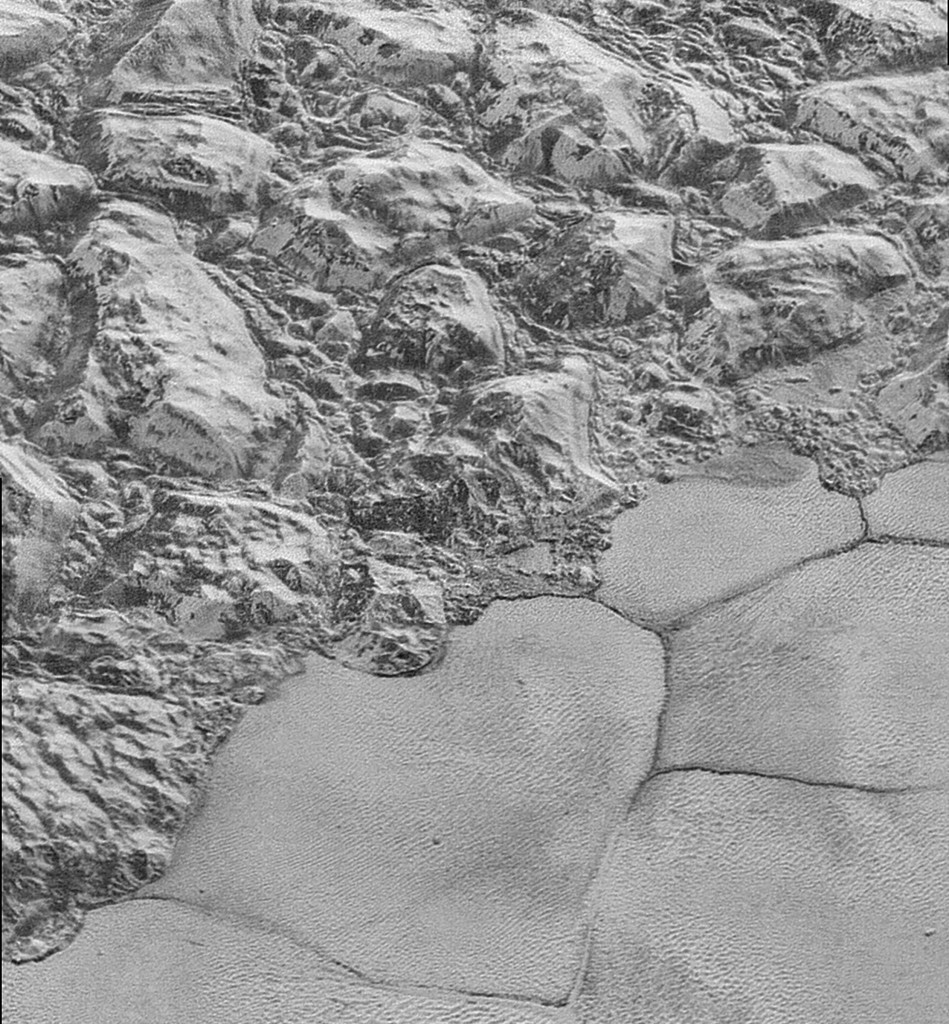
The Mountainous Shoreline of Sputnik Planum: Great blocks of Pluto’s water-ice crust appear jammed together in the informally named al-Idrisi mountains. Some mountain sides appear coated in dark material, while other sides are bright. (Click for full image and caption)“These close-up images, showing the diversity of terrain on Pluto, demonstrate the power of our robotic planetary explorers to return intriguing data to scientists back here on planet Earth,” said John Grunsfeld, former astronaut and associate administrator for NASA’s Science Mission Directorate. “New Horizons thrilled us during the July flyby with the first close images of Pluto, and as the spacecraft transmits the treasure trove of images in its onboard memory back to us, we continue to be amazed by what we see.”
The images being released today form a strip 50 miles (80 kilometers) wide trending from Pluto’s jagged horizon about 500 miles (800 kilometers) northwest of the informally named Sputnik Planum, across the al-Idrisi mountains, onto the shoreline of Sputnik and then across its icy plains.
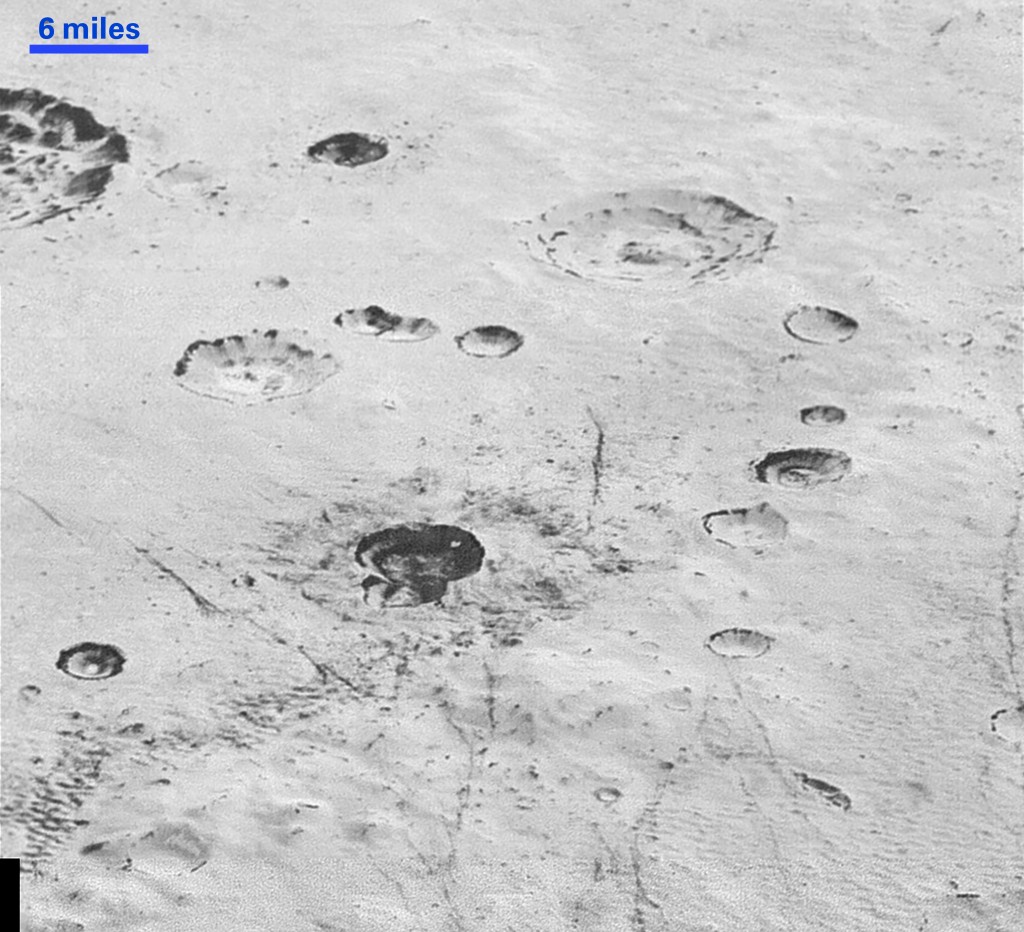
Layered Craters and Icy Plains: Pluto’s rugged, icy cratered plains include layering in the interior walls of many craters. Layers in geology usually mean an important change in composition or event, but at the moment New Horizons team members do not know if they are seeing local, regional or global layering. (Click for full image and caption)“These new images give us a breathtaking, super-high resolution window into Pluto’s geology,” said New Horizons Principal Investigator Alan Stern, of Southwest Research Institute (SwRI) in Boulder, Colorado. “Nothing of this quality was available for Venus or Mars until decades after their first flybys; yet at Pluto we’re there already – down among the craters, ice fields and mountains – less than five months after flyby! The science we can do with these images is simply unbelievable.”
A video made from these images reveals amazing details on a world 3 billion miles away – as do individual close-ups taken from the wider swath. The images are six times better than the resolution of the global Pluto map New Horizons obtained, and five times better than the best images of Pluto’s cousin Triton, Neptune’s large moon, obtained by Voyager 2 in 1989.
Very Best Views of Pluto: This movie is composed of the sharpest views of Pluto that NASA’s New Horizons spacecraft obtained during its flyby of the distant planet on July 14, 2015. The pictures are part of a sequence taken near New Horizons’ closest approach to Pluto, with resolutions of about 250-280 feet (77-85 meters) per pixel – revealing features smaller than half a city block on Pluto’s diverse surface. The images include a wide variety of spectacular, cratered, mountainous and glacial terrains – giving scientists and the public alike a breathtaking, super-high resolution window on Pluto’s geology. Click for full caption – Click for the full image
“The mountains bordering Sputnik Planum are absolutely stunning at this resolution” added New Horizons science team member John Spencer. “The new details revealed here, particularly the crumpled ridges in the rubbly material surrounding several of the mountains, reinforce our earlier impression that the mountains are huge ice blocks that have been jostled and tumbled and somehow transported to their present locations.”
These images were made with the telescopic Long Range Reconnaissance Imager (LORRI) aboard New Horizons, in a timespan of about a minute centered on 11:36 UT on July 14 – just about 15 minutes before New Horizons’ closest approach to Pluto – from a range of just 10,000 miles (17,000 kilometers). They were obtained with an unusual observing mode; instead of working in the usual “point and shoot,” LORRI snapped pictures every three seconds while the Ralph/Multispectral Visual Imaging Camera (MVIC) aboard New Horizons was scanning the surface. This mode requires unusually short exposures to avoid blurring the images.
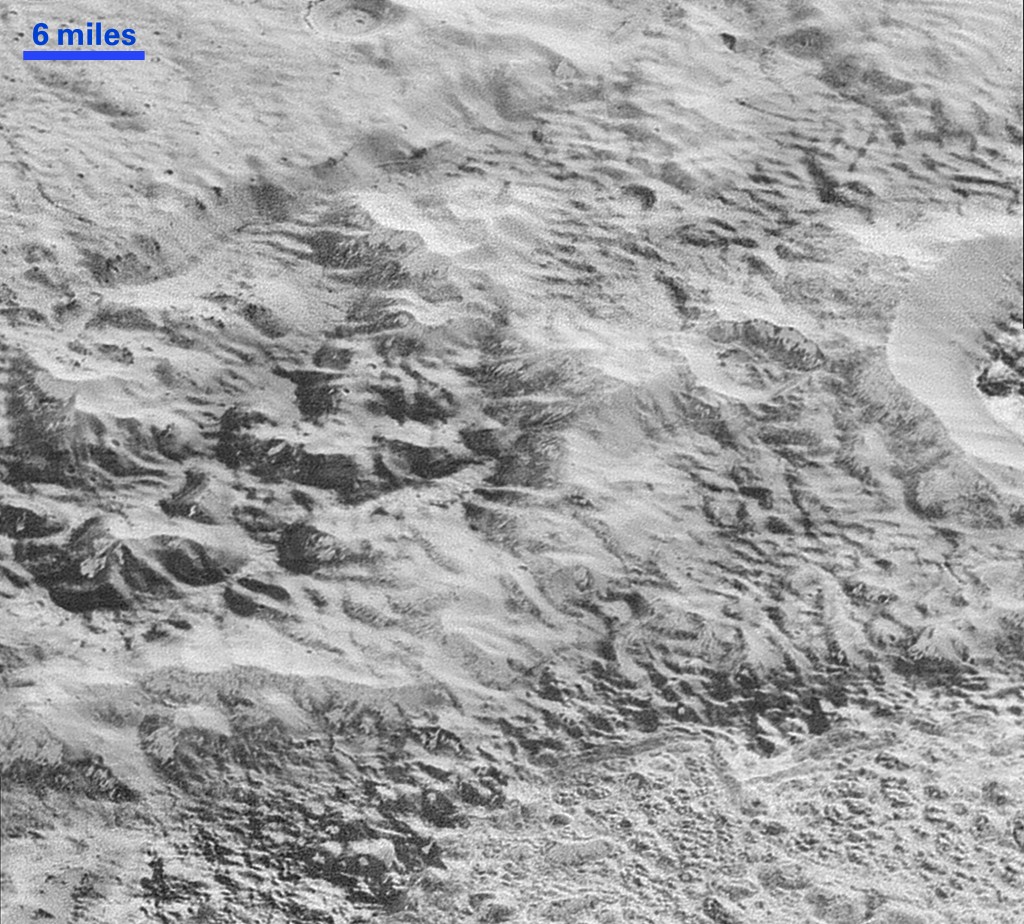
Pluto’s Badlands: Erosion and faulting has sculpted portions of Pluto’s icy crust into rugged badlands. The prominent 1.2-mile-high cliff at the top, running from left to upper right, is part of a great canyon system that stretches for hundreds of miles across Pluto’s northern hemisphere. (Click for full image and caption)Mission scientists expect more imagery from this set over the next several days, showing even more terrain at this highest resolution.
New Horizons, speeding through deep space at more than 32,000 miles per hour, is approximately 104 million miles (167 million kilometers) beyond Pluto and 3.2 billion miles (5.2 billion kilometers) from Earth. All spacecraft systems are healthy.
New Horizons is part of NASA’s New Frontiers Program, managed by the agency’s Marshall Space Flight Center in Huntsville, Alabama. The Johns Hopkins University Applied Physics Laboratory in Laurel, Maryland, designed, built, and operates the New Horizons spacecraft and manages the mission for NASA’s Science Mission Directorate. The Southwest Research Institute leads the mission and mission science, payload operations, and encounter science planning.