This video shows Int. Space Station Expedition 45 Commander OlegKononenko of the Russian Federal Space Agency (Roscosmos), Flight Engineers KjellLindgren of NASA and Kimiya Yui of the Japan Aerospace Exploration Agency leaving the station and returning to earth on Friday morning:
The Dawn probe investigating the asteroid and dwarf planet Ceres has moved its orbit closer to the surface and gotten better views of those famous bright areas at the bottom of some craters:
This representation of Ceres’ Occator Crater in false colors shows differences in the surface composition. Image Credit: NASA/JPL-Caltech/UCLA/MPS/DLR/IDA › Full image and captionCeres reveals some of its well-kept secrets in two new studies in the journal Nature, thanks to data from NASA’s Dawn spacecraft. They include highly anticipated insights about mysterious bright features found all over the dwarf planet’s surface.
In one study, scientists identify this bright material as a kind of salt. The second study suggests the detection of ammonia-rich clays, raising questions about how Ceres formed.
About the Bright Spots
Ceres has more than 130 bright areas, and most of them are associated with impact craters. Study authors, led by Andreas Nathues at Max Planck Institute for Solar System Research, Göttingen, Germany, write that the bright material is consistent with a type of magnesium sulfate called hexahydrite. A different type of magnesium sulfate is familiar on Earth as Epsom salt.
Nathues and colleagues, using images from Dawn’s framing camera, suggest that these salt-rich areas were left behind when water-ice sublimated in the past. Impacts from asteroids would have unearthed the mixture of ice and salt, they say.
“The global nature of Ceres’ bright spots suggests that this world has a subsurface layer that contains briny water-ice,” Nathues said.
A New Look at Occator
The surface of Ceres, whose average diameter is 584 miles (940 kilometers), is generally dark — similar in brightness to fresh asphalt — study authors wrote. The bright patches that pepper the surface represent a large range of brightness, with the brightest areas reflecting about 50 percent of sunlight shining on the area. But there has not been unambiguous detection of water ice on Ceres; higher-resolution data are needed to settle this question.
The inner portion of a crater called Occator contains the brightest material on Ceres. Occator itself is 60 miles (90 kilometers) in diameter, and its central pit, covered by this bright material, measures about 6 miles (10 kilometers) wide and 0.3 miles (0.5 kilometers) deep. Dark streaks, possibly fractures, traverse the pit. Remnants of a central peak, which was up to 0.3 miles (0.5 kilometers) high, can also be seen.
With its sharp rim and walls, and abundant terraces and landslide deposits, Occator appears to be among the youngest features on Ceres. Dawn mission scientists estimate its age to be about 78 million years old.
Study authors write that some views of Occator appear to show a diffuse haze near the surface that fills the floor of the crater. This may be associated with observations of water vapor at Ceres by the Herschel space observatory that were reported in 2014. The haze seems to be present in views during noon, local time, and absent at dawn and dusk, study authors write. This suggests that the phenomenon resembles the activity at the surface of a comet, with water vapor lifting tiny particles of dust and residual ice. Future data and analysis may test this hypothesis and reveal clues about the process causing this activity.
“The Dawn science team is still discussing these results and analyzing data to better understand what is happening at Occator,” said Chris Russell, principal investigator of the Dawn mission, based at the University of California, Los Angeles.
The Importance of Ammonia
In the second Nature study, members of the Dawn science team examined the composition of Ceres and found evidence for ammonia-rich clays. They used data from the visible and infrared mapping spectrometer, a device that looks at how various wavelengths of light are reflected by the surface, allowing minerals to be identified.
Ammonia ice by itself would evaporate on Ceres today, because the dwarf planet is too warm. However, ammonia molecules could be stable if present in combination with (i.e. chemically bonded to) other minerals.
The presence of ammoniated compounds raises the possibility that Ceres did not originate in the main asteroid belt between Mars and Jupiter, where it currently resides, but instead might have formed in the outer solar system. Another idea is that Ceres formed close to its present position, incorporating materials that drifted in from the outer solar system – near the orbit of Neptune, where nitrogen ices are thermally stable.
“The presence of ammonia-bearing species suggests that Ceres is composed of material accreted in an environment where ammonia and nitrogen were abundant. Consequently, we think that this material originated in the outer cold solar system,” said Maria Cristina De Sanctis, lead author of the study, based at the National Institute of Astrophysics, Rome.
In comparing the spectrum of reflected light from Ceres to meteorites, scientists found some similarities. Specifically, they focused on the spectra, or chemical fingerprints, of carbonaceous chondrites, a type of carbon-rich meteorite thought to be relevant analogues for the dwarf planet. But these are not good matches for all wavelengths that the instrument sampled, the team found. In particular, there were distinctive absorption bands, matching mixtures containing ammoniated minerals, associated with wavelengths that can’t be observed from Earth-based telescopes.
The scientists note another difference is that these carbonaceous chondrites have bulk water contents of 15 to 20 percent, while Ceres’ content is as much as 30 percent.
“Ceres may have retained more volatiles than these meteorites, or it could have accreted the water from volatile-rich material,” De Sanctis said.
The study also shows that daytime surface temperatures on Ceres span from minus 136 degrees to minus 28 degrees Fahrenheit (180 to 240 Kelvin). The maximum temperatures were measured in the equatorial region. The temperatures at and near the equator are generally too high to support ice at the surface for a long time, study authors say, but data from Dawn’s next orbit will reveal more details.
As of this week, Dawn has reached its final orbital altitude at Ceres, about 240 miles (385 kilometers) from the surface of the dwarf planet. In mid-December, Dawn will begin taking observations from this orbit, including images at a resolution of 120 feet (35 meters) per pixel, infrared, gamma ray and neutron spectra, and high-resolution gravity data.
Dawn’s mission is managed by the Jet Propulsion Laboratory for NASA. Dawn is a project of the directorate’s Discovery Program, managed by NASA’s Marshall Space Flight Center in Huntsville, Alabama. UCLA is responsible for overall Dawn mission science. Orbital ATK Inc., in Dulles, Virginia, designed and built the spacecraft. The German Aerospace Center, Max Planck Institute for Solar System Research, Italian Space Agency and Italian National Astrophysical Institute are international partners on the mission team.
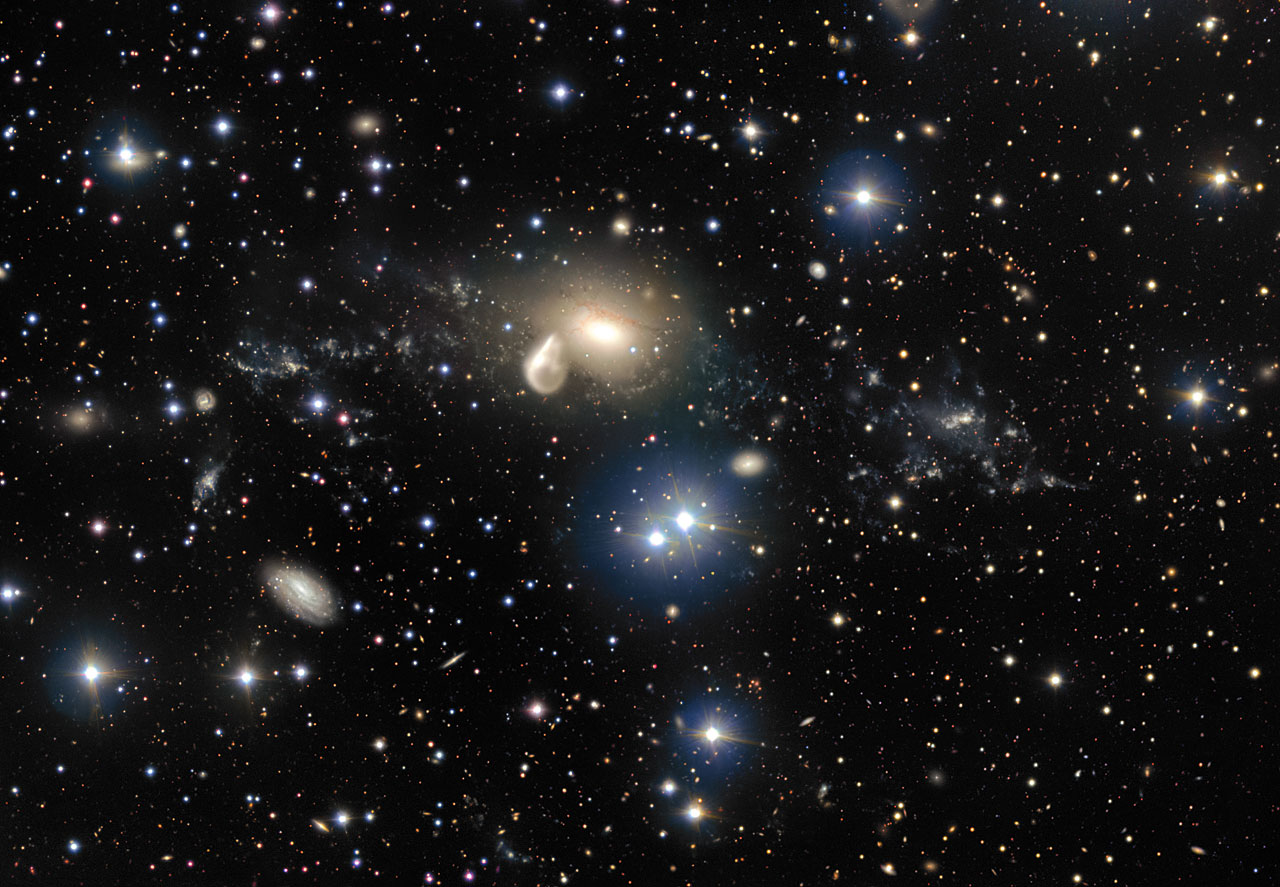
The spectacular aftermath of a 360 million year old cosmic collision is revealed in great detail in new images from ESO’s Very Large Telescope at the Paranal Observatory. Among the debris is a rare and mysterious young dwarf galaxy. This galaxy is providing astronomers with an excellent opportunity to learn more about similar galaxies that are expected to be common in the early Universe, but are normally too faint and distant to be observed by current telescopes.
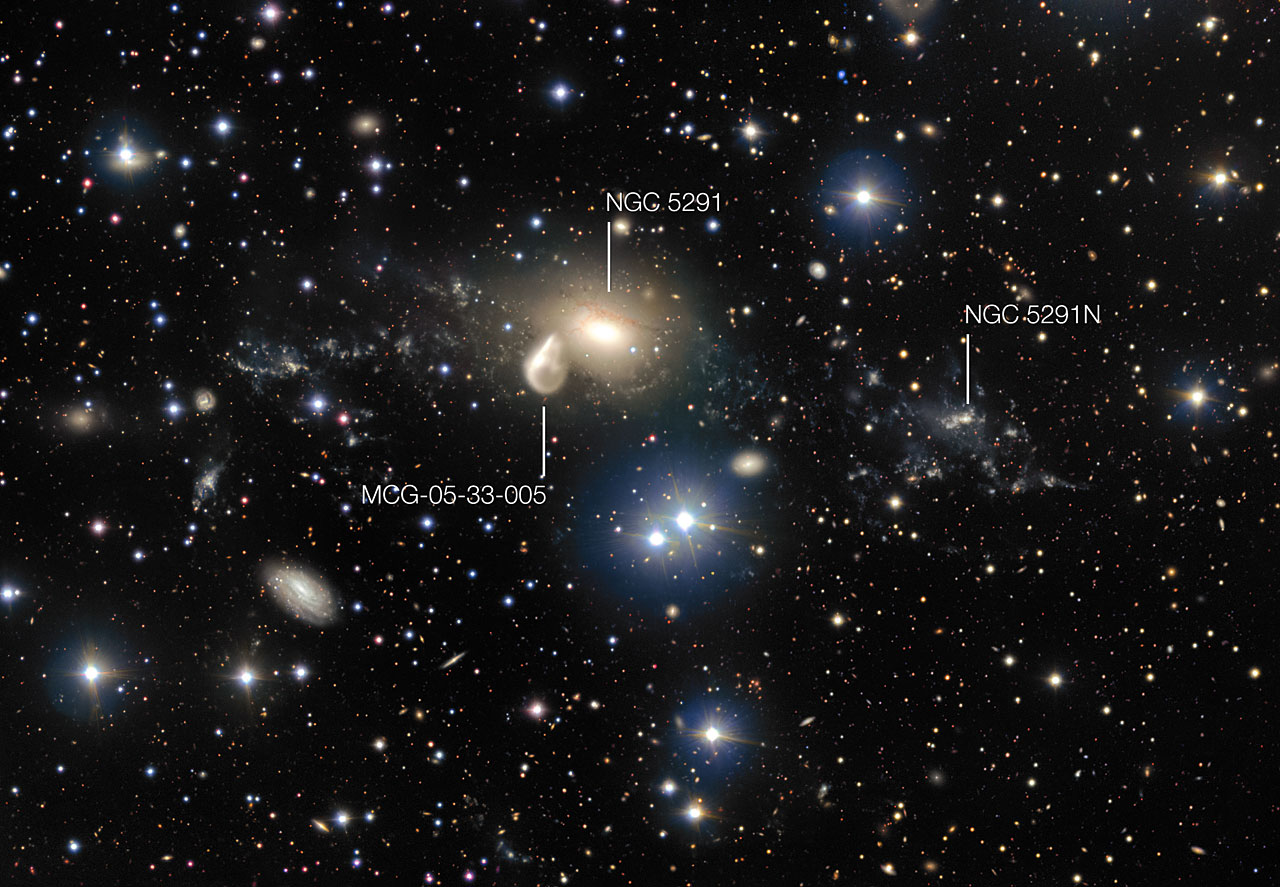
The spectacular aftermath of a 360 million year old cosmic collision is revealed in great detail in this image from ESO’s Very Large Telescope at the Paranal Observatory. Among the debris surrounding the elliptical galaxy NGC 5291 at the centre is a rare and mysterious young dwarf galaxy, which appears as a bright clump towards the right of the image. This object is providing astronomers with an excellent opportunity to learn more about similar galaxies that are expected to be common in the early Universe, but are normally too faint and distant to be observed by current telescopes.
NGC 5291, the hazy, golden oval dominating the centre of this image, is an elliptical galaxy located nearly 200 million light-years away in the constellation of Centaurus (The Centaur). Over 360 million years ago, NGC 5291 was involved in a dramatic and violent collision as another galaxy travelling at immense speeds barrelled into its core. The cosmic crash ejected huge streams of gas into nearby space, which later coalesced into a ring formation around NGC 5291 [1].
The spectacular aftermath of a 360 million year old cosmic collision is revealed in great detail in this image from ESO’s Very Large Telescope at the Paranal Observatory. Among the debris surrounding the elliptical galaxy NGC 5291 at the centre is a rare and mysterious young dwarf galaxy known as NGC 5291N. It is providing astronomers with an excellent opportunity to learn more about similar galaxies that are expected to be common in the early Universe, but are normally too faint and distant to be observed by current telescopes.
Over time, material in this ring gathered and collapsed into dozens of star-forming regions and several dwarf galaxies, revealed as pale blue and white regions scattered around NGC 5291 in this new image from the FORS instrument, mounted on the VLT. The most massive and luminous clump of material, to the right of NGC 5291, is one of these dwarf galaxies and is known as NGC 5291N.
This chart shows the location of the interacting galaxy system NGC 5291 in the bright southern constellation of Centaurus. Most of the stars visible with the naked eye on a dark clear moonless night are shown and the location of the galaxy is marked with a red circle. NGC 5291 can be seen as a faint fuzzy spot through larger amateur telescopes. Credit ESO, IAU, Sky & Telescope
The Milky Way, like all large galaxies, is believed to have formed through the build-up of smaller dwarf galaxies in the early years of the Universe. These small galaxies, if they have survived on their own up to the present day, now normally contain many extremely old stars.
Yet NGC 5291N appears to contain no old stars. Detailed observations with the MUSE spectrograph [2] also found that the outer parts of the galaxy had properties typically associated with the formation of new stars, but what was observed is not predicted by current theoretical models. Astronomers suspect that these unusual aspects may be the result of massive collisions of gas in the region.
This video takes us from a broad view of the southern Milky Way deep into the large constellation of Centaurus. The sequence ends with a close-up view from ESO’s Very Large Telescope of an interacting galaxy called NGC 5291, about 200 million light-years from Earth. Credit: ESO/Digitized Sky Survey 2/N. Risinger (skysurvey.org)
NGC 5291N doesn’t look like a typical dwarf galaxy, but instead it shares a striking number of similarities with the clumpy structures present within many of the star-forming galaxies in the distant Universe. This makes it a unique system in our local Universe and an important laboratory for the study of early gas-rich galaxies, which are normally much too distant to be observed in detail by current telescopes.
This close-up pan video shows the spectacular aftermath of a 360 million year old cosmic collision, as revealed in great detail in an image from ESO’s Very Large Telescope at the Paranal Observatory. Among the debris surrounding the elliptical galaxy NGC 5291 is a rare and mysterious young dwarf galaxy. It is providing astronomers with an excellent opportunity to learn more about similar galaxies that are expected to be common in the early Universe, but are normally too faint and distant to be observed by current telescopes. Credit: ESO/Digitized Sky Survey 2/N. Risinger (skysurvey.org)
This unusual system has previously been observed by a wide range of ground-based facilities, including ESO’s 3.6-metre telescope at the La Silla Observatory[3]. However, the capabilities of MUSE, FORS and the Very Large Telescope have only now allowed some of the history and properties of NGC 5291N to be determined.
This wide-field view shows the sky around the galaxy NGC 5291. This system has interacted with other galaxies and is surrounded with debris from earlier encounters. Some of this material is now forming dwarf galaxies rich in young stars. This picture was created from images forming part of the Digitized Sky Survey 2. Many other galaxies are also visible. Credit: ESO/Digitized Sky Survey 2. Acknowledgement: Davide De Martin
Future observations, including those by ESO’s European Extremely Large Telescope (E-ELT), may allow astronomers to further unravel this dwarf galaxy’s remaining mysteries.
Notes
[1] NGC 5291 is currently also interacting more gently with MCG-05-33-005 — or the Seashell Galaxy — the unusual comma-shaped galaxy appearing to leech off NGC 5291’s luminous core.
[2] NGC 5291N was observed using integral field spectrography during MUSE’s first Science Verification run. Integral field spectrography collects a spectrum at every point on the sky, providing a powerful three-dimensional view of the target. The MUSE observations revealed unexpected oxygen and hydrogen emission lines in the outskirts of NGC 5291N.
[3] NGC 5291 was studied by astronomers using ESO’s 3.6-metre telescope at the La Silla Observatory back in 1978. These observations revealed large amounts of material in the intergalactic space around the galaxy, which we now know to be the star-forming regions and several dwarf galaxies created from the collapse of the galaxy’s gaseous ring.
The latest TMRO.tv program is now available in the archive:
This week we welcome on William Pomerantz, VP of Special Projects at Virgin Galactic. Will and Jared talk LauncherOne and the new carrier aircraft Cosmic Girl.
News topics discussed included:
* Blue Origin has a successful Sub-Orbital Vertial Takeoff / Vertical Landing Flight * H-2A Launch with Telstar 12 Vantage * Long March 4C with Yaogan 29 * Vega launch with LISA Pathfinder * Japanese Spacecraft to Make Second Attempt to Orbit Venus * Vehicle Assembly Building (VAB) receiving fire suppression system upgrades * SpaceX aims to resume Falcon 9 flights in mid-December * ESA plans for Rosetta’s grand finale on comet 67P * A Different kind of Space Race
TMRO is a viewer supported program:
TMRO Space Pods are crowd funded shows. If you like this episode consider contributing to help us to continue to improve. Head over tohttp://www.patreon.com/spacepod for information, goals and reward levels. Don’t forget to check out our weekly live show campaign as well over at http://www.patreon.com/tmro
The Silicon Valley Astronomy Lectures are sponsored by Foothill College, “in the heart of California’s Silicon Valley”. The “speakers over the years have included a wide range of noted scientists, explaining astronomical developments in everyday language”. More than 40 of the lectures are available on line in the archive at SVAstronomyLectures – YouTube.
many of the magnificent mission images and explain the findings from both the main orbiter and the probe that landed on Titan, Saturn’s biggest moon. She also discusses the geysers on the moon Enceladus and what we have learned about the plumes that erupt.