ESO: Sharpest view ever of dusty disc around an aging star

The latest European Southern Observatory (ESO) report:

Sharpest View Ever of Dusty Disc Around Aging Star
VLTI finds discs around aging stars similar to those around young ones

The Very Large Telescope Interferometer at ESO’s Paranal Observatory in Chile has obtained the sharpest view ever of the dusty disc around an aging star. For the first time such features can be compared to those around young stars — and they look surprisingly similar. It is even possible that a disc appearing at the end of a star’s life might also create a second generation of planets.
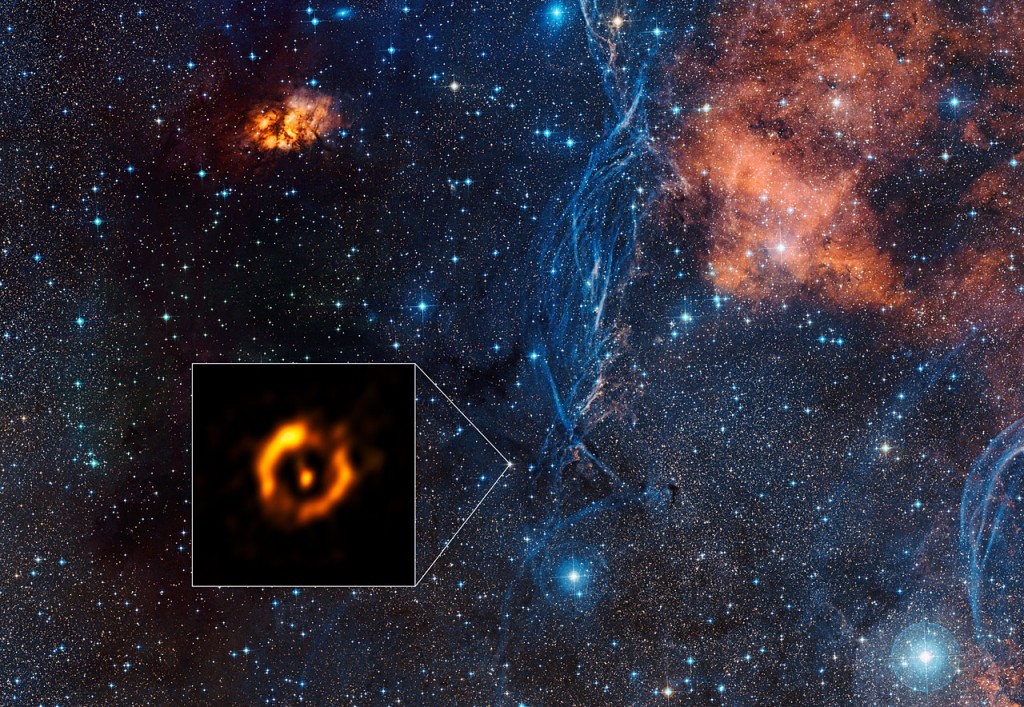
The Very Large Telescope Interferometer at ESO’s Paranal Observatory in Chile has obtained the sharpest view ever of the dusty disc around the close pair of aging stars IRAS 08544-4431. For the first time such discs can be compared to the discs around young stars — and they look surprisingly similar. It is even possible that a disc appearing at the end of a star’s life might also create a second generation of planets. The inset shows the VLTI reconstructed image, with the brighter central star removed. The background view shows the surroundings of this star in the constellation of Vela (The Sails).

As they approach the ends of their lives many stars develop stable discs of gas and dust around them. This material was ejected by stellar winds, whilst the star was passing through the red giant stage of its evolution. These discs resemble those that form planets around young stars. But up to now astronomers have not been able to compare the two types, formed at the beginning and the end of the stellar life cycle.

Although there are many discs associated with young stars that are sufficiently near to us to be studied in depth, there are no corresponding old stars with discs that are close enough for us to obtain detailed images.
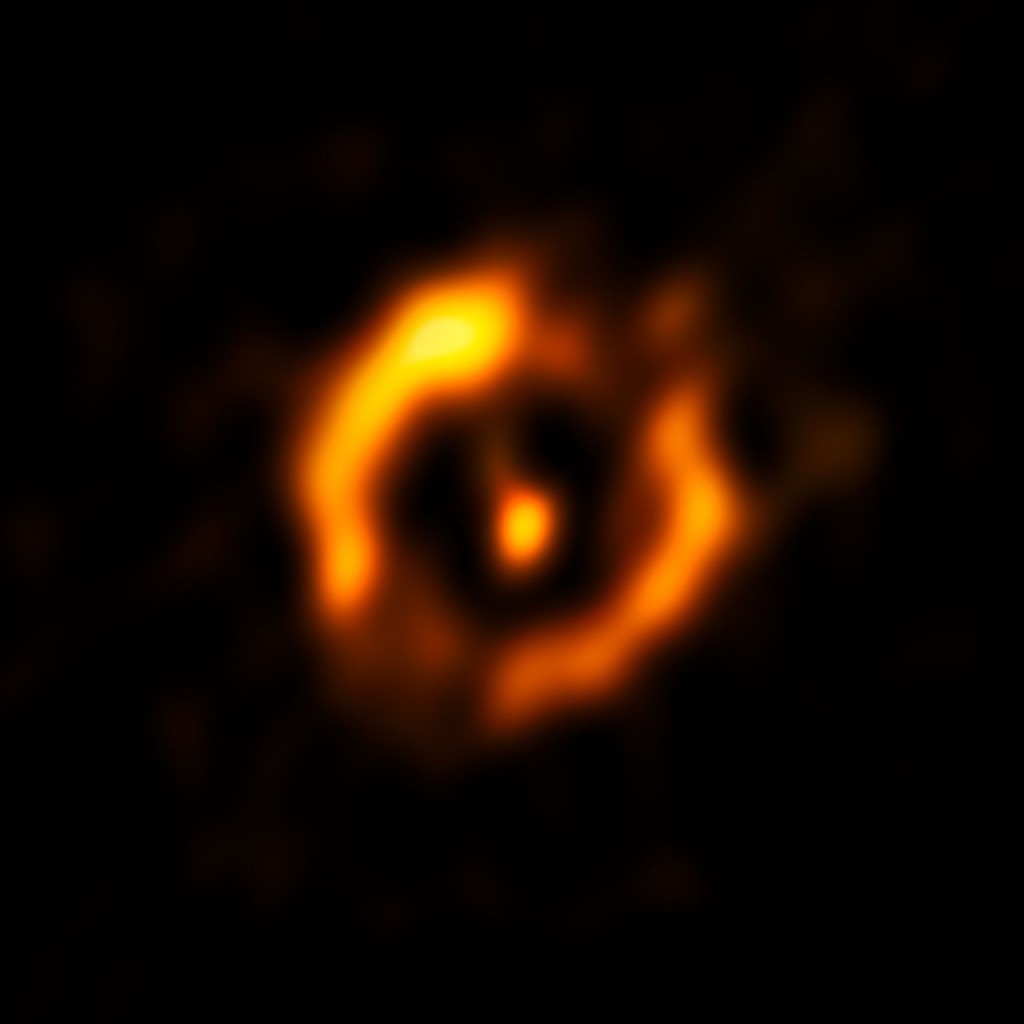
The Very Large Telescope Interferometer at ESO’s Paranal Observatory in Chile has obtained the sharpest view ever of the dusty disc around the close pair of aging stars IRAS 08544-4431. For the first time such discs can be compared to the discs around young stars — and they look surprisingly similar. It is even possible that a disc appearing at the end of a star’s life might also create a second generation of planets. This view shows the VLTI reconstructed image, with the brighter central star removed. A fainter glow from the secondary star is visible, which came as a surprise to the observers.

But this has now changed. A team of astronomers led by Michel Hillen and Hans Van Winckel from the Instituut voor Sterrenkunde in Leuven, Belgium, has used the full power of the Very Large Telescope Interferometer (VLTI) at ESO’s Paranal Observatory in Chile, armed with the PIONIER instrument, and the newly upgraded RAPID detector.

Their target was the old double star IRAS 08544-4431 [1], lying about 4000 light-years from Earth in the southern constellation of Vela (The Sails). This double star consists of a red giant star, which expelled the material in the surrounding dusty disc, and a less-evolved more normal star orbiting close to it.

Jacques Kluska, team member from Exeter University, United Kingdom, explains:

“By combining light from several telescopes of the Very Large Telescope Interferometer, we obtained an image of stunning sharpness — equivalent to what a telescope with a diameter of 150 metres would see. The resolution is so high that, for comparison, we could determine the size and shape of a one euro coin seen from a distance of two thousand kilometres.”

Thanks to the unprecedented sharpness of the images [2] from the Very Large Telescope Interferometer, and a new imaging technique that can remove the central stars from the image to reveal what lies around them, the team could dissect all the building blocks of the IRAS 08544-4431 system for the first time.

This video takes the viewer deep into a spectacular region of the southern Milky Way in the constellation of Vela (The Sails). We pass many interesting objects, including star formation regions and the blue filaments of a supernova remnant, before closing in on the faint star IRAS 08544-4431. This aging object is surrounded by a dusty disc that has been clearly resolved for the first time by the Very Large Telescope Interferometer at ESO’s Paranal Observatory in Chile. Credit: ESO/Digitized Sky Survey 2/N. Risinger (skysurvey.org).  Acknowledgement: Davide De Martin. Music: Johan B. Monell (www.johanmonell.com)

The most prominent feature of the image is the clearly resolved ring. The inner edge of the dust ring, seen for the first time in these observations, corresponds very well with the expected start of the dusty disc: closer to the stars, the dust would evaporate in the fierce radiation from the stars.

“We were also surprised to find a fainter glow that is probably coming from a small accretion disc around the companion star. We knew the star was double, but weren’t expecting to see the companion directly. It is really thanks to the jump in performance now provided by the new detector in PIONIER, that we are able to view the very inner regions of this distant system,”

adds lead author Michel Hillen.

The team finds that discs around old stars are indeed very similar to the planet-forming ones around young stars. Whether a second crop of planets can really form around these old stars is yet to be determined, but it is an intriguing possibility.

“Our observations and modelling open a new window to study the physics of these discs, as well as stellar evolution in double stars. For the first time the complex interactions between close binary systems and their dusty environments can now be resolved in space and time,”

concludes Hans Van Winckel.
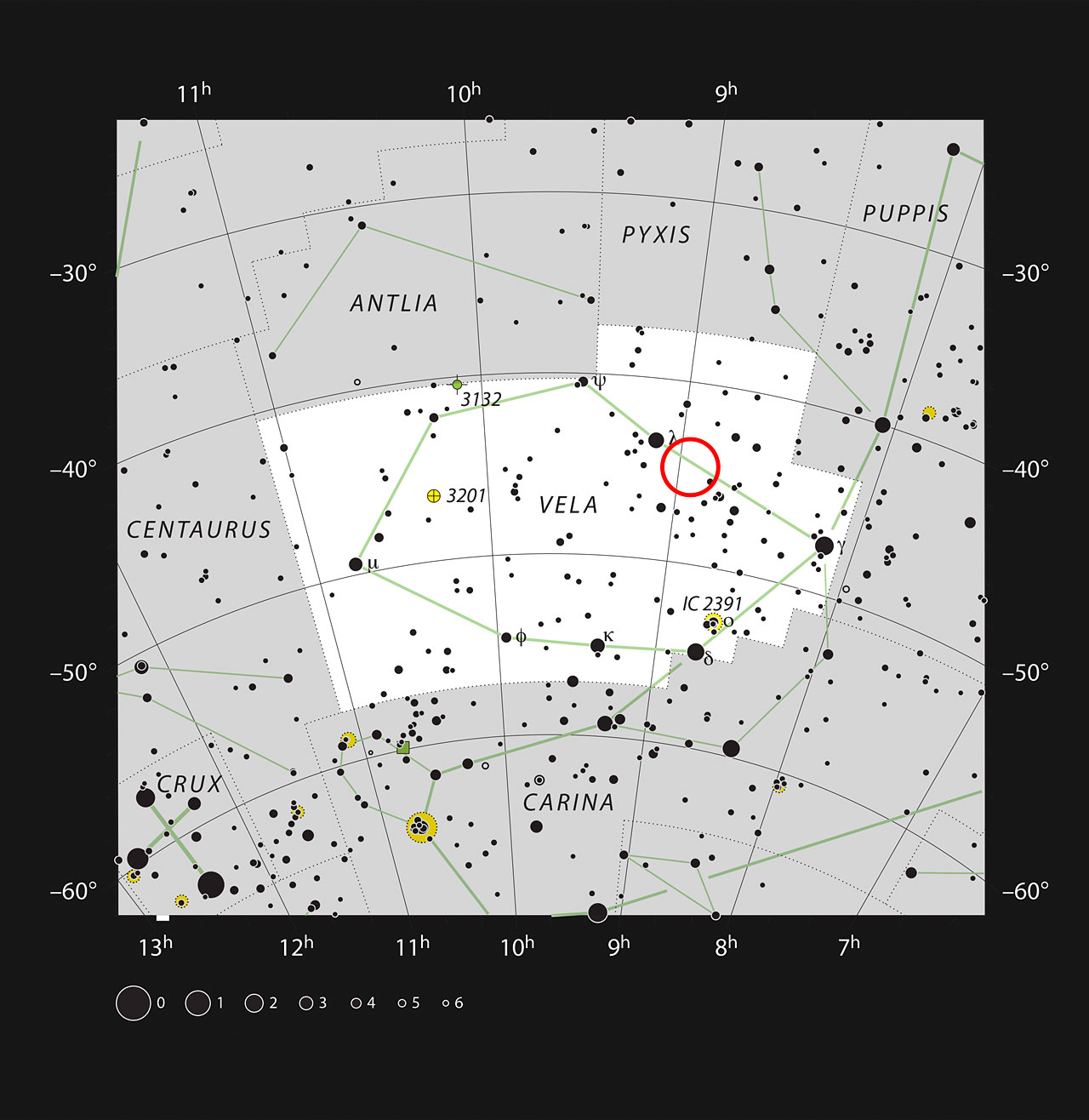
This chart shows the location of the aging double star IRAS 08544-4431 in the constellation of Vela (The Sails). All stars visible to the naked eye on a dark and clear night are shown. This star is visible with a small telescope as an unremarkable single faint point of light.

Notes

[1] The name of the object indicates that it is a source of infrared radiation that was detected and catalogued by the IRAS satellite observatory in the 1980s.

[2] The resolution of the VLTI, used with the four Auxiliary Telescopes, was about one milliarcsecond (1/1000th of 1/3600th of a degree).

Videos: “From Here to the Stars” interview series by the Tennessee Valley Interstellar Workshop

The Tennessee Valley Interstellar Workshop  (TVIW) recently initiated a Youtube video series titled, From Here to the Stars, that consists of interviews with scientists and leading thinkers in the area of interstellar travel. Here are the first four entries in the series:

In Episode 1, Stephen Euin Cobb, Host of “Future and You” podcast, interviews Marc G. Millis, Founder and Director of Tau Zero Foundation, in association with Tennessee Valley Interstellar Workshop (Les Johnson, Executive Producer).

—

In Episode 2, Stephen Euin Cobb, Host of “Future and You” podcast, interviews Dr. Louis D. Friedman, Co-Founder of The Planetary Society with Carl Sagan and Bruce C. Murray and Planetary Society Executive Director Emeritus, in association with Tennessee Valley Interstellar Workshop (Les Johnson, Executive Producer).

—

In Episode 3, Stephen Euin Cobb, Host of “Future and You” podcast, interviews Dr. Philip Lubin, a professor of Physics at the University of California, Santa Barbara and a co-recipient of the 2006 Gruber Prize in Cosmology along with the COBE science team for their groundbreaking work in cosmology. This series is produced in association with Tennessee Valley Interstellar Workshop (Les Johnson, Executive Producer).

See the see DEEP-IN webpage for more about the work of Lubin’s group at UCSB on “Directed Energy Interstellar Precursors”.

—

In Episode 4, Stephen Euin Cobb, Host of “Future and You” podcast, interviews Dr. Gregory L. Matloff, Emeritus Associate and Adjunct Associate Professor of Physics at New York City College of Technology (NYCCT), Fellow of the British interplanetary Society, and Hayden Associate at the American Museum of Natural History. This series is produced in association with Tennessee Valley Interstellar Workshop (Les Johnson, Executive Producer).

Dawn: A mountain on Ceres comes into focus + A mission review

Marc Rayman, the Dawn mission Chief Engineer and Mission Director, writes an interesting review of the project: Dear Indawnbitably Successful Readers – Dawn Blog

And here is a new science report today:

Dawn’s First Year at Ceres: A Mountain Emerges 

PIA20348-16-640x350[1]
The mysterious mountain Ahuna Mons is seen in this mosaic of images from NASA’s Dawn spacecraft. Dawn took these images from its lowest-altitude orbit. Image Credit: NASA/JPL-Caltech/UCLA/MPS/DLR/IDA
One year ago, on March 6, 2015, NASA’s Dawn spacecraft slid gently into orbit around Ceres, the largest body in the asteroid belt between Mars and Jupiter.  Since then, the spacecraft has delivered a wealth of images and other data that open an exciting new window to the previously unexplored dwarf planet.

“Ceres has defied our expectations and surprised us in many ways, thanks to a year’s worth of data from Dawn. We are hard at work on the mysteries the spacecraft has presented to us,” said Carol Raymond, deputy principal investigator for the mission, based at NASA’s Jet Propulsion Laboratory, Pasadena, California.

PIA20349-640x350[1]
This side-perspective view of Ceres’ mysterious mountain Ahuna Mons was made with images from NASA’s Dawn spacecraft. Dawn took these images from its low-altitude mapping orbit, 240 miles (385 kilometers) above the surface, in December 2015. The resolution of the component images is 120 feet (35 meters) per pixel. A 3-D (anaglyph) view is also available
Among Ceres’ most enigmatic features is a tall mountain the Dawn team named Ahuna Mons. This mountain appeared as a small, bright-sided bump on the surface as early as February 2015 from a distance of 29,000 miles (46,000 kilometers), before Dawn was captured into orbit. As Dawn circled Ceres at increasingly lower altitudes, the shape of this mysterious feature began to come into focus. From afar, Ahuna Mons looked to be pyramid-shaped, but upon closer inspection, it is best described as a dome with smooth, steep walls.

Dawn’s latest images of Ahuna Mons, taken 120 times closer than in February 2015, reveal that this mountain has a lot of bright material on some of its slopes, and less on others. On its steepest side, it is about 3 miles (5 kilometers) high. The mountain has an average overall height of 2.5 miles (4 kilometers). It rises higher than Washington’s Mount Rainier and California’s Mount Whitney.

Scientists are beginning to identify other features on Ceres that could be similar in nature to Ahuna Mons, but none is as tall and well-defined as this mountain.

“No one expected a mountain on Ceres, especially one like Ahuna Mons,” said Chris Russell, Dawn’s principal investigator at the University of California, Los Angeles. “We still do not have a satisfactory model to explain how it formed.”

About 420 miles (670 kilometers) northwest of Ahuna Mons lies the now-famous Occator Crater. Before Dawn arrived at Ceres, images of the dwarf planet from NASA’s Hubble Space Telescope showed a prominent bright patch on the surface. As Dawn approached Ceres, it became clear that there were at least two spots with high reflectivity. As the resolution of images improved, Dawn revealed to its earthly followers that there are at least 10 bright spots in this crater alone, with the brightest area on the entire body located in the center of the crater. It is not yet clear whether this bright material is the same as the material found on Ahuna Mons.

“Dawn began mapping Ceres at its lowest altitude in December, but it wasn’t until very recently that its orbital path allowed it to view Occator’s brightest area. This dwarf planet is very large and it takes a great many orbital revolutions before all of it comes into view of Dawn’s camera and other sensors,” said Marc Rayman, Dawn’s chief engineer and mission director at JPL.

Researchers will present new images and other insights about Ceres at the 47th Lunar and Planetary Science Conference, during a press briefing on March 22 in The Woodlands, Texas.

When it arrived at Ceres on March 6, 2015, Dawn made history as the first mission to reach a dwarf planet, and the first to orbit two distinct extraterrestrial targets. The mission conducted extensive observations of Vesta in 2011-2012.

Dawn’s mission is managed by JPL for NASA’s Science Mission Directorate in Washington. Dawn is a project of the directorate’s Discovery Program, managed by NASA’s Marshall Space Flight Center in Huntsville, Alabama. UCLA is responsible for overall Dawn mission science. Orbital ATK Inc., in Dulles, Virginia, designed and built the spacecraft. The German Aerospace Center, Max Planck Institute for Solar System Research, Italian Space Agency and Italian National Astrophysical Institute are international partners on the mission team. For a complete list of mission participants, visit: http://dawn.jpl.nasa.gov/mission

More information about Dawn is available at the following sites:


The Space Show this week – Mar.7.2016

The guests and topics of discussion on The Space Show this week:

1. Monday, March 7, 2016: 2-3:30 PM PST: We welcome back ROBERT WALKER from the UK for a discussion about Mars and HSF. Check out his writings at www.science20.com/space.

2. Tuesday, March 8, 2016: 7-8:30 PM PST (10-11:30 PM EST, 9-10:30 PM CST): We welcome ROLAND MILLER to discuss his new book, Abandoned in Place: Preserving America’s Space History.

3. Friday, March 11, 2016: 2016; 9:30-11AM PST; (12:30-2 PM EST; 11:30AM – 1 PM CST. We welcome back DR. CATHARINE (Cassie) CONLEY, the Director of the NASA Office of Planetary Protection.

4. Sunday, March 13 2016: 12-1:30 PM PST (3-4:30 PM EST, 2-3:30 PM CST): This is an OPEN LINES discussion. All STEM, space, and STEAM topics are welcome. First Time callers are welcome.

See also:
* The Space Show on Vimeo – webinar videos
* The Space Show’s Blog – summaries of interviews.
* The Space Show Classroom Blog – tutorial programs

The Space Show is a project of the One Giant Leap Foundation.

Everyone can participate in space