“A New Moon Rises” – An exhibition of HD images of the lunar surface

NASA’s Lunar Reconnaissance Orbiter has been circling the Moon since June 2009 and has been imaging the lunar surface at much higher resolution than obtained during previous missions going back to the Apollo era. The images can be quite spectacular and some of the most striking are currently on display in an exhibition called A New Moon Rises at the National Air and Space Museum in Washington D.C. Here is a report on the show: Desolate magnificence – The Space Review.

Below is a sampling of the Craters, Vistas, and Major Discoveries on display:

The image below shows “A Very Young Crater”  with [spectacular] ejecta surround it. The crater is

about 1,400 meters (4,600 feet) across. Since there are no superimposed impact craters on the ejecta, and the delicate lacy impact spray is still preserved near the rim, this crater formed very recently, perhaps sometime in the past few thousand years.
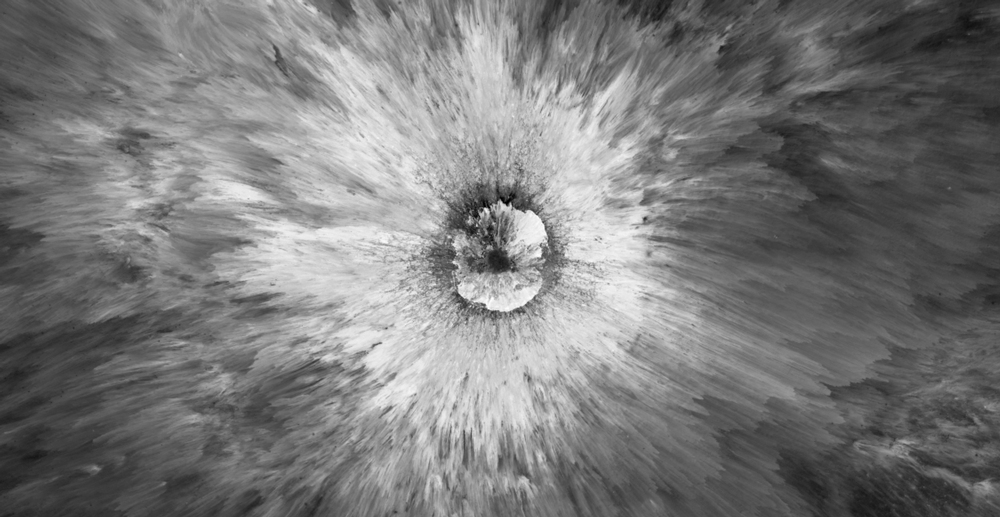
Young Impact Crater - 11865p

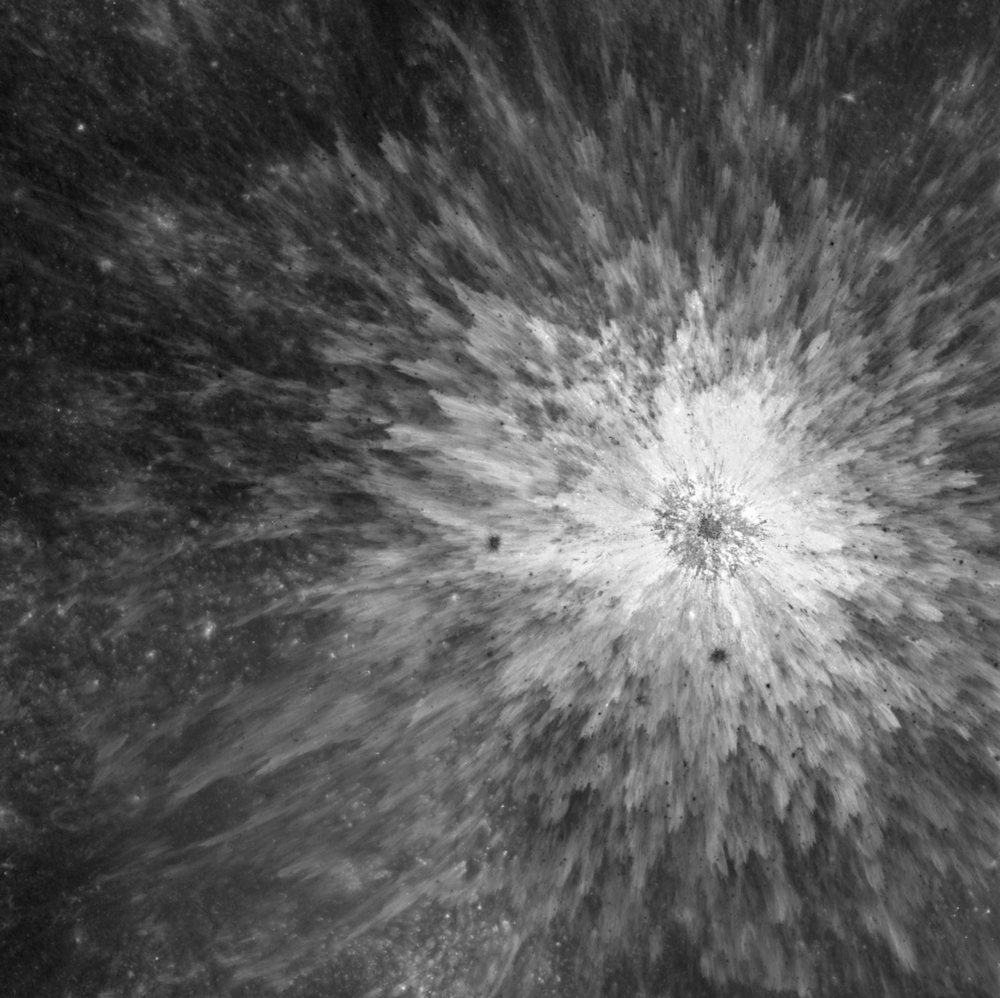
Below are two “Copernican Craters” that have

… large, spectacular ejecta patterns of bright material thrown across the Moon’s surface. These craters are no more than 1 billion years old—”Copernican age” in the lunar geologic timescale. Because they are so bright and have few impact craters on them, they may be as young as a few million years. Each is incredibly well preserved: crisp crater rims, steep crater walls, and delicate small-scale ejecta patterns. The overhead sunlight highlights the brightness variations.
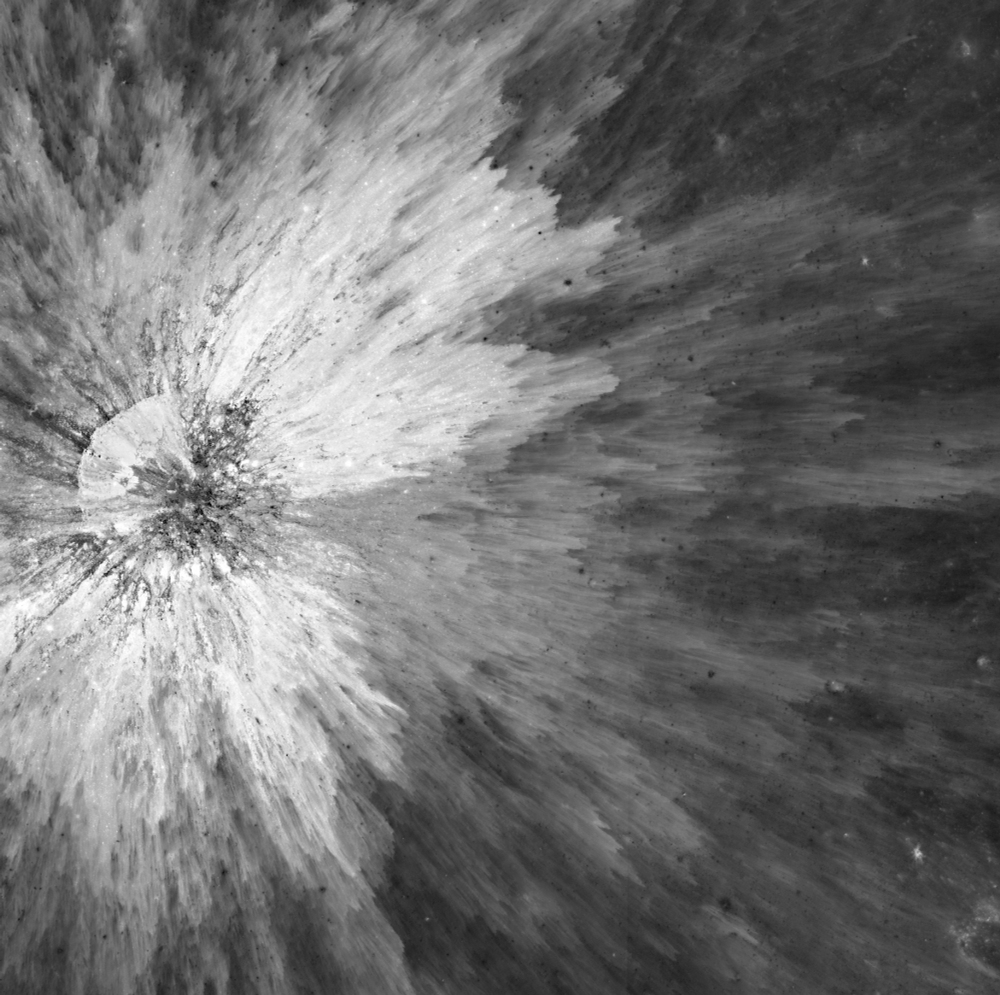
Copernican Crater - 11863p

Copernican Crater - 11864p

The lunar feature below is titled, “The Strangest of Swirls”

Reiner Gamma is one of the Moon’s most distinctive and mysterious features. This striking, tadpole-shaped swirl puzzles lunar scientists. Some think that its origin, as with other swirls, is somehow related to the shielding effects of localized magnetic field anomalies.
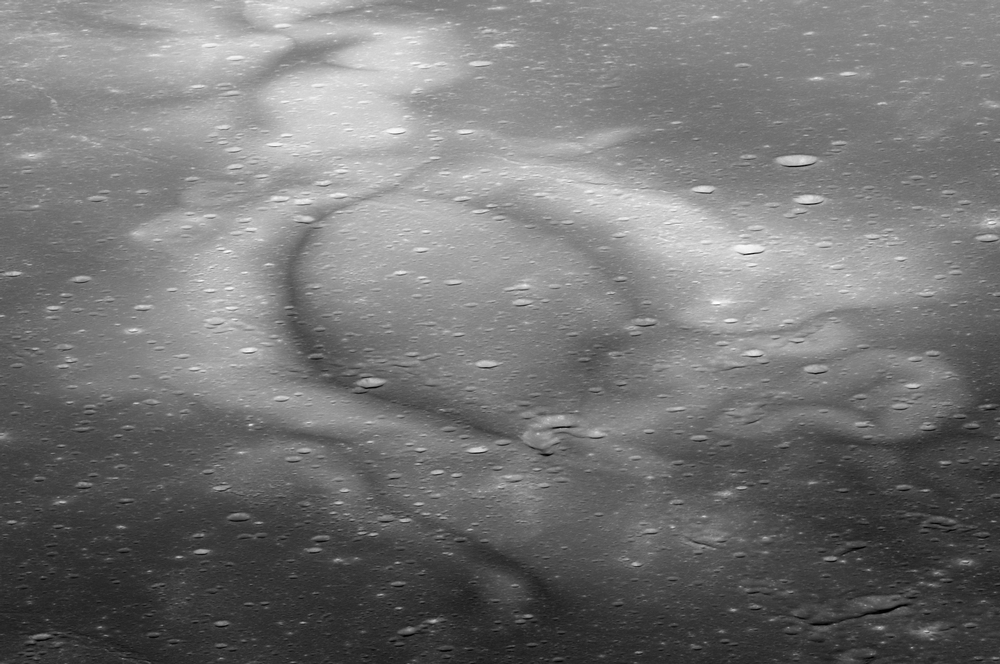
Reiner Gamma-11843p

The images below

…, taken at different times, reveal that a cave extends at least 25 meters (82 feet) under the surface of the Moon. Collapse pits, where the near-surface lunar crust has caved in, can provide a window into the shallow subsurface. Image IDs: M126710873R, M155016845R, M152662021R

11829p[1]

—

Here is an entertaining video about how the LRO is operated:

The Space Show this week – Mar.21.16

The guests and topics of discussion on The Space Show this week:

1. Monday, March 21, 2016: 2-3:30 PM PDT (5-6:30 PM EDT, 4-5:30 PM CDT): We welcome CHRIS CARBERRY & RICK ZUCKER of ExploreMars, Inc. for updates.

2. Tuesday, March 22, 2016: 7-8:30 PM PDT (10-11:30 PM EDT, 9-10:30 PM CDT): We welcome back DR.MIKE GRIFFIN, former NASA Administrator for space policy moving forward.

3. Friday, March 25, 2016: 2016; 9:30-11AM PDT; (12:30-2 PM EDT; 11:30AM – 1 PM CDT. JOHN STRICKLAND returns for the final part of his three part series.

4. Sunday, March 27 2016: 12-1:30 PM PDT (3-4:30 PM EDT, 2-3:30 PM CDT): NO SHOW DUE TO EASTER.

See also:
* The Space Show on Vimeo – webinar videos
* The Space Show’s Blog – summaries of interviews.
* The Space Show Classroom Blog – tutorial programs

The Space Show is a project of the One Giant Leap Foundation.

Video: TMRO 9.10 – Innovation at the Speed of Space

The latest episode of TMRO.tv is now available on line: Innovation at the Speed of Space – #SpeedOfSpace – TMRO

This week we ask if the speed of space innovation is getting faster with new entrants on the scene. Will it ever reach the speed of technology innovation?

Space news topics covered this week:

* Soyuz launches Resurs P3
* Proton launches ExoMars
* Soyuz launches Soyuz
* ULA VP resigns after controversial comments
* Space Fire
* Iran planning a space launch soon
* Space Clothes

TMRO is viewer supported:

TMRO Live is a crowd funded show. If you like this episode consider contributing to help us to continue to improve. Head over to http://www.patreon.com/tmro for information, goals and reward levels. Don’t forget to check out our SpacePod campaign as well over at http://www.patreon.com/spacepod

Video: ‘On the shoulders of giants’ – Tim Peake’s Principia mission on the ISS

A nicely made video of highlights of UK astronaut Tim Peake’s mission on the Int. Space Station with beautiful imagery of the earth:

From the caption:

“If I have seen further, it is by standing on the shoulders of giants” is the famous quote by renowned scientist Sir Isaac Newton. This is particularly apt as a title for this video summary of ESA astronaut Tim Peake’s Principia mission – named after Newton’s monumental work Philosophiae Naturalis Principia and now building on the work of previous European astronaut missions, while being supported by a huge team of scientists and engineers on the ground.

The music accompanying this video was chosen by Tim, coming from the soundtrack of one of his favourite films, the 2004 movie Layer Cake. This piece is called ‘Drive to the Boatyard’, by internationally known British film composer Ilan Eshkeri. Ilan provided a slightly extended piece specially for ESA.

Tim comments: “I’m delighted with this video, which captures the essence of human spaceflight and natural beauty of our planet from space – all put to Ilan’s inspiring soundtrack!”

More info on Principia: http://www.esa.int/Our_Activities/Hum…

More about Ilan Eshkeri: http://www.ilaneshkeri.com/

Music by I. Eshkeri, © Ole Colorful Drawings Music Inc. administered by SonyATV Music Publishing

Everyone can participate in space