ESO: Young star’s outburst pushes protoplanetary disc snow line outward

ESO (European Southern Observatory) releases another report this week:

Stellar Outburst Brings Water Snow Line Into View 
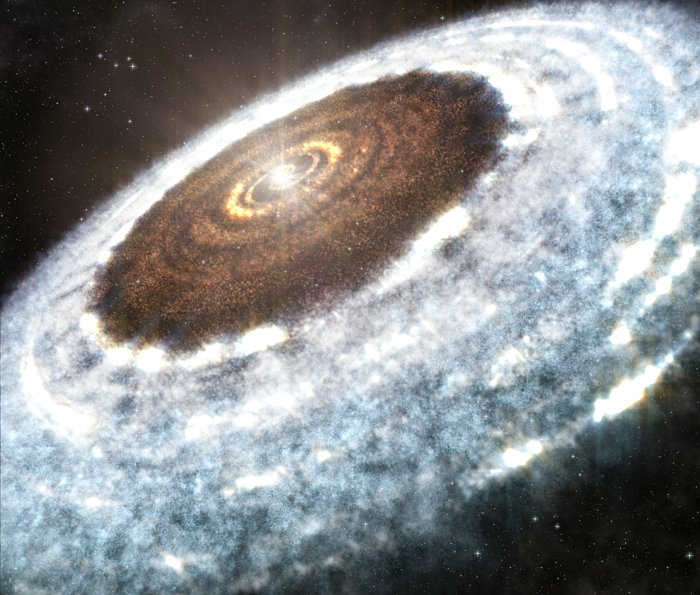
This artist’s impression of the water snowline around the young star V883 Orionis, as detected with ALMA.

The Atacama Large Millimeter/submillimeter Array (ALMA) has made the first ever resolved observation of a water snow line within a protoplanetary disc. This line marks where the temperature in the disc surrounding a young star drops sufficiently low for snow to form. A dramatic increase in the brightness of the young star V883 Orionis flash heated the inner portion of the disc, pushing the water snow line out to a far greater distance than is normal for a protostar, and making it possible to observe it for the first time. The results are published in the journal Nature on 14 July 2016.
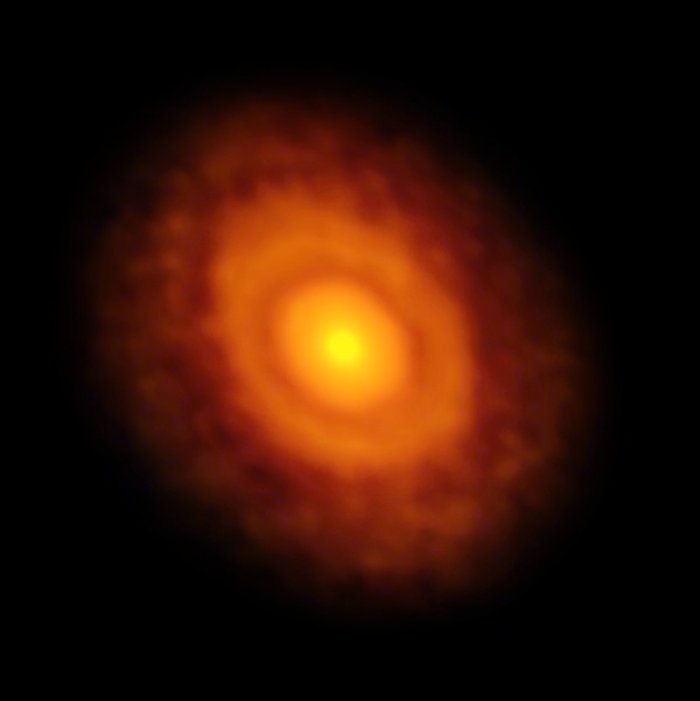
This image of the planet-forming disc around the young star V883 Orionis was obtained by ALMA in long-baseline mode. This star is currently in outburst, which has pushed the water snow line further from the star and allowed it to be detected for the first time. The dark ring midway through the disc is the water snowline, the point from the star where the temperature and pressure dip low enough for water ice to form.

eso1626e[1]
Same image but with orbits of the planet Neptune and dwarf planet Pluto in our Solar System are shown for scale.
Young stars are often surrounded by dense, rotating discs of gas and dust, known as protoplanetary discs, from which planets are born. The heat from a typical young solar-type star means that the water within a protoplanetary disc is gaseous up to distances of around 3 au from the star [1] — less than 3 times the average distance between the Earth and the Sun — or around 450 million kilometres [2]. Further out, due to the extremely low pressure, the water molecules transition directly from a gaseous state to form a patina of ice on dust grains and other particles. The region in the protoplanetary disc where water transitions between the gas and solid phases is known as the water snow line [3].

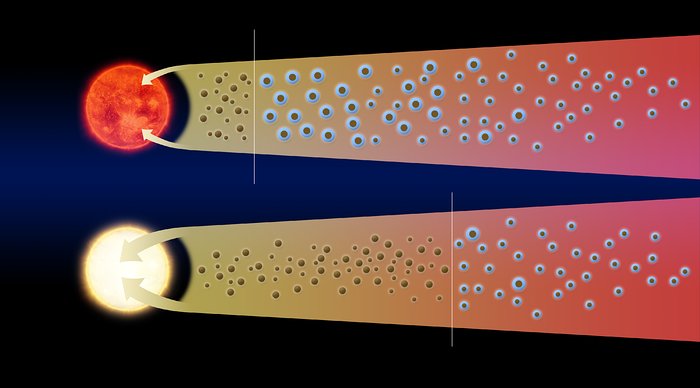
This illustration shows how the outburst of the young star V883 Orionis has displaced the water snowline much further out from the star, and rendered it detectable with ALMA.

But the star V883 Orionis is unusual. A dramatic increase in its brightness has pushed the water snow line out to a distance of around 40 au (about 6 billion kilometres or roughly the size of the orbit of the dwarf planet Pluto in our Solar System). This huge increase, combined with the resolution of ALMA at long baselines [4], has allowed a team led by Lucas Cieza (Millennium ALMA Disk Nucleus and Universidad Diego Portales, Santiago, Chile) to make the first ever resolved observations of a water snow line in a protoplanetary disc.

Zooming on the young star V883 Orionis. This star is currently in outburst, which has pushed the water snow line further from the star and allowed it to be detected for the first time with ALMA. Credit: ESO/Digitized Sky Survey 2/N. Risinger (skysurvey.org)/M. Kornmesser. Music: Johan B. Monell

The sudden brightening that V883 Orionis experienced is an example of what occurs when large amounts of material from the disc surrounding a young star fall onto its surface. V883 Orionis is only 30% more massive than the Sun, but thanks to the outburst it is experiencing, it is currently a staggering 400 times more luminous — and much hotter [5].

Lead author Lucas Cieza explains:

“The ALMA observations came as a surprise to us. Our observations were designed to look for disc fragmentation leading to planet formation. We saw none of that; instead, we found what looks like a ring at 40 au. This illustrates well the transformational power of ALMA, which delivers exciting results even if they are not the ones we were looking for.”

The bizarre idea of snow orbiting in space is fundamental to planet formation. The presence of water ice regulates the efficiency of the coagulation of dust grains — the first step in planet formation. Within the snow line, where water is vapourised, smaller, rocky planets like our own are believed to form. Outside the water snow line, the presence of water ice allows the rapid formation of cosmic snowballs, which eventually go on to form massive gaseous planets such as Jupiter.

The discovery that these outbursts may blast the water snow line to about 10 times its typical radius is very significant for the development of good planetary formation models. Such outbursts are believed to be a stage in the evolution of most planetary systems, so this may be the first observation of a common occurrence. In that case, this observation from ALMA could contribute significantly to a better understanding of how planets throughout the Universe formed and evolved.

Notes

[1] ] 1 au, or one astronomical unit, is the mean distance between the Earth and the Sun, around 149.6 million kilometres.This unit is typically used to describe distances measured within the Solar System and planetary systems around other stars.

[2] This line was between the orbits of Mars and Jupiter during the formation of the Solar System, hence the rocky planets Mercury, Venus, Earth and Mars formed within the line, and the gaseous planets Jupiter, Saturn, Uranus and Neptune formed outside.

[3] The snow lines for other molecules, such as carbon monoxide and methane, have been observed previously with ALMA, at distances of greater than 30 au from the protostar within other protoplanetary discs. Water freezes at a relatively high temperature and this means that the water snow line is usually much too close to the protostar to observe directly.

[4] Resolution is the ability to discern that objects are separate. To the human eye, several bright torches at a distance would seem like a single glowing spot, and only at closer quarters would each torch be distinguishable. The same principle applies to telescopes, and these new observations have exploited the exquisite resolution of ALMA in its long baseline modes. The resolution of ALMA at the distance of V883 Orionis is about 12 au — enough to resolve the water snow line at 40 au in this outbursting system, but not for a typical young star.

[5] Stars like V883 Orionis are classed as FU Orionis stars, after the original star that was found to have this behaviour. The outbursts may last for hundreds of years.
ESO: New imaging of Orion Nebula reveals many more low-mass objects than expected

A new report from ESO (European Southern Observatory):

Deepest Ever Look into Orion

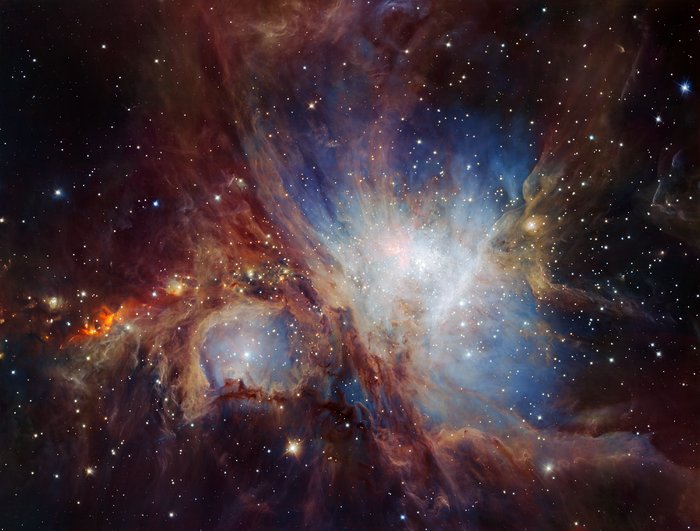
This spectacular image of the Orion Nebula star-formation region was obtained from multiple exposures using the HAWK-I infrared camera on ESO’s Very Large Telescope in Chile. This is the deepest view ever of this region and reveals more very faint planetary-mass objects than expected.

ESO’s HAWK-I infrared instrument on the Very Large Telescope (VLT) in Chile has been used to peer deeper into the heart of Orion Nebula than ever before. The spectacular picture reveals about ten times as many brown dwarfs and isolated planetary-mass objects than were previously known. This discovery poses challenges for the widely accepted scenario for Orion’s star formation history.

An international team has made use of the power of the HAWK-I infrared instrument on ESO’s Very Large Telescope (VLT) to produce the deepest and most comprehensive view of the Orion Nebula [1] to date. Not only has this led to an image of spectacular beauty, but it has revealed a great abundance of faint brown dwarfs and isolated planetary-mass objects. The very presence of these low-mass bodies provides an exciting insight into the history of star formation within the nebula itself.

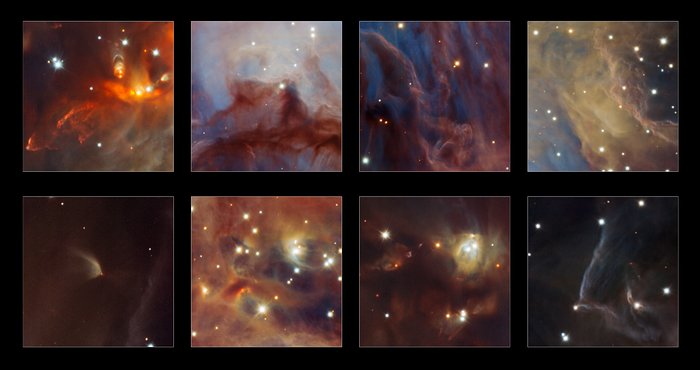
This image shows some highlights from a spectacular new image of the Orion Nebula star-formation region obtained from multiple exposures using the HAWK-I infrared camera on ESO’s Very Large Telescope in Chile. This is the deepest view ever of this region and reveals more very faint planetary-mass objects than expected.

The famous Orion Nebula spans about 24 light-years within the constellation of Orion, and is visible from Earth with the naked eye, as a fuzzy patch in Orion’s sword. Some nebulae, like Orion, are strongly illuminated by ultraviolet radiation from the many hot stars born within them, such that the gas is ionised and glows brightly.

The relative proximity of the Orion Nebula [2] makes it an ideal testbed to better understand the process and history of star formation, and to determine how many stars of different masses form.

This video gives a close-up view of a spectacular new image of the Orion Nebula star-formation region that was obtained from multiple exposures using the HAWK-I infrared camera on ESO’s Very Large Telescope in Chile. This is the deepest view ever of this region and reveals many more very faint planetary-mass objects than expected. Credit: ESO/H. Drass et al. Music: Johan B. Monell (www.johanmonell.com)

Amelia Bayo (Universidad de Valparaíso, Valparaíso, Chile; Max-Planck Institut für Astronomie, Königstuhl, Germany), a co-author of the new paper and member of the research team, explains why this is important:

“Understanding how many low-mass objects are found in the Orion Nebula is very important to constrain current theories of star formation. We now realise that the way these very low-mass objects form depends on their environment.“

This new image has caused excitement because it reveals a unexpected wealth of very-low-mass objects, which in turn suggests that the Orion Nebula may be forming proportionally far more low-mass objects than closer and less active star formation regions.

This video starts from a wide view of the night sky and zooms in on the famous constellation of Orion. The final part gives a close-up view of a spectacular new image of the Orion Nebula star-formation region that was obtained from multiple exposures using the HAWK-I infrared camera on ESO’s Very Large Telescope in Chile. This is the deepest view ever of this region and reveals more very faint planetary-mass objects than expected. Credit: ESO/H. Drass et al./N. Risinger (skysurvey.org)/M. Kornmesser. Music: Johan Monell (www.johanmonell.com)

Astronomers count up how many objects of different masses form in regions like the Orion Nebula to try to understand the star-formation process [3]. Before this research the greatest number of objects were found with masses of about one quarter that of our Sun. The discovery of a plethora of new objects with masses far lower than this in the Orion Nebula has now created a second maximum at a much lower mass in the distribution of star counts.

This sequence compares an infrared image of the Orion Nebula star-formation region that was obtained from multiple exposures using the HAWK-I infrared camera on ESO’s Very Large Telescope with a picture of the same part of the sky imaged in visible light with the WFI camera on the MPG/ESO 2.2-metre telescope. The longer wavelength light detected by HAWK-I can penetrate the dusty regions of the nebula and expose many young stars that are normally invisible and also reveal many curious features created by very young stars and the jets that they expel. Credit: ESO/H. Drass/Igor Chekalin. Music: Johan B. Monell (www.johanmonell.com)

These observations also hint tantalisingly that the number of planet-sized objects might be far greater than previously thought. Whilst the technology to readily observe these objects does not exist yet, ESO’s future European Extremely Large Telescope (E-ELT), scheduled to begin operations in 2024, is designed to pursue this as one of its goals.

Lead scientist Holger Drass (Astronomisches Institut, Ruhr-Universität Bochum, Bochum, Germany; Pontificia Universidad Católica de Chile, Santiago, Chile) enthuses:

“Our result feels to me like a glimpse into a new era of planet and star formation science. The huge number of free-floating planets at our current observational limit is giving me hope that we will discover a wealth of smaller Earth-sized planets with the E-ELT.”

Notes

[1] Nebulae such as the famous one in Orion are also known as H II regions to indicate that they contain ionised hydrogen. These immense clouds of interstellar gas are sites of star formation throughout the Universe.

[2] The Orion Nebula is estimated to lie about 1350 light-years from Earth.

[3] This information is used to create something called the Initial Mass Function (IMF) — a way of describing how many stars of different masses make up a stellar population at its birth. This provides an insight into the stellar population’s origins. In other words, determining an accurate IMF, and having a solid theory to explain the origin of the IMF is of fundamental importance in the study of star formation.

Video: Evolution and explosion of massive stars

Carl Sagan said, “We are made of starstuff.” And most of that starstuff came from the explosions of really big stars. Here is a recent SETI Institute seminar about the latest developments in understanding the life and death processes of massive stars: The Evolution and Explosion of Massive Stars -SETI Institute

Massive stars (at least ~8 solar masses) play an essential role to the evolution of the universe. They lose energy in radiation and neutrinos as they evolve, to create elements necessary to life and to stir the interstellar medium. Upon their death, they experience a dynamical instability that often creates spectacular explosions, which are the birth cries of exotic compact remnants – neutron stars and black holes.

The field of evolution and explosion of massive stars has progressed tremendously in the past half-century, yet there are still many issues remain at large. In this talk, soon to be Dr. Sukhbold will provide a generic overview of the problem and will discuss recent developments on surveying the explosion outcomes of massive stars (nucleosynthesis, remnants, light curves) through 1-dimensional calculations

The Space Show this week – July.11.16

The guests and topics of discussion on The Space Show this week:

1. Monday, July11 , 2016: 2-3:30 PM PDT (5-6:30 PM EDT, 4-5:30 PM CDT): SCOTT LOWTHER returns as our guest to discuss nuclear propulsion.

2. Tuesday, July 12, 2016: 7-8:30 PM PDT (10-11:30 PM EDT, 9-10:30 PM CDT) We welcome DR. DR. KAREN JONSCHER AND DR. VIRGINIA LEE FERGUSON to discuss their research regarding liver problems for long duration human spaceflight. You can read about their research at www.sciencedaily.com/releaseses/2016/04/160420151419.htm.

3. Friday, July 15, 2016: 2016; 9:30-11AM PDT; (12:30-2 PM EDT; 11:30 AM – 1 PM CDT) ADAM JOHNSON is back to discuss his follow up book, 2001: The Lost Science: The Scientists, Influences & Designs From The Frederick I. Ordway III Estate.

4. Sunday, July 17, 2016: 12-1:30 PM PDT (3-4:30 PM EDT, 2-3:30 PM CDT): CHRIS STONE returns to discuss space deterrence and his new book. He posted an article in a recent Space Review on this subject. See http://www.thespacereview.com/article/3019/1.

See also:
* The Space Show on Vimeo – webinar videos
* The Space Show’s Blog – summaries of interviews.
* The Space Show Classroom Blog – tutorial programs

The Space Show is a project of the One Giant Leap Foundation.

Nicole Stott, a water-colorist on the ISS, helps the ‘Space Suit Art Project’ boost childhood cancer awareness

During her three month stay on the International Space Station in 2009, NASA astronaut Nicole Stott was the first to create a watercolor painting in space: Astronaut-turned-artist Nicole Stott shares view from space in paintings – collectSPACE  –

Artistically-inclined since childhood (“my mom calls me the ‘artsy-crafty’ one in the family”), Stott was inspired to take the watercolor set to space after the crew support staff at NASA asked her to think about what she would like to do during her limited free time on the station.

“I thought it would be kind of cool to paint in space,” she recalled. “At that time, I did not know that no one else had painted in space.”

Her website, The Artistic Astronaut, includes a gallery displaying her current artwork as well as this picture of one of her watercolors painted while on the station:

924868_b0b4705e90cd4cff8e513e361c242d4d[1]
“First NASA Astronaut to paint with watercolors in Space during ISS Expedition 21 / Oct 2009. Nicole brought along with her to ISS a small watercolor kit & the paintbrush of friend & wonderful artist Ron Wood’s. She painted “The Wave” based on a picture she took of Isla Los Roques, Venezuela through the window of the Russian Service Module.”
She is also a co-leader in the new Space Suit Art Project with the MD Anderson Cancer Center:

MD Anderson, NASA and ILC Dover partner on
Space Suit Art Project to increase childhood cancer awareness

Pediatric cancer patients aim for the moon with space inspired art project

MD Anderson News Release 07/08/2016: Today, several of Space City’s best-known institutions — The University of Texas MD Anderson Cancer Center, theNational Aeronautics and Space Administration (NASA)  and ILC Dover — announced a partnership that brings the benefits of arts and science to pediatric cancer patients while increasing awareness of childhood cancer. More than 530 patients, families, and staff members painted original artwork used to create full-sized suits for the Space Suit Art Project.

1468002829155[1]

Born out of an idea from MD Anderson’s Arts in Medicine Program, which helps pediatric patients cope with cancer treatment through art, this project inspired leaders at NASA’s International Space Station (ISS) to support the effort with help from astronauts, scientists and engineers. NASA provided patterns for the suits and worked with ILC Dover, a manufacturing and engineering company that develops NASA space suits, to assemble the suits by stitching the hand-painted art pieces together into a wearable replica space suit.

“This project has inspired hope for kids fighting cancer, instilled them with courage and created unity, all while increasing awareness of childhood cancer and the importance of pediatric cancer research,” said Ronald A. DePinho, M.D., president of MD Anderson. “We are so proud of this project and grateful for the passion and support we’ve received from NASA, ISS and ILC Dover. This is a wonderful example of the power of collaboration.”

On average, one in 285 children in the US will be diagnosed with cancer before the age of 20. Similar to adults, children going through cancer treatment can experience anxiety and depression. Research shows creative arts therapy benefits cancer patients as mental health and behavioral health are positively impacted. At MD Anderson, art gives patients a sense of control and purpose, makes them more comfortable in the hospital environment, and helps build community among patients and families.

“This collaboration highlights both the knowledge and inspiration that flow from the International Space Station,” said Ellen Ochoa, Ph.D., veteran astronaut and director of NASA’s Johnson Space Center. “Our astronauts conduct research on board the orbiting National Laboratory that benefit people around the world, including experiments that may inform future cancer research.”

Leading the effort to connect science, technology, arts and the human spirit are Ian Cion, director of the Arts in Medicine Program; Nicole Stott, retired NASA astronaut and the first person to paint in space; and David Graziosi of ILC Dover. Their collaboration created the Space Suit Art Project, which demonstrates the transformative power of arts in the healing process through three space suits designed to convey different meanings: Hope, Courage and Unity.

The first suit, HOPE was stitched together from more than 600 hand-painted art pieces created by patients, families and staff at MD Anderson. It represents the hope patients and families have as they go through treatment. Their primary hope is to survive cancer, but it’s deeper than survival. The project inspires hope for progress in childhood cancer research, which is consistently underfunded, and hope that childhood diseases like cancer can one day be eliminated. One patient inspired by the Space Suit Art Project and who provided artwork for the first two suits shared his hope.

“Even though my cancer is back after I already survived it twice, working on this project makes the days go faster and reminds me about the importance of hope,’ said Jacob, a 17-year-old Ewing’s sarcoma survivor. “I’m excited to tell people that my art may go to space, and, one day, I hope to work with the space exploration vehicles at NASA.”

COURAGE, the second space suit created with patients at MD Anderson, many of whom were on isolation during their treatment, is meant to demonstrate the courage it takes to be isolated from family and friends during long periods of time. Astronauts face similar isolation during space exploration missions. Stott took a watercolor paint kit on her space missions to remain connected to the world left behind and to help document her experiences.

Creation of the third space suit, UNITY, will be an international collaboration with children’s hospitals around the world. The UNITY space suit will represent the global issues surrounding childhood cancers, with a goal to unite others, help spread awareness about childhood cancers and offer hope and courage to cancer patients around the globe.

“The kids and families we’ve met during this creative journey have shown us all the importance of hope, the power of courage and the strength of unity,” said Stott. “All of the partners involved with this project and I hope people will see these works of art and they will be inspired to learn more about the story behind it, which is the need for increased awareness of childhood cancer. There’s so much work to be done for pediatric cancer research — we’re just trying to do our little part.”

The Space Suit Art Project officially launched today at MD Anderson. Ochoa, Stott, patients and families, astronauts and other collaborative leaders of the project joined MD Anderson President Dr. DePinho on stage for the special unveiling of the first space suit, HOPE, and a special announcement that COURAGE will be going into space later this month.

Everyone can participate in space