NASA’s weekly Space to Ground reviews a busy week for the Int. Space Station:
NASA’s weekly Space to Ground reviews a busy week for the Int. Space Station:
NOAA’s DSCOVR (Deep Space Climate Observatory) spacecraft has a clear view of the hemisphere of the Earth facing the Sun. This can give it a great view of the Moon and Earth together. In the video below, I concantenated three videos produced by the EPIC (Earth Polychromatic Camera) on DSCOVR, two of which show the Moon crossing the face of the Earth and one showing the Earth eclipsing the Moon.
The reason that the DSCOVR spacecraft can obtain such views is because it sits a million miles away from Earth on the L1 Lagrange point (see diagram below). L1 is one of five Lagrange spots where an object can remain fixed relative to the earth due to the counterbalancing pulls of the Sun and Earth’s gravitational forces and the inertia of the object.
 Diagram of DSCOVR at the L1 point. (Credits NOAA).
Here is a new video that shows a time lapse of one year of DSCOVR images of Earth:
A new report from the Hubble space observatory:
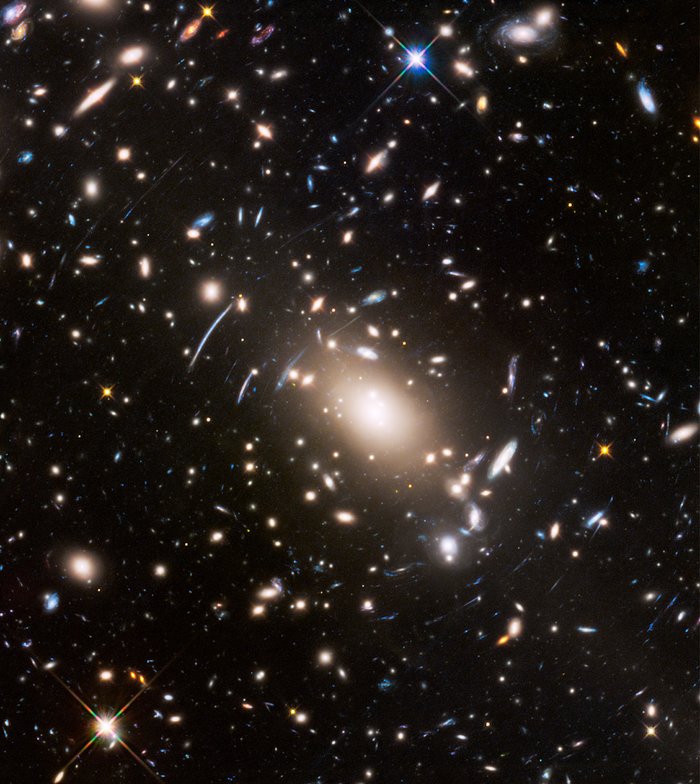
Fifty years ago Captain Kirk and the crew of the starship Enterprise began their journey into space — the final frontier. Now, as the newest Star Trek film hits cinemas, the NASA/ESA Hubble space telescope is also exploring new frontiers, observing distant galaxies in the galaxy cluster Abell S1063 as part of the Frontier Fields programme.
Space… the final frontier. These are the stories of the Hubble Space Telescope. Its continuing mission, to explore strange new worlds and to boldly look where no telescope has looked before.
The newest target of Hubble’s mission is the distant galaxy cluster Abell S1063, potentially home to billions of strange new worlds.
This video begins with a view of the night sky from the ground, before zooming in on the distant galaxy cluster Abell S1063 as the NASA/ESA Hubble Space Telescope sees it. The cluster was observed as part of the Frontier Fields programme. Credit: Fuji/DSS/Hubble. Music: Johan B. Monell (www.johanmonell.com)
This view of the cluster, which can be seen in the centre of the image, shows it as it was four billion years ago. But Abell S1063 allows us to explore a time even earlier than this, where no telescope has really looked before. The huge mass of the cluster distorts and magnifies the light from galaxies that lie behind it due to an effect called gravitational lensing. This allows Hubble to see galaxies that would otherwise be too faint to observe and makes it possible to search for, and study, the very first generation of galaxies in the Universe. “Fascinating”, as a famous Vulcan might say.
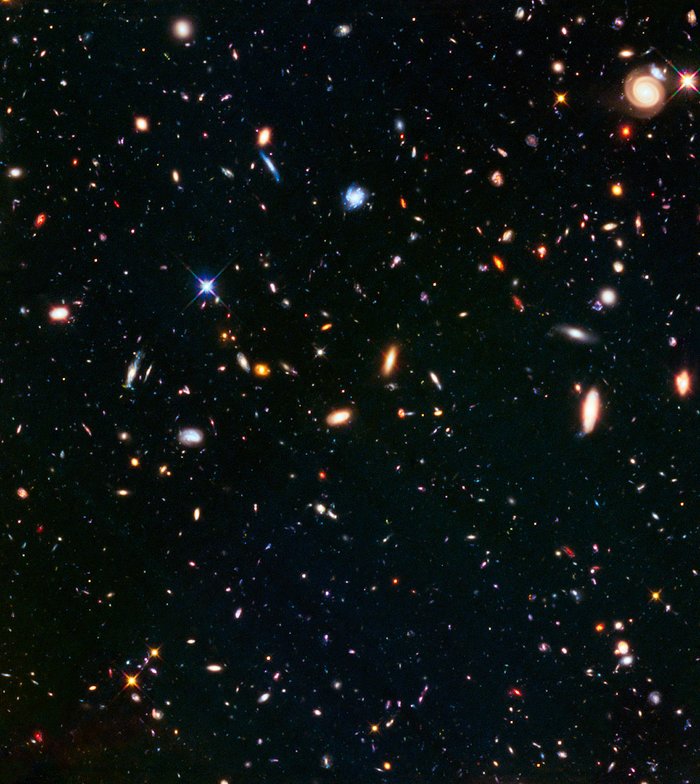
The first results from the data on Abell S1063 promise some remarkable new discoveries. Already, a galaxy has been found that is observed as it was just a billion years after the Big Bang.
Astronomers have also identified sixteen background galaxies whose light has been distorted by the cluster, causing multiple images of them to appear on the sky. This will help astronomers to improve their models of the distribution of both ordinary and dark matter in the galaxy cluster, as it is the gravity from these that causes the distorting effects. These models are key to understanding the mysterious nature of dark matter.
This video pans over NASA/ESA Hubble Space Telescope observations of the galaxy cluster Abell S1063, which were made as part of the Frontier Fields programme. The many galaxies within the cluster become clearly visible, as well as the background galaxies, enlarged by gravitational lensing. Credit: ESA/Hubble. Music: Johan B. Monell (www.johanmonell.com)
Abell S1063 is not alone in its ability to bend light from background galaxies, nor is it the only one of these huge cosmic lenses to be studied using Hubble. Three other clusters have already been observed as part of the Frontier Fields programme, and two more will be observed over the next few years, giving astronomers a remarkable picture of how they work and what lies both within and beyond them [1].
Data gathered from the previous galaxy clusters were studied by teams all over the world, enabling them to make important discoveries, among them galaxies that existed only hundreds of million years after the Big Bang (heic1523) and the first predicted appearance of a gravitationally lensed supernova (heic1525).
Such an extensive international collaboration would have made Gene Roddenberry, the father of Star Trek, proud. In the fictional world Roddenberry created, a diverse crew work together to peacefully explore the Universe. This dream is partially achieved by the Hubble programme in which the European Space Agency (ESA), supported by 22 member states, and NASA collaborate to operate one of the most sophisticated scientific instruments in the world. Not to mention the scores of other international science teams that cross state, country and continental borders to achieve their scientific aims.
Notes
[1] The Hubble Frontier Fields is a three-year, 840-orbit programme which will yield the deepest views of the Universe to date, combining the power of Hubble with the gravitational amplification of light around six different galaxy clusters to explore more distant regions of space than could otherwise be seen.
SpaceX successfully launched a Dragon Cargo vehicle on a Falcon 9 rocket late Sunday night. The Dragon reached the Int. Space Station this morning and berthed to it. The first stage of the Falcon 9 returned for a landing a few minutes after liftoff. Below are videos of the F9 launch, the booster landing, and the Dragon rendezvous and berthing.
And two videos of the first stage booster landing:
The Dragon approaches the ISS:
And astronauts on the station reach out and grab the Dragon with the station’s robotic arm and bring it in for attachment to a port:
Today is the 47th anniversary of the Apollo 11 landing on the Moon. There will be a new documentary debuting today – Go: The Great Race – Moon Landing Special on ‘Through the Decades’ – Decades TV Network – July 20, 2016 – but there are many older ones available on line, e.g.:
Today on The Space Show (7-8:30 pm PDT, 10-11:30 pm EDT, 9-10:30 pm CDT) Rand Simberg and Bill Simon will discuss the Evoloterra ceremony. See my report here on Our Evoloterra evening from a few years ago.
Today is also the 40th anniversary of the landing of the first Viking spacecraft on Mars: