Philae lander on Comet 67P/C-G has been found

The European Space Agency (ESA) announced today that the Philae spacecraft, deployed from the Rosetta mother ship on November 14, 2014 to land on Comet 67P/Churyumov–Gerasimenko has finally been found. After several bounces it had ended up in a shadowed area. After a short time it went silent since the solar panels could not replenish its battery and before its location could be determined.

Philae found!

Less than a month before the end of the mission, Rosetta’s high-resolution camera has revealed the Philae lander wedged into a dark crack on Comet 67P/Churyumov–Gerasimenko.
ESA_Rosetta_PhilaeFound-1024x640[1]
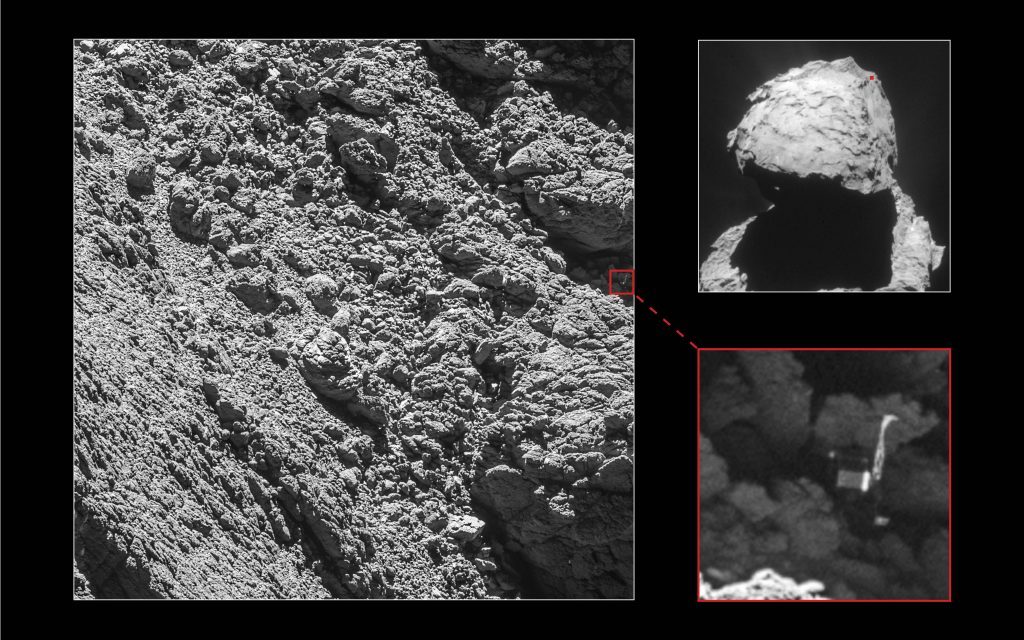
Rosetta’s lander Philae has been identified in OSIRIS narrow-angle camera images taken on 2 September 2016 from a distance of 2.7 km. The image scale is about 5 cm/pixel. Philae’s 1 m-wide body and two of its three legs can be seen extended from the body. The images also provide proof of Philae’s orientation. A Rosetta Navigation Camera image taken on 16 April 2015 is shown at top right for context, with the approximate location of Philae on the small lobe of Comet Churyumov-Gerasimenko marked.
The images were taken on 2 September by the OSIRIS narrow-angle camera as the orbiter came within 2.7 km of the surface and clearly show the main body of the lander, along with two of its three legs.

The images also provide proof of Philae’s orientation, making it clear why establishing communications was so difficult following its landing on 12 November 2014.
Philae_close-up_node_full_image_2[1]
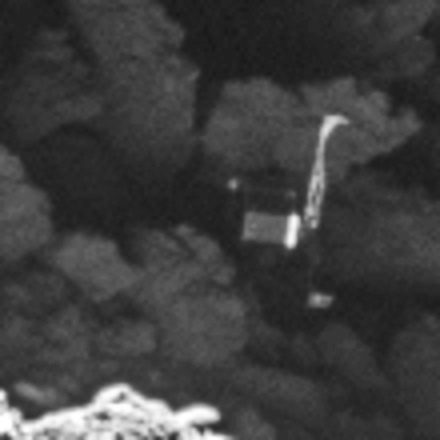
Close-up of the Philae lander, imaged by Rosetta’s OSIRIS narrow-angle camera on 2 September 2016 from a distance of 2.7 km. The image scale is about 5 cm/pixel. Philae’s 1 m-wide body and two of its three legs can be seen extended from the body. The images also provide proof of Philae’s orientation. The image is a zoom from a wider-scene, and has been interpolated.

“With only a month left of the Rosetta mission, we are so happy to have finally imaged Philae, and to see it in such amazing detail,”

says Cecilia Tubiana of the OSIRIS camera team, the first person to see the images when they were downlinked from Rosetta yesterday.

“After months of work, with the focus and the evidence pointing more and more to this lander candidate, I’m very excited and thrilled that we finally have this all-important picture of Philae sitting in Abydos,”

says ESA’s Laurence O’Rourke, who has been coordinating the search efforts over the last months at ESA, with the OSIRIS and SONC/CNES teams.
OSIRIS_narrow-angle_camera_image_with_Philae_2_September_node_full_image_2[1]
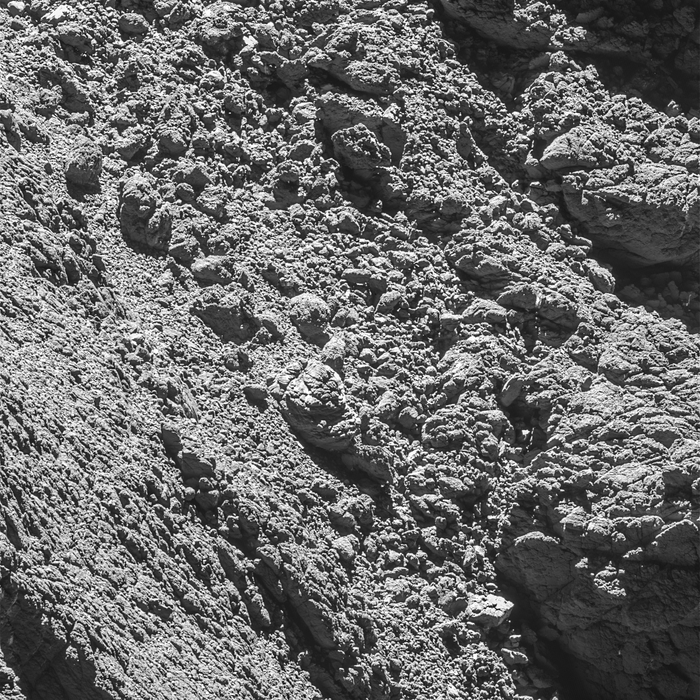
An OSIRIS narrow-angle camera image taken on 2 September 2016 from a distance of 2.7 km in which Philae was definitively identified. The image has been processed to adjust the dynamic range in order to see Philae while maintaining the details of the comet’s surface. Philae is located at the far right of the image, just above centre. The image scale is about 5 cm/pixel.
Philae was last seen when it first touched down at Agilkia, bounced and then flew for another two hours before ending up at a location later named Abydos, on the comet’s smaller lobe.

After three days, Philae’s primary battery was exhausted and the lander went into hibernation, only to wake up again and communicate briefly with Rosetta in June and July 2015 as the comet came closer to the Sun and more power was available.
Philae_close-up_labelled_node_full_image_2[1]
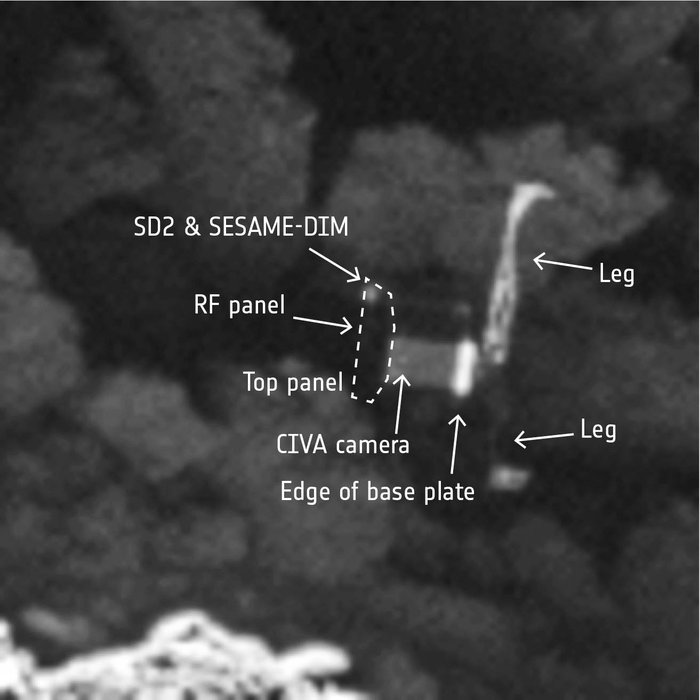
A number of Philae’s features can be made out in this image taken by Rosetta’s OSIRIS narrow-angle camera image on 2 September 2016. The images were taken from a distance of 2.7 km, and have a scale of about 5 cm/pixel. Philae’s 1 m wide body and two of its three legs can be seen extended from the body. Several of the lander’s instruments are also identified, including one of the CIVA panoramic imaging cameras, the SD2 drill and SESAME-DIM (Surface Electric Sounding and Acoustic Monitoring Experiment Dust Impact Monitor).
However, until today, the precise location was not known. Radio ranging data tied its location down to an area spanning a few tens of metres, but a number of potential candidate objects identified in relatively low-resolution images taken from larger distances could not be analysed in detail until recently.

While most candidates could be discarded from analysis of the imagery and other techniques, evidence continued to build towards one particular target, which is now confirmed in images taken unprecedentedly close to the surface of the comet.

At 2.7 km, the resolution of the OSIRIS narrow-angle camera is about 5 cm/pixel, sufficient to reveal characteristic features of Philae’s 1 m-sized body and its legs, as seen in these definitive pictures.

“This remarkable discovery comes at the end of a long, painstaking search,” says Patrick Martin, ESA’s Rosetta Mission Manager. “We were beginning to think that Philae would remain lost forever. It is incredible we have captured this at the final hour.”

[ Matt Taylor, ESA’s Rosetta project scientist says,]

“This wonderful news means that we now have the missing ‘ground-truth’ information needed to put Philae’s three days of science into proper context, now that we know where that ground actually is!” …

[ Holger Sierks, principal investigator of the OSIRIS camera adds,]

“Now that the lander search is finished we feel ready for Rosetta’s landing, and look forward to capturing even closer images of Rosetta’s touchdown site,” …

The discovery comes less than a month before Rosetta descends to the comet’s surface. On 30 September, the orbiter will be sent on a final one-way mission to investigate the comet from close up, including the open pits in the Ma’at region, where it is hoped that critical observations will help to reveal secrets of the body’s interior structure.

Further information on the search that led to the discovery of Philae, along with additional images, will be made available soon.

A selection of recent space audio webcasts

Here is a sampling of recent space related audio webcasts:

** Planetary Radio

  • The Pale Red Dot: A Planet Called Proxima b – “The announcement was made just days ago. Co-discoverer Michael Endl tells us about the discovery of a roughly Earth-mass planet orbiting in the habitable zone of the closest star to our own”

—

** The Space Show

  • Sun, 08/21/2016 – 12:00 – Dr. Doug Plata talked about using spinning systems to provide artificial gravity that would lower the costs of missions to the Moon and Mars by extending crew time. He talked about some very low cost Gravitron experiments at 11rpms.

—

** This Orbital Life

  • Voices From L5 – Voices From Mars – This Orbital Life – “An amazing special episode this week – Sheyna Grifford, the chief health and safety officer on the NASA-Ames HI-SEAS Mars analogue mission joins us for a time-delayed interview live from the HI-SEAS Mars simulation. Sheyna is currently involved in a long term Mars analogue and has graciously given us her time to discuss the mission, health and crew selection. Honestly we cover so much ground and Sheyna has so many amazing stories about her experiences in analogues – this is an unmissable episode!”

—

** The Orbital Mechanics:

—

** John Batchelor Show


—

** Science Friday


====

MPL3D Solar System offers interactive 3D space simulation

Check out the latest version of MPL3D Solar System – an interactive 3D space simulation –

MPL3D Solar System is a visual tool to arouse interest for astronomy and to divulge science in an entertaining way.

MPL3D Solar System maps out the majority of the close known universe. Stretching beyond our own Solar System, it reaches out to include another 120 extrasolar planets amongst over 10,000 mapped objects in this interactive simulation. Based on scientific data, every planet has been carefully reproduced as a visual representation, alongside the technical details. You can explore our own planets, exoplanets, nebulae, star clusters, several galaxies and even Sagittarius A*, the black hole that exists at the centre of our own galaxy.

“MPL3D Solar System (Touch) v1.5” includes now touch enabled capabilities and a customizable spaceship mode, allowing the user to fly all around the galaxy with Newtonian physics for the space flight.

This is the 5th version of the MPL3D saga, that keeps on with a continuous improvement of the original idea: An astronomy tool for the whole family.

Better textures for celestial bodies and improved graphic effects, including 7 combinations of HDR/Bloom, heat haze for stars and spaceship engines, and revised effects for nebulae, star clusters and galaxies.

Touch control adds a new feeling of intuitive, natural handling, bringing a new experience to the final user.

Spaceship mode enhances the entertainment side of the simulation, and even a fabulous 3d asteroids mini-game has been included. Spaceship control mode has all the common options in this type of simulations, which also include joystick and touch control, to allow a better control of the spaceship.

On the spaceship graphics side, seven configurable cameras, dozens of effects and up to eight light sources. The cockpit includes all kind of gauges for the three crew members, like gyroscope, g forces indicator, mission time, and even a 3d radar of the solar system.

A more extensive overview of the program:


=====

Video: “Space to Ground” ISS report – Sept.2.2016

Here is this week’s “Space to Ground” report from NASA on activities related to the Int. Space Station:


====

Video: Sci-fi short films via DUST

Check out the new digital channel called DUST – “sci fi videos and visions of the future”. They aim “to become the destination for premium sci-fi content”.

Lots of sci-fi short films at Dust – YouTube. Here, for example, is one called Telescope:

The short follows a cosmic archaeologist who travels backwards in time to capture photos of Earth’s brighter days.  The other character is a charming astronomer who gazes back up at the stars and considers the Earth’s future.

See also Dust on Facebook.

Here is a DUST promotional video:

Everyone can participate in space