Hubble observes star reverse from up to down in temperature

A report from a team using the Hubble telescope:

Astronomers observe star reborn in a flash 
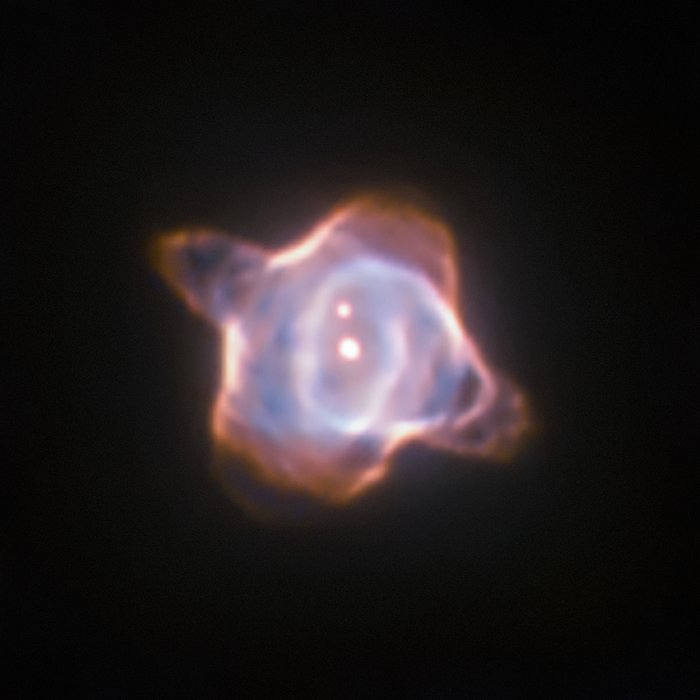
This image of the Stingray nebula, a planetary nebula 2700 light-years from Earth, was taken with the Wide Field and Planetary Camera 2 (WFPC2) in 1998. In the centre of the nebula the fast evolving star SAO 244567 is located. Observations made within the last 45 years showed that the surface temperature of the star increased by almost 40 000 degree Celsius. Now new observations of the spectra of the star have revealed that SAO 244567 has started to cool again.

Over a period of 30 years dramatic increases in the temperature of the star SAO 244567 have been observed. Now the star is cooling again, having been reborn into an earlier phase of stellar evolution. This makes it the first reborn star to have been observed during both the heating and cooling stages of rebirth.

This animation shows the fast evolution of SAO 244567. The animation starts 10 300 BC, with the star having a radius 152 times the size of the Sun and a surface temperature of about 3500 degree Celsius, giving it its orange colour. At this point of its life the star had already lost half of its initial mass.

After 10 000 years the star slowly shrinks to only 40 times the size of the Sun; at the same time its temperature rises to 6800 degree Celsius, causing its colour to change to white-yellow. As the star heats up to about 20 000 degree Celsius Helium fusion inside the star suddenly gets re-ignited — the late thermal pulse.

After the flash the star heats quickly and becomes a blue-white star with a temperature of 21 000 degree Celsius, only 4 times larger than the Sun. SAO 244567 shrinks further till it only a third the size of the Sun and a temperature of 60 000 degree Celsius; this status was reached in the year 2002. Now new observations show that the star is still blue and hot — with about 50 000 degree Celsius — but started to expand again: its size is about two third of our Sun.

Within the next few hundreds of years SAO 244567 will expand back to its giant dimensions and also change its colour to orange — as shown at the end of the animation. Credit: ESA/Hubble, L. Calçada

Even though the Universe is constantly changing, most processes are too slow to be observed within a human lifespan. But now an international team of astronomers have observed an exception to this rule.

“SAO 244567 is one of the rare examples of a star that allows us to witness stellar evolution in real time”, explains Nicole Reindl from the University of Leicester, UK, lead author of the study. “Over only twenty years the star has doubled its temperature and it was possible to watch the star ionising its previously ejected envelope, which is now known as the Stingray Nebula.”

SAO 244567, 2700 light-years from Earth, is the central star of the Stingray Nebula and has been visibly evolving between observations made over the last 45 years. Between 1971 and 2002 the surface temperature of the star skyrocketed by almost 40 000 degrees Celsius. Now new observations made with the Cosmic Origins Spectrograph (COS) on the NASA/ESA Hubble Space Telescope have revealed that SAO 244567 has started to cool and expand.

This is unusual, though not unheard-of [1], and the rapid heating could easily be explained if one assumed that SAO 244567 had an initial mass of 3 to 4 times the mass of the Sun. However, the data show that SAO 244567 must have had an original mass similar to that of our Sun. Such low-mass stars usually evolve on much longer timescales, so the rapid heating has been a mystery for decades.

Back in 2014 Reindl and her team proposed a theory that resolved the issue of both SAO 244567’s rapid increase in temperature as well as the low mass of the star. They suggested that the heating was due to what is known as a helium-shell flash event: a brief ignition of helium outside the stellar core [2].
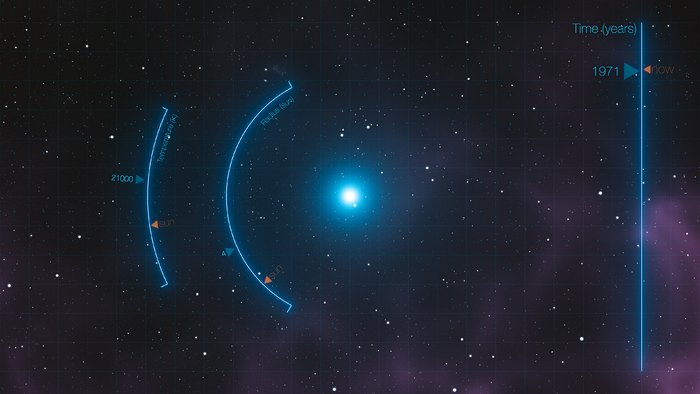
This artist’s impression shows a still from the video showing the evolution of SAO 244567’s rapid evolution.

This theory has very clear implications for SAO 244567’s future: if it has indeed experienced such a flash, then this would force the central star to begin to expand and cool again — it would return back to the previous phase of its evolution. This is exactly what the new observations confirmed. As Reindl explains:

“The release of nuclear energy by the flash forces the already very compact star to expand back to giant dimensions — the born-again scenario.”

It is not the only example of such a star, but it is the first time ever that a star has been observed during both the heating and cooling stages of such a transformation.

Yet no current stellar evolutionary models can fully explain SAO 244567’s behaviour. As Reindl elaborates:

“We need refined calculations to explain some still mysterious details in the behaviour of SAO 244567. These could not only help us to better understand the star itself but could also provide a deeper insight in the evolution of central stars of planetary nebulae.”

Until astronomers develop more refined models for the life cycles of stars, aspects of SAO 244567’s evolution will remain a mystery.

Notes

[1] The other star thought to have experienced the same type of helium flash event (see[2]) is FG Sagittae, located in the constellation Sagitta, making SAO 244567 the second of its kind. However, other objects undergoing similar “born-again” scenarios are known, including Sakurai’s Object, located in Sagittarius.

[2] Helium flash events, also known as late thermal pulses, occur late in the evolution of about 25% of low- to medium-mass stars. After evolving off the main sequence, these stars enter the red giant phase, where the star expands dramatically. Various changes occur in the star’s chemical and physical composition during this phase, until it has burnt most of the helium available in its core, which is by then composed of carbon and oxygen. Helium fusion continues in a thin shell around the core, but then turns off as the helium becomes depleted. This allows hydrogen fusion to start in a layer above the helium layer. After enough additional helium accumulates, helium fusion is reignited, leading to a thermal pulse which eventually causes the star to expand, cool and brighten temporarily.

Mars Curiosity rover sends remarkable images of layered rocket formations

Lots of wonderful new pictures from the Curiosity rover on Mars:

Mars Rover Views Spectacular Layered Rock Formations

pia21044_hires1
This view [larger image] from the Mast Camera (Mastcam) in NASA’s Curiosity Mars rover shows an outcrop with finely layered rocks within the “Murray Buttes” region on lower Mount Sharp. The buttes and mesas rising above the surface in this area are eroded remnants of ancient sandstone that originated when winds deposited sand after lower Mount Sharp had formed. Curiosity closely examined that layer — called the “Stimson formation” — during the first half of 2016, while crossing a feature called “Naukluft Plateau” between two exposures of the Murray formation. The layering within the sandstone is called “cross-bedding” and indicates that the sandstone was deposited by wind as migrating sand dunes. The image was taken on Sept. 8, 2016, during the 1454th Martian day, or sol, of Curiosity’s work on Mars.
The layered geologic past of Mars is revealed in stunning detail in new color images returned by NASA’s Curiosity Mars rover, which is currently exploring the “Murray Buttes” region of lower Mount Sharp. The new images arguably rival photos taken in U.S. National Parks.

pia21041_hires1
This view [see larger image] from the Mast Camera (Mastcam) in NASA’s Curiosity Mars rover shows a sloping hillside within the “Murray Buttes” region on lower Mount Sharp. The rim of Gale Crater, where the rover has been active since landing in 2012, is visible in the distance, through the dusty haze. The image was taken on Sept. 8, 2016, during the 1454th Martian day, or sol, of Curiosity’s work on Mars.
Curiosity took the images with its Mast Camera (Mastcam) on Sept. 8. The rover team plans to assemble several large, color mosaics from the multitude of images taken at this location in the near future.

“Curiosity’s science team has been just thrilled to go on this road trip through a bit of the American desert Southwest on Mars,” said Curiosity Project Scientist Ashwin Vasavada, of NASA’s Jet Propulsion Laboratory, Pasadena, California.

The Martian buttes and mesas rising above the surface are eroded remnants of ancient sandstone that originated when winds deposited sand after lower Mount Sharp had formed.

pia21042_hires1
This view [see larger image]  from the Mast Camera (Mastcam) in NASA’s Curiosity Mars rover shows sloping buttes and layered outcrops within the “Murray Buttes” region on lower Mount Sharp. The buttes and mesas rising above the surface are eroded remnants of ancient sandstone that originated when winds deposited sand after lower Mount Sharp had formed. Curiosity closely examined that layer — called the “Stimson formation” — during the first half of 2016, while crossing a feature called “Naukluft Plateau” between two exposures of the Murray formation. The layering within the sandstone is called “cross-bedding” and indicates that the sandstone was deposited by wind as migrating sand dunes.

“Studying these buttes up close has given us a better understanding of ancient sand dunes that formed and were buried, chemically changed by groundwater, exhumed and eroded to form the landscape that we see today,” Vasavada said.

The new images represent Curiosity’s last stop in the Murray Buttes, where the rover has been driving for just over one month. As of this week, Curiosity has exited these buttes toward the south, driving up to the base of the final butte on its way out. In this location, the rover began its latest drilling campaign (on Sept. 9). After this drilling is completed, Curiosity will continue farther south and higher up Mount Sharp, leaving behind these spectacular formations.

pia21043_hires1
This view [see larger image] from the Mast Camera (Mastcam) in NASA’s Curiosity Mars rover shows finely layered rocks within the “Murray Buttes” region on lower Mount Sharp. The buttes and mesas rising above the surface in this area are eroded remnants of ancient sandstone that originated when winds deposited sand after lower Mount Sharp had formed. Curiosity closely examined that layer — called the “Stimson formation” — during the first half of 2016, while crossing a feature called “Naukluft Plateau” between two exposures of the Murray formation. The layering within the sandstone is called “cross-bedding” and indicates that the sandstone was deposited by wind as migrating sand dunes. The image was taken on Sept. 8, 2016, during the 1454th Martian day, or sol, of Curiosity’s work on Mars.
Curiosity landed near Mount Sharp in 2012. It reached the base of the mountain in 2014 after successfully finding evidence on the surrounding plains that ancient Martian lakes offered conditions that would have been favorable for microbes if Mars has ever hosted life. Rock layers forming the base of Mount Sharp accumulated as sediment within ancient lakes billions of years ago.

pia21045_hires1
This view [see larger image]  from the Mast Camera (Mastcam) in NASA’s Curiosity Mars rover shows a hillside outcrop with layered rocks within the “Murray Buttes” region on lower Mount Sharp.
On Mount Sharp, Curiosity is investigating how and when the habitable ancient conditions known from the mission’s earlier findings evolved into conditions drier and less favorable for life.

For more information about Curiosity, visit: http://mars.jpl.nasa.gov/msl

====

The Space Show this week – Sept.12.2016

The guests and topics of discussion on The Space Show this week:

1. Monday, Sept. 12, 2016: 2-3:30 PM PDT (5-6:30 PM EDT, 4-5:30 PM CDT): No show as am at AIAA Space 2016.

2. Tuesday, Sept. 13, 2016: 7-8:30 PM PDT (10-11:30 PM EDT, 9-10:30 PM CDT) No show as am at AIAA Space 2016.

4. Friday, Sept. 16, 2016: 9:30-11AM PDT; (12:30-2 PM EDT; 11:30 AM – 1 PM CDT) No show due to AIAA Space 2016.

5. Sunday, Sept. 18 2016: 12-1:30 PM PDT (3-4:30 PM EDT, 2-3:30 PM CDT): For today I will archive and play the taped interviews from AIAA Space 2016. This will include my visit to the Woodward lab with John Hunt regarding Dr. Jim Woodward‘s work on the Mach Thrusters. The program will be available as soon as you see it on the website as an archived program and in your podcast download.

See also:
* The Space Show on Vimeo – webinar videos
* The Space Show’s Blog – summaries of interviews.
* The Space Show Classroom Blog – tutorial programs

The Space Show is a project of the One Giant Leap Foundation.

Video: Discussion of the earth-scale planet found orbiting Proxima Centauri

The discovery of an Earth scale planet in the habitable zone of our nearest star, Proxima Centauri was recent big news. Here is a video of a SETI Institute panel discussion of the finding: A Terrestrial Exoplanet at Proxima Centauri | SETI Institute. The video starts with Guillem Anglada, who led the group that made the discovery, giving an overview of their finding.

Here is the video caption:

Dr. Anglada will discuss the new paper he is first author in reporting the presence of a 1.3 Earth mass exoplanet in a temperate orbit around Proxima Centauri. This finding was reported in Nature on Thursday 25 Aug 2016.
http://www.nature.com/nature/journal/…
Dr. Anglada will particpate remotely, and Dr. Franck Marchis of the SETI Institute will host a local panel to discuss the implications of the finding. “Our little world will never seem the same again”.

Everyone can participate in space